Ohio-ACC Newsletter, September 2022 |
|
Dear Ohio-ACC Colleague,
It is my pleasure to invite you to the Ohio-ACC 2022 Annual Meeting on Saturday, October 22, at the Hilton Columbus at Easton. Our planning committee has designed an excellent agenda that is accredited for CME, CNE, MOC, and CPE. We are thrilled to join you in person after meeting virtually for two years. Please plan to participate and come together as a group. Register today! And if you need a hotel room, please make your reservation before the September 23rd cut-off.
|
|
Ohio-ACC 2022 Annual Meeting topics include:
Dr. Richard Lewis Memorial Lecture
Early Rhythm Control or Prevention: A New Paradigm for Atrial Fibrillation
Andrea M. Russo, MD, FACC
Moderator: Nathan Dittoe, MD, FACC
Cardiovascular Disease in South Asians
Santosh G. Menon, MD, FACC
Moderator: Kanny Grewal, MD, FACC
ACC/AHA Guidelines on Revascularization: The Controversy - The CV Surgical and Interventional Perspectives
Raja Nazir, MD, FACC and Joseph Sabik, MD, FACC
Prevention: The Future of Lipid-Lowering Therapies
Kelly Bartsch, PharmD, BCPS, CLS and Kavita Sharma, MD, FACC
Moderator: Ellen Sabik, MD, FACC
Fellow in Training Oral Competition
Moderator: David Harris, MD, FACC, FASE, FSCMR
We would like to thank our meeting sponsors at the time of printing: Amryt Pharma (Silver), Cincinnati Children's (Silver), Janssen (Silver), and Novo Nordisk (Silver).
|
|
CardiOhio Podcast
I am delighted to share all of the Ohio-ACC CardiOhio Podcast episodes with you. To subscribe to this podcast, copy and paste this URL into the podcast app of your choice. We really hope that you will find this information valuable and useful for your practice.
Episode 1: Putting the Chest Pain Guidelines into Practice: Practical Tips from Imaging Experts.
Guests: Dennis Calnon, MD, FACC and Paul Cremer, MD
Episode 2: Success with Failure: Practical Perspectives for Heart Failure Management
Guests: Lindsay Castle, DO and Kenneth Varian, MD, PhD
Episode 3: The Symptomatic Athlete: Strategies for Evaluation and Return to Play
Guests: Michael Emery, MD, FACC and Simon Lee, MD, FACC
Episode 4: 2022 Ohio-ACC Spring Summit Re-Cap
Guests: Ben Alencherry, MD, Joseph Pietrolungo, DO, FACC, and Andrea Robinson, MSN, ACNP, AACC
Episode 5: HCM Update, part 1, Diagnosis, Testing, and Patient Perspective
Guests: Milind Desai, MD, MBA, FACC and Mike Papale
Episode 6: HCM Update, part 2 – Management and New Therapies
Guest: Milind Desai, MD, MBA, FACC
Episode 7: Post-PCI Antiplatelets: A Patient-Centered Focus
Guest: Jagadish Khanagavi, MD, FACC
ACC Legislative Conference
ACC’s 2022 Legislative Conference will take place Oct. 16-18 in person at the Hyatt Regency on Capitol Hill. The meeting will offer cardiovascular clinicians spanning the entire care team a chance to hear from ACC leaders, staff, and other experts on health policy issues affecting patients and the profession, while also providing an important opportunity to speak directly with members of Congress and their staff. Don’t miss this opportunity to learn more about the major issues impacting the practice of cardiology and meet with your members of Congress. Register today. Please note that the registration system will only recognize the email address that received the invitation. If you would like to update your email address, contact Meg Novak.
Congratulations to the Newly Elected Ohio-ACC Board of Trustees
|
|
 |
District 1 - CWRU MetroHealth
Meera D. Kondapaneni, MD, FACC
District 1 - Cleveland Clinic
Michael Faulx, MD, FACC
District 2 – University of Toledo
George V. Moukarbel, MD, FACC
District 3 – Akron
Kenneth D. Varian, MD, PhD
District 4 - Columbus Practicing Community
Lindsay M. Castle, DO, FACC
|
|
|
|
District 5 – Dayton
Haseeb Jafri, MD, FACC, FHRS
District 6 - University of Cincinnati
Jagadish B. Khanagavi, MD, FACC, FSCAI
Cardiovascular Surgical Position
Sergio A. Carrillo, MD, FACS, FACC
Pediatric Cardiologist Position
Janine Arruda, MD, FAAP, FACC
VA Position
Ajay Agarwal, MD, FACC
|
|
|
|
Contact Us
If Gwen Goldfarb, our chapter executive, or I can be of assistance to you, please let us know.
Sincerely,
Kanny
|
|
Fellows in Training News
Ben Alencherry, MD, and Maryam Saleem, MD, Co-Chairs
|
|
Ohio-ACC FIT Bootcamp
Special thanks to the faculty:
Muhammad Afzal, MD, OSUMC
Indra Bole, MD, OSUMC
Otto Costantini, MD, SUMMA
Marissa Edmiston, MD, MetroHealth-CWRU
Jagadish Khanagavi, MD, FACC, UC
Khalid Murad, MD, MetroHealth-CWRU
Hemindermeet Singh, MD, FACC, MercyHealth
Kenneth Varian, MD, PhD, SUMMA
Special thanks to the fellows in training:
Andrew Hornick, MD, OSUMC
Hashim Jilani, MD, UC
Matthew Laubham, DO, Nationwide Children’s Hospital
Chandramohan Meenakshisundaram, MD, University of Toledo
Robert Sibilia, MD, UC
Beni Verma, MD, MetroHealth-CWRU
2022-2023 FIT Council
We want to congratulate the new members of the Ohio-ACC 2022-23 FIT Council:
Ben Alencherry, MD, Cleveland Clinic – Co-Chair
Maryam Saleem, MD, University of Cincinnati – Co-Chair
Ali Azeem, MD, University Hospitals / Case Western Reserve University
Nicholas Biondi, DO, University of Cincinnati
Jasyn Blankenship, DO, Doctors Hospital OhioHealth
Razleen Brar, MD, Cleveland Clinic Children’s
Eunice Dugan, MD, Cleveland Clinic
Alexander Erskine, MD, Kettering Health Network
Brianna French, MD, Summa Health System/NEOMED
Andrew Hornick, MD, The Ohio State University
Ahmad Jabri, MD, MetroHealth
Matthew Laubham, DO, Nationwide Children’s Hospital / The Ohio State University
Chander Shekhar, MD, Aultman Hospital
Rohit Vyas, MD, University of Toledo
Ohio-ACC ePoster Competition
This year, FITs, residents, and CV team members have the opportunity to be part of the Poster Competition. Abstracts accepted for presentation at the Ohio-ACC Annual Meeting will be available On Demand through the ePoster Portal. With this exciting format, participants will showcase their posters along with MP4 voice-over PowerPoint presentations of their submissions. Submit your work by Sept. 11.
Ohio-ACC Fellow Grand Round Series
The Ohio-ACC FIT council will soon conduct its first-ever Fellow Grand Round Series. This series will be conducted by different institutions across Ohio. It aims to bring fellows across the state together via virtual noon conferences. This longitudinal interactive learning and networking platform will pave the way for better and more equitable learning experiences and provide resources for cardiology fellows across the state. Stay tuned for invitations.
|
|
Restrictive Covenant Challenges |
|
The shift from independent to employed/integrated practice over the last decade has prompted concerns regarding restrictive covenants and non-compete clauses included in physician contracts. Not only do individual states have their own guidelines, but the potential benefits must be weighed against the potential risks to patient care, clinician well-being and the broader goal of achieving the quadruple aim. In response to these concerns, the ACC Board of Governors (BOG) has developed a white paper designed to be a resource for ACC members and their Chapters, in conjunction with legal counsel, on various aspects of the restrictive covenant issue. The white paper, which does not constitute official ACC policy, includes results from a survey of physician members by the BOG and MedAxiom along with an overview of legal perspectives, the current status of restrictive covenants in individual states, and a closer look at potential reasons to either retain restrictive covenants and/or restrict or eliminate them. Learn more.
|
|
|
Contact CMS to Oppose Further Cuts to
RUC-Recommended Work RVUs
|
|
Last year, despite opposition from ACC, HRS, other partner organizations, and patients, CMS reduced payment for ablation services from their 2021 values. These 2022 reductions were the result of the bundling of 3D mapping (93613), left atrial recording (93621), or intracardiac echocardiography (93662) services into the primary CPT codes for supraventricular tachycardia (SVT) (93653) and atrial fibrillation (AF) (93656) without any increases to account for the newly bundled services.
CMS recently announced in the CY2023 Medicare Physician Fee Schedule Proposed Rule that it intends to further reduce reimbursement for SVT, ventricular tachycardia (VT), and AF ablations (CPT codes 93653, 93654 and 93656). Additionally, CMS indicated that it will maintain the current reduced values for add-on codes to ablate additional arrhythmias (code 93655) and to treat AF with additional ablation after pulmonary vein isolation (code 93657). CMS also proposes work RVUs that undercut well-informed recommendations for new pulmonary artery revascularization services (338X3-338X7), new pulmonary angiography injection services (93XX0-93XX3) and existing pulmonary angiography injection services (93653-93658).
Why It Matters
Beyond the troubling trend of general reductions via conversion factor cuts (proposed -4.5% for CY2023), statutory cuts from sequestration and PAYGO rules, and a flat annual payment update that fails to account for significant inflation in practice costs, patient complexity, and enhanced physician work associated with the greater utilization of same-day discharge protocols, these specific services also suffer unwarranted reductions in the proposed rule. The Centers for Medicare & Medicaid Services (CMS) proposes further work reductions for cardiac ablation services that were already reduced significantly for 2022, reductions for existing pulmonary angiography injection services, and reduced values for new codes describing congenital pulmonary angiography and pulmonary artery revascularization services below societal recommendations.
These specific reductions are an alarmingly significant departure from the American Medical Association/Specialty Society RVS Update Committee (RUC) recommended values. The RUC survey and evaluation process (in which practicing physician feedback is used to create proposed relative values for services) was consistently disregarded in favor of lower valuations with little explanation. Despite the RUC process making great efforts to develop updated work inputs based on survey data and relativity, CMS further reduced proposed values.
How Can You Help?
The ACC supports and works to help develop reimbursement models that recognize the reality of limited CMS funding for health services, that reward high quality and high valued outcomes, that align incentives of payers, patients, and providers, and that are a fair reflection of clinician work.
The ACC will also continue to work vigorously to address the significant structural inadequacies of the Medicare payment system through continued engagement with Congress and policy makers. Your ACC recently endorsed a framework of joint principles for Medicare payment reform with the American Medical Association and other societies. Working with our colleagues across organized medicine, your ACC will be a leading voice in efforts to solve these persistent, painful shortcomings and build a sustainable system that improves the lives of patients and the clinicians who care for them.
|
|
2022 AHA/ACC/HFSA Heart Failure Guidelines: Spotlight on At-Risk & Pre-HF Recommendations
Christopher Tanski, PharmD, BCCP, BCPS
|
|
In April, the AHA/ACC/HFSA writing committee released an updated clinical practice guideline for the management of heart failure (HF) that expands upon the recommendations for those at-risk for HF and those with pre-HF1. These new guidelines are worth reviewing in their entirety, but the increased focus on prevention and earlier management reveals an opportunity for screening, treatment, and multidisciplinary care coordination.
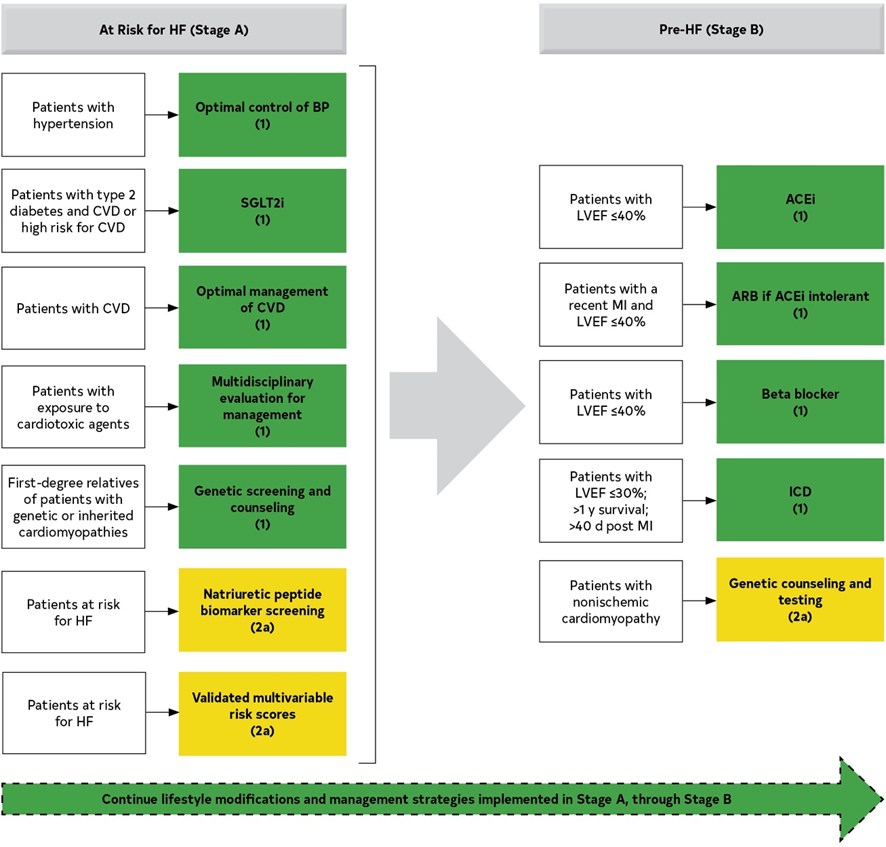
The “2013 ACCF/AHA Guidelines for the Management of Heart Failure” and its focused update defined Stage A (at risk for HF) as at-risk for HF without structural disease or HF symptoms2,3. The 2022 guidelines elaborate on this definition to include the absence of cardiac biomarkers associated with stretching or injury. The new guidelines similarly expand the definition of Stage B (pre-HF) to include evidence of elevated filling pressures or patients with risk factors and increased biomarkers like BNP or cardiac troponin (these cutoffs are defined in appendix 3 of the full guidelines). New to the 2022 guidelines, a role for risk prediction models such as the PCP-HF model has been highlighted as a tool for screening patients deemed at risk for HF. The need for multidisciplinary approaches to implement preventative care and risk factor modification for Stage A and Stage B patients will grow as more of our colleagues become aware of this new guidance.
The 2022 guidelines continue to emphasize optimal blood pressure control and management of pre-existing CVD or atherosclerotic disease in the Stage A population. The utilization of SGLT2 inhibitors in cardiovascular care was not reflected in the 2013 guidelines or 2017 focus update, but they are highlighted as a pharmacotherapy recommendation for patients with type 2 diabetes and CVD or at high risk of CVD. The table below reflects the GDMT recommendations for the pre-HF (stage B) population based on their LVEF findings and cardiovascular history and reinforces the role of early initiation of ACEi/ARBs and beta blockers in these patients to prevent symptomatic HF and reduce mortality.
The updated heart failure guidelines reveal an opportunity for the care team, from primary care to heart failure specialist and everyone in between, to be more vigilant about early screening for patients who may be at risk for HF, as well as earlier risk factor modification both pharmacologically and non-pharmacologically to delay progression.
|
|
Nominations for available positions on ACC’s Committees, including NCDR and ACC Accreditation Services’ committees, are now being accepted until Tuesday, Sept. 13. Interested applicants or nominators are encouraged to review the open positions on the Committee Nominations Portal and may self-nominate or nominate a colleague. Applicants will be notified of results by the end of 2022. ACC’s committee nomination process is an important opportunity to continue to increase diversity at the College and include perspectives spanning the entire profession. The Nominating Committee strongly encourages applicants from various backgrounds, cultures, specialties, practice settings and career stages. For more information, view the Committee Nominations FAQs or email committees@acc.org with questions.
There's still time to enroll in the Collaborative Maintenance Pathway (CMP) and ensure that you have two chances to pass this year. Depending on your specialty, the first Performance Assessment window for the year was Aug. 13-21 and upcoming on Oct. 8-16. The CMP Performance Assessment windows are now nine days so you have two consecutive weekends to participate. Plus, the 7-hour requirement has been removed, so it's now it's up to you how much time to spend reading the text, watching the presentations, and answering the practice questions. Learn More.
The ACC Board of Trustees has approved the College's newest slate of officers and trustees put forth by the ACC Nominating Committee. The 2023 slate of officers and trustees includes: B. Hadley Wilson, MD, FACC (ACC President); Cathleen Dalton Biga, MSN, RN, FACC (ACC Vice President); Jeffrey T. Kuvin, MD, FACC (Trustee); Roxana Mehran, MD, FACC (Trustee); Sandra J. Lewis, MD, FACC (Trustee); and Akshay K. Khandelwal, MD, FACC (Finance Committee Chair-Elect/Chair). These officers will transition following ACC.23 in New Orleans, LA, next March. Learn more.
With more than 6 million Americans with heart failure, patient education is key in managing and living with this condition. To help patients better understand and manage heart failure, ACC’s CardioSmart team has developed a package of tools and resources including a new Action Plan for Heart Failure With Preserved Ejection Fraction (HFpEF). The package also includes infographics, decision aids, and updated tools teaching patients how to make the most of their follow-up visits, use checklists, daily trackers, and more. Download the tools for free.
|
|
|
|
|
|
|