|
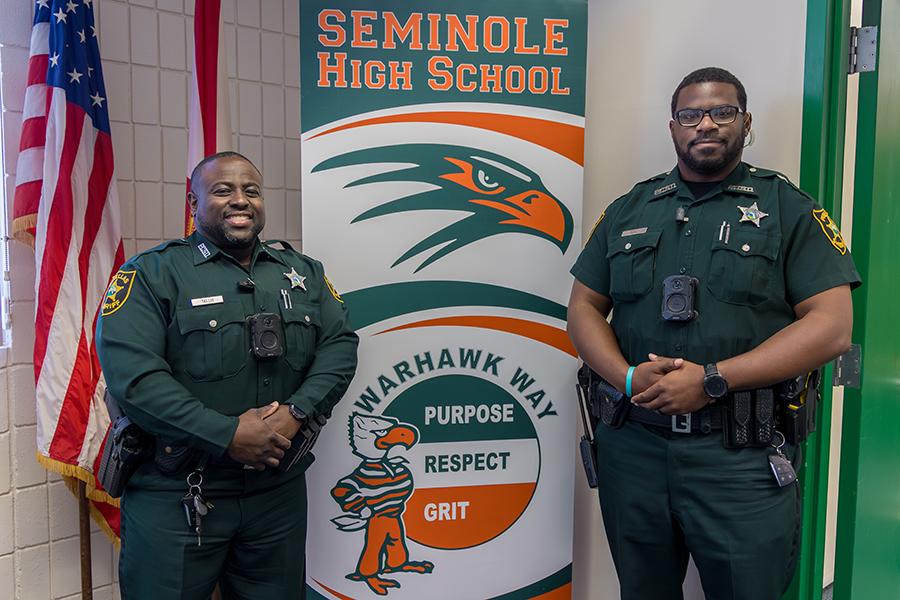
Deputy Louis Neal got into just one fight in high school, and it wasn’t supposed to be his fight. “I stepped in to break up two friends who were fighting and somehow I was suddenly part of the fight too.” It all could have gone so differently. He could have been Tasered, he could have ended up in handcuffs. But his School Resource Officer (SRO) Deputy Steven Tellis already knew Neal well. “He pulled me aside and said, you know this isn’t you. He told me what the consequences could have been.”
Deputy Tellis remembers the moment vividly. “He was a good kid. When I first saw him I thought, I hope we never have to fight, because he’s a big guy!” He soon got to know the young Neal and found out he had a high GPA and was a skilled student athlete, participating in football, basketball, and track. Deputy Tellis watched him at football games, and gave him advice about training. They competed to see who could bench-press the most. When he saw Neal in that fight, he knew it wasn’t a reflection of his real character.
“I was grateful to him for being so understanding with me, because in that situation I wasn’t thinking about consequences,” Deputy Neal said. “I just wanted to help my friends. That’s why I always give these kids the benefit of the doubt when I can. I learned from it, and I never got into another fight, never touched another person again.”
Neal continued to make a good impression on his SRO, and Deputy Tellis impressed the young man too. When a recruiter from FAMU came to the school, Deputy Tellis immediately told him to focus on Neal, not just for his football prowess but for his intelligence and character too.
Neal ended up playing football for FAMU. “I was grateful, that was a big thing in my life,” Deputy Neal said. “One of the biggest things anyone could do for me. Growing up, I didn’t get a lot of things handed to me. So when I had someone who was on my side, who could speak greatness in my life, that made a big difference to me.”
Neal contacted his SRO after he signed with FAMU. “That was one of the greatest cop days of my life, because I had a positive effect on his life,” Deputy Tellis said. “It’s not about accolades from the agency, it’s about making a difference to one person.”
A greater “cop day” was yet to come. Although Deputy Tellis never specifically recommended that Neal pursue a career in law enforcement, he made the job look so good that Neal majored in Criminal Justice, and when he graduated he joined the Pinellas County Sheriff’s Office. “The difference he made with me, I want to give to other people,” Deputy Neal said. He learned the ropes in patrol for a few years, and then became an SRO at Seminole High School. “I think I can make a difference in a kid’s life too. He’s the reason I’m here. I saw that, and now I want to be that.”
One day Deputy Tellis got a call from Human Resources. “They told me that Neal applied, and he said I’m the reason. I had to pull my car over, it made me that emotional. Just to know you had such an impact on someone’s life. It’s the best feeling I’ve ever had, aside from my children being born. It was the greatest feeling I’ve ever had as a cop.”
The SRO legacy stretches even farther back – Deputy Tellis’s own SRO when he was a kid at Dunedin High influenced him to start his law enforcement career. One day he was called into the office and found two detectives waiting to talk with him. He was accused of a crime. His SRO, who knew his character, immediately came to his defense and quickly showed that he had been somewhere else when the crime occurred. In fact, he’d been doing the most good-kid thing imaginable: giving an anti-tobacco speech at an elementary school. The matter was quickly resolved, but the SRO’s advocacy made a deep impression on him. They became friends, and the SRO would one day become his daughter’s godfather.
With both Deputy Neal and Deputy Tellis, the fact that their SRO knew their good characters helped them stay out of trouble and correct any youthful mistakes. Now, Deputy Neal makes a point of getting to know all of the kids as well as he can. “I don’t want them to ever see an SRO as an adversary. I want them to see me as someone they can come to if they need any help.”
Not every kid can be helped, though that’s never going to stop them from trying. But they only have a few hours a day to help set a kid on the right course. “You try to be a good influence in the time you have but you’re competing with the rest of their life,” Deputy Tellis said. He’s seen successes, like Deputy Neal, but he’s also seen tragedies.
“I had a conversation with one kid two weeks before he was murdered. I talked with him about the need to change his life. He said he was going to… and he was gunned down two weeks later.” Another kid he tried hard to help ended up killing someone, and he’s in prison now. “All you can do is try. I can see when someone is headed for trouble, but they have to be the ones to take a different path.”
Deputy Neal says his life could have gone differently. “I grew up in Childs Park. All my friends knew about was going to jail and dying. That’s what I saw growing up. I didn’t want to be that. I wanted to be better.” He had a strong, loving mother who helped keep him in line, and he wishes every kid had that. “The best thing I can say is, just be there. When parents are present, and give their kids someone to look up to, it makes a big difference.”
Tellis wishes that parents would see SROs as partners, not adversaries. “They should be doing the heavy lifting at home, while we support them at school. If kids are disciplined at home, I shouldn’t have to do much other than to call their parents.”
An SRO needs to know how to communicate with kids, and that involves both talking and listening. They both agree that yelling at a kid won’t help anyone. Still, they have to let kids know that even pranks can have consequences, and the world outside school isn’t always as forgiving. “Every kid that I’ve been tough with has said to me that they felt like I cared about them,” Deputy Tellis sad. “We have to be a little tough on our kids, because society isn’t going to be easy.”
Being an SRO even helped Deputy Tellis be a better dad. “I learned a lot about my kids being in this unit,” he said. “I’m more understanding. And it keeps me young. I know all the slang!” Right now, Deputy Tellis is a floating SRO, filling in at different schools as needed. He and Deputy Neal sometimes get to work together. “I wouldn’t change anything about my career. I’ve seen some terrible things, I’ve seen kids who I thought were going to make it, who made bad choices. That’s the unfortunate part about this job. You get to know so many kids, then you’re watching the news one night and there they are.” But kids who grow up like Deputy Neal remain beacons of hope that make the job worthwhile.
Deputy Tellis has some advice for the kids too. “Don’t be in such a hurry to grow up,” he said. “Be young. In school you get some safety, some forgiveness when you make mistakes. The rest of the world isn’t like that. Enjoy being young while you can. You have your whole life to be an adult.”
|