Change can be a good thing | | |
Section 106 of the National Historic Preservation Act is, at its core, a safeguard. It requires federal agencies to consider how their projects may affect historic properties, and it ensures that the public has a meaningful opportunity to participate in those decisions. For many communities, Section 106 is the most powerful tool citizens have to help protect the places that tell their stories.
Section 106 in today’s legislative landscape
During the current federal session, the National Historic Preservation Act has been discussed in multiple committees and agencies, with a focus on review timelines and predictability—how to streamline the process without weakening it.
We’re encouraged to see bipartisan support for historic preservation at the national level. In Oklahoma, we’ve found that success comes from thoughtful, well‑designed regulatory implementation by the Advisory Council on Historic Preservation (ACHP), not from cutting corners.
How Oklahoma performs under the current system
Under existing regulations, the Oklahoma State Historic Preservation Office (OKSHPO) works closely with federal and state agencies to provide timely, consistent reviews. We also develop programmatic agreements that help agencies operate more efficiently.
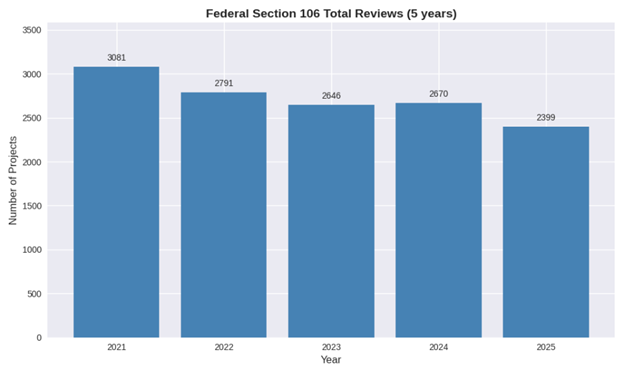
Oklahoma reviewed 13,587 federal undertakings in the past five years, showing our capacity to efficiently manage high volumes.
- All reviews met the 30‑day deadline, with exceptions only where allowed.
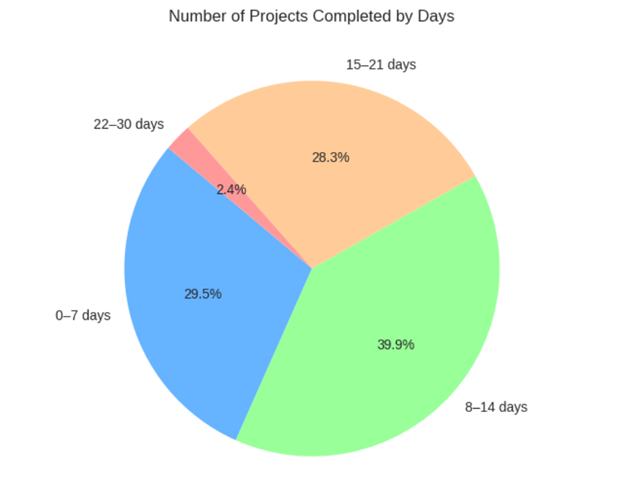
- Most projects were reviewed within eight to 21 days.
- Staffing ranged from 11 employees at its peak to just four at its lowest, yet deadlines were still met.
This track record demonstrates that the current regulatory framework—when implemented thoughtfully—supports both efficiency and preservation.
| Graphs provided by the SHPO | |
Looking closer at FY25: myths, realities, and what the numbers actually show
When we take a closer look at the FY25 data, we see a familiar pattern. Like most rumors in the preservation world, there are kernels of truth mixed with a fair amount of myth. The numbers tell a much clearer story.
In FY25, the OKSHPO reviewed 2,399 federal undertakings across the state. Of those:
- 190 undertakings required additional information because the federal agency or its delegate did not provide enough detail for the OKSHPO to make a determination.
- Of the 2,399 undertakings, 2,060 were found to have no effect on historic properties, allowing them to proceed without conditions or mitigation.
- Only nine were determined to have an adverse effect on historic resources.
These proportions are consistent with previous years. The vast majority of projects move forward with no issues, and only a small fraction require mitigation.
| | |
Timelines matter — and Oklahoma delivers
We fully recognize that timely reviews are essential for modern infrastructure development, housing rehabilitation, and economic growth. Under current regulations, the OKSHPO continues to meet every required deadline, even with fluctuating staffing levels and increasing project volume.
As federal discussions continue about potential regulatory changes, here are several considerations that could strengthen the Section 106 process nationwide:
✔️ Designate a Single Lead Federal Agency
Many projects involve multiple federal agencies. Establishing a clear lead agency—with guidance on how that designation is made—would reduce confusion and prevent unnecessary delays for both SHPOs and project proponents.
✔️ Ensure Qualified Delegates
Federal agencies may delegate their Section 106 responsibilities, but when delegates lack training in archaeology, architectural history, planning, or related fields, reviews take longer and require more clarification. Properly trained delegates would streamline the process and reduce strain on limited SHPO resources.
✔️ Standardize the Level of Effort
Different federal agencies apply Section 106 with varying levels of rigor. Some over‑compensate, investing more time and money than necessary. Others under‑perform, leading to costly requests for additional information later. A consistent, clearly defined level of effort would benefit everyone involved.
Linear projects: a challenge elsewhere, a strength in Oklahoma
During recent committee hearings, many officials highlighted delays associated with long, linear projects. Fortunately, Oklahoma is well‑positioned in this area. Decades of experience with pipelines and transportation corridors have prepared OKSHPO staff to efficiently review modern linear projects such as broadband expansion. Existing programmatic agreements already provide clear, streamlined pathways for these undertakings.
Rising pressure, shrinking resources
While Oklahoma’s Section 106 workload remains steady, the pressure for faster turnaround times continues to grow. Our office is responsible for all programs required under federal law:
- Section 106 review
- National Register of Historic Places
- Historic Tax Credits
- Certified Local Governments program
Change Is coming
What form that change takes—regulatory updates, new guidance, or increased investment in staffing and technology—remains to be seen. But the data from Oklahoma makes one thing clear: when implemented thoughtfully, the current Section 106 framework can be both efficient and effective.
To learn more about Section 106 and its processes, you can visit the Advisory Council on Historic Preservation (ACHP) website and view An Introduction to Section 106.
| | |
On March 2, 2026, we were thrilled to welcome Wren Fleming to the SHPO team as our new division administrative assistant. Wren brings five years of experience with the US Marine Corps and many years with the US Department of Labor, adding valuable organizational strength and a service‑driven mindset to our division. As the first point of contact for the SHPO, Wren has already jumped into learning preservation terminology, program areas, and the unique rhythms of our work.
Wren’s support is helping ease the pressure of a reduced staff, and we are grateful for the energy and professionalism he has brought from day one. We are excited to have Wren on board and look forward to the positive impact he will continue to make.
| |
2026 SHPO Calendar of Events (April-June)
The Oklahoma Historical Society, State Historic Preservation Office, presents its April–June 2026 calendar of events. There are no registration fees unless noted. All events will take place virtually, unless otherwise stated. For more information, call 405-521-6249 or visit okhistory.org/shpo/events. Note: If you have a disability and require accommodation, call 405-521-6249 at least two days prior to the event.
CONTINUING EDUCATION OPPORTUNITIES: Many of these programs meet the requirements for HSW hours/State of Oklahoma's Board of Governors of Licensed Architects, Landscape Architects, and Interior Designers, and for professional development hours/Oklahoma State Board of Licensure for Professional Engineers and Land Surveyors. The OKSHPO will email certificates of attendance upon request after the event, and participants self-report or document their attendance according to the policies of the respective boards.
Register online at okhistory.org/shpo/register.
Please check our website for updates at okhistory.org/shpo/events.
| | | |  | |
SHPO Lunch and Learn: "21 Crossing" with Michael Mayes and Kristina Wyckoff (12 p.m.)
Historic Preservation Review Committee Meeting (1:30 p.m., Dr.
Leroy H. Fischer Boardroom, 800 Nazih Zuhdi Drive, Oklahoma City and virtually via Teams)
| | | | | |
Oklahoma History Symposium: Milestones in Oklahoma History (Oklahoma History Center, 800 Nazih Zuhdi Drive, Oklahoma City)
Section 106 of the National Historic Preservation Act (10 a.m. – 11 a.m.)
National Register of Historic Places Overview (10 a.m. – 11 a.m.)
The Historic Preservation Tax Credit: "50 Years and Now It’s Your Turn" (10 a.m. – 11 a.m.)
SHPO Closed
| | | | | SHPO Lunch and Learn: How to use the Gateway to research your historic property with Chad Williams (12 p.m.) | | Preservation Oklahoma, Inc. Expands Board | | |
Preservation Oklahoma, Inc. (POK), Oklahoma's statewide preservation nonprofit, has recently added four members to their Board of Directors, expanding statewide representation for the group.
- Ryan Sproul (Isabella, Major County)
- Kelly Tompkins (Enid, Garfield County)
- Preston Gunkel (Altus, Jackson County)
- Kelli Gaston (Norman, Cleveland County)
To learn more about Preservation Oklahoma, Inc.'s mission and programs, visit preservationok.org.
| |
Make hay while the sun shines
Stories from Oklahoma's centennial farms and ranches
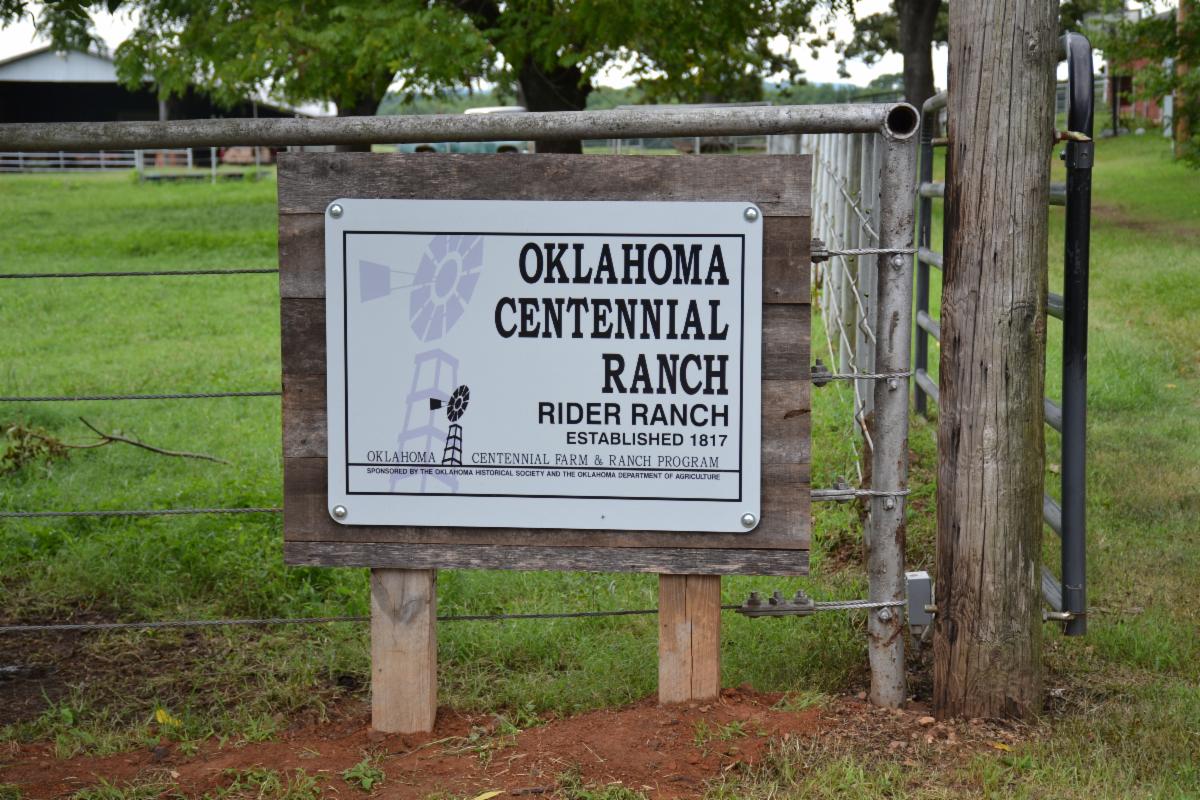
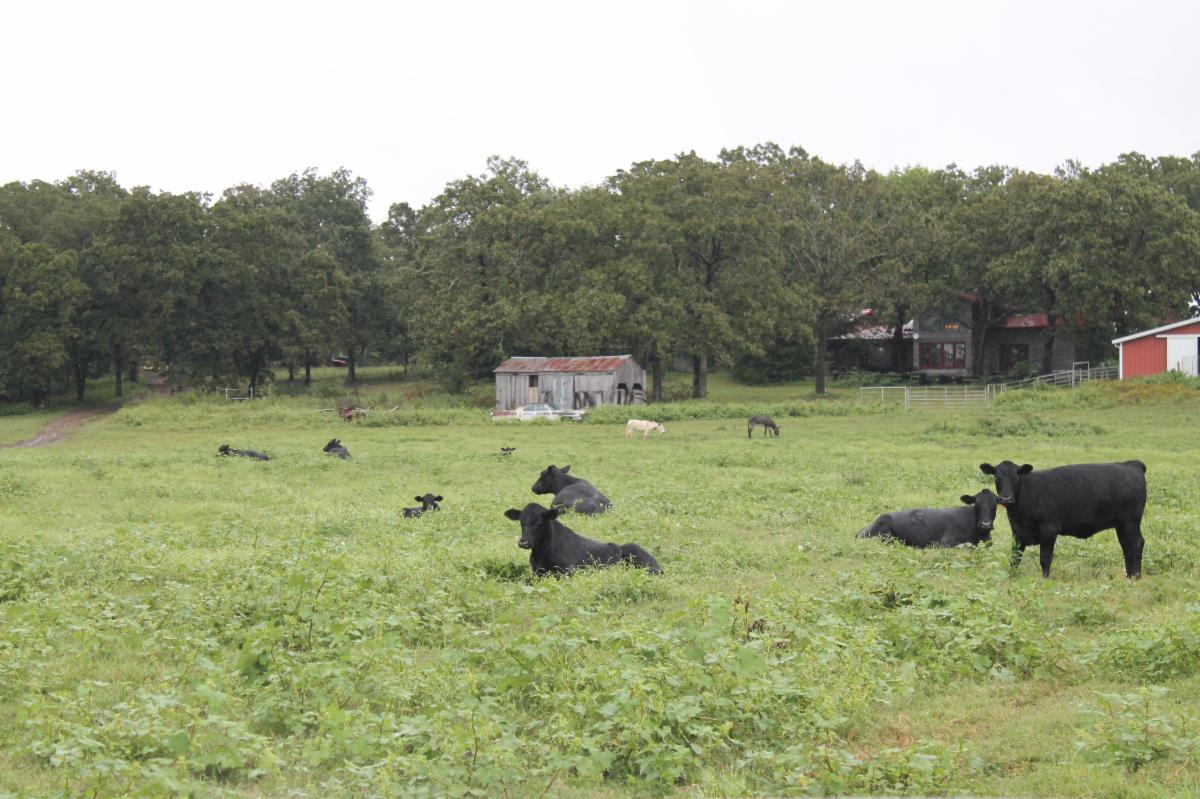
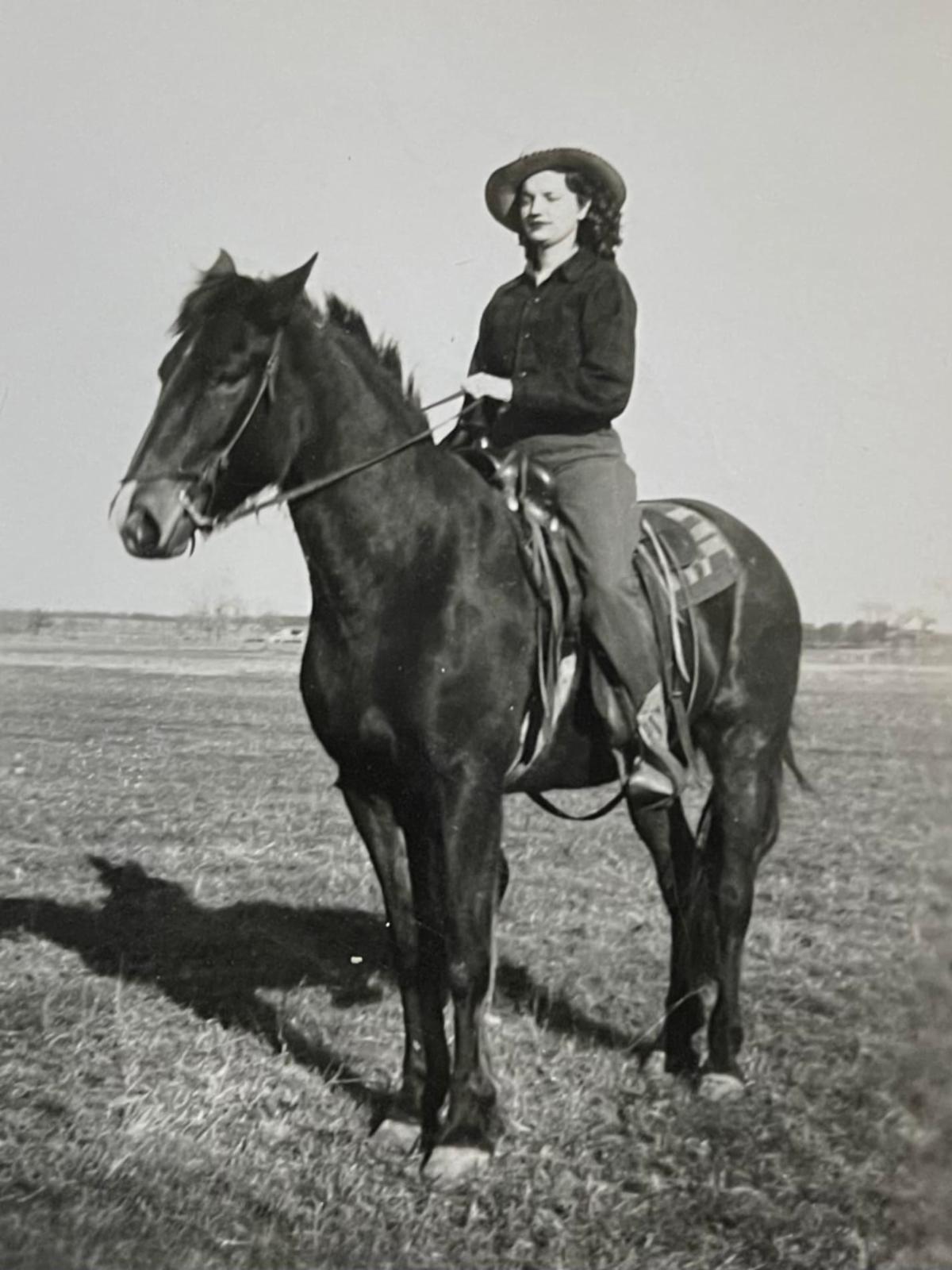
| | Images: Centennial Ranch Sign and Property Photo, courtesy of OKSHPO;
Echo on Horseback, courtesy of The Tom and Echo Rider Collection on Facebook. | |
During Women's History Month, we are highlighting the incredible woman behind Rider Ranch in Sequoyah County. The ranch was originally established by the family of Echo Garvin Rider in the community of Miller Ridge in the Cherokee Nation. Sadly, her father, John Franklin Garvin, died after being struck by lightning just six months before Echo was born on October 19, 1919.
Echo Garvin earned a Master's degree from Northeastern State University and became a teacher of students of all ages, eventually becoming a principal at Brushy School, where she would begin the first bus route. During World War II, Echo painted stars on the wings of Boeing planes and painted liberty and troop ships for Moore Dry Dock and Kaiser Shipyards. She and her beloved husband, Tom G. Rider, raised cattle and were instrumental in establishing the Blue Ribbon Downs in Sallisaw. Echo also cofounded the Fourteen Flags Museum, preserved the Judge Franklin Faulkner Cabin west of Akins (her father's birthplace), and was featured in the National Geographic and Oklahoma Hall of Fame magazines. She also appeared on Osiyo: Voices of the Cherokee People (View the OsiyoTV episode).
Rider Ranch became a centennial ranch in 2018. Echo would live to 100 years of age before passing away on May 27, 2020.
In her 100-year lifetime, Echo lived through and saw many things:
- Passage of the 19th Amendment in 1920
- Passage of the Indian Citizenship Act (Snyder Act) in 1924
- Establishment of Route 66 (1926)
- Adoption of the Star Spangled Banner as our anthem (1931)
- Assassinations of John F. Kennedy (1963), Martin Luther King, Jr. (1968), and Robert F. Kennedy (1968)
- Astronauts land on the Moon (1969)
- First female Supreme Court justice, Sandra Day O'Connor (1981)
- First female principal chief of the Cherokee Nation, Wilma Mankiller (1985)
- Oklahoma City Thunder (2008)
- First Black president, Barack Obama (2009)
- Lived through six wars (WWII, Korean War, Vietnam War, Gulf War, the War in Afghanistan, and the Iraq War)
To learn more about the Oklahoma Centennial Farm & Ranch Program, visit okhistory.org/shpo/farmandranch.
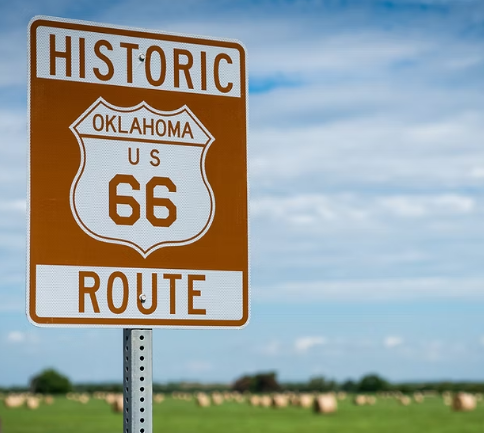
| | Masthead photo credit: Image of a sign along Route 66, courtesy of the Oklahoma Department of Transportation. | | |
OK | Preservation Advocate
April 2026
Volume 2, Issue 3
| | | | |