|
Dear Members and Colleagues,
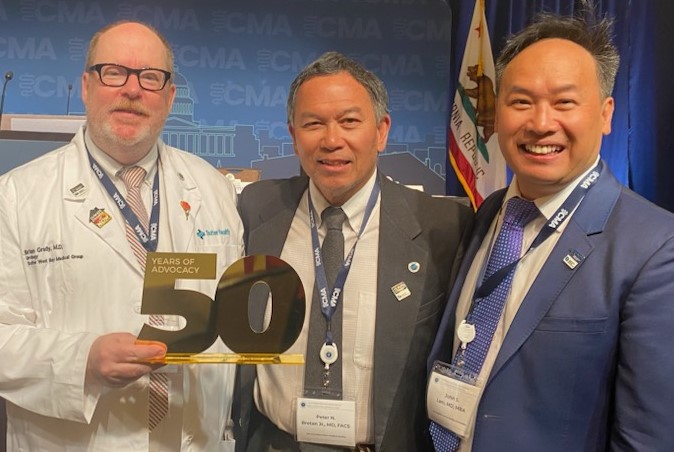
The California Medical Association (CMA) hosted its 50th annual Legislative Advocacy Day on April 10, 2024, in Sacramento. More than 400 physician and medical student leaders from all specialties and modes of practice met with legislators on priority health care issues. The California Urological Association (CUA) sponsored a table at this event bringing together CUA members to get hands-on experience and learn the nuts and bolts of advocating for their patients and profession.
There were 3 issues that we discussed with our legislators, which include upholding the Managed Care Organization (MCO) tax agreement, prior authorization reform, and physician oversight on the use of artificial intelligence (AI) tools.
The first ask was to preserve quality health care for all Californians by maintaining last year’s historic budget agreement for Medi-Cal providers. Medi-Cal provides essential health coverage to one in three Californians and is foundational to the state’s health care delivery system and economy. California has the largest Medi-Cal program in the country, serving nearly 15 million people and nearly 50 percent of children get their health care through Medi-Cal programs. Medi-Cal provider rates have not increased in more than a decade, and for most physicians, it’s been more than 25 years—leaving millions of patients insured but without meaningful access to health care. Renewal of the MCO Tax will allow the state to draw down additional federal funding to support the Medi-Cal program and its providers and last MCO Tax expired in 2022, underscoring the urgency of renewing this mechanism to sustain and improve Medi-Cal services. The recent budget initiatives, including grants for behavioral health infrastructure and transitional housing for homeless individuals with serious behavioral health conditions, demonstrate the state's commitment to addressing critical healthcare needs. However, it is important to ensure that these initiatives translate into tangible improvements in access and quality of care for California’s most vulnerable populations. The CMA and the Coalition to Protect Access to Care, a broad and diverse group of health care organizations, have filed a statewide ballot initiative with the California Attorney General’s office to expand access to health care for millions of Californians.
Specifically, the initiative will:
- Make the Medi-Cal provider rate increases that were included in the 2023-24 state budget deal permanent for generations to come;
- Expand access to health care for Medi-Cal patients, which will result in reduced emergency rooms usage, and shortening wait times for all Californians;
- Increase funding for mental health programs that care for children and Medi-Cal patients; and
- Enable California to manufacture its own insulin and other prescription drugs to increase affordability for Californians.
CMA will be working closely with the other members of the coalition to gather the hundreds of thousands of signatures needed for the initiative to be placed on the November 2024 ballot.
The next ask was support for prior authorization reform. In order to address administrative hassles, SB 516, championed by Senator Nancy Skinner, seeks to streamline the prior authorization process, reducing administrative burdens for physicians and ensuring timely access to care for patients. The bill introduces significant changes, including exemption criteria based on physician approval rates, mandating electronic prior authorization processes, and annual evaluation of prior authorization rates by plans/insurers. Physicians can focus more on patient care when there is reduced paperwork and faster access to treatments, which leads to improved outcomes and patient satisfaction. Furthermore, faster access to care without unnecessary prior authorization requirements can enhance patient experiences and ensure timely treatment for medical needs.
The last ask was support for physician oversight with the use AI tools. SB 1120, introduced by Senator Josh Becker, addresses the growing use of AI in healthcare decision-making processes. While AI has the potential to improve efficiency, concerns regarding accuracy and bias necessitate appropriate oversight to safeguard patient care and uphold medical standards. As physicians, we understand the importance of maintaining clinical judgment and oversight in healthcare decisions. SB 1120 reinforces these principles by requiring licensed physicians to have final approval over AI-assisted utilization review decisions, ensuring that patient care remains paramount in all healthcare processes. The bill also mandates transparency in utilization review processes and imposes penalties for non-compliance, promoting accountability and adherence to clinical guidelines.
Thank you to those who attended and all of you who advocate for your practice and our patients by your CUA membership.
|