|
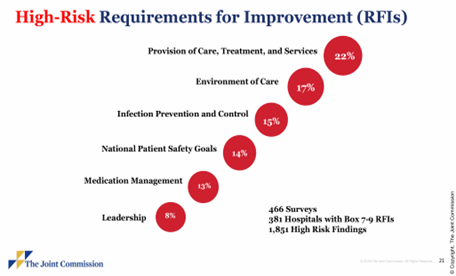
Summary of findings scored under the High-Risk Chapters:
Provision of Care, Treatment, and Services:
Lack of nutrition assessments, insufficient discharge planning, incomplete pre-sedation assessments, unclean conditions in the kitchen, lack of documentation related to medication titration, and insufficient assessments such as in the emergency department.
Environment of Care:
There has been no eyewash where corrosive chemicals are stored or handled, no maintenance of medical equipment such as dialysis machines, anesthesia machines, SPD washers, or sterilizers, issues with critical air pressure relationships, utility systems failures, or infection control risk assessments developed or implemented.
Infection Prevention and Control:
Insufficient decontamination, disinfection, or sterilization of surgical instruments, improper sterilization time, and/or temperature. Improper high-level disinfection (HLD) solution temperature, and lack of monitoring of HLD solution during the HLD process. Lack of proper sterile storage and lack of bi-directional tracking of instruments undergoing sterilization of HLD.
National Patient Safety Goals:
Not using two patient identifiers during episodes of care, lack of telemetry policy for clinical alarms, patients with risk for self-harm, and observation levels not matching the actual level of risk. (Lack of application of the facility policy requiring a one-to-one caregiver). Inconclusive environmental risk assessments within dedicated spaces.
Medication Management:
Administration of titrated medications inconsistent with physicians' orders, PRN medications administered not compliant with the order, lack of implementation of policies regarding medication compounding, lack of cleaning sterile compounding rooms, and lack of clarification of orders before dispensing.
Leadership:
Lack of leadership oversight and implementation of policies and procedures, lack of a governing body to ensure compliance with CMS CoPs, lack of compliance with corrective actions, and lack of quality metrics for contracted services.
Based on the lists of high-risk areas, we highly advise developing tracers, environmental rounds, and frequent audits to close the gap on what could be a high-risk finding; or one that could lead to something higher up the matrix, such as an immediate threat to health and safety.
|