The American Society of Le Souvenir Français Inc.
Monthly Bulletin - Vol. IV. No 3 - March 2024
|
|
French Explorers of the American West
(Part one - 1634-1804)
|
|
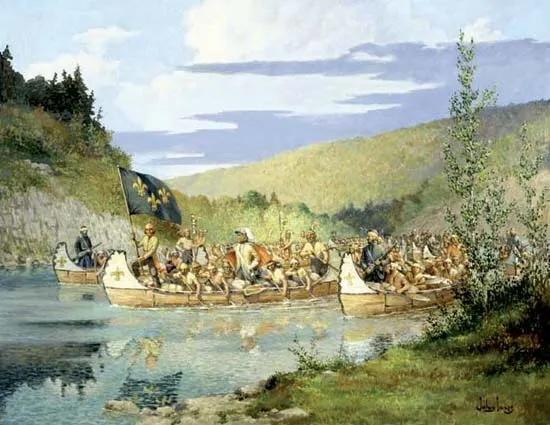
Cover illustration:
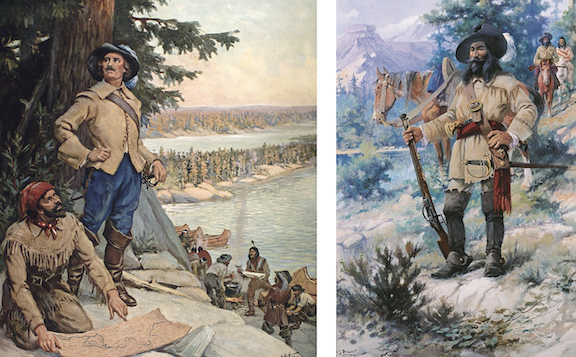
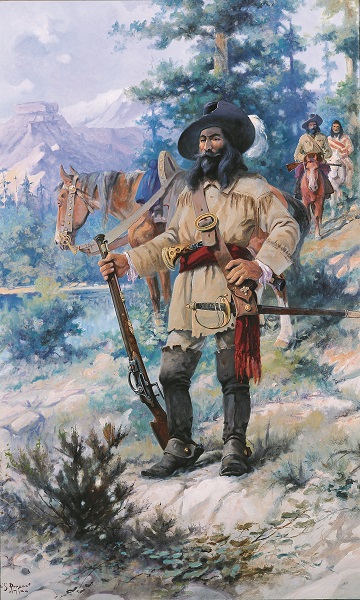
A painting by John Innes shows Pierre de la Vérendrye with his fellow explorers
Library and Archives Canada, Acc. No. 1973-22-1; gift of W.E. Gale, Vancouver, B.C.
|
|
EDITORIAL
America the Beautiful... "O beautiful for spacious skies, For amber waves of grain, For purple mountain majesties, Above the fruited plain!..."
Join us on an exciting journey this month, as we travel from the Mississippi River to the Pacific Ocean, commemorating more than two hundred years of historical events and the intrepid explorers who unveiled vast portions of the American West.
In a series of several Bulletins, we will delve into the adventures of French explorers and pioneers who braved the unknown, encountered indigenous tribes, and conquered towering mountains initially in search of direct routes to the Indies or, as the reality of geography became clear, the golden shores of California.
We've previously discussed renowned explorers like La Salle, Père Marquette, Jolliet, and others who traversed the vast lands from Québec to New Orleans.
In this Part One of our series, we'll head westward, beginning with the Verendrye expedition from 1736 to 1742, which went all the way to Wyoming and the Rocky Mountains.
We'll then explore a pivotal moment in American history: the Louisiana Purchase of 1803, which instantly doubled the size of the young nation and led to President Thomas Jefferson to launch the famous Lewis & Clark expedition. The French were never far: several expedition members were of French descent and were well-equipped to engage peacefully with Native American tribes due to their familiarity with these regions.
In future Bulletins, we will honor many French pioneers of the Far West, who started communities and thriving businesses in Colorado, Wyoming, Montana, California...
So, grab your paddle, saddle up, and let's embark on this adventure together!
In keeping with our series honoring members of the Lafayette Flying Corps, we will honor this month Frank Leaman Baylies, who fought under French uniform during World War One and whose ashes rest at the Lafayette Escadrille Memorial in Marnes-la-Coquette just outside Paris.
As announced upon several occasions before, we will continue to alert you on several upcoming events and relay news of celebrations.
We thank you for your numerous comments and suggestions. We invite you to share this Bulletin with friends, associates, and most importantly, the education community: nothing is more important than passing the torch to younger generations!
On behalf of the Board of Directors.
Thierry Chaunu, President,
American Society of Le Souvenir Français, Inc.
|
|
Historical Context:
The French seek a route to the Western Sea
|
|
An elusive pursuit...
• Since the time of Christopher Columbus, France, like other European powers, sought to discover a practical sea route to China and the Indies. The French aimed to find a route to the Orient by sailing north of the Spanish territories.
• In pursuit of this goal, King François 1er dispatched Jehan de Verrazane* to explore the region and search for the coveted sea route to the South Sea, which was the name given to the Pacific Ocean at that time. However, due to the limitations of the ships during that era, Verrazane was unable to sail directly along the coast. Instead, he had to navigate out to sea and then back towards land, resulting in him only encountering fragmented sections of the North American coast. Consequently, Verrazane inadvertently overlooked the discovery of both the Chesapeake and Delaware bays. As he approached the North Carolina outer banks, he hastily assumed that the expanse of water lying beyond was none other than the Pacific Ocean...
• A decade later, when Jacques Cartier sailed northward towards the Saint Lawrence River and arrived at present-day Montreal, indigenous tribes informed him of a vast body of water situated further west. He too wrongly concluded that the Pacific Ocean was within reach..
• By the time of Samuel de Champlain in 1603, it was believed that traveling far up the St. Lawrence River would lead to a lake that served as the origin of both the St. Lawrence River and a westward-flowing river that reached the Pacific Ocean.
• According to the accounts of the Indians, in 1634, Jean Nicolet was dispatched further west with the purpose of locating a river leading to "People of the Sea" in hopes of establishing contact with Cathay traders. He embarked on a journey from Lake Huron, passing through Lake Michigan and reaching Green Bay, adorned in a damask robe in anticipation of his encounter with the Chinese. The French held the belief that this river could potentially serve as their long-awaited passage to the Indies and China, although they were uncertain about its exact course. They speculated that it might flow northward towards a hypothetical "Mer Glaciale," which they believed could be situated west of Hudson's Bay and connected to the Pacific. Alternatively, they considered the possibility of the river leading in a southwesterly direction, either towards the Gulf of Mexico (as the Mississippi River does) or to the "Vermillion Sea," which was then believed to be a body of water located between the North American coast and the vast island of California. Lastly, there was also the notion that this river could be the fabled "River of the West," flowing directly westward to reach the Western Sea...
• In 1669, the French were provided with more accurate information regarding the "Messipi" River, which had a southward flow. They held the hope that this river would lead them to the Vermillion Sea, near Baja California, thereby providing them with a potential route to the Orient. Consequently, Louis Jolliet and Father Jacques Marquette were dispatched in 1673 to embark on an expedition to explore the river and determine its destination. Jolliet and Marquette navigated the Mississippi River in canoes until they reached its confluence with the Arkansas River. It was at this juncture that they realized the high likelihood of the river ultimately emptying into the Gulf of Mexico. Consequently, they made the decision to turn back. However, upon reaching the confluence of the Missouri River with the Mississippi from the western direction, the explorers thought that it could potentially be the pathway leading to the Western Sea.
• In the later part of the century, French explorers in the western regions of New France kept hearing similar stories from their Indian allies. An example of this is in 1685 when Daniel Greyselon, Sieur Duluth, was told that there was a lake with undrinkable saltwater just twenty days away from his location.
• Alas, there was no conclusive evidence supporting the existence of a sea route leading west from the Great Lakes, despite some suggestive accounts. The uncertainty surrounding the existence of such a route was evident in the maps of the time, which often left the area west of the Great Lakes uncharted until the 19th century and mostly blank.
• By 1730, the French were still actively seeking a "River of the West" that would offer a water passage from the western part of New France to the Pacific Ocean. This quest became a primary focus for a family of French fur trappers, led by Pierre Gaultier de la Varennes, Le Sieur de la Vérendrye. Stationed on Lake Superior, Pierre Vérendrye learned from Indigenous peoples about a significant river that could potentially lead to the Pacific. With support from French Canadian merchants, he and his sons established a series of trading posts northwest of Lake Superior as strategic bases for exploring in search of this anticipated river. Ultimately, their expedition, 75 years before the famed Lewis & Clark "Corps of Discovery", took them as far as today's Dakotas and Montana...where they are honored at the State Capitol.
• Regrettably, the French were unable to access the Sea of the West, the River of the West, or any other waterway that could lead them from the Great Lakes to the Pacific. And, due to the outcome of the French & Indian War in 1763, they relinquished all their territories in New France to the British, leaving their Western territories and Louisiana under the custody of Bourbon's Spain...until they took it back, only to sell their entire possessions three years later to the United States in 1803.
This Bulletin recalls the great deeds of many of these French explorers, including those participating in the famed Lewis & Clark expedition of 1804, as they all paved the way for the Western expansion of the United States.
* We use the French spelling Jehan de Verrazane, since this is the way he himself signed his name, up to his last will in 1526 and in most official documents. As we are about to celebrate the 500th anniversary of his landing in New York on April 17, 1524 (which he named "Nouvelle Angoulême" in honor of King François Ier), we refer the reader to our past Bulletin:
April 2023: Tribute to Jean de Verrazane
|
|
Jean Nicolet, discoverer of Wisconsin |
|
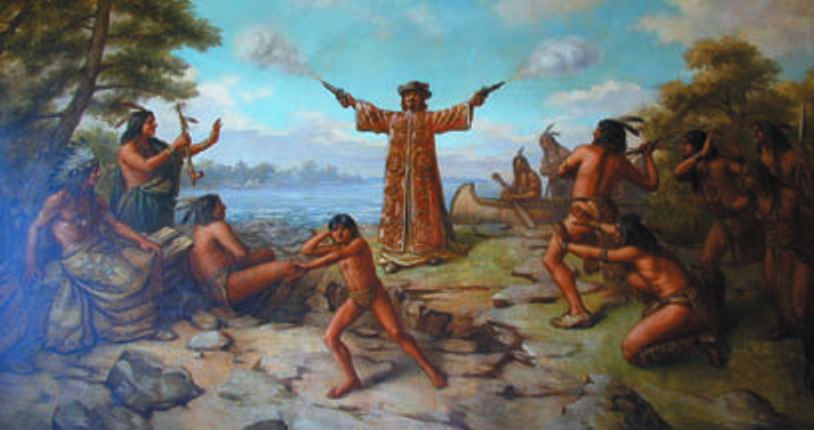
Above: Mural of Jean Nicolet, landing at the Bay of Green Bay, Wisconsin, in 1634. Painted by Franz Edward Rohrbeck (1852-1919) in 1910 in the rotunda of the Brown County Courthouse, Green Bay, Wisconsin. It shows Nicolet wearing a Chinese damask tunic strewn with flowers and birds, and discharging two pistols into the air. This mural, among others in the courthouse, has recently received criticism, over its perceived example of "early terrorism". Public Domain, https://commons.wikimedia.org/w/index.php?curid=8265724
Marker, “Nicolet Landing 1634-1909”
4550 Benderville Rd, Green Bay, WI 54311
|
|
Long before the expeditions of the 19th Century to explore the Far West, the French established in Canada were pursuing the discovery of a direct transcontinental route to reach China and India.
• Jean Nicolet (Nicollet), Sieur de Belleborne (c. 1598 – October 1642) was noted for exploring Lake Michigan, Mackinac Island, Green Bay, and being the first European to set foot in what is now the U.S. state of Wisconsin.
• In 1634, Jean Nicolet landed at Red Banks, near modern-day Green Bay, in search of a passage to the Orient.
• He was so convinced he would find a land route from Canada to China that he had brought with him in his canoe - - all the way from Canada - - a brightly colored yellow silk chinese robe, which he quickly unpacked and wore once in sight of the Red Banks. He also carried two pistols, to convey his authority... Nicolet wrongly assumed that the people greeting him on the banks were from China.
• Actually, far from being Chinese, they were native American Indians who called themselves Ho-Chunk. The Ho-Chunk people seemed to appreciate Nicolet's ritual display and Nicolet thus named himself the French ambassador to the Ho-Chunk people.
• The Ho-Chunk, was mistakenly translated by the French as "People of the Sea". However, the Ojibwe Indians, who served as guides to the French, had a less appealing name for them: Winnebago, or "people of the fragrant waters," translated to French as, Puants ("Stinkers"), hence the name "Baie des Puants" given to that part of Wisconsin. Father Jacques Marquette, for his part, thought the name referred to the smell of the swamps when he explored the area in May 1673. Hence the French also called the bay: Baie Verte, which means Green Bay.
• Nicolet established a small trading post named La Baye on the Baie des Puants in 1634 which is today Green Bay, Wisconsin. Fort La Baye, a French military post, was eventually built in 1717, and occupied until 1760.
• The town of La Baye was incorporated in 1754. At the end of the Seven Years' War, it went under British control in 1761 and was renamed Green Bay, which was incorporated under this name in 1839.
• Inscription of marker:
“Commemorating the discovery of Wisconsin in 1634 by Jean Nicolet, Emissary of Governor Champlain of New France. In this vicinity Nicolet first met the Winnebago Indians.”
"Erected 1909 by State Historical Society of Wisconsin & Green Bay Historical Society."
|
|
There are many sites honoring Jean Nicolet's expedition |
|
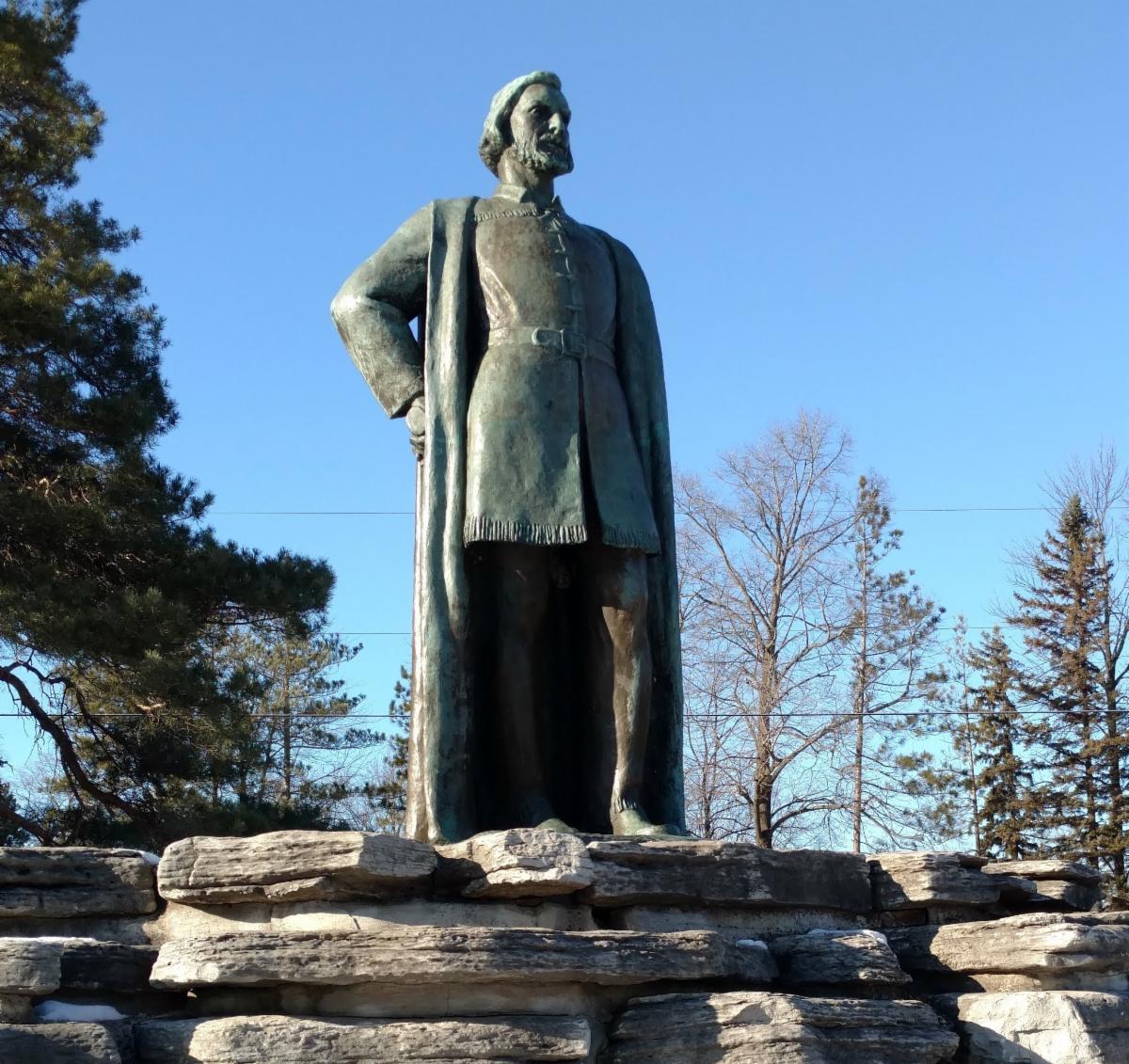
Above: A statue of Nicolet, built in 1951, is located in Wequiock Falls County Park in Brown County, Wisconsin. The statue was paid for by contributions from Wisconsin school children and was set up in 1950, along with a historical marker commemorating Nicolet’s landing at Red Banks.
|
|
Statue and Memorial of Jean Nicolet
Nicolet Landing, 4556 Benderville Rd, Green Bay, WI 54311
• Inscription:
“Many of the explorers who followed Columbus were more interested in finding an easy route to Asia than they were in exploring and settling this continent. In 1634 Jean Nicolet, emissary of Gov. Samuel de Champlain of New France, landed at Red Banks on the shore of Green Bay about a mile west of here. His mission was to arrange peace with the “People of the Sea” and to ally them with France. Nicolet half expected to meet Asiatics on his voyage and had with him an elaborate Oriental rove which he put on before landing. The Winnebago Indians who met him were more impressed with the “thunder” he carried in both hands as he stepped ashore firing his pistols. Nicolet reported to his superiors that he was well entertained with “sixscore beavers” being served at one banquet, but it was the pelts and not the flesh of the beaver that were to be highly prized by those who followed him.”
• In 1634 Jean Nicolet passed through the Straits of Mackinac searching for a water route to China. He was not the only one, several French explorers all stopped at Mackinac.
Marker “Michilimackinac Cove”
500 N State St, St Ignace, MI 49781
• Inscription:
“Famous landing place for 17th century adventurers, explorers, voyageurs, traders, coureurs de bois, soldiers and missionaries, who followed Indian routes to this shore; — Brule, Nicolet, Dablon, Marquette, Perrot, Jolliet, La Salle, Hennepin, de Tonty, Duluth, Lahontan, Cadillac, making history here.
Erected by the Kiwanis Club of St. Ignace, 1959. Approved by the Michilimackinac Historical Society"
• Note, the importance of Mackinac as a stronghold and rear-base for western expeditions.
Marker “France at Mackinac”
251 South State Street, Saint Ignace MI 49781
• Inscription (Excerpts):
“... French Explorers: In the 1620s French explorer Etienne Brûlé became the first European to set eyes on the Great Lakes. In 1634 Jean Nicolet passed through the Straits of Mackinac searching for a water route to China. By 1658 traders led by Medard Chouart des Groseilliers and Pierre Esprit Radisson plied these waters in search of furs in Michigan and Wisconsin...”[...]
“French Culture and Indian Ways: French men often married Native women. An Indian wife provided an important connection between the European trader and the Native peoples. Her family ties were essential because Indian people wanted to trade with merchants they could trust. Their children bridged both cultures and were known as metis. Metis were the major population of the Straits of Mackinac into the early 19th century. Today French descendants remain in the Straits area.”
“French Marines at Mackinac: Soldiers of the Compagnies Franches de la Marines (Independent Company of Marines) served at the Straits of Mackinac beginning in the late 1600s. In 1715 French Marines began a 45-year period of service at Fort Michilimackinac. Here they protected the community and supervised the fur trade. French officers also recruited Native American warriors at Michilimackinac to fight against British forces as far away as Ohio and New York.”[...]
Erected by Mackinac State Historic Parks."
• The French explorer Jean Nicolet is believed to have been the first European to reach Lake Michigan, possibly in 1634 or 1638. Later in 1679, Nicolet explored the southernmost part of the lake where modern-day Chicago is. In the earliest European maps of the region, the name of Lake Illinois has been found in addition to that of "Michigan", named for the Illinois Confederation of tribes. Its name is derived from the Ojibwa Indian word mishigami, meaning large lake.
Marker “Lake Michigan”
Gros Cap Roadside Park, US-2, St Ignace, MI 49781
• Inscription:
“This lake, the sixth largest in the world, was discovered in 1634 by Jean Nicolet, who explored this north shore to Green Bay but found no Orientals as the French in Quebec had hoped he would. The general size and outline of the lake was established in the 1670’s by Marquette and Jolliet. They named it Lake Michigan. Its elongated shape was an obstacle to transcontinental expansion, but its water soon proved a real boon to commerce.
Erected 1957 by Michigan Historical Commission.”
• A postcard from 1906 reads: “The Jean Nicolet Monument at Menasha, Wisconsin - erected by the Woman's Club of Menasha in 1906. Close to this location, Jean Nicolet landed and was the first white man in Wisconsin, meeting here the Winnebago tribe. He held the earliest white council with 5000 savages...”
“Jean Nicolet Monument”
301 Park St, Menasha, WI 54952
• Inscription
“Near This Spot Landed
1634
First White Man in Wisconsin
Jean Nicolet
Met the Winnebago Tribe
Held Earliest White Council”
—
“Erected by
Women's Clubs of Menasha
1906”
• Jean Nicolet is honored in several ways:
|
|
Médard Chouart des Groseilliers & Pierre-Esprit Radisson
|
|
Above:
Marker “Pierre-Esprit Radisson and Medard Groseilliers”
At the intersection of State Highway 27 / 70 and Reserve Road, Stone Lake WI 54876
|
|
• Médard Chouart des Groseilliers (born Charly-sur-Marne, Champagne, 1618- died 1696) was a French explorer and fur trader. He immigrated to New France in 1641. He is frequently associated with his brother-in-law, Pierre-Esprit Radisson, who was 20 years younger. After serving at a Jesuit mission for several years, Groseilliers used his knowledge of Algonguin, Huron, and Iroquois languages to begin trading in furs with Indians. In August 1654, he was dispatched to the new Huron lands to journey westward. In another expedition in August 1659, Chouart and Radisson traveled to the far end of Lake Superior and wintered at Lac Courte Oreilles, Wisconsin. Being fined by the French for operating without a licence, they went to London to seek the backing of King Charles II, and thus established the Hudson Bay Company. Eventually, they returned to French service, and on 20 May 1682, the French established their own fur-trading company, known as La Compagnie de la Baie d'Hudson or Compagnie du Nord. Chouart and Radisson even engaged in conflict with their former employers, resulting in a diplomatic incident. The French government ultimately sided with the British, whose leader, the Duke of York, was France's best chance to re-convert the English back to Catholicism. Upon returning to France, Chouart declined an offer to rejoin the Hudson's Bay Company and instead returned to his farm at Trois-Rivièresin Québec. His ultimate fate remains unknown.
• Inscription:
“These brothers-in-law during the winter of 1659-60 camped with the Ottawa Indians two miles upstream from this point on Lac Court Oreilles (meaning "Lake of the Short Ears" in French). Early French explorers called the Ottawa Indians "Court Oreilles." Radisson's journal reports that among the gifts they brought to the Indians were "2 ivory combs and 2 wooden ones," also some "red paint and 6 looking glasses of tin." The combs and paint were "to make themselves beautiful, the looking glasses to admire themselves."
“Radisson and Groseilliers were the first white men to discover and explore northwestern Wisconsin. When the French Governor General of Canada confiscated their rich cargo of furs because he claimed they did not have the proper credentials to trade with the Indians, Radisson and Groseilliers left the service of the French government. They went to England and were instrumental in the formation of the Hudson's Bay Company in Canada.”
“Erected 1960, 300th Anniversary Discovery and Exploration of Northwestern Wisconsin”
|
|
Daniel Greysolon Sieur Du Lhut |
|
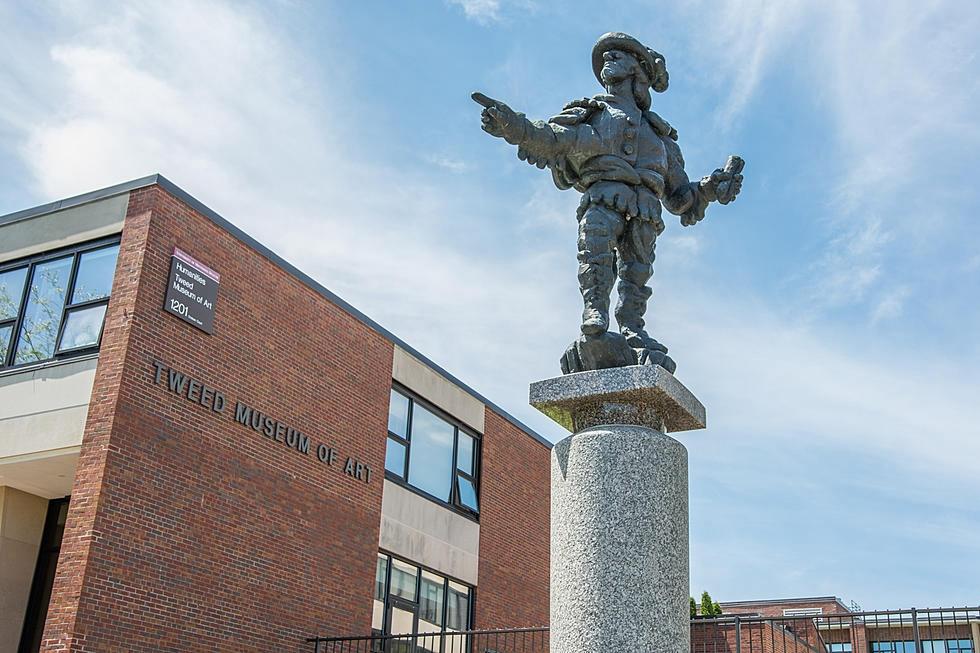
Photo: Statue “Daniel Greysolon Sieur Du Lhut”
Tweed Museum of Art, Humanities Bldg, 1201 Ordean Ct, Duluth, MN 55812
|
|
• Daniel Greysolon, Sieur du Lhut, was a French soldier and explorer who played a significant role in establishing French dominance over the region north and west of Lake Superior. Born around 1639 in Saint-Germain-Laval, near Saint-Étienne, France, Du Lhut began his military career as an ensign in the regiment at Lyon in 1657. By 1665, he had become an officer in the royal household regiment. Du Lhut participated in the conflict against the Dutch under the Great Condé in 1674, having already undertaken two voyages to New France.
• In 1675, Du Lhut returned to Montreal and remained there until September 1678. During this time, he led a group of Frenchmen and three Indian slaves to the Lake Superior region. His objective was to negotiate peace among the Indian tribes residing north and west of the lake, as this area was a valuable source of beaver pelts. In September 1679, Du Lhut successfully brought the Indian tribes together in an assembly that declared amity among them. After spending the winter in the West, he decided to venture even farther west the following summer in search of the western ocean. Du Lhut's expedition reached the Mississippi River and explored what is now Minnesota.
• Upon his return to Montreal, Du Lhut found himself accused of being a renegade trader, which violated a 1676 edict prohibiting Frenchmen from engaging in trading activities in the wilderness. In order to clear his name, he returned to France but was back in 1682. The following year, he embarked on another journey to the West, aiming to renew his efforts in peacemaking and dissuade the Indians from trading their pelts with the English. Du Lhut also sought Indian support for French troops and fought alongside Louis de Frontenac against the British's Indian allies, the Oneida and Onondaga, during campaigns. By 1696, he held command at Fort Frontenac and subsequently retired to spend his remaining years in Montreal. The city of Duluth, Minnesota, was named in honor of Daniel Greysolon, Sieur du Lhut, recognizing his contributions to French control in the region.
|
|
Claude Charles Du Tisne, explorer of Kansas |
|
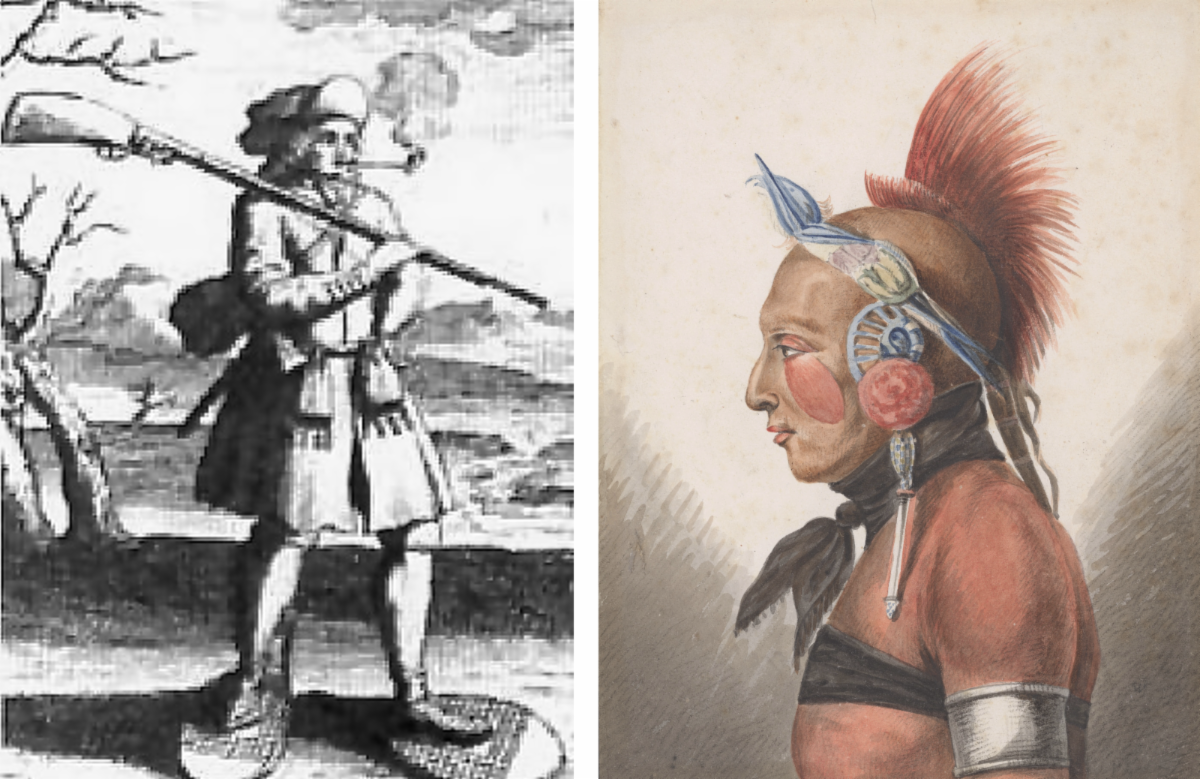
Illustrations above:
Right: Osage warrior watercolor 1811–ca. 1813 by Pavel Petrovich Svinin (1787/88–1839), New York Metropolitan Museum of Art, Public Domain, after Charles Balthazar Julien Févret de Saint-Mémin, who had drawn American Indians from life in 1805–7. "An Osage Warrior" is derived directly from Saint-Mémin’s portrait "Osage Warrior II" (1807; Winterthur Museum, Delaware).
|
|
• Claude Charles Du Tisne (born in Paris 1688- died in Illinois, 1730) also spelled Dutisné led the first official French expedition to visit the Osage and the Wichita Indians in 1719 in what became known as Kansas in the present-day United States.
• He was born in France around 1681 and went to Canada in 1705 as a soldier. He was sent to establish a fort on the Ohio River. He built up a reputation for competence and knowledge of the frontier and the Indians.
• He embarked into several expeditions, leaving his base in Kaskaskia in Illinois seeking contact with the Comanches and establishing friendly trading relations with several tribes, such as the Missouria and the Miamis, the Winnebago, the Pawnee, the Oto, the Iowa, the Osage and Kansa peoples.
• Du Tisne was impressed with the physical size of the Osage, often more than six feet tall, and well-proportioned. They wore their hair in a scalp-lock. He was less impressed with their character, "in general they are traitors who easily break their promises."
• The term "Osage" is a French version of the tribe's name. The Osage people refer to themselves in their indigenous language as 𐓏𐓘𐓻𐓘𐓻𐓟 (Wazhazhe), or "mid-waters", which can be roughly translated as "calm water", in French: "eau sage".
• Upon reaching the Wichita tribe Du Tisne wrote that they twice threatened him with a tomahawk over his head, but he persuaded them that his purpose was peaceful. He concluded a trade agreement with the Wichita, concluding they could be satisfied with a few guns and other presents.
• After this expedition, Du Tisne continued to work on the frontier. He was promoted to captain and given command of Fort de Chartres in Illinois. He died in 1730 of a wound received from a Meskwaki or Fox Indian.
Louis Houck (the most eminent historian of early Missouri, gives the following incident of DuTisne’s life as related by Bossu:
“On one occasion, being together with some Frenchmen, among unfriendly Indians, who were to barter goods, he found that the Indians meditated a hostile attack, and understanding fully their purpose, as he wore a wig, he took it from his head and threw it defiantly on the ground, saying from time to time, “You will have my scalp: take it up if you dare to do it!” the astonishment of the Indians was inexpressible, for Du Tisne had had his head shaved before this happened.
Afterwards, he told them it was very wrong of them to attempt to injure him, because he only came to make an alliance with them, but that, if they compelled him he would burn the waters in their lakes and rivers and thus hinder them from paddling their canoes, and also set fire to their forests. To demonstrate the truth of his power, he secured a little pot, put some brandy in it and set it on fire, and the Indians, not being then acquainted with brandy, were amazed. At the same time he took out of his pocket a convex glass and set fire to a rotten tree by means of the sun. The Indians, really believing that he had power to burn their lakes and rivers and forests, caressed and loaded him with presents and accompanied him as an escort, so that no one might do him any harm.”
|
|
Jean-Baptiste Bernard de la Harpe
Discoverer of Little Rock, Arkansas
|
|
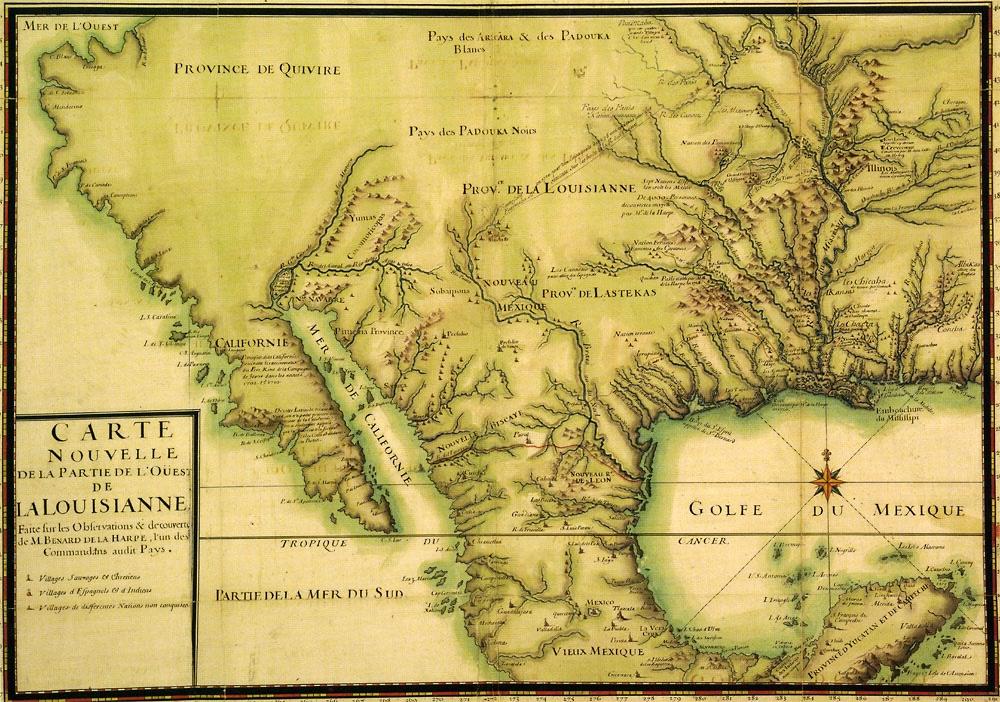
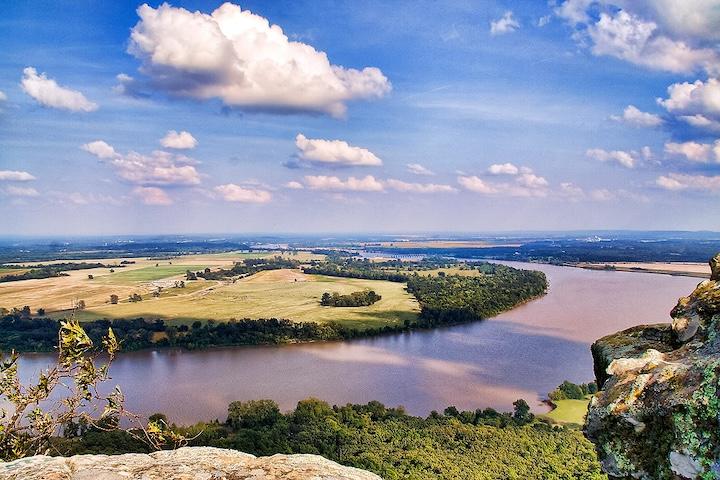
Top: Carte de la Nouvelle Partie de la Louisiane ("Map of the new part of Louisiana" ) by La Harpe 1723
Bottom: Arkansas River from Petit Jean State Park. Photo by Mike Keckhaver
https://encyclopediaofarkansas.net/media/petit-jean-state-park-7873/
|
|
• Jean-Baptiste Bénard de la Harpe (1683 in Saint-Malo –1765) was a French officer, trader and explorer who is credited with the discovery of Little Rock, Arkansas. He was also the first known French explorer to set foot in the future state of Oklahoma.
• In 1718, La Harpe left France, along with 40 men, and established a trading post in April 1719 on the Red River near what is now Texarkana, Texas. after 23 days of traveling, La Harpe and his party reached a large settlement 13 miles south of Tulsa, OK.
• The importance of La Harpe's exploration is that it was one of the two first-known French contacts with the Wichita and Apache Indians and the first known French expedition to set foot in the future state of Oklahoma.
• In 1722, La Harpe ascended the Arkansas River and found two distinct rock formations on the Arkansas River, the smaller one the South bank he named Le petit rocher and the larger on the North bank le rocher francais.
• Later in 1722, he presided over the transfer of Pensacola, Florida to the Spanish. In 1723 he returned to France and never came back to the Americas.
• Marker, “Arkansas River of yesterday”
Petit Jean State Park, Stouts Point Scenic Overlook, Stouts Point Road, Morrilton, AR 72110
• Inscription (excerpts):
"The Arkansas River below you has a long history and continues to flow through time.
Bernard de La Harpe, the first European known to explore the Arkansas River, arrived here in 1722. His expedition was commissioned by France to establish whether this area was suitable for colonization and to map the Arkansas River and its tributaries. La Harpeand 25 men traveled upstream from Arkansas Post to a point 50 miles from Little Rock, near Petit Jean Mountain. Knowledge gained during this expedition led the way for many hunters and traders to use the Arkansas River as their main travel route.
La Harpe's journal reveals the dangers of navigating the Arkansas River:
“Having advanced a league through the river, our small pirogue...has been dashed upon a log by the violence of the current, so that it turned over. The men hung to the log, but all that was in the pirogue has been lost, which consists of eighty-five pickaxes and hatchets, a boiler, three muskets and several other objects, wheat and clothes. We have had much difficulty in pulling the pirogue from beneath the log, after which we resumed the course.
Exploration of the Arkansas River ” - Bernard de la Harpe, 1721-1722
[...]
• Another marker explains the origin of the name "Little Rock"
Arkansas River Trail, Little Rock, AR 72201
• Inscription:
“Jean-Baptiste Bénard de La Harpe was the first European explorer to record the existence of a large rocky bluff on the north bank of the Arkansas River. According to his journal, La Harpe named it le Rocher Français ("the French Rock") on April 9, 1722. It later became known as the Big Rock. The French referred to the smaller outcropping on the south bank as le Petit Rocher ("the Little Rock"). The name first appeared on a 1799 French map of the area. The first official reference to Little Rock occurred in the Treaty of 1818, indicating the northernmost point of the Quapaw reservation. An August 20, 1822, article in the Arkansas Gazette described the rock: "It projects several feet into the river, forming below it a fine basin for boats, and its top reaches perhaps about midway between low water mark and the summit of the bank of the river. The name Little Rock was given to it by the aborigines or the early white settlers of the county to distinguish it from the Big Rock." In the 1950s, la Petite Roche became the accepted spelling based on local scholar Samuel D. Dickinson's suggestion.”
• Another marker celebrates the first Peace council with Indian tribes:
1357 Route US 64 - OK-72, Haskell OK 74436
• Inscription:
“First peace council and alliance in Oklahoma between a European nation and Indian tribes held here at a Tawakoni village by Comdt Bernard De La Harpe on his first visit to the Arkansas River. He erected a post here carved with the coat-of-arms of the French king, on Sept. 10, 1719. This date marks the beginning of French place names and trade activities in Oklahoma.
Erected 1995 by Oklahoma Historical Society”
• Marker, “Expedition of Bernard de la Harpe, The Red River Journey”
Across from Oklahoma’s Governor Mansion, Capitol View, Oklahoma City, OK 73105
• Inscription:
“Authorized by French authorities to explore, trade with the Indians, and establish trade relations with Spanish settlements in New Mexico, Jean-Baptiste Benard de la Harpe made an extensive tour of eastern Oklahoma in 1718-1719. The Caddo guided the la HarpeExpedition to a Wichita village along the "Alcansas" river near present-day Tulsa, Oklahoma. Along the way the explorer noted the bounty of flora and fauna. La Harpeestablished a formal relationship with both the Caddo and the Wichita that would ensure decades of trade. Moreover, he sent geographer Gaston du Rivage 180 miles up the Red River and established a thriving trade and successful alliance with the tribes on the upper Red River.”
|
|
The Verendrye Expedition
75 years before Lewis & Clark
|
|
Venturing into South Dakota |
|
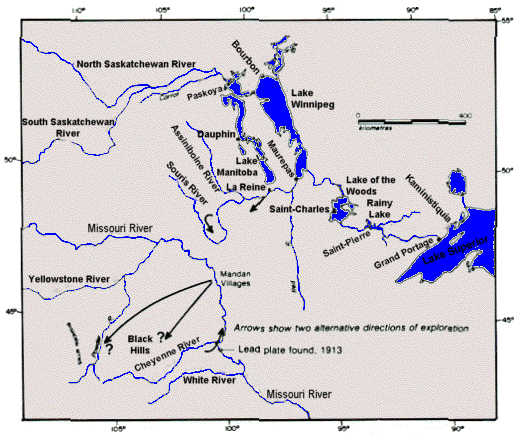
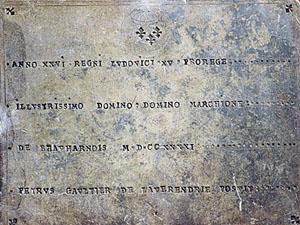
Illustrations Above:
Top left: Jean-Baptiste de La Vérendrye and his cousin, Christopher Dufrost de La Jemeraye
Middle: A map showing the area of operations of the La Verendrye family in the 1730s and 1740s
Bottom: “Verendrye Plate"
South Dakota State Historical Society
900 Governors Dr, Pierre, SD 57501
• A group of school children playing on the hill found the lead plate in 1913. The translation is as follows:
(Front):
”In the twenty-sixth year of the reign
of Louis XV, the most illustrious Lord,
the Lord Marquis of Beauharnois being Viceroy,
1741, Pierre Gaultier de La Verendrye placed this.”
(Back):
Placed by the Chevalier Verendrye
(his brother) Louis (and) La Londette and
A. Miotte. 30 March 1743.
|
|
• Pierre Gaultier de Varennes, sieur de La Vérendrye was a leading explorer for New France, and with his four sons he led many early exploratory expeditions into the northern plains of North America. By the 1730s, the Vérendryes had established several trading posts in what are now NorthDakota and Canada. Their expedition of 1742-43 sought to extend the range of influence further west, with an ultimate goal of reaching the Pacific Ocean. In this they were unsuccessful.
• In 1742 two of his sons (probably Louis-Joseph and François) made another expedition to the Missouri. Because of the difficulty of identifying places(...) they may have been the first European explorers to view the Rocky Mountains. This was more than 60 years before the expedition of Lewis and Clark.
• They are believed to have explored into present-day Montana and Wyoming, but there is significant scholarly debate about exactly which Native American peoples they encountered and where they went. They told the local Native Americans that the cairn they built over the site was a memorial of their passage, but in fact, it marked their claim of the territory for France
A marker explains the strategic importance of this expedition:
• Inscription:
“In the 1700s, England, France, and Spain all worked hard to colonize North America. The French king gave Quebec fur trader, Pierre Gaultier de Varennes, Sieur de La Verendrye, authorization to expand France's hold in the new world. The French moved west, and south out of Canada, establishing fur trading forts and claiming territory as they went.
In 1742, La Verendrye sent his sons Francois and Louis-Joseph on an expedition to find a route to the rumored “Sea of the West.” If it existed, a western water route would be invaluable to French trade. Members from the tribes guided them along their way. The Verendrye brothers camped nearby with a tribe along the Missouri River in March 1743. They buried a lead plate at this spot, claiming the region for France. They were the first Europeans documented to have entered the northern plains. They never did find a water route to the west.
Erected by The South Dakota State Historical Society; a Preserve America grant and the Dakota, Minnesota and Eastern Railroad Corporation.”
|
|
La Verendrye National Monument |
|
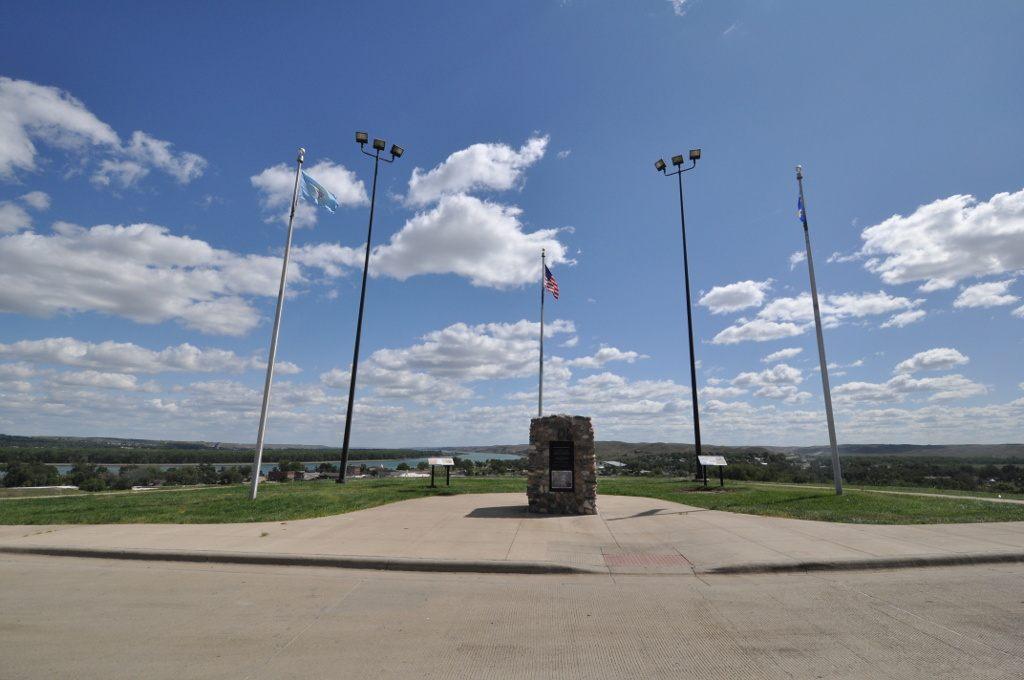
Photos: Verendrye National Monument, Verendrye Drive Fort Pierre, SD 57532
|
|
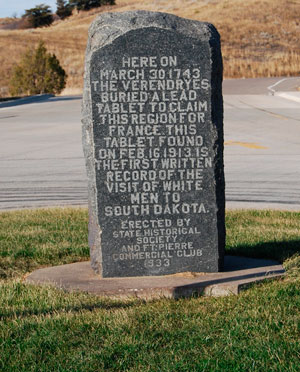
• Pierre Gaultier De La Verendrye and his sons explored the interior of North America in the 18th century. In 1742, Francois and Louis-Joseph Verendrye embarked on an expedition to find a water route to the Pacific Ocean. Though the Verendryes’ epic achievements were dismissed as a failure in their time because they found no Northwest Passage to the Pacific, this site documents their undisputed role in the French effort to achieve colonial dominance in North America. The Verendryes penetrated further into the heartland of North America than any previously known European explorers. They reached the area in South Dakota where Pierre and Fort Pierre are now located 61 years before Meriwether Lewis and William Clark first arrived in the area. At the end of March, 1743, after visiting with local Arikaras, they buried a lead plate at the site to lay the basis for French sovereignty on the upper Missouri.
• Inscription:
“Here on March 30, 1743 the Verendryes buried a lead tablet to claim this region for France. This tablet found on Feb. 16, 1913, is the first written record of the visit of white men to South Dakota. Erected 1933 by the South Dakota State Historical Society and the Fort Pierre Commercial Club"
• A plaque at the monument reads:
“Established June 29, 1917. To commemorate discovery of this area in 1742 by the Sons of Verendrye, celebrated French explorer. Crowhigh Mountain was used as an observation station to spy out unknown land farther west. In 1738 the elder Verendrye and one son made a trip to within a day's journey of the Missouri River, and were the first white men to enter what is now North Dakota. This was in the course of a journey from Verendrye's trading post in Manitoba, Canada, in an effort, which was unsuccessful, to reach the western sea by an overland route.”
Marker, Fort Saint Pierre:
• Inscription:
“The oldest continuous white settlement in the area of South Dakota.”
“First visited by Verendrye, who took over for France by planting a lead plate on March 31, 1743. A monument marks the spot. It is over the R.R. track first street to right, on hill to you left .6 miles.”
“Joseph LaFrombois started first fur post here in 1817 on west bank of Missouri just south of mouth of Bad river. Whites here since then.”
“Practically on same site, French Fur Co., Pierre D. Papin & Pascual Cerres had post Ft. Teton 1827 sold to Am. Fur Co., 1830. Bad River, then called Little Missouri was site where Father Hoecken on June 12-13, 1840 baptized 25 children, offspring of 13 traders and trappers, among them Dorion, Papin, Halsey, Campbell, Brazeau and Alleron.”
“All these things happened in limits of Ft. Pierre.”
Erected 1955 by R. S. Howe Co. and State Highway Commission.”
|
|
Other sites honoring La Vérendrye |
|
Illustration:
Mural “Pierre de La Verendrye”
Montana State Capitol, 1301 E 6th Ave, Helena, MT 59601
|
|
“Pierre de La Verendrye”
“Paxson depicts French-Canadian trader and explorer Pierre Gaultier de Varenne, Sieur de La Verendrye (1685–1749), who, in 1912, was believed to be the first white man to reach what is now Montana. More likely it was one of Verendrye’s sons who, in the company of an Indian war party on January 1, 1743, encountered mysterious “shining mountains,” possibly in the region of the Bighorn Mountains. Whatever the facts of the matter, Paxson distinguishes himself as the only Capitol artist to depict the early French presence in the Northwest.”
|
|
Other markers:
Marker “European Interest in the Missouri”
110 N Main St, Three Forks, MT 59752
• Inscription:
“Throughout the 16th and 17th centuries, England, France and Spain competed in the search for a water route across North America. Explorers such as DeSoto, La Salle and de la Verendrye believed that the Mississippi-Missouri was the fabled Northwest Passage to the wealthy Orient.
By 1760, the French had penetrated father up the Missouri that any other nation, but England emerged from the French and Indian Wars as the strongest power on the continent. With the birth of the United States in 1776, a fourth nation entered the contest for domination of the western lands. The power struggle continued for another 25 years, with the United States siding with one European nation, then another. In the end, the desire of France to limit England's power made possible the purchase of the western territory by the United States.”
|
|
Illustrations:
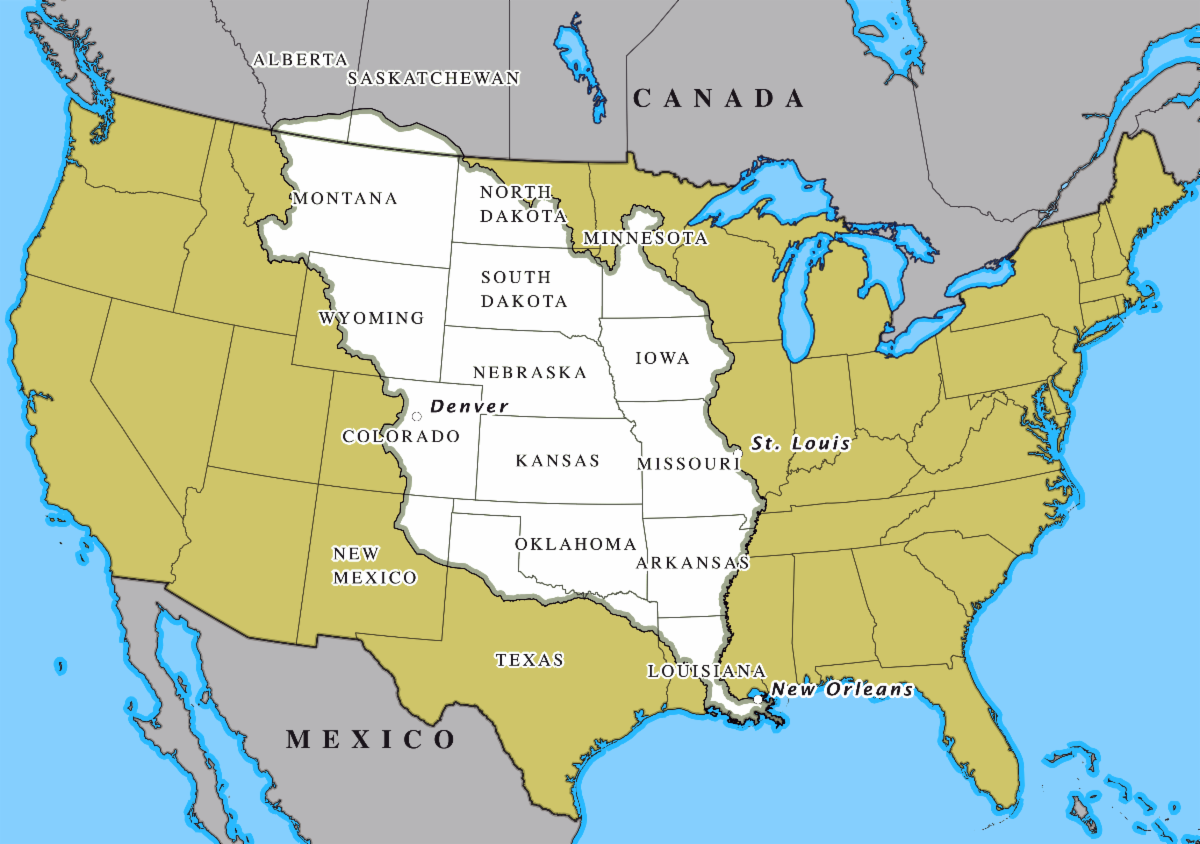
Top: Map: The Louisiana Purchase Projection = USA Contiguous Albers Equal Area Conic (EPSG:102003) Sources: Natural Earth and Portland State University
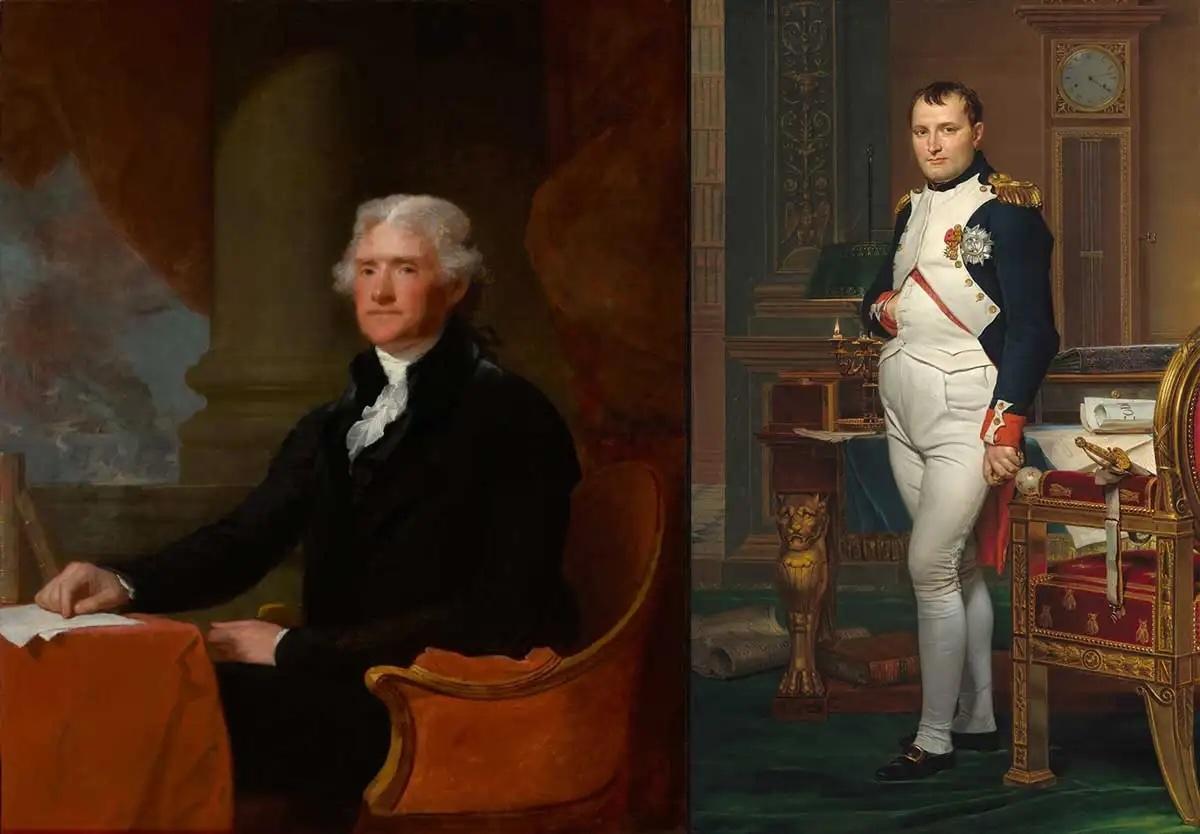
Middle: Portrait of Thomas Jefferson by Gilbert Stuart via the Bowdoin College Museum of Art; with Portrait of Emperor Napoleon Bonaparte by Jacques-Louis David, 1812, via the National Gallery of Art, Washington DC
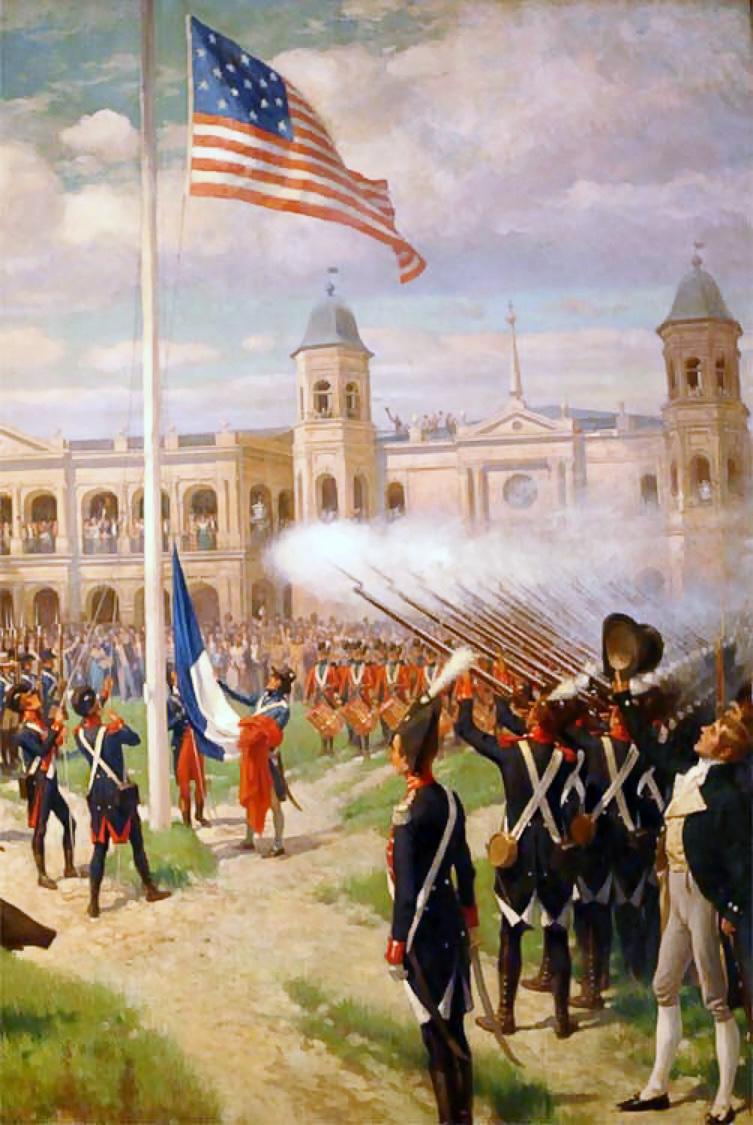
Bottom: Flag raising in the Place d'Armes of New Orleans, marking the transfer of sovereignty over French Louisiana to the United States, December 20, 1803, as depicted by Thure de Thulstrup
|
|
• The Kingdom of France had controlled the Louisiana territory from 1682 until it was ceded to Spain in 1762 as a sort of custody under a "Bourbon pact", following the loss of the Seven Years war and Canada. In 1800, Napoleon, then the First Consul of the French Republic, regained ownership of Louisiana in exchange for Tuscany. By 1803, he lost interest in establishing a North American empire and needed funds to fight the British. At the same time Prsident thomas Jefferson was seeking to acquire the crucial port of New Orleans. Instead, Napoléon Bonaparte directed his emissaries to offer not just New Orleans but all of the Louisiana Territory to the Americans.
• In this transaction with France, signed on April 30, 1803, the United States purchased 828,000 square miles of land west of the Mississippi River for $15 million. For roughly 4 cents an acre, the United States doubled its size, expanding the nation westward.
The Louisiana Purchase
Today part of the United States:
|
|
The Lewis & Clark Expedition
spoke French (in great part)
|
|
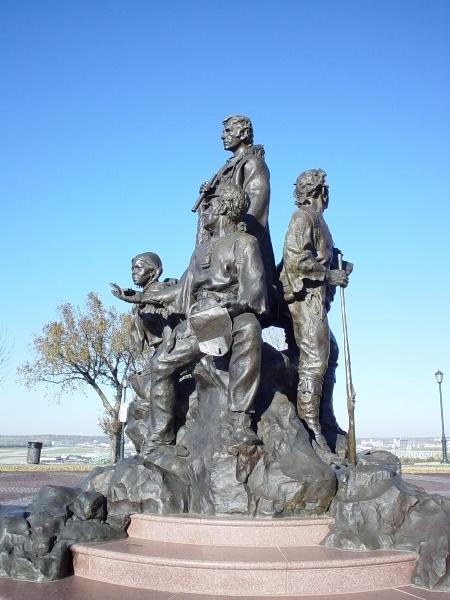
Statue & Marker « The Lewis & Clark Discovery Corps”
611 W 8th ST, Kansas City MO 64105
Created by sculptor Eugene Daub, “Corps of Discovery” features Lewis, Clark, York, and Sacagawea with her baby Jean Baptiste and Seaman (Lewis's Newfoundland dog).. Created of bronze and granite, it stands 21 feet tall and about 18 feet wide. It was dedicated in April 2000. Photo: http://lewisandclarktrail.com/
|
|
The Lewis & Clark expedition
• The Lewis and Clark Expedition, also referred to as the Corps of Discovery Expedition, was an important endeavor undertaken by the United States to explore the newly acquired western territory following the Louisiana Purchase. Led by Captain Meriwether Lewis and Second Lieutenant William Clark, the Corps of Discovery consisted of a select group of U.S. Army personnel and civilian volunteers. On May 14, 1804, Clark and 30 members departed from Camp Dubois in Illinois, while Lewis and ten others joined them in St. Charles, Missouri. From there, they embarked on a journey up the Missouri River.
• During their expedition, the group crossed the Continental Divide of the Americas near the Lemhi Pass, eventually reaching the Columbia River and the Pacific Ocean in 1805. The return voyage commenced on March 23, 1806, from Fort Clatsop in Oregon and concluded on September 23 of the same year.
• The expedition was commissioned by President Thomas Jefferson shortly after the Louisiana Purchase in 1803. Its primary objectives were to explore and map the newly acquired territory, find a practical route across the western part of the continent, and establish American presence in the region before European powers could make any claims. Additionally, the expedition had secondary goals of conducting scientific research on the area's flora, fauna, and geography, as well as establishing trade relations with local Native American tribes. Upon their return to St. Louis, the expedition members presented their findings to President Jefferson, providing him with maps, sketches, and journals documenting their discoveries.
• The ability to converse with native tribes was essential to the success of the mission. Hence the need to have French Canadians in the expedition. For a fascinating insight on the difficulty of conversing with so many different local languages, we cite this excerpt from "Corps of Discovery" by Glen F. Williams of the United States Army, Center of Military History:
"The ability to communicate in Indian languages was one of those absolutely crucial capabilities that Lewis and Clark had to acquire in order to accomplish the diplomatic component of their mission. One must recall that there is no single American Indian language. The native inhabitants of the Great Plains spoke many different languages and dialects. Even those from within the same “language group,” are not always mutually intelligible. Long before contact with Europeans, the various Indian nations on the plains developed a system of hand signs that could be mutually understood in order to communicate, negotiate peace, establish military alliances, and conduct trade with one another. What made the Captains’ task of finding sufficient interpreters even more complex was the fact that they did not know how many different Indian tribes of the various nations would be encountered along the route [...] Next to the ability to speak one or more Indian languages, proficiency in French was a decided advantage. French-Canadian traders and trappers had lived among various Indian tribes for decades, and the expedition was sure to encounter a number of them along the way"... (https://history.army.mil/LC/The%20People/interpreter.htm)
• Inscription on pedestal (Excerpts - side in English):
“The French-speaking community made a significant contribution to the ultimate success of the epochal Lewis & Clark expedition. The St. Louis Chouteau brothers, fur traders Auguste and Pierre, lodged the two captains in their substantial homes many times during the winter of 1803-04, and assisted in procuring supplies, boats, and personnel [...] French voyageurs had ventured up the Missouri for over a century before 1804.
French explorers, the Verendryes, reached an area two-thirds of the way along Lewis & Clark’s route in 1742 in present Montana, near the Rockies and the headwaters of the Missouri. Le Page du Pratz’s 1758 “Histoire de la Louisiane” (with map) was a useful resource. The Indians had told the French of the Rockies and the West, including the Great Salt lake, and of mountains and a river system leading west (part of which eventually became known as the Bitterroots, the Snake, and the Columbia) and the Chouteaus had access to French maps and memoires alluding to these features. President Jefferson even obtained a French passport for Lewis since the Louisiana Territory had been French until less than a year before.
Patron (captain) Baptiste Deschamps and his Gallic engages took supplies and personnel in the large “red pirogue” as far as the Mandan-Hidatsa villages in present North Dakota. A French-Shawnee interpreter, George Drouillard, also acted as chief hunter, arbiter of disputes, and enforcer of the two captains’ orders, and Lewis praised him highly in his reports.
Toussaint Charbonneau, another French-Indian interpreter, was occasionally a problem. But his young Indian wife, Sacagawea, procured from her brother, a Shoshoni chief, the indispensable horses to ride over the snow-covered mountains. Her little French-Shoshoni papoose, Jean Baptiste Charbonneau, was with her on the entire voyage and later lived at Kawsmouth as a youth.
A probable expedition veteran, Frenchman Pierre La Liberté, deeded the land for the first Catholic church (now Cathedral) in Kansas City in 1834. En route up the Missouri, the French boatmen recited the names given long before by their countrymen to features along the river. Near present Kansas City (French “Chez les Canses” or home of the Kansa) were: Pierre à Flêche, L’Eau d’Azur River, Charretin Creek, La Bénite Creek, Petite Riviere Platte, Remore Creek, and Isles des Parques. Above present Leavenworth they pointed out the remains of French Fort de Cavagnial (1744-64) and Isle au Vache (Cow Island), where the French had kept their livestock.”
|
|
Lewis & Clark's Corps of Discovery
List of participants of French descent:
Permanent:
US Military
Pierre Cruzatte, Private, boatman, fiddler, interpreter
Francois Labiche, Private, interpreter, hunter, boatman
Jean Baptiste Lepage, Private, hunter
Non-Military Members:
George Drouillard, interpreter, scout, hunter, trapper
Toussaint Charbonneau, interpreter, cook, Sacagawea’s husband
Sacagawea, wife, mother, interpreter, gatherer, occasional guide
Jean Baptiste Charbonneau (Pompy), toddler
“Engagés” (contract boatmen)
US Military
Jean-Baptiste Deschamps, Private, foreman of the French contract boatmen.
Charles Herbert, aka "Cadien", Private
Jean-Baptiste La Jeunesse, Private, boatman
Non-Military Members:
La Liberté, Private, boatman
Étienne Malboeuf, contract boatman. His sister was married to Jean Baptiste La Jeunesse.
Peter (Pierre) Pinaut
Paul Primeau, boatman
François Rivet, contract boatman
Peter (Pierre) Roi (or Roy) surviving records give little information.
Philippe Degie
Pierre Dorion, Sr. ("Old Dorion")
Pierre Dorion, Jr. ("Young Dorion")
Joseph Gravelines
|
|
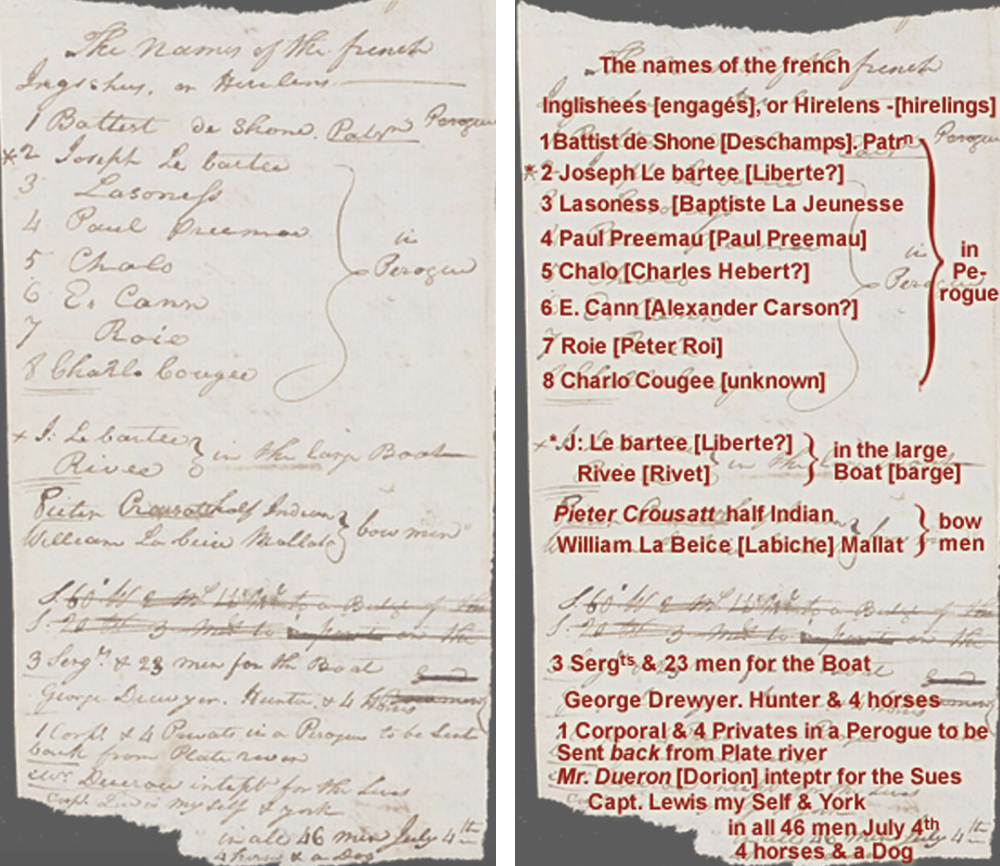
The names of the french
Inglishees [Engagés] or Hirelens [Hirelings]
in pirogue:
6 E. Cann [Alexander Carson?]
8 Charlo Cougee [unknown]
bow men:
William La Biece [Labiche] Mallat
3 Sergts & 23 men for the Boat
1 Corporal & 4 Privates in a Pirogue to be Sent Back from Plate river
Mr. Dueron [Dorion] interptr for the Sues
Capt. Lewis my Self & York
in all 46 men, July 4th
4 horses & a Dog
|
|
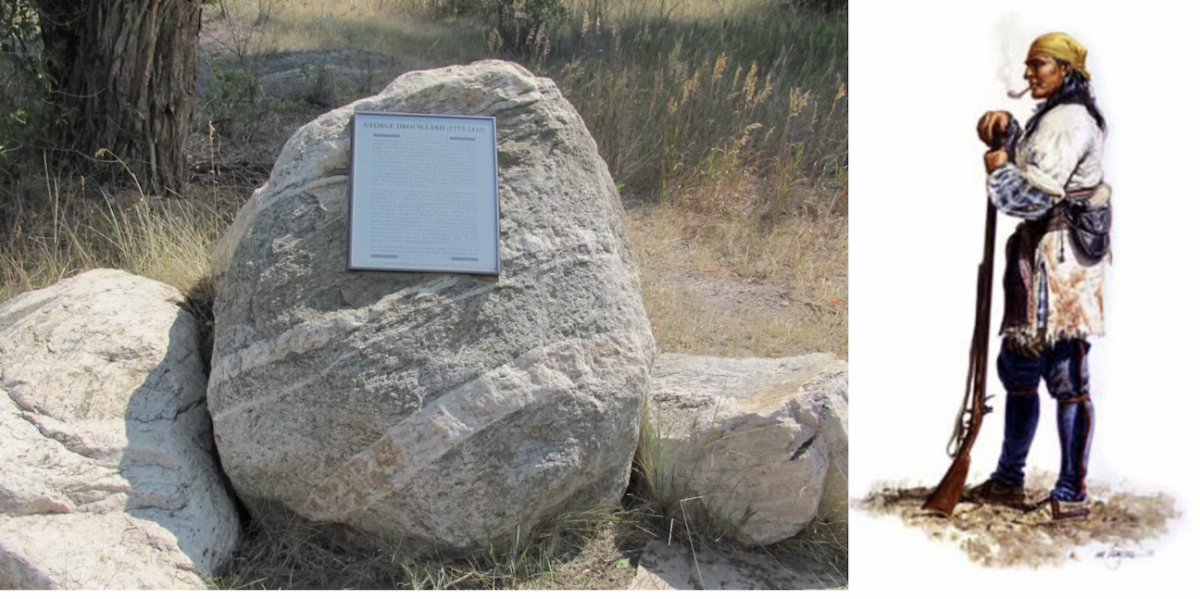
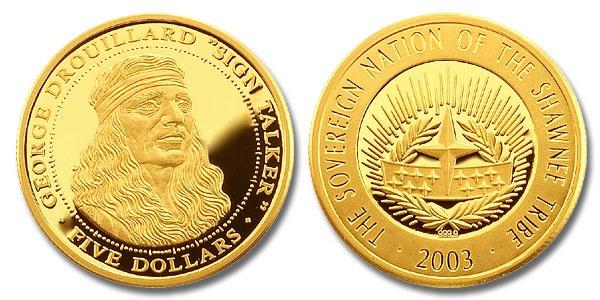
Top Left: Memorial Plaque, “George Drouillard (1773-1810)”
2928 Frontage Road, Three Forks MT 59752
This memorial plaque stands in the vicinity of where George Drouillard likely died near the banks of the Jefferson River, a few miles west of Three Forks, Montana.
Bottom: The 2003 Shawnee Nation Five Dollar gold coin commemorates George Drouillard
|
|
• Georges Drouillard, born around 1775 and died in 1810, played a crucial role as a member of the Corps of Discovery. With a French Canadian father and a Shawnee mother, Drouillard spent his formative years in Ohio and the Detroit area.
• Drouillard spoke French, Shawnee, English, and was an expert at sign language. He possessed exceptional hunting and tracking skills, earning him high praise from Lewis at the conclusion of their journey. As a civilian member of the Corps, he encountered Lewis and Clark in November at Fort Massac, situated along the lower Ohio River. At that time, he resided in Massac Village and the Cape Girardeau District of Missouri. The captains enlisted his services to locate and accompany a group of expedition recruits from South West Point, Tennessee, who had failed to reach Massac.
• On December 25, 1803, Drouillard officially joined the expedition as an interpreter and hunter.
• Throughout the expedition, he often found himself in the midst of perilous situations, including a confrontation with a band of Blackfeet Indians on July 26, 1806. Following the conclusion of the expedition, Drouillard remained in the Western region as a fur trapper.
• Unfortunately, he met his demise at the hands of the Blackfeet near the Three Forks of the Missouri in the spring of 1810. Drouillard's life has been the subject of a biography, various articles, and even a historical novel.
• Inscription:
“George Drouillard, the son of a Shawnee mother and French-Canadian father, was one of the most valued members of the Lewis and Clark Expedition. Meriwether Lewis noted in a letter to Secretary of War Henry Dearborn that Drouillard was "a man of much merit; he has been peculiarly useful from his knowledge of the common (sign) language of gesticulation, and his uncommon skill as a hunter and woodsman." Discharged from the Corps of Discovery in October, 1806, Drouillard partnered with St. Louis fur trader Manuel Lisa in 1807 to further trap and trade on the upper Missouri. Upon returning to St. Louis, Drouillard described his explorations of the Bighorn region to William Clark, then Superintendent of Indian Affairs, who added the new information to his map of the West.
Three year later in the employment of the St. Louis Missouri Fur Company, Drouillard found himself once more poised at the headwaters of the Missouri River. As the company men, under Pierre Menard, constructed a trading post between the Jefferson and Madison Rivers, the trappers drew constant attention from the Blackfeet who resented their presence. Chafing at the constrains the ever-present Blackfeet placed on the trappers Drouillard and a party of men from the post set out to trap the upper Jefferson. After two days of successful trapping on his own, Drouillard and two others left the main camp on the third day. When they did not return, a search party discovered the mutilated bodies of all three men less than three miles from camp. The physical evidence indicated that Drouillard "made a most obstinate resistance" before being overwhelmed.
George Drouillard, a "man of much merit," lies buried in an unmarked grave somewhere near the banks of Jefferson River.”
Erected by Montana Historical Society.
|
|
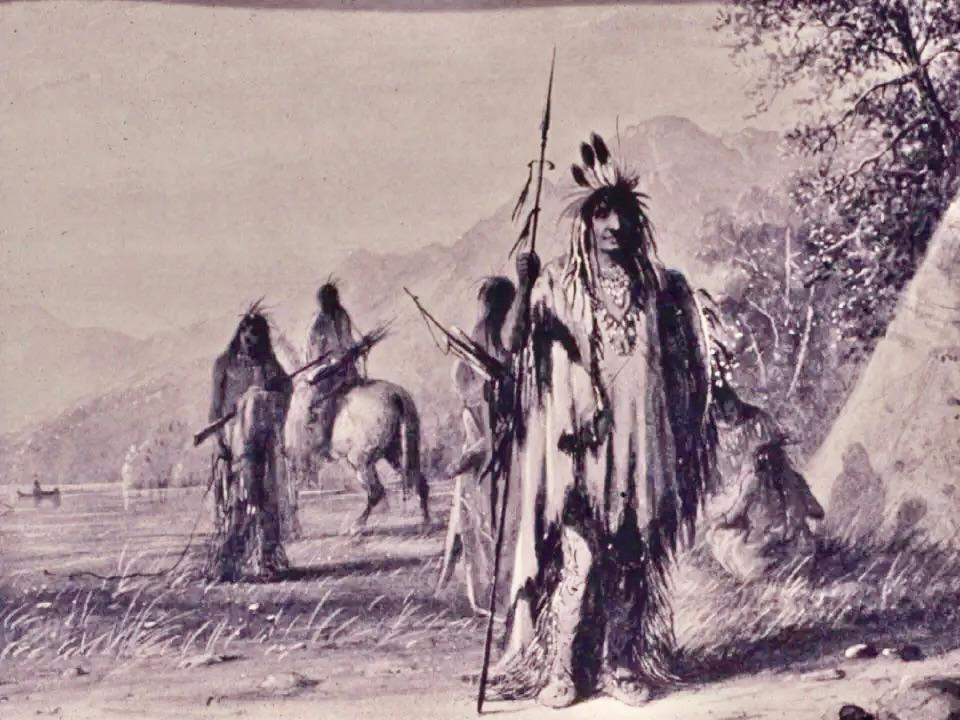
Illustration: Shoshone Camp. Jefferson National Expansion Memorial Digital Collection, https://www.nps.gov/articles/000/the-chain-of-communication.htm
Marker, “Survival”
7024 US-93, Sula, MT 59871
|
|
• Francois Labiche [uncertain] formerly Milhomme aka Milhomme dit Labuche, was a Metis of French and Omaha descent, born about 1775, died about 1836).
• Captains Meriwether Lewis and William Clark picked François Labiche in Kaskaskia, IL, because of his experience as a trader with the Indians. He was an invaluable link in the chain of communication with various tribes and in his great success as a hunter.
• Lewis was so impressed with his interpreter skills, he recommended him for a bonus. Later Labiche accompanied Lewis to Washington to interpret for the Native American chiefs who went to meet President Jefferson.
• In 1827, he signed a contract with Pierre Chouteau of St. Louis to serve as a “boatman, voyageur, and winterer” for the American Fur Company.
• Inscription (excerpts):
Five Languages
[...] “Because it was a language no one in the Expedition spoke, transactions between the two groups went through five translations. A Shoshone lad who lived with the Salish was able to translate to Sacajawea, who was also Shoshone, who passed the message to Charbonneau, her husband, in the Hidatsa language. Charbonneau translated to Labiche in French who then delivered the message to the captains in English.”
Erected by U.S. Forest Service, National Park Service, Montana Department of Transportation.”
|
|
Marker, « Through the Short Narrows”
Lyle, WA 98635
|
|
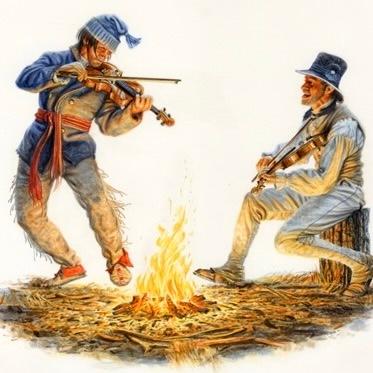
• Pierre Cruzatte (?-1825-28) special qualifications were that his father was French and his mother Omaha and he spoke both their languages along with English, he himself had been as far up the Missouri River as Nebraska around 1802, and he was a river pilot, a person skilled in “reading” rivers and selecting the best paths for boats to follow
• Pierre belonged to the Cruzatte family, who were among the initial settlers of St. Louis. His comrades referred to him as "the Old Frenchman", suggesting that he might have been significantly older than the other men in the group.
• He has great fiddle playing skills, which played a crucial role in fostering positive interactions with the indigenous people they came across. Consequently, the term "Fiddle diplomacy" was coined to describe this unique approach to diplomacy.
• Inscription (excerpts):
"Swelling, boiling & whorling in every direction"
The Lewis and Clark Expedition arrived here after shooting the rapids of the "Short Narrows." In that narrow section of the Columbia, the water squeezed through a channel of basalt that compressed the width of the river from 400 to 45 yards.
William Clark and his "principal waterman" Pierre Cruzatte, examined the tumultuous waters of the narrows. They decided to take their canoes through the passage - a risky plan. Clark wrote. "I deturmined to pass through this place notwithstanding the horrid appearance of this agitated gut Swelling, boiling & whorling in every direction (which from the top of the rock did not appear as bad as when I was in it.).” [...]
Private Pierre Cruzatte: Described as a small, wiry man, Pierre Cruzatte had one eye and was nearsighted. Despite these limitations, he was an excellent boatman and lead the Expedition's canoes through the rapids in this area. The violin was his passion, and he played regularly for the explorers and tribes. During the westbound journey, the Expedition named present-day Wind River after him, calling it "Cruzats River.”[...]
Erected by Lewis & Clark Expedition - Washington.
|
|
Private Jean-Baptiste Lepage |
|
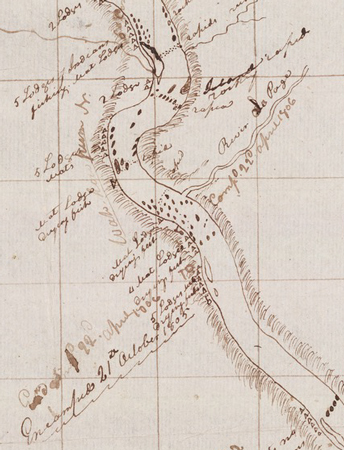
Above: Map, Beinecke Rare Book and Manuscript Library, Yale University, WA MSS 303.
As the party descended the Columbia River in 1805, they passed a small river, 40 yards wide on the south (present Oregon) side. On his map, Clark labeled it River La Page (located in the upper right corner of the figure). The river is the present John Day River.
Marker, « Encamped on the N. side”
Patit Rd, Dayton, WA 99328
|
|
• Jean-Baptiste Lepage, a French-Canadian trapper born on August 20, 1761 in Kaskaskia, Illinois (now present-day Illinois), possessed significant knowledge of the region prior to the expedition. He had resided among the Mandan people and had also ventured into the Black Hills of South Dakota and the Little Missouri River. As a result, Lepage likely became one of the earliest European-Americans to explore this particular area. The Captains were pleased to have someone with his expertise join their team.
• Inscription(excerpts):
"The Lewis and Clark Expedition camped in the small valley below this viewpoint on May 2, 1806. The Expedition included thirty-three people from diverse backgrounds and cultures. Known as the Corps of Volunteers for Northwestern Discovery, each person had important responsibilities and duties.[...]
(The list of members of the Corps appears in three columns, one for each of the three messes organized by Captains Meriwether Lewis and William Clark.) [...] Erected by Lewis & Clark Expedition - Washington"
|
|
The Charbonneau Family:
Toussaint, his wife Sacagawea, and their son Jean-Baptiste
|
|
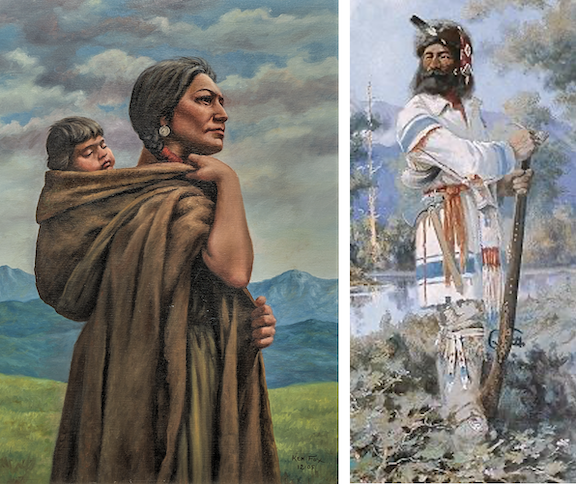
Illustrations:
Portrait of Sacagawea at the National Mississippi River Museum & Aquarium
|
|
• Toussaint Charbonneau, born on March 20, 1767, and passing away on August 12, 1843, was a French Canadian explorer, fur trapper, and merchant renowned for his involvement in the Lewis and Clark Expedition as the spouse of Sacagawea.
• During the late 1790s, Charbonneau transitioned into a fur trader who resided among the Hidatsa and Mandan indigenous communities. While living among the Hidatsa, Charbonneau acquired a Shoshone girl named Sacagawea (Bird Woman) through purchase or as a prize. The Hidatsa had taken Sacagawea during one of their customary raiding and hunting excursions to the west.
• Sacagawea's decision to accompany Charbonneau may have been influenced by limited options or a preference for her new circumstances. Upon marrying Sacagawea in 1804, Charbonneau was already wed to Otter Woman, another Shoshone woman. Charbonneau eventually recognized both women as his wives, although the nature of their union, whether by Native American tradition or common-law marriage, remains uncertain. By the summer of 1804, Sacagawea was expecting their first child.
• In November 1804, Lewis and Clark invited Charbonneau to join the expedition as an interpreter. While Charbonneau was proficient in French and some Hidatsa, and didn't speak English fluently, Lewis and Clark were particularly interested in having two Shoshone women accompany them. With Charbonneau, Sacagawea, and Otter Woman contributing their linguistic abilities, the expedition gained proficiency in Hidatsa and Shoshone.
• Charbonneau's negotiation skills proved valuable when the expedition obtained much-needed horses at the Shoshone camp. Charbonneau and his family remained with the Lewis and Clark expedition until August 1806, receiving a payment of $500.33, a horse, and a lodge for their nineteen-month service. Additionally, William Clark penned a farewell letter to Charbonneau, expressing a desire for continued interaction.
• Although the exact date of Charbonneau's demise is uncertain, it is believed that he passed away in 1843, as evidenced by Jean-Baptiste settling his father's estate that year. It is widely acknowledged that Charbonneau was laid to rest in Fort Mandan, North Dakota.
|
|
Sacajawea and her son Jean-Baptiste ("Pomp") |
|
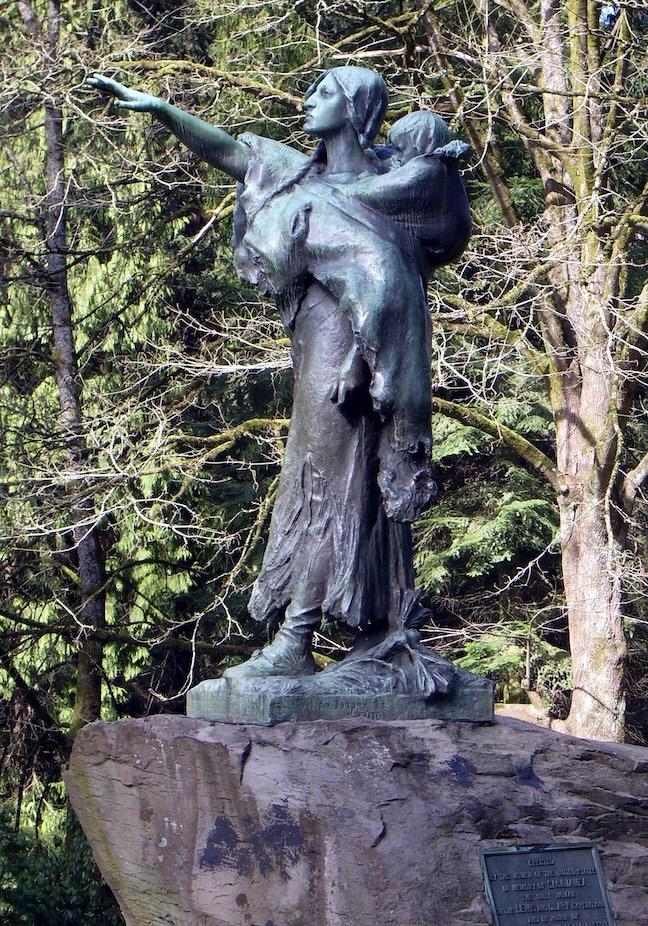
Above: Statue, Jean-Baptiste Charbonneau and his mother Sacajawea
2600 SW Lewis Clark Way, Portland, OR 97205
Statue of Sacajawea in Washington Park, viewed from the south. It was sculpted by Alice Cooper from Denver, Colorado and unveiled in 1905 at the Lewis & Clark Centennial Exposition. It depicts Sacajawea pointing the way westward.
|
|
• Sacajawea, also known as Sakakawea or Sacagawea, (May c. 1788 – December 20, 1812, or April 9, 1884) was Toussaint Charbonneau's wife. A Lemhi Shoshone woman, Sacagawea and several other children were taken captive by a group of Hidatsa. Toussaint bought her and married her. She accompanied her husband in the expedition.
• On November 4, 1804, Clark recorded in his journal:
" [A] french man by Name Chabonah, who Speaks the Big Belley language visit us, he wished to hire & informed us his 2 Squars (squaws) were Snake Indians, we engau (engaged) him to go on with us and take one of his wives to interpret the Snake language..."
• Clark later nicknamed her "Janey". Lewis recorded the birth of her baby boy Jean Baptiste Charbonneau on February 11, 1805. Having a woman and infant demonstrated the peaceful intent of the expedition.
• On the 14th of May in 1805, Sacagawea demonstrated her bravery by retrieving various items that had been lost from a boat that had overturned. These items included the valuable journals and records of Lewis and Clark. Recognizing her swift response, the commanders of the expedition decided to honor her by naming a river after her, the Sacagawea River.
• In August 1805, the corps encountered a Shoshone tribe and sought to negotiate for horses in order to cross the challenging Rocky Mountains. Sacagawea played a crucial role as an interpreter during these negotiations and it was during this time that they discovered that the leader of the tribe, Cameahwait, was actually... her own brother!
• After giving birth to a daughter, Lizette, historical documents suggest that Sacagawea died in 1812 of an unknown sickness.
• The National American Woman Suffrage Association embraced Sacagawea in the early 1900's as an emblem of women's value and autonomy. In honor of her achievements, numerous statues and plaques were erected.
Jean-Baptiste Charbonneau (February 11, 1805 – May 16, 1866), son of Sacajawea and Toussaint Charbonneau, was born in North Dakota and was nicknamed by Clark “Pomp”.
• As a baby, he was carried on the back of his mother during the Lewis & Clark expedition to the Pacific Ocean and back, and his presence reassured the Native tribes of the expeditions’ peaceful intentions
• After the expedition, he lived with Clark in St. Louis, Missouri as a boy, where he attended St. Louis Academy. Clark paid for his education.
• He spoke French and English and learned German and Spanish during his six years in Europe from 1823 to 1829. He spoke Shoshone and other western Native American languages, which he picked up during his years of trapping and guiding.
• He lived a remarkable life of adventures in the West, as a fur trader, fighting during the Mexican-American War, alcalde (mayor) of Mission San Luis Rey de Francia, a gold digger in Oregon, and hotel operator in Northern California, where he died at the age of 61 of pneumonia.
|
|
City & Lake “Coeur d’Alène”
“Nez Percé” National Historical Park
State of Idaho
|
|
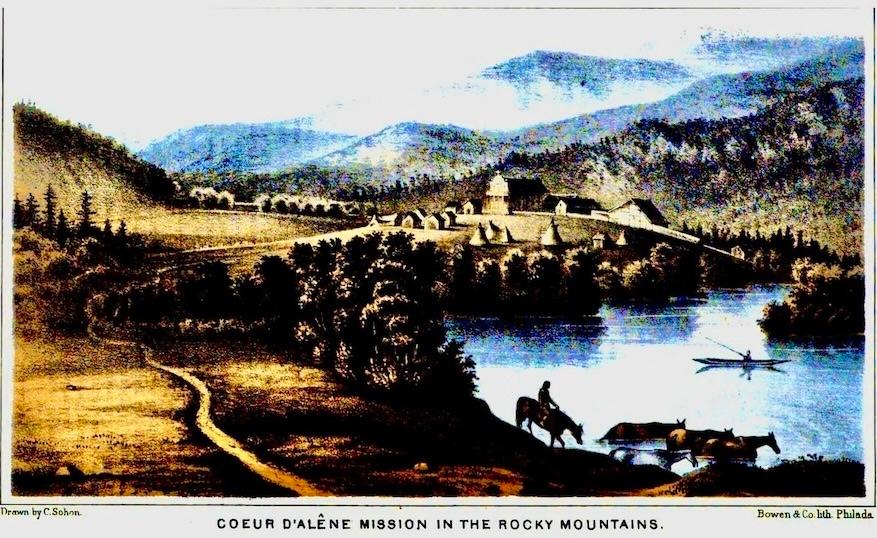
Coeur d'Alene Mission of the Sacred Heart on Lake Coeur d'Alene in Idaho, United States, about 1855. Gustavus Sohon, artist. Located where the Coeur d'Alene River enters into Lake Coeur d'Alene, the mission was established in 1843 by the Roman Catholic Church as a Christian missionary outpost
|
|
• Coeur d’Alene is a city and the county seat of Kootenai County, Idaho, and also a satellite city of Spokane in Oregon, a few miles west. It is named after the Coeur d'Alene people, a federally recognized tribe of Native Americans who lived along the rivers and lakes of the region.
• The French name Cœur d'Alêne translates to "heart of an awl". The name is first recorded by the Lewis and Clark Expedition (1805) when interpreters Sakagawea and her husband Toussaint Charbonneau first met the tribe. It was later popularly said to have been given by French traders to one of the chiefs of the tribe noted for his stinginess, or meaning the tribal traders had hearts as sharp as the tip of an awl - or that they were sharp businessmen.
• The Coeur d'Alene (also Skitswish; natively Schi̲tsu'umsh) are a Native American nation and one of five federally recognized tribes in the state of Idaho.
• The Coeur d'Alene have sovereign control of their Coeur d'Alene Reservation, which includes a significant portion of Lake Coeur d'Alene and its submerged lands.
• French explorers and trappers indiscriminately used and popularized the name "NezPercé" for the Nimíipuu and nearby Chinook. The name translates as "pierced nose", but only the Chinook used that form of body modification. As a federally recognized tribe, the Nez Perce Tribe govern their Native reservation in Idaho.
|
|
Sacajawea Park, Linvingston, Montana |
|
Marker, Sacajawea Park, Livingston MT 59047
|
|
• Inscription:
“Sacajawea and her son traveled with Captain William Clark down the Yellowstone River passing through this area on July 15, 1806. Sacajawea was a Shoshone teenager whose knowledge of native tribes, languages, and geographical landmarks of the area proved invaluable to the Corps of Discovery.
She was the wife of Toussaint Charbonneau, a French interpreter who offered his services to Lewis and Clark at Fort Mandan (in present-day North Dakota) on their westward journey.
She gave birth to a son, Jean Baptiste, at Fort Mandan and took him with here to the Pacific Ocean and back. Sacajawea assisted the Corps of Discovery in trading for horses with the Lemhi Shoshoni tribe.
Erected by Lewis and Clark National Historic Trail, National Park Service.”
|
|
Mural, “Sacajawea on the Yellowstone”
Montana State Capitol, 1301 E 6th Ave, Helena, MT 59601
"Lewis and Clark at Three Forks" by Edgar S. Paxson, oil on canvas, 1912, 81" x 153"
(Photo by Don Beatty)
|
|
• Mural at Montana State Capitol:
“Lewis and Clark at Three Forks”
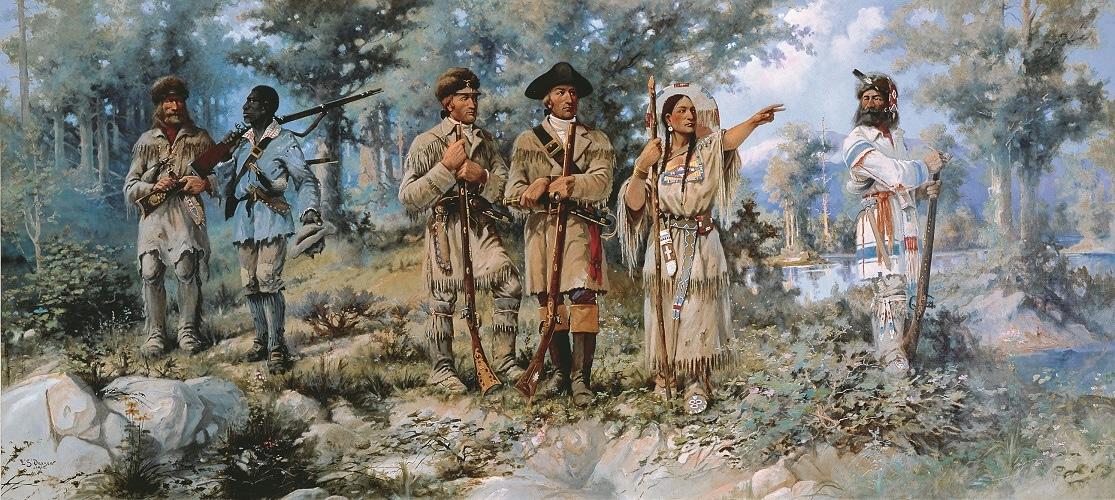
“Two great moments converged for the Lewis and Clark Expedition in late July 1805: their arrival at the Three Forks that made up the headwaters of the Missouri River and Sacagawea’s recognition of her people’s hunting grounds from which she had been abducted five years earlier. The stream in the right mid-ground represents the importance of the geographical discovery. Sacagawea’s bold signal expresses the encouraging probability that her people would soon be found. Sacagawea’s pointing motion, although dramatically satisfying, was not a gesture that either the Hidatsa (her captors) or the Shoshone (her people) would have made. Clark (at left) and Lewis flank Sacagawea; to the right is her husband, French interpreter Toussaint Charbonneau. At the far left are explorer John Colter and Clarkd’s African American slave, York.”
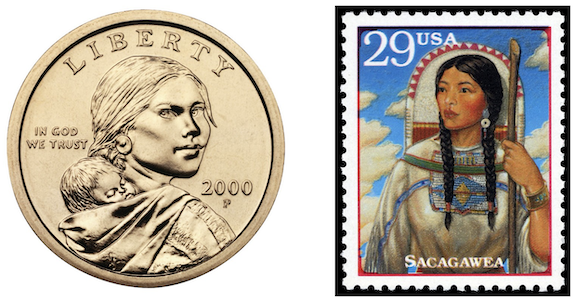
Charbonneau and his mother Sacagawea appear on the United States Sacagawea dollar coin. Pompeys Pillar on the Yellowstone River in Montana and the community of Charbonneau, Oregon are named for him.
|
|
Above: Sacagawea Golden Dollar Coin and USPS stamp
(issued 2000-2008), United States Mint
The Sacagawea stamp was issued in 1994.
|
|
Pierre Dorion Sr.
Pierre Dorion Jr. and his wife Marie Dorion
|
|
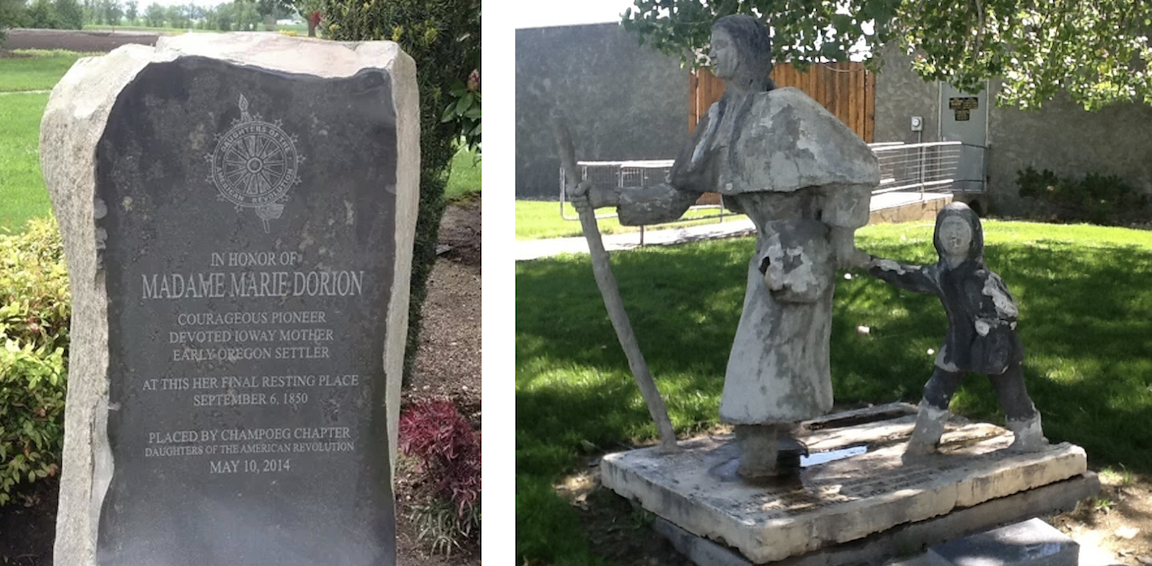
Photos:
Left: monument at Saint Louis Church, 14013 Manning Rd NE, Woodburn, OR 97071
Right: statue of Marie Dorion and child
Old Fort Boise, 109 Parma Rd, Parma, ID 83660
• Inscription at the base of statue:
“In mid-winter 1814 Marie Dorion
fled from near Parma to Walla Walla
500 miles, one of the greatest feats
of endurance ever known”
|
|
Pierre Dorion, Sr. (Old Dorion) and his son Pierre, Jr. (Young Dorion) were both utilized by Lewis and Clark as interpreters during their journey up to the Sioux nation.
• Pierre Dorion, Sr. resided in Cahokia in 1780 before moving to live among the Yankton Sioux, where he eventually married a Sioux woman. Dorion had previously lived with the Yankton Sioux for twenty years, and he proved to be a gifted interpreter and knowledgeable diplomat. Lewis & Clark commissioned Dorion: “to act with a flag & some Cloathes & Provisions & instructions to bring about a peace with the Scioux Mahars, Panies, Ponceries, Ottoes & Missouries— and to employ any trader to take Some of the Cheifs of each or as many of those nations as he Could Perticularly the Sceiouex.”
• Pierre Dorion Jr. spent much of his early life among the Yankton people and accompanied his father in a part of the Lewis & Clark expedition.
By the winter of 1810-1811, Dorion Jr. had married Marie, a French-Yankton woman and was the sole proficient speaker of the Sioux languages in St. Louis, making him a valuable asset for fur traders.
W. Prince Hunt of the Pacific Fur Company managed to enlist Dorion Jr. for an expedition to the Pacific shores, and accepted that Marie and their two children accompany him. Despite facing numerous challenges, the overland expedition successfully reached Fort Astoria in present-day Oregon in 1812.
Tragically, in early 1814, Dorion and six other trappers were killed by a group of either Northern Shoshone or Bannocks. Following this, his wife Marie and their two children embarked on a remarkable journey back to the safety of Pacific Fur Company posts.
• Marie Aioe Dorion, later known as Madame Marie Dorion Venier Toupin (approximately 1786 – September 5, 1850) was also an interpreter. Like her first husband Pierre Dorion Jr., she belonged to the Métis community. Her lineage comprised of an Iowa mother and a father of French Canadian descent. After Pierre Jr.'s death she remarried twice, all with French Canadian husbands. She was also recognized as Marie Laguivoise, a name documented in 1841 at the Willamette Mission, which seemingly derived from Aiaouez, later known as Iowa. When news reached her of Pierre's tragic death, she managed to successfully escape and made her way towards the west accompanied only by her two children. Their arduous journey involved traversing frigid rivers, navigating snowy expanses, and scaling treacherous canyons. With immense courage and unwavering resilience, they were ultimately rescued by benevolent Walla Walla Indians.
Marie Dorion died in 1850 and is buried at French Prairie, Oregon.
Marker, “Pierre Dorion, Sr."
W Riverside Dr, Yankton, SD 57078
• Inscription:
“West of this stone near the crest of the hill is the burial site of Pierre Dorion, Sr., an early trader in what is now South Dakota. Born in Canada in 1740, Pierre came to this area around 1774–1775 to trade with the Sioux. He married Holy Rainbow, the daughter of a Yankton Sioux chief. While delivering a boatload of hides and tallow to St. Louis, Pierre met the Corps of Discovery on June 12th, 1804 on their trek upriver and was hired as their interpreter.
On August 29th & 30th, Pierre translated the Sioux language for Captains Lewis and Clark while in grand council below Calumet Bluff near Gavins Point Dam. Pierre was then hired by Lewis and Clark to take a delegation of Yankton Sioux to Washington D.C. to meet President Thomas Jefferson in 1805. Pierre died in 1810.”
Memorial, «Madame Marie L’Aguivoise Dorion”
Madame Dorion Memorial Park, Burbank, WA 99323
• Inscription:
Madame Marie L'Aguivoise Dorion (1786-1850)
"Madame Dorion of the Iowa tribe was the second woman to come west on an overland route. She made the Journey with her husband, Pierre and two young sons. They were part of the Wilson Price Hunt party employed by the Pacific Fur Comany. The Hunt party was part of American John Jacob Astor's attempt to establish a fur trading empire in the Pacific Northwest. Her husband was an experienced guide that had earlier traveled west with the Lewis and Clark expedition. The trip was especially arduous for Marie. She was at that time expecting her third child and caring for her sons, Baptise, age 5 and Paul, age 3.The party left the Missouri territory in 1811 to establish trading posts along the Columbia River. After enduring cold, starvation and perilous whitewater river crossings the party arrived near this location on January 21, 1812. The Pacific Fur Company later established Fort Nez Perces along the Walla Walla and Columbia Rivers just west of this location. They eventually reached Fort Astoria for a long deserved rest. The Dorion family and a party of trappers later set out for the Snake River country in the winter of 1813 on a fur trapping expedition. Here Snake warriors attacked the party. All the men were killed, leaving Marie Dorion and her two young children to live out the winter hiding in the Blue Mountains, near present day Hilgard, Oregon. Marie managed to keep her family alive and they endured the cruel hardships of cold and starvation. Marie then led her family to safety in the spring. Marie Dorion later remarried and lived in Walla Walla, Washington and later in the Willamette Valley of Oregon. She died on September 5, 1850 at the age of 64. Even in death she was revered by those who knew her. She was buried in a place of honor at the parish of St. Louis Catholic Church in the Willamette Valley. She had died as she had lived, a brave and noble pioneer esteemed by all who knew her."
|
|
END OF PART ONE OF OUR SERIES
Long before the celebrated Lewis & Clark expedition, several French explorers had ventured far into the West, trying to find this direct route to China, claiming land for the King of France. Although they are duly recognized at many sites (some of them rediscovered at the beginning of the 20th Century) with markers, statues and monuments, they are mostly forgotten or barely mentioned in school textbooks, in the United States and in France as well.
They had lived for generations with the local Indian tribes, trading with them, mixing blood lines. That was before the "Conquest of the West " and the forced relocation of so many native tribes.
Yet, French pioneers were actually among the first cohorts of immigrants, and this will be the topic of our next series.
|
|
Tribute to Lt. Frank Leaman Baylies
Lafayette Flying Corps
"Died for France"
on June 16, 1918, at Arvillers (Somme)
|
|
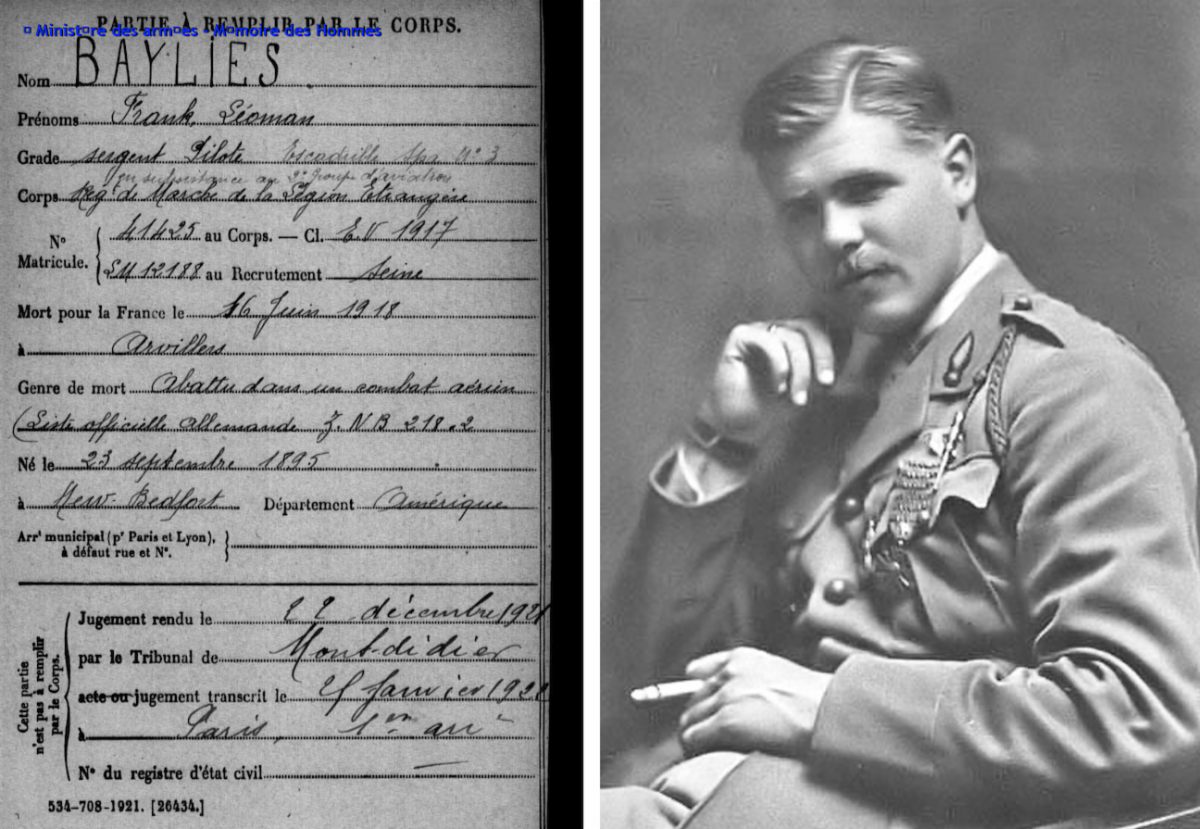
Left: Page from Lt. Baylies' "Livret Militaire". Buried at Escadrille Lafayette Monument, Marnes-la-Coquette, France.
|
|
We continue our series started this past October with tributes to members of the Escadrille Lafayette, later part of the Lafayette Flying Corps. For access to our Bulletin dedicated to the Escadrille Lafayette, please click on:
This month, we pay hommage to Lt. Frank Leaman Baylies, who "Died for France" while serving in World War One.
Lieutenant Frank Leaman Baylies, born on September 23, 1895, in New Bedford, Massachusetts, was an American World War I flying ace who achieved twelve aerial victories while serving in the French Aeronautique Militaire. Initially, Baylies volunteered for the Ambulance Corps in May 1916 and served on the Western Front, as well as in Serbia and Salonika. His bravery and dedication were recognized when he was awarded the Croix de Guerre in March 1917 for his efforts in evacuating the wounded amidst enemy fire.
Baylies' journey into aviation began after he had the opportunity to take a joy ride with a French aviator. Inspired by the experience, he volunteered for aviation training. However, due to his substandard vision, he was rejected by the American air service. Undeterred, Baylies joined the French aviation service in May 1917, where he discovered his natural talent for piloting.
Initially assigned to Escadrille 73 as a Corporal on November 17, 1917, Baylies became the 13th member of the squadron and was assigned airplane number 13. Despite the superstitions surrounding this number, Baylies remained undeterred and focused on his mission. A month later, he was reassigned to Escadrille 3 as a Spad pilot.
From February 19, 1918, to May 31, 1918, Baylies achieved a remarkable twelve victories, two of which were shared with André Dubonnet. His success in combat did not come without challenges. He was shot down on March 28. However, Baylies demonstrated his resourcefulness and determination by rescuing the altimeter and watch from the wreckage and successfully outrunning a detachment of German infantry to reach the safety of the nearby French trenches.
On 13 May Baylies was transferred to the United States Air Service and commissioned as a Second Lieutenant. He declined a Captain's commission so he could remain on detached service with SPA 3 as a fighting aviator and not a Flight Leader in an American Aero Squadron. He thus remained with the French, until his death in action on June 16, 1918 while engaging Fokker Triplanes from Jasta 19. Mistaking the Fokkers for British Sopwiths, Baylies and his wingmen attempted to join their formation, only realizing their error at the last moment. Despite his efforts to evade, Baylies was shot down by the fourth Fokker that targeted him. One wingman, André Dubonnet, was also downed but survived, while François Macari narrowly escaped.
Lieutenant Frank Leaman Baylies will always be remembered for his exceptional bravery and skill as a flying ace during World War I.
He received the French Legion of Honor, Croix de Guerre with 6 Palms and a Star, the Medaille Militaire, and the Aero Club of America Medal.
First buried at Le Rollet near Compiègne, his body was exhumed in 1927 and brought to its present resting place of honor at the Lafayette Escadrille Memorial, Marnes-la-Coquette, France.
|
|
ANNOUNCEMENTS AND SAVE THE DATES |
|
Our Hermione Fund raising appeal continues!
|
|
• In November, our Society kicked-off the US Fund raising campaign to help Save the Hermione and have it sail back in time for the United States Semiquicentennial. This is an ongoing campaign and all donations are tax-deductible.
|
|
"Merci Train" 75th Anniversary Celebrations |
|
• Our November 2022 Bulletin narrated the incredible story and ongoing legacy of the "Train de la Reconnaissance Française", affectionately called "The Merci Train" (November 2022: "The Merci Train, 49 boxcars of French gifts"
• 2024 is the 75th anniversary of the "Merci Train", a gesture of friendship and gratitude from the French people to Americans who gave 49 boxcars full of gifts for each State in 1949.
• The Merci Train, the 40&8 National Box Car Association and many other local organizations, custodians of the various "Merci train" boxcars in several States are planning celebrations throughout the year. We are honored to help get the word out.
• The Historic Museum of Holly Hill is planning with our Society, represented by Brigitte van den Hove-Smith, Déléguée Générale Adjointe, South East USA a special commemoration in Holly Hill, Daytona Beach, FL at the Florida boxcar on November 11 at 11:00AM, with the French General Consulate in Miami. Stay tuned for more details!
• Another "Save the Date": February 2, 2025 for the re-dedication of the Hawai'i boxcar, currently being restored thanks to Mr. Jeff Livingston, Historian, 40 & 8 Project Manager, Hawaiian Railway Society, and volunteers, as well as the enthusiastic support of the Aloha Chapter, NSDAR, of the Daughters of the American Revolution, Laura Ingenluyff, State Vice-Regent, Hawai'i NSDAR. See the photos below that we just received, showing the incredible efforts that are being deployed to save this historical artifact.
Our Society applauds the dedication and efforts of the American Legion and all the patriotic associations all over the United States who are the custodians of these boxcars. Their preservation work and dedication are admirable.
|
|
Photos © 2022 & 2024 courtesy of Jeff Livingston, 40&8 Society - Beverly Burden, NSDAR |
|
If you don't have one of these posters and the Merci Train posters, please contact National Box Car Association Secretaire Virgil Blum via email. You can find his contact information at the Forty & Eight website: https://www.fortyandeight.org/box-car/
Funds raised help support the National Box Car Association and their programs!
|
|
The Revolutionary War Conference 250 in the Mohawk Valley is Back and Registration is Open!
Conference & Bus Tour
June 14-16, 2024
Pre-registration is Required for the Conference Loaded with the Top Historians regarding the American War for Independence and One-of-a-Kind Bus Tour of Revolutionary Schenectady and Johnstown!
Registration:
Conference 250 Speakers:
- Fireside Chat - James Kirby Martin with guest host Mark Edward Lender - Professor and Student Discuss the American Revolutionary War, the Upcoming 250th Anniversary and Their Legacies
- Nancy Bradeen Spannaus - Alexander Hamilton's War for American Economic Independence Through Two Documents: The Full Vindication of the Measures of Congress (Dec. 15, 1774) and The Farmer Refuted (Feb. 23, 1775) (Supported by the Alexander Hamilton Awareness Society)
- Gary Ecelbarger - "This Happy Opportunity": George Washington and the Battle of Germantown
- Shirley L. Green - Revolutionary Blacks: Discovering the Frank Brothers, Freeborn Men of Color, Soldiers of Independence
- Mark Edward Lender - "Liberty or Death!" - Some Revolutionary Statistics and Existential Warfare
- Shawn David McGhee - No Longer Subjects of the British King: The Political Transformation of Royal Subjects to Republican Citizens, 1774-1776
- James Kirby Martin - The Marquis de Lafayette Visits the Mohawk Valley, Again and Again
- Kristofer Ray - The Cherokees, the Six Nations and Indian Diplomacy circa 1763-1776
- Matthew E. Reardon - The Traitor's Homecoming, Benedict Arnold's Raid on New London, September 4-13, 1781
- John L. Smith - The Unexpected Abigail Adams: A Woman “Not Apt to Be Intimidated” (Supported by the Dr. Joseph Warren Foundation)
- Glenn F. Williams - No Other Motive Than the True Interest of This Country: Dunmore's War 1774
- Mohawk Valley Resident Historian - Chris Leonard (Schenectady City Historian) - Storehouse Schenectady: Depot and Transportation Center for the Northern War
- David Moyer - Recent Archaeology Discoveries on the Site of Revolutionary War Fort Plain
Bus Tour - 1774: The Rising Tide (About 20 seats left)
In 1774, the politics of the Revolution had arrived in the Mohawk Valley with a vengeance. At the eastern end of the Mohawk another violent Liberty Pole riot was having a detrimental effect on the local citizens of Schenectady. Meanwhile further west along the Mohawk River, in Johnstown, events took a turn when Sir William Johnson passed away in July, thus starting a new chapter in political unrest.
The Bus Tour will include several stops in both Schenectady and Johnstown, such as the Schenectady Stockade, Johnson Hall (Sir William Johnson Lays in Rest) and more. Lunch is included and will consist of a sit-down buffet with many options. This is a rain or shine tour, please dress for the weather and wear shoes for walking. A tour booklet will be provided.
Conference Location: The Fulton-Montgomery Community College's Theater - The Visual Arts & Communications Building (Campus Map Building #2) - 2805 NY-67, Johnstown, NY 12095 - Please Park in Lots 5, 4 or Visitor's Lot - Please Click Here - FMCC Campus Map
Thank you for Supporting the Fort Plain Museum & Historical Park, a 501(c)3 nonprofit organization!
389 Canal Street
Fort Plain, NY 13339
Hours of Operation
Open Saturdays through April
10 AM to 4 PM
|
|
80th anniversary of D-Day - events in preparation |
|
There will be countless official ceremonies celebrating the 80th Anniversary of D-Day on June 6, 2024, at the beaches of Normandy, in Paris, and at commemorations with the participation of French Consulates throughout America.
• We are proud to announce that our First Vice-President, Patrick du Tertre, who is also co-Founder of TheFrenchWillNeverForget.org, along with Paul Bensabat, Jean-Pierre Heim, and Christian Millet (in memoriam), are planning a momentous celebration in Paris, with 1,944 schoolchildren waving American and French flags at the foot of the replica of the Statue of Liberty, Pont de Grenelle, with the Eiffel Tower in the background.
One goal is to create a video clip and an emblematic photo to be distributed widely and especially in the United States. TheFrenchWillNeverForget (TFWNF) welcomes any idea and participation around the concept and started collecting funds to support this event. TFWNF is a 501c3 not for profit association and your donation is fully deductible. Any amount will help, and you will be recognized officially in the donors list. You can mail checks written to The French Will Never Forget to Patrick du Tertre PO Box 375 Bethel CT 06801. For companies there are 4 levels of sponsorship available, You can contact Patrick directly at patrick@dutertre.com
This event is supported by Le Souvenir Français in France and will be joined by many French and American local patriotic associations, including Post#1 of the American Legion in Paris.
• You may remember that 3 years ago we also supported premiere in New York
the incredibly moving documentary "The Girl Who Wore Freedom", by filmmaker Christian Taylor.
This is the perfect time to view it again, or for the first time! It is now widely available on several platforms such as AppleTV or Amazon Prime Video. For a complete list, visit: https://thegirlwhoworefreedom.com/
• "Operation Mirror 2024": Flame of Liberty from the arc of Triumph, Paris to Arlington National Cemetery
As part of the 80th anniversary of the Normandy landings, the organizers of the "Flame of Liberty" plan to physically transport the Flame of the French Nation to the United States. The flame will make a stopover in the United Kingdom, which played a significant role in the liberation and served as the departure point for the Allied armada. A replica of the flame will be placed at Southwick House, near Portsmouth, which served as the headquarters for the Allied naval forces during 1943. It was at this location that General Eisenhower decided to postpone the landings until June 6, 1944. Additionally, the project aims to place this French flame on the tomb of the Unknown Soldier at Arlington National cemetery in Virginia. This gesture is intended to express France's gratitude to its two allies, as their commitment was crucial in regaining its freedom. The "Flame of the Nation", which has been burning since November 11, 1923, on the tomb of the Unknown Soldier under the Arc de Triomphe, will be collected on May 8, 2024, around 7:30 pm, following the daily rekindling of the flame. It will be transported in a convoy of vintage 1944 military vehicles along the "Voie de la Liberté" from the village of Saint Symphorien-le-Château. 44 young Frenchmen will accompany the flame on its 915 km journey from Paris to Cherbourg, cross the Atlantic on board a Cunard cruiseship, land in New York and ultimately reach Arlington, VA. where the flamme will be presented at the Tomb of the Unknown Soldier on May 24th at 2:00PM. This project is placed under the High Patronage of Mr. Emmanuel Macron, president of the French Republic. Le Souvenir Français in Paris, which is an association placed since its inception in 1887 under the High Patronage of the President of the Republic, is an official partner of "Operation Mirror".
Our Society here in the US is assisting with logistics (transportation, hotel) and liaison with our close partners at the Tomb of Unknown Soldier Foundation.
A welcome ceremony at the pier in NY to welcome the students upon their arrival is in the planning stages, along with other French and American youth organizations in the Tri-State area. Please stay tuned for details in our next Bulletin.
• We are also proud to announce that on June 7th, our Society will honor Anna Marly, the composer of the "Chant des Partisans", in close partnership with the Alaska Chapter of the Daughters of American Revolution. Anna Marly is buried in Palmer, Alaska. Her hymn galvanized the French Resistance and became the second unofficial French national anthem. She became an American Citizen in 1965. The wreath-laying will be done by the French Honorary Consul in Alaska, Ms. Sonia Lelarge, and Alaska officials.
Stay tuned for more details in our upcoming Bulletins.
|
|
Gravesite, “Anna Marly”
Palmer Pioneer Cemetery , S Old Glenn Hwy, Palmer, AK 99645
• Anna B. Smiernow, born Anna B. Betulinskaya, known as Anna Marly, (30 October 1917 – 15 February 2006) was born in Saint Petersburg, Russia and died in Palmer, Matanuska-Susitna Borough, Alaska. Her mother fled the Russian Revolution with baby Anna and found refuge in Nice, France. As a teenager, Anna became a ballet dancer in Monaco and as a young woman became a cabaret singer in Paris when WWII broke out. She joined the Free French in 1940.
• Anna Marly is the composer of the "Chant des Partisans" ( Joseph Kessel and Maurice Druon wrote the lyrics) which became a second national anthem of France after La Marseillaise during WWII and up until today, whenever ceremonies are held in honor of the French Resistance.
• After the war and her divorce, she moved to Latin America, then Pennsylvania with her second husband, and moved to Alaska after his death. She became a naturalized American citizen in 1965.
• She also wrote "La Complainte du Partisan" (known in English as "The Partisan"), which was later famously covered by Leonard Cohen and Joan Baez.
• Inscription:
Composer - Singer
"She made her talent into a weapon for France."
---- General Charles De Gaulle
|
|
PAST MONTHLY BULLETINS
OUR GOAL: turn the spotlight on a famous, or less famous, episode or historical figure during the long shared history between France and the United States, with illustrations and anecdotes.
You can have access to all our past 2023 monthly Bulletins
(in English and French) by clicking these thumbnails below or by
|
|
CALENDAR OF EVENTS 2024
List is subject to change. All dates to be confirmed
|
|
2024 promises to be a busy year with several projects and events!
It will be the start of the Bicentennial of Lafayette's Farewell Tour with many, many events starting in August, to celebrate his triumphal tour as "Guest of the Nation" throughout 24 States and lasting 13 months! This Bicentennial is organized by The American Friends of Lafayette and we will provide in future bulletins all details.
• Friday, March 22: 75th anniversary ceremony at the Texas "Merci train" boxcar at Camp Mabry, Austin, TX
• Sunday, May 5: celebration of "French Alliance Day" at Washington Memorial Chapel, Valley Forge, PA
• Monday, May 27: Memorial Day
• May 24: "Operation Miroir" In honor of the 80th Anniversary of
D-Day: Fifty young French students will carry "La Flamme de la Nation" from the Arc de Triomphe in Paris to Arlington National Cemetery, where a ceremony will take place on May 24th at 2:00PM. Our Society is helping out with logistics between NY and Arlington.
• Thursday, June 6: D-Day allied landing in Normandy celebration
• Thursday, June 6: TheFrenchWillNeverForget.org is planning a memorable event in front of the replica of the Statue of Liberty in Paris at the Pont de Grenelle, with the Eiffel Tower in the background, with 1,944 schoolchildren waiving American and French flags. With the support of Le Souvenir Français in Paris and several other French and American patriotic associations.
• Friday, June 7: American Society of Le Souvenir Français wreath-laying at Anna Marly's grave, Pioneer cemetery, Palmer, Alaska (composer of Le Chant des Partisans) by Mme Sonia Lelarge, Honorary Consul of France in Alaska, in cooperation with the Daughters of the American Revolution.
• Tuesday, June 18: Appel du 18-Juin
• Friday July 5: annual wreath-laying at the tomb of general Lafayette at Picpus cemetery, Paris, by the American Ambassador.
• Weekend July 12-13-14: annual wreath laying ceremony in front of the Statue of Rochambeau in Newport, R.I., homage at the tombs of Admiral de Ternay, Chevalier Pierre Rousseau de Fayolle, LT Benjamin de la Villemarais at Trinity Churchyard and "Tribute to France"
• Saturday, July 13: Bastille Day celebration in Central Park
• Thursday, August 15: 80th anniversary of Allied landing in Provence
• Friday, August 16: Kick-off Lafayette Farewell Tour Bicentennial on Broadway
• Friday, October 18: stele and boulder with bronze plaque honoring by name the hussars who died at the Battle of Hook, to be installed between our two markers at Abingdon Elementary School park.
• Saturday, October 19: celebration of French-American Victory at Yorktown, dedication of a bronze plaque "Sailors buried at sea” at the French Memorial
• Sunday, November 10: Annual wreath-laying at the 463 "Morts Pour la France", Notre Dame Church in Manhattan
• Monday, November 11: Veterans Day / Armistice Day, 5th Avenue Parade in NYC, Washington DC, Houston, TX
• Monday, November 11: wreath-laying ceremony at the Merci Train boxcar in Holly Hill , Daytona Beach, Florida
Exact dates to be announced in the future:
• Tribute at Varian Fry's grave, Green-Wood cemetery, Brooklyn, NY (Righteous Among the Nations)
• Ceremony to honor the memory of 8 French Soldiers who are buried by Old St. Peter's Church in Old Hillside Cemetery, Cortlandt, NY
• Re-dedication: La Pérouse Memorial restoration at LaPerouse Bay, Maui, HI
• Dedication of 4 commemorative plaques in honor of the 4 American “Companions de la Libération”: General Dwight D. Eisenhower, John Hasey, James Worden, Jacques Tartière
• Dedication of a bronze plaque honoring "Le Tigre" French prime minister Georges Clemenceau in New York, where he spent four years as a young journalist from 1865-1869
• Dedication of a bronze plaque at Gramercy Park, New York, honoring Varian Fry who lived in Marseilles in 1940 and 1941 and helped many jews escape to America.
• Dedication of the Memorial to 4 soldiers from the Royal-Deux Ponts regiment who are buried in the vicinity of the Odell House – Rochambeau Headquarters
• Other sites of exhibits in France of the touring US Unknown Soldier exhibition in Paris will be announced as they are confirmed.
• Statue of Alexis de Tocqueville, author of the 1835-1840 classic "Democracy in America" (university site TBD)
• Bronze plaque to the memory of 3 soldiers of the Auxonne, Saintonge and Soissonnais regiments who died at West Point in 1782.
• Bust of Antoine de Saint Exupéry at the Intrepid Pier, New York
• Commemoration at Odet Philippe's monument, Philippe's Park, Safety Harbor, FL (Founder of grapefruit industry in Florida)
• Bust of Jean Ribault, site of the Trinity shipwreck, near Cape Canaveral, FL
• Beautification of "Matanzas" marker at the site of Jean Ribault's colony massacre in 1565, Saint Augustine, FL.
Last but not least, we will pursue our national fund-raising campaign in partnership with other US patriotic and cultural organizations to help the frigate Hermione sail again and participate in the upcoming semiquincentennial (250th anniversary) of the United States.
Help us make these a reality with your tax-deductible financial support!
You are welcome to specify the project(s) you wish to help.
Un grand "Merci"!
|
|
OUR MISSIONS:
• To preserve the memory of the French soldiers, sailors and airmen who gave their lives for freedom, and who are buried in the United States.
• To honor French Citizens who did great deeds in the United States, or with a strong connection with the United States,
• To promote the appreciation for French culture and heritage in the United States, and the ideals that unite our two nations, in order to pass the torch of memory to younger generations.
• To strengthen the long-standing traditional bonds of friendship between the American and French peoples, and to this end: erect or maintain memorials and monuments and encourage historical research, public presentations and publications in the media.
The American Society of Le Souvenir Français, Inc. is an independent American corporation, apolitical, established in 1993 in NY, with 501 (c) 3 non-profit status.
|
|
Board of Directors
American Society of Le Souvenir Français, Inc.
Members (2024):
Françoise Cestac, Honorary President • Thierry Chaunu, President, and General Delegate, Le Souvenir Français in the United States • Yves de Ternay, Treasurer • Patrick du Tertre, 1st Vice President • Henri Dubarry • Francis Dubois • Alain Dupuis, 2nd Vice President & Deputy General Delegate, Le Souvenir Français in the United States • Daniel Falgerho, General Secretary • Clément Mbom, Education Advisor • Jean-Hugues Monier, Auditor • Harriet Saxon • Nicole Yancey
Regional Delegates:
Jacques Besnainou, Great Lakes and Midwest • Bruno Cateni, South
Prof. Norman Desmarais, New England • Alain Leca, Washington D.C. •
Marc Onetto, West Coast • Brigitte Van den Hove – Smith, Southeast • Nicole Yancey, Yorktown & Virginia, former Honorary Consul of France in Virginia
|
|
Help us implement several historic commemorative projects celebrating the 246-year-old Franco-American friendship and alliance! |
|
The American Society of Le Souvenir Français, Inc. is a registered NY State non-profit corporation and has full IRS tax exempt 501(c)3 status. All donations are tax deductible.
Copyright © 2024 The American Society of Le Souvenir Français, Inc.
All Rights Reserved
Merci de nous contacter si vous souhaitez recevoir ce bulletin dans sa version traduite en français.
Contact: Thierry Chaunu, President
500 East 77th Street #2017, New York, NY 10162
|
|
|
|
|
|
|