|
|
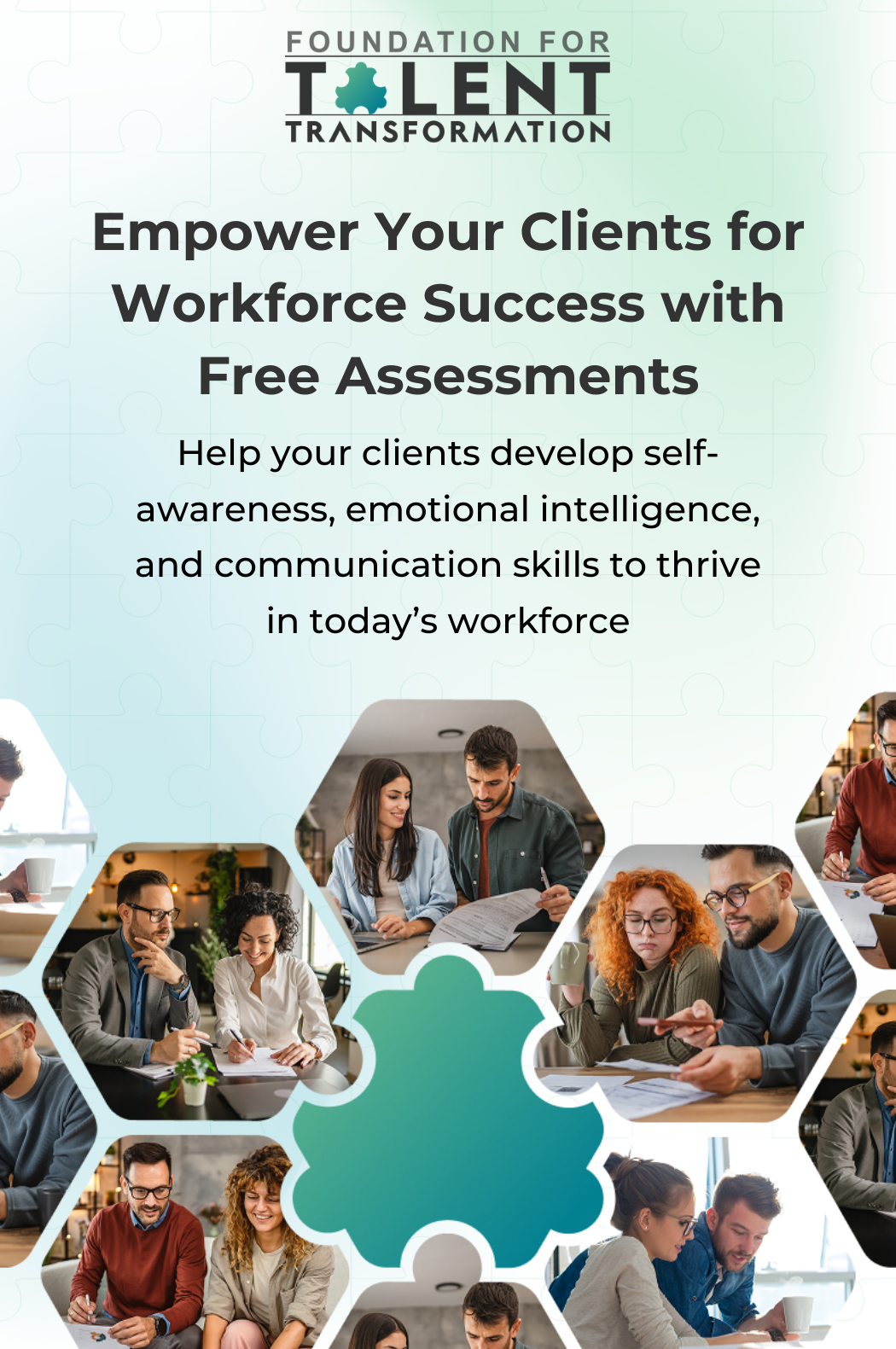
Partner with the Foundation for Talent Transformation to help people build the skills for lasting employability. Together, we will help you improve participation, completion, job readiness, placement, retention, and advancement, while gaining insights to strengthen program delivery and participant success!
| |
November 2, 2026
Welcome to the November 2026 Edition of the MUS Connector!
At Midwest Urban Strategies (MUS), we recognize that the strength of America's public workforce system depends on the knowledge, skills, and commitment of the professionals who serve within it. Yet, while we invest considerable resources in preparing individuals for employment, we must also ask an important question: Are we investing enough in the professional development of those responsible for developing our workforce? Workforce practitioners face increasingly complex demands, evolving employer expectations, emerging technologies, and changing policies. Supporting their continued learning is not simply a professional benefit; it is essential to strengthening workforce system performance and delivering meaningful outcomes.
This month, we are especially excited about the next chapter of MUS's commitment to learning and professional excellence. By advancing the Workforce Works Learning Laboratory (WWLL) as a collaborative platform for accessible, affordable, and relevant professional development and working alongside our members and partners, we aim to strengthen learning opportunities that respond to the real needs of workforce practitioners. Their work often happens behind the scenes, but its impact is felt across families, businesses, and communities throughout the country.
As we celebrate this season of gratitude, let's move beyond saying thank you and demonstrate our appreciation through meaningful investment in the people who make workforce development work. Because when we strengthen workforce professionals, we strengthen the entire workforce system.
| | |
From the Desk of the Executive Director
Who Trains the Trainers?
Rethinking Professional Development for Workforce Professionals
by Tracey Carey
Executive Director
The holiday that reminds us to practice gratitude happens this month. So, with Thanksgiving around the corner, you might be asking yourself, “What am I grateful for?” First, for me, is my family. A close second is my opportunity to serve. This month, I am thinking deeply about the people in my community: the workforce professionals who show up every day at Job Centers and in their communities to engage, support, coach, nudge, and encourage people who are looking for a new (or improved) opportunity to work and engage in the labor market.
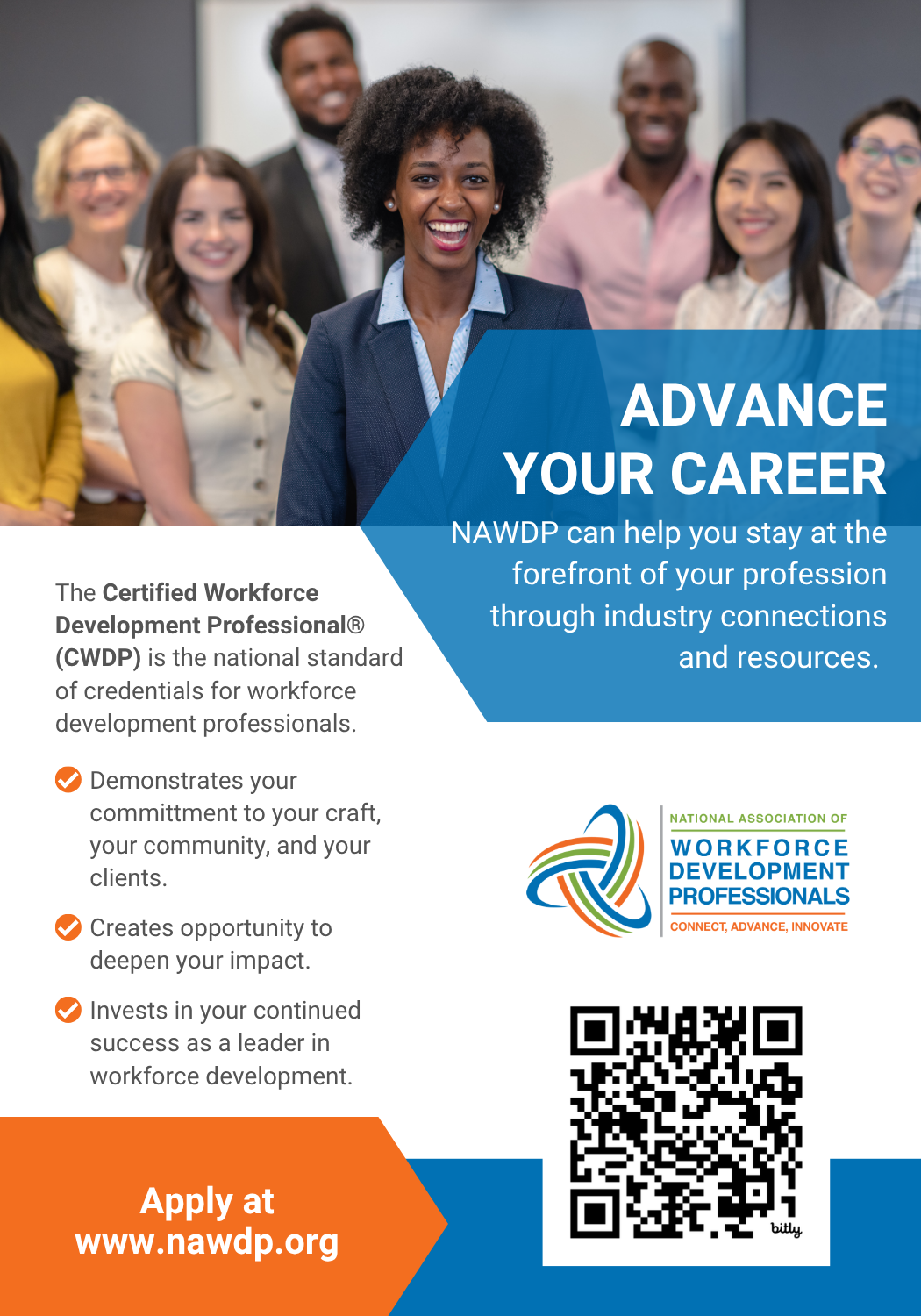
Last month MUS had the privilege of gaining formal accreditation from the Continuing Education Unit Accreditation Council (CEUAC) and now we are turning our attention to how we, as a workforce development industry, develop, deploy, and codify learning that matters to workforce system professionals. We are grateful for the pioneering work that the National Association of Workforce Development Professionals (NAWDP) has led in the creation of the Certified Workforce Development Professional (CWDP) credential. Many of our members are proud holders of the CWDP and lots are also Global Career Development Facilitators (GCDF), a credential that was created by the National Career Development Association in partnership with the Center for Credentialing and Education. The Workforce and Career Development Certification Training, organized and delivered by Tad Grants, is an excellent model that combines the competencies of the three primary credentials into one 120-hour training course. Graduates of that training are eligible to apply for the CWDP, the GCDF and the Certified Career Services Provider (CCSP).
For workforce organizations that have the resources to support the professional development of their staff, these offerings are excellent opportunities to build fundamental competency. But far too many of these organizations are structurally underfunded and the policy of WIOA prohibits the use of ITA (training) funds for the professional development of staff. While administrative funds (or Governor set aside) would be allowable ways to invest in staff credentialing, those uses are rarely prioritized. These realities lead to an underprepared workforce tasked with preparing the future workforce.
So, the question remains: how might we build a learning system and infrastructure that is affordable, accessible, and relevant to support the workforce development needs of our workforce professionals?
The fact that the workforce development system has three long-standing industry defined credentials is evidence that we value the practice of professional development. These credentials are critical tools that can support the standards of excellence for workforce system professionals. We at MUS are rolling up our sleeves, in partnership with our friends at NAWDP, to tackle this problem through our Workforce Works Learning Laboratory (WWLL). MUS has delivered Learning Labs since its beginnings in 2015 and with our accreditation, we are formalizing that system to create a one stop shop for the professional development needs of our colleagues in the field. In true MUS fashion, we will do this WITH you, not FOR you.
So please join us for listening sessions and feedback forums as we seek to surface solutions to the long-standing need for structured and sustainable professional development for workforce practitioners. See you there! And Happy Thanksgiving!
| | |
Midwest Urban Strategies Welcomes
Nate Klinck to the Board of Directors
| | |
Midwest Urban Strategies is pleased to announce the appointment of Nate Klinck to the Board of Directors! Nate serves as Executive Vice President of Programs at EmployIndy, where he leads the integration and execution of the organization’s workforce strategies across Community Career Services, Business Partnerships & Talent Connections, and Career Connected Learning. In this role, he drives program alignment, strengthens operational performance, and fosters cross-department collaboration to deliver coordinated, high-impact services for residents, employers, and community partners.
With more than 20 years of experience in workforce development, education, and economic development, Nate has held senior leadership roles across state government, nonprofit organizations, and national consulting firms. His background spans workforce policy, system design, program strategy, and large-scale implementation, including previous leadership positions with the Indiana Construction Roundtable Foundation, Thomas P. Miller & Associates, the Indiana Career Council, and the Indiana Department of Workforce Development. Nate earned a Master of Public Administration from Indiana University’s School of Public and Environmental Affairs and a Bachelor of Arts in English Literature from Indiana University Bloomington.
Welcome Nate! We look forward to working with you!
| | |
Open the Door: Second-Chance Employer
Workforce Works!! Learning Lab
December 2, 2026, 2:00-3:30 pm CST
| | Every successful second-chance hire starts with an employer willing to say yes. In this Learning Lab, D Byers & Associates will share practical strategies for engaging employers as hiring partners and messaging that works. Learn how to position second-chance hiring as a workforce solution, address employer concerns, and leverage supports and incentives that reduce risk. Through discussion and real-world examples, you'll gain adaptable employer outreach language, a stronger hiring pitch, and connections with peers advancing second-chance employment. | | | | |
MUS Policy Perspective
by Chris Andresen
Senior Vice President
Dutko Government Relations
Federal workforce development policy and funding are essentially on hold while we await the results of the midterm elections. Members of Congress will spend October in their states/districts ahead of the November 3rd elections. That presents an opportunity for local workforce development boards and stakeholders to invite federal elected officials to attend events, visits American Jobs Centers, or tour local employers active with local workforce development boards.
There is universal recognition that local elected officials must better understand the local workforce development system and its impact throughout the community. The best way to showcase that is with in-person visits and direct interactions/observations with elected officials, staff, businesses, and WIOA participants. With the congressional recess for the month of October, extending invitations to those Members of Congress could help to build a foundation for WIOA Reauthorization and workforce development funding for this year and beyond.
While this can feel daunting, we have several recent examples of congressional members, staff and Administration officials visiting local workforce development boards. Given the consistent advocacy in Washington, DC for workforce development policy and funding, Members are looking to learn more about these programs and how they are impacting their constituents – in many cases, they may not truly appreciate the barriers faced by individuals and the extensive work done to get people into job training and/or work.
| |
Why MUS? Because Workforce Innovation is Stronger, Together!
by Kellie Landaker
Director of Membership, Learning, & Innovation
Workforce development organizations face increasingly complex challenges from changing labor market demands and evolving federal policies to limited resources and the need to demonstrate meaningful outcomes. No organization should have to navigate these challenges alone. Midwest Urban Strategies brings workforce leaders together to connect, learn, innovate, and strengthen the systems that create economic opportunity.
Through a collaborative network of Workforce Development Boards and strategic partners, MUS creates opportunities to exchange proven practices, strengthen organizational capacity, advance professional development, and elevate the collective voice of workforce leaders. Whether your organization is seeking innovative solutions, stronger partnerships, professional learning opportunities, or a platform to share its expertise, MUS provides an active and engaged community that is committed to turning shared knowledge into meaningful action.
Expand your network. Strengthen your organization. Help shape what's next for workforce development. Join MUS today!
Interested in Membership? Contact kellie@midwesturbanstrategies.com.
| |
November 2026 Member Spotlight
Organization Name:
National Association for Workforce Development Professionals (NAWDP)
Executive Leader:
Melissa Robbins
Chief Executive Officer
Website:
www.nawdp.org
About NAWDP
Since its founding in 1984, The National Association of Workforce Development Professionals(NAWDP) has served as a trusted resource and advocate for professionals who help individuals prepare for, secure, and succeed in employment. Through advocacy, training, certification, and connection, NAWDP equips practitioners with the tools and support they need to drive economic opportunity, empower communities, and shape a more inclusive workforce system. No matter your role in the workforce development ecosystem—whether you provide direct services, support operations, engage with employers, or lead strategic efforts—NAWDP is your partner in progress.
The National Association of Workforce Development Professionals (NAWDP) is a professional association representing individual workforce development and human resources practitioners, who connect jobseekers, educators and employers to advance the American economy. NAWDP provides the professional development, resources, and certification credibility to individuals seeking to thrive in the workforce development industry as thought leaders and innovators. As the leading advocate for workforce development professionals, NAWDP builds relationships and connections with other industry-leading organizations to challenge and collaborate for the advancement of the industry.
Mission & Vision
At the National Association of Workforce Development Professionals (NAWDP), we champion those who champion others. Every day, workforce development professionals across the nation empower individuals, strengthen communities, and drive economic growth. Our mission, vision, and values guide our efforts to support and elevate this essential work.
CWDP Certification
Ready to get certified? NAWDP is the developer of the Certified Workforce Development Professional® (CWDP) certification. It was developed using research based on the job requirements of a wide range of workforce development roles. The results have been validated by professionals across the nation in a variety of settings as representative of the skills and competencies required for success in the industry.
NAWDP is governed and managed by a Board of Directors who are elected to represent the views and the needs of the membership of the geographic area they are elected to represent.
Learn more about NAWDP visit their website: HERE
| | |
The Workforce Behind the Workforce: Upcoming Events
by Marjorie Cohen
Director, Strategic Initiatives
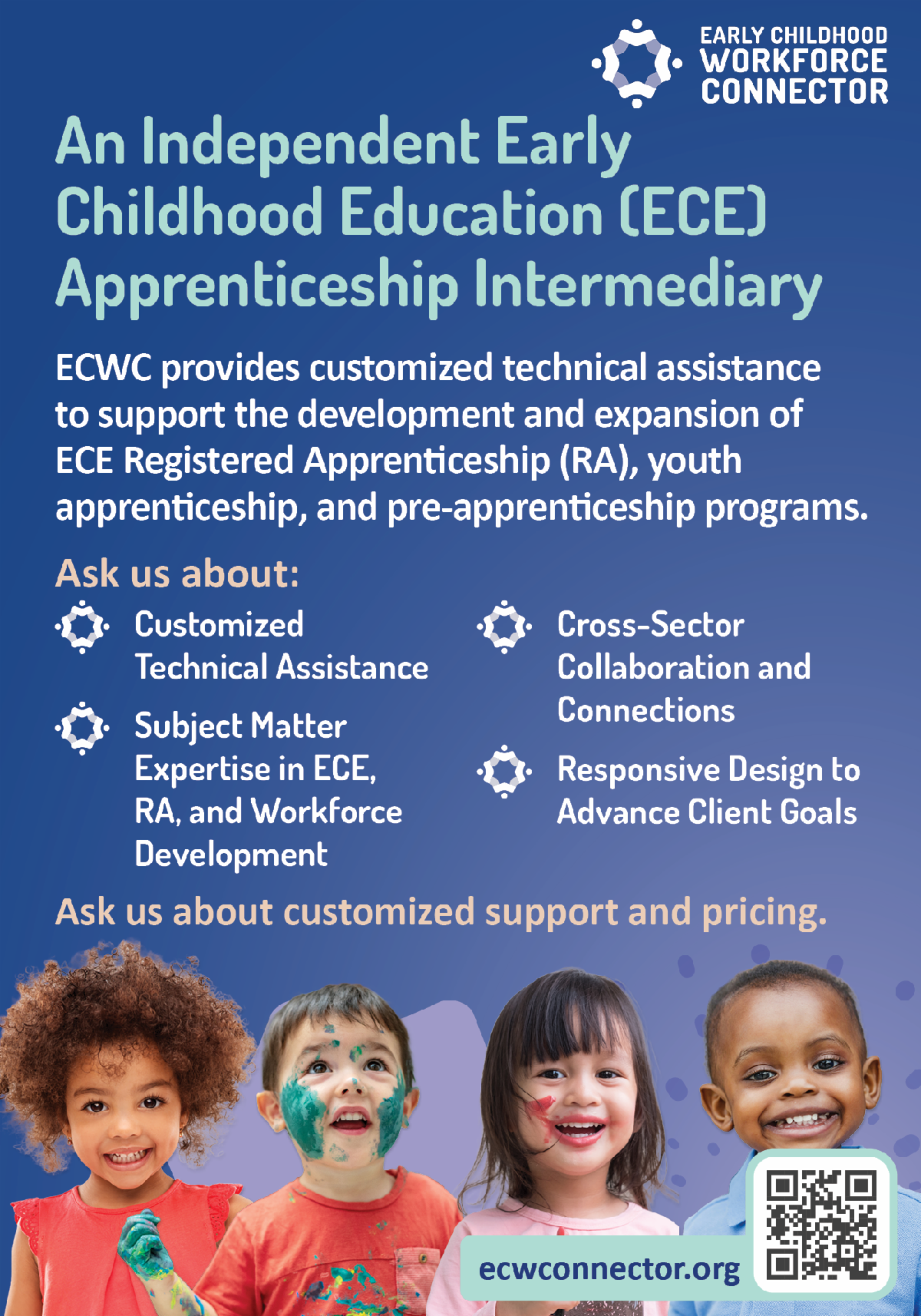
Upcoming webinar from the Early Childhood Workforce Connector (ECWC), a national independent ECE apprenticeship intermediary co-founded by Midwest Urban Strategies!
ECWC’s Mentorship in Action: Resources, Tools, and Partner Perspectives Webinar Tuesday, December 8, 2026, 2:00 PM- 3:15 PM ET
Strong mentorship can transform an Early Childhood Education Registered Apprenticeship (ECE RA) experience for everyone involved. In this webinar, participants will explore what mentorship means within an ECE RA program and how effective, relationship-centered mentoring supports apprentice growth and improves program quality in ECE settings. We will also address the value of mentor self-care and ongoing professional growth as essential to sustainable, effective mentorship.
Hear directly from partners who have implemented successful mentorship models and learn how their approaches strengthen relationships and positively impact ECE RA programs. Participants will leave with actionable tools, resources, and ideas they can adapt to strengthen mentorship within their own programs.
Click HERE to register today!
| | |
Workforce Works!!
What's Next?
by Casandra Blassingame
Brand, Communications &
Partnership Strategist
| |
From Connecting Learning and Work
to Transforming Workforce Systems
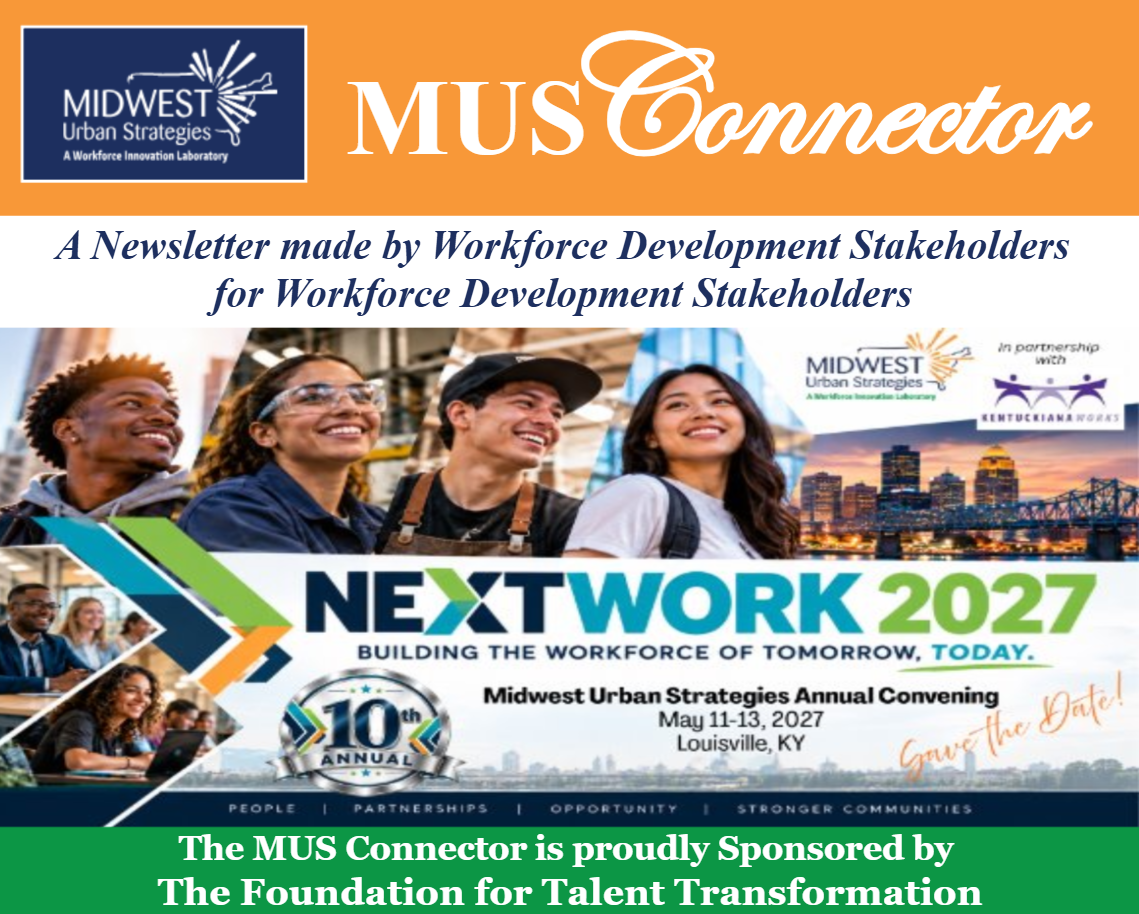
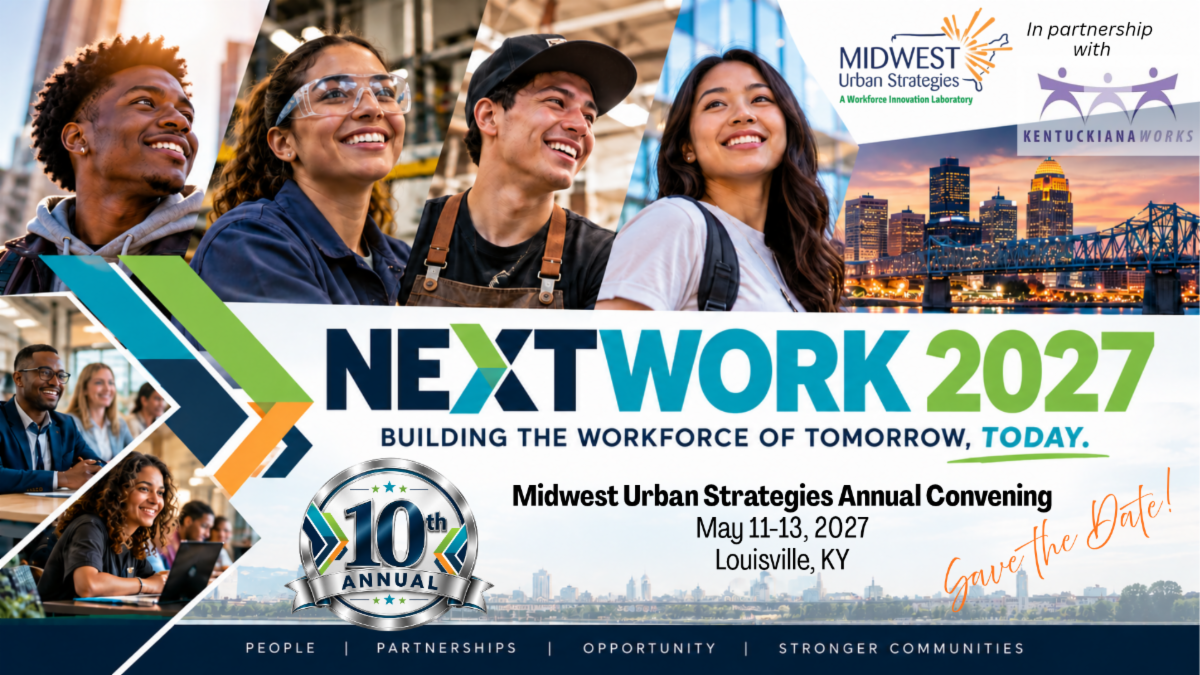
Can you believe it has been 10 years since the first MUS Convening? I was reminded of the event in Cincinnati, OH and I was there! Who knew? The vision has grown from a small, yet powerful group of Thought Leaders in this industry to what it is today: An incredibly, curated and coordinated convening of some of the best minds in workforce development.
Workforce Works is entering an exciting new chapter for Midwest Urban Strategies (MUS). With new strategic affiliations and partnerships, accreditation, the expansion of the Workforce Works Learning Laboratory, and the upcoming 10th Annual Convening hosted by Kentuckiana Works, MUS has an opportunity to position Workforce Works as more than a recognizable brand!
Workforce Works provides a platform for connecting workforce innovation, professional learning, employer engagement, and economic mobility. MUS is no longer just connecting workforce professionals and leaders. MUS is turning these connections into measurable improvements in America's public workforce system!
| |
Applying a Shared Approach to
Workforce Development
by Sandy Mead
Executive Vice President - Workforce Partnership
Skilltrade
Strong sector partnerships begin with understanding regional workforce priorities, recognizing the value each partner brings to the table, and building relationships around shared goals that support employers, job seekers, and the communities they serve.
As employers place greater emphasis on skills-based hiring, the public workforce system plays an important role in supporting this shift by connecting job seekers with career pathways and employers with skilled talent. Meeting both needs requires a willingness to think differently about how workforce resources are developed, communicated, and delivered.
Workforce Development Boards (WDBs) and American Job Centers (AJCs) are uniquely positioned to lead this effort. Their relationships with employers, educators, and community organizations provide a foundation for developing regional workforce strategies. But their role also presents an opportunity to make existing services more visible, accessible, and relevant to the people and businesses they serve.
Creating opportunities is only part of the equation. Employers and job seekers need to understand what resources are available and how to access them. For businesses, that may include recruitment assistance, incumbent worker training, work-based learning, and other workforce services. More intentional outreach and open conversations can uncover needs, strengthen relationships, and connect people with resources they may not have known existed.
Developing effective sector partnerships also means engaging employers and training providers early, before solutions are determined. Employers help identify the skills and competencies they need, while training providers can help develop or adapt programs to meet those demands. Bringing community organizations into these conversations helps ensure that training pathways also reflect the realities facing job seekers, including transportation, childcare, housing instability, and financial barriers.
This kind of proactive planning creates room for creativity, collaboration, and approaches that may challenge traditional workforce practices. It also shifts the conversation from promoting individual programs to developing regional solutions shaped by employer demand and community needs.
Detroit, Michigan, offers a wonderful example of sector strategies in action. Through a partnership involving Detroit at Work, Focus: HOPE, Skilltrade, and local healthcare employers, residents have accessed hybrid Medical Assistant training supported by hands-on clinical instruction, supportive services, and employer-connected externships. The collaboration demonstrates how coordinated resources and community relationships can help individuals gain industry-recognized credentials and pursue meaningful employment.
These efforts also reflect the five pillars of America's Talent Strategy: Industry-Driven Strategies, Worker Mobility, Integrated Systems, Accountability, and Flexibility and Innovation. Together, they reinforce the importance of employer-informed training, accessible career pathways, coordinated services, measurable outcomes, and a willingness to explore new approaches.
| |
|
Money on the Table: NAWDP’s Take on
TEGL 04-26 and the Governor’s Reserve
by Amanda Grigsby, CDMP, PCM® Digital Marketing
Director of Marketing and Communications
National Association of Workforce Development Professionals
Underused state set-aside dollars could help power apprenticeship and Earn and Learn. NAWDP explains how.
Workforce leaders often say that demand for apprenticeship and Earn and Learn models are growing faster than the funding to build them. A new analysis from the National Association of Workforce Development Professionals (NAWDP) points to a different problem: money that already exists but isn’t being used.
On September 28, NAWDP published its take on Training and Employment Guidance Letter (TEGL) 04-26, Using WIOA Governor’s Reserve Funding to Advance Workforce Development Priorities. The guidance covers the Governor’s Reserve, the 15% state set-aside under WIOA. These funds rarely get much attention and this TEGL is a strong reason they should.
NAWDP highlights fund utilization data from the June 30, 2025 reporting period:
- About 35% of states carried over half or more of their unobligated Governor’s Reserve funding from PY 2024 into PY 2025.
- Only 13 states carried over 30% or less.
NAWDP notes that this pattern is nothing new. The TEGL also puts a dollar figure on how much goes unspent each year, and NAWDP’s full take explains why that figure deserves attention. The gap shows up locally too. NAWDP cites August 2025 data showing that half of local workforce development boards have not placed a single participant in a Registered Apprenticeship program.
NAWDP identifies six administration priorities that Governor’s Reserve funding can advance:
- Registered Apprenticeship expansion
- Workforce Pell implementation
- Connecting talent to opportunity through talent marketplaces
- Industry-driven skills training
- AI literacy
- Improving WIOA performance and accountability
Several of these connect directly to the pillars of America’s Talent Strategy that frame this month’s Connector.
One of the most useful points concerns eligibility. In most cases, Governor’s Reserve funds have no eligibility requirements beyond age determination. That affects both how quickly states can put the money to work and what they must report. NAWDP explains when eligibility determination does apply, and what that means for PIRL reporting.
What Else You’ll Find in NAWDP’s Full Take
-
How Governor’s Reserve funding connects to the State Apprenticeship Expansion Formula Round 4 (SAEF4) grant under TEGL 08-25
-
Why TEN 05-26, DOL’s updated framework for pre-apprenticeship programs released September 8, belongs in your playbook
- A direct link to the complete TEGL
- A downloadable version of NAWDP’s take, which you can share with your board, partners, and state contacts
Read NAWDP’s full take on TEGL 04-26
Reading the guidance is the first step. Putting it into action is the next.
NAWDP will be hosting Maria Remboulis on Thursday, December 3, from 1:00 to 2:00 p.m. CST for “NAWDP’s Take on It.” She will break down TEGL 04-26 and explore practical ways states and local workforce systems can put Governor’s Reserve funds to work.
The session will highlight opportunities to align funding with critical workforce needs, including:
- Expanding Registered Apprenticeships
- Strengthening pre-apprenticeship programs
- Supporting AI literacy and industry-driven training
- Improving WIOA performance
Whether you’re looking to leverage resources, strengthen partnerships, or advance workforce priorities in your state or community, you’ll gain insights to help turn guidance into action. Register today!
| |
Frontline Employees and
Workforce Development
by Ronald L. Jacobs, PhD
Principal, SiTUATE, LLC
In general, frontline employees represent those roles that directly deliver services or produce products for a customer. Frontline employees are closest in proximity to an organization’s customers in a relative sense. Examples of frontline employees include the most obvious positions such as customer service representatives, retail positions, and even skilled trades. Conceptually, frontline employees might serve customers outside the organization, such as serving consumers, or inside the organization, such as serving the next group that receives what was done before them. Interestingly, I suggest that most apprenticeships in fact prepare individuals for frontline roles.
Today, identifying frontline roles has become increasingly difficult. In the past, we’d kiddingly say that frontline employees were simply those workers who got their hands dirty. Or another informal identifier was what people wore to work. Frontline employees typically wore non-collared shirts, while supervisors and managers wore collared shirts and thus were not considered frontline employees.
Perhaps using these simple attributes might have worked in the past, but today the broadening range of job responsibilities challenges most definitions. And it’s possible for some jobs to have blended frontline and supervisory expectations. Could a university faculty member be considered a frontline employee? Frontline employee roles have typically been viewed as being semi-skilled in nature. The amount of training or education seems not to matter much anymore. More important is proximity to those being served. Regardless of the business sector or job responsibilities, frontline employees seem subject to two major related challenges.
Frontline employees bear the brunt of most organizational change efforts, especially in terms of disrupting the work that they do. When change occurs, such as implementing AI, the work of frontline employees invariably undergoes the most change relative to other roles in the organization. Interestingly, when conducting our skills gap analysis process in a client’s work setting, I observed this point demonstrated repeatedly. Regardless of the nature of the change effort, the results of the process invariably show that skills gaps occur most often among the frontline employees of the organization.
The influence of organizational change on frontline employee expectations began in earnest in the 1980s when global competition threatened the competitiveness of U.S. manufacturing industries. At the time, some observers simply blamed our national lack of competitiveness squarely on frontline production workers who were perceived to be overpaid and non-productive, all the while being protected by overzealous unions. In fact, global competition was a wake-up call for change in all aspects of organizations, including management and engineering, jolting everyone’s assumptions to the core.
I first observed the powerful influence of change on frontline employee expectations in the early 1990s, when helping to implement a quality management system in a GM plant. Survival of the plant depended on improving quality and reducing costs, two difficult goals to achieve at once. GM had adopted a system-wide work design called synchronous work groups, which was based on the Toyota Production System. In the new work design, production employees were expected to work cooperatively as a team member with the expectation that each person could eventually operate all the equipment in their sub-assembly area. Production workers would now become multi-skilled instead of each worker basically operating one piece of equipment without much awareness of what came before or after their actions.
Not unexpectedly, many workers faced immense challenges when adapting to the new synchronous work design, especially those with many years of service. They were required to learn about the new work design, work effectively with others, and operate the equipment in their work areas.
In summary, the first challenge described recognizes that when change occurs, the work of frontline employees is disrupted as much or more than any other role. This understanding leads to the second major challenge facing frontline employees. That is, the second challenge is dealing with the personal anxiety and emotions when others suddenly dictate changes in work life along with potential job loss. Many workforce development professionals may include similar information in their current programs already. Understanding the role of frontline employees seems to be an additional idea of importance when communicating with students about their future in the workforce.
| |
Better Conversations,
Stronger Apprenticeships
by Eric Shepherd, Executive Director Foundation for Talent Development
An apprentice watches a mentor complete a task. The steps look straightforward until it is time to try. One detail is unclear, but the apprentice hesitates to ask. Will another question make them seem unprepared? That moment matters.
A conversation could clarify the task, reveal a misunderstanding, and build confidence. Silence leaves uncertainty unresolved. Apprenticeships connect learning with earning. Their daily value also depends on how people learn from one another. For workforce boards, employers, and training partners, strengthening these interactions is a practical way to support apprenticeship success.
Social learning happens when people observe others, exchange ideas, ask questions, practice together, and reflect on feedback. Apprenticeships provide opportunities for all five. Yet working alongside an expert does not guarantee that an apprentice understands the expert’s thinking. An experienced technician may recognize a warning sign without mentioning it. A supervisor may change priorities without explaining the decision.
Mentors can make their reasoning visible: “I checked this first because…” or “Here is what made me choose this approach.” Invite apprentices to explain their thinking too. “Talk me through what you would do next” reveals more than “Does that make sense?” The answer helps mentors see where further explanation or practice is needed.
Asking for help requires communication skills and confidence. Apprentices may worry about slowing the team down or appearing incapable, particularly during their first weeks. Mentors can make questions an expected part of learning. Ask, “Which step should we go through again?” Allow time for an answer. Respond respectfully when someone raises a concern.
Apprentices also need practice asking useful questions. “I understand how to complete the task, but how do I check that the result is correct?” gives a mentor something specific to address. These exchanges build habits that matter beyond a single task: listening carefully, acknowledging uncertainty, and seeking guidance before proceeding.
Fellow apprentices can be valuable learning partners. Comparing experiences helps people discover different approaches and recognize questions they had not considered. A workforce team could bring apprentices together to discuss a challenge from the week. Each person explains what happened, what they tried, and what they would do differently.
Keep the discussion focused on learning. Encourage participants to ask clarifying questions before offering advice. Remind them to check technical guidance with their mentor or instructor. Collaboration then becomes an opportunity to practice communication while making sense of workplace experience.
Feedback works best when the apprentice understands what happened and what to practice next. “Be more professional” offers little direction. “When the assignment changed, your teammate did not receive an update. How could you keep them informed next time?” identifies a specific behavior and invites reflection. Ask for the apprentice’s perspective.
Agree on one action, then revisit it after they have had a chance to practice. Workforce coaches can reinforce this process by helping apprentices prepare for feedback conversations and reflect afterward. A brief discussion can turn an uncomfortable experience into a useful development opportunity.
The Foundation for Talent Transformation’s psychometric assessments, online courses, and AI coaches can help apprentices develop the skills these conversations require. Assessments encourage reflection on communication styles, emotional intelligence, and responses to conflict.
Online courses introduce practical approaches to listening, teamwork, and workplace challenges. AI coaches provide opportunities to prepare questions, consider feedback, and think through a conversation before speaking with a mentor. Connect these resources to a real situation. Choose one skill, practice it during the apprenticeship, and discuss what happened with a coach or supervisor.
Workforce partners can encourage employers to build questions, explanations, and reflection into everyday apprenticeship activities. Ask mentors and apprentices what helps them learn together and where communication breaks down. Every demonstration, shared task, and feedback discussion offers an opening. Making those conversations count helps apprentices understand the work, contribute to their teams, and prepare for greater responsibility.
| | |
NAWDP 101: Getting to Know NAWDP
November 4, 2026, 1:00-2:00 pm CST | Are you new to NAWDP or thinking about becoming a member? Curious about the Certified Workforce Development Professional® (CWDP) credential and how it can support your professional growth? Join NAWDP’s Director of Membership, Alexis Franks, for an engaging introduction to NAWDP, including the benefits of membership, valuable resources and professional development opportunities, current NAWDP initiatives, and an overview of the CWDP and how you can earn it. Register Here
EVENT: 30 Minutes of Excellence – November: When There Are No Jobs to Place Them In: A Veteran Economic Readiness Framework for Rural and Underserved Workforce Areas
November 10, 2026, 1:00-1:30 pm CST | Veterans in rural communities face a compounded challenge: they were never taught how the civilian economy works, and the economies they’re returning to may not have traditional employment pathways. The standard model – resume, interview, placement – breaks down when there are no employers hiring. Join Ritchie Thomas, Army Veteran and CEO/Founder of Military Transition University, as he presents a rural-adapted economic readiness framework built on six employment tracks that actually work in rural and underserved geographies. Register Here
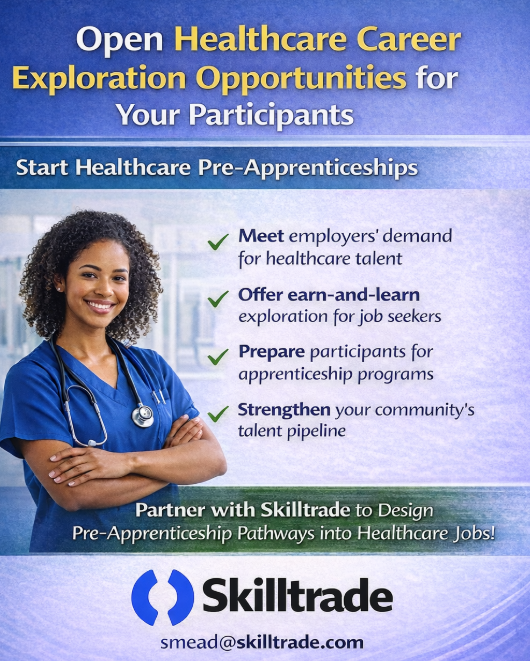
Skilltrade seeks partners to launch new Clinical Medical Assistant Career Training Pilot Programs across the country. Contact Sandy Mead to collaborate and learn more: Here
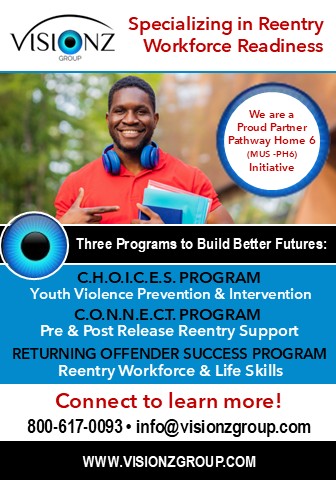
Visionz Group seeks partners to collaborate on expanding workforce readiness and reentry training programs in communities nationwide. Organizations interested in strengthening youth intervention, pre- and post-release support, and returning citizen workforce development are encouraged to connect and learn more: Here
The Foundation for Talent Transformation introduces its Well-being Framework in a comparative study of global models. More About Well-being Framework: Here
The Community Spotlight Advertisements are open to any organization, employer, or partner that wants to share programs, services, events, or solutions with a national audience of workforce leaders and practitioners. The MUS Connector provides a respected platform for those contributing to workforce innovation, talent development, and system strengthening to connect with peers across the country. To learn more about placement options or request a rate card, please contact Casandra at Casandra@midwesturbanstrategies.com.
Explore and Connect Today!
262-794-3019
| | Disclaimer: The views and opinions expressed in the author’s articles featured in this newsletter are those of the individual authors and do not necessarily reflect the official policy or position of Midwest Urban Strategies nor do they represent the views of any federal funding agency. Inclusion of these articles does not imply endorsement by Midwest Urban Strategies. | | | | |