We filed a Fair Housing Act case challenging racial discrimination against Housing Choice Voucher renters |
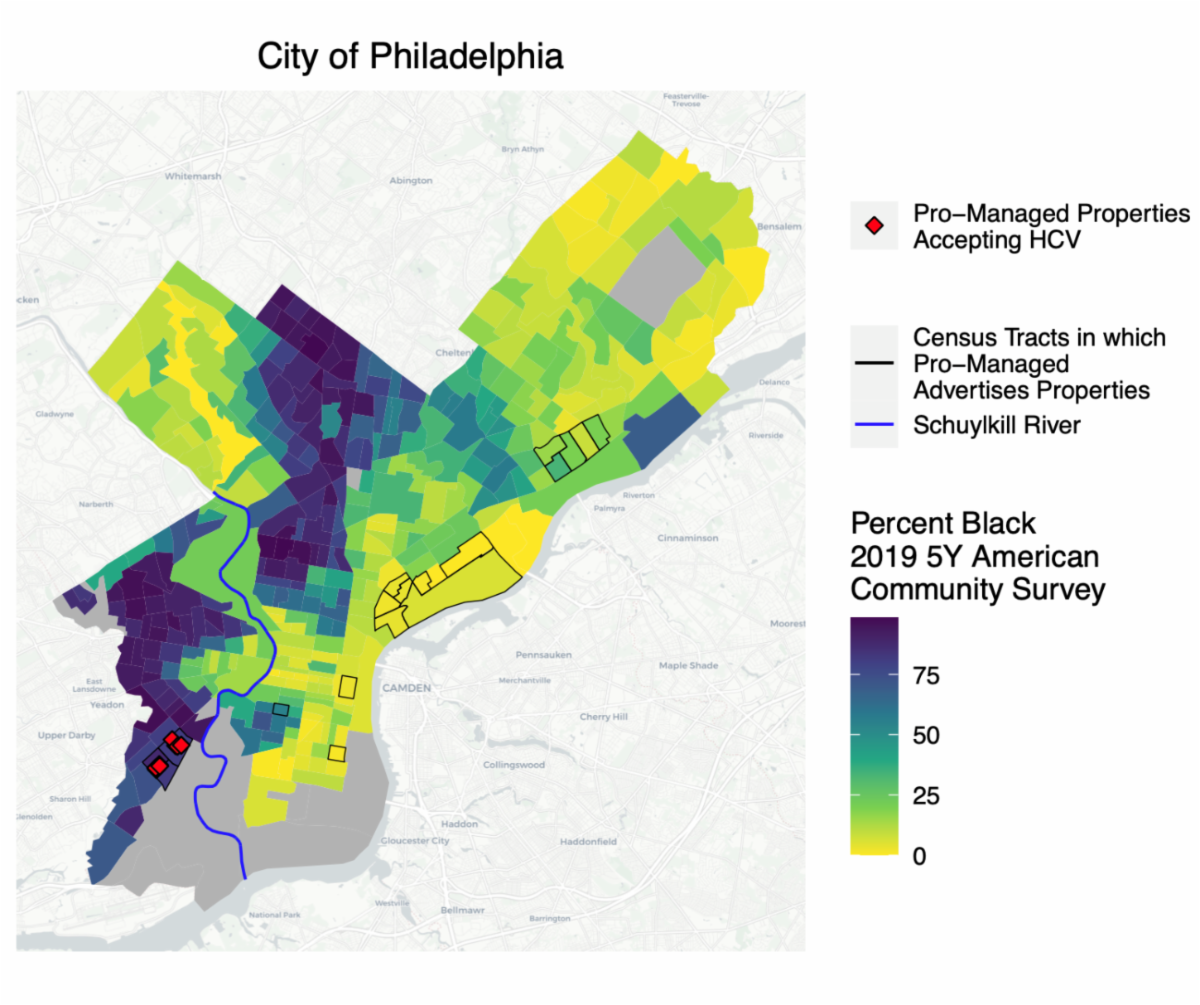
The above map shows Philadelphia’s non-Hispanic Black population by census tract. Each outlined census tract contains ProManaged properties. The red diamonds represent properties in which ProManaged advertises that it accepts Housing Choice Vouchers.
A 2018 study from the Urban Institute found that 67% of landlords in Philadelphia refuse to accept Housing Choice Vouchers (a.k.a. Section 8)—and this rejection rate rises to 83% in low-poverty neighborhoods. The widespread refusal to accept vouchers limits the ability of these renters to access safe and affordable housing in diverse neighborhoods, deepening racial segregation and the concentration of poverty in Philadelphia.
In Philadelphia, 84 percent of voucher holders are Black, compared to 44 percent of renters in the city as a whole. In a six month investigation using fair housing testers who posed as perspective renters, HEC found that ProManaged rejects voucher holders in predominately white and integrated neighborhoods, while advertising that Section 8 is accepted only in a limited number of units in vast-majority Black neighborhoods.
“Limiting a group of majority-Black tenants exclusively to majority-Black neighborhoods is modern day redlining,” said Rachel Wentworth, Executive Director of the Housing Equality Center.
In addition to yesterday's Fair Housing Act suit, we also filed a separate complaint on September 27 with the City of Philadelphia Commission on Human Relations against ProManaged for violation of Philadelphia’s local Fair Practices Ordinance, which explicitly prohibits landlords from refusing to rent based on “any lawful source of income, [including]…housing assistance programs."
“Renters looking for housing should be given fair consideration, whether they pay with assistance from a parent or a Housing Choice Voucher,” said Law Center staff attorney Sari Bernstein. “The widespread discrimination against voucher holders in Philadelphia makes it difficult for thousands of families to find a place to live, pushing them out of neighborhoods of their choice or into those that have faced disinvestment and neglect for decades. And Philadelphia law is unambiguous: source of income discrimination is illegal.”
|
|
What the independent state legislature theory could mean for challenges to partisan gerrymandering |
On December 7, 2022, the U.S. Supreme Court heard oral argument in Moore v. Harper. In the case, state legislative leaders in North Carolina put forth a radical legal argument that could reshape elections across the country: the independent state legislature theory, which posits that state legislatures alone, without the checks and balances of state constitutions, courts or governors, are responsible for all aspects of federal elections.
The case came about when legislative leaders in North Carolina went to the U.S. Supreme Court to challenge their state supreme court's authority to review congressional district maps, after the state court struck down a map that gave Republicans, the dominant party in the North Carolina legislature, a 10-4 advantage as a partisan gerrymander in violation of the state constitution's free elections clause.
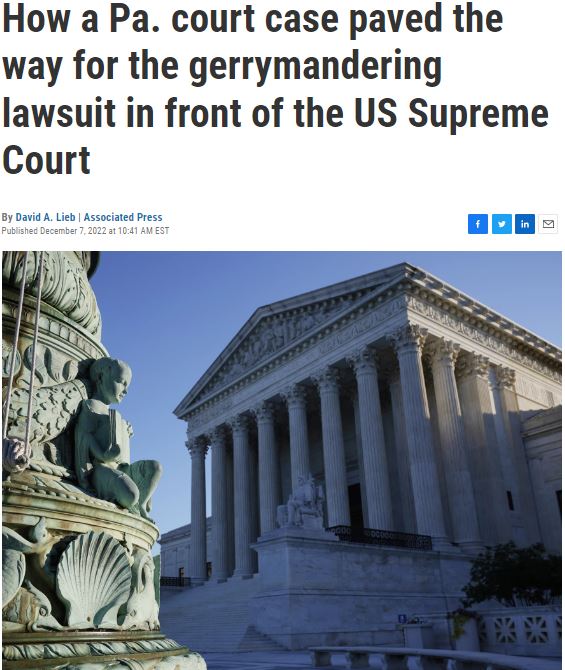
The report highlights our successful challenge to Pennsylvania's 2011 congressional district map as an unconstitutional partisan gerrymander. "A 2018 decision by the Pennsylvania Supreme Court provided a template for voting-rights advocates to pursue gerrymandering claims in state courts," reporter David Lieb writes. "Although the Pennsylvania Constitution contains no specific mention of partisan gerrymandering, the state’s high court said it was prohibited under a state constitutional provision requiring 'free and equal' elections."
If the Supreme Court endorses the independent state legislature theory, both the federal and state courthouse doors could be shut to voters whose voices are diminished by extreme partisan gerrymandering.
|
|
An update on our case taking on Pennsylvania firearm preemption laws |
Our case challenging Pennsylvania’s firearm preemption laws is now before the Pennsylvania Supreme Court. These state laws have tied the hands of local governments for decades, preventing cities like Philadelphia from enacting gun safety reforms that have been proven to keep guns off the streets and save lives.
|
|
We're hiring a one-year grant funded environmental justice organizer! |
We're seeking applications for an environmental justice community organizer. This is a one-year, grant-funded position, and the organizer will be a full-time employee. This position will increase the capacity of the environmental justice team as they develop and implement organizing campaign strategies to achieve their goals, with an emphasis on the Garden Justice Legal Initiative. The organizer will help build and maintain relationships with community members, mobilize impacted residents around specific issues, engage in policy research and community education, monitor legislative and policy changes related to urban agriculture and environmental justice, and together with the community leaders, identify advocacy opportunities and implement strategies to achieve community goals.
|
|
Thank you to everyone who made Giving Tuesday a success! |
|
Thank you for stepping up this Giving Tuesday! Our clients are facing Pennsylvania and Philadelphia's most urgent challenges head-on. Your generous support allows us to stand with them in the courtroom, in the state capitol, at city hall, and in our community. Thank you!
There's still time to help our clients stand up for their communities this year with a recurring monthly membership contribution or a one-time contribution. Your membership will give us the sustainable support we need to take action when our neighbors face discrimination, neglect or exploitation in their homes, their schools, or at the ballot box.
|
|
|
|
|
|
|