In this issue

Finding Your Purpose Beyond the Lab


Medical Writer's Corner


Business Spotlight


Word of the Month

Visit my website

The Fall is Here!

Dearest readers, the fall is here, marking the beginning of change and transformation. Just as the leaves adapt and evolve, revealing their vibrant hues before embracing a new journey, we, too, find ourselves at the cusp of significant personal and professional shifts. This month, we're celebrating the power of adapting to change and the growth that comes with evolution.


For many PhDs transitioning from academia to freelance medical writing, this journey is akin to a metamorphosis.


Our feature article, "Finding Your Purpose Beyond the Research Lab as a Freelance Medical Writer," explores how embracing change can lead to a fulfilling career that harmonizes your scientific expertise with your passion for communication. It's about redefining your purpose, finding new forms of intellectual stimulation, and staying true to your goals amidst challenges.


In the Medical Writer's Corner, we discuss the importance of tone and respectful language in medical writing. Adapting our communication styles is crucial for making complex medical information accessible and empathetic and ensuring we connect meaningfully with diverse audiences.


The Business Spotlight shines on expanding your portfolio by identifying and incorporating new deliverables. By analyzing job ads, you can evolve your skill set and stay competitive in the ever-changing landscape of medical writing.


Finally, our Word of the Month is Evolve—to develop gradually from a simple to a more complex form.

As we embrace the crisp air, the scent of pumpkins and cinnamon, and the vibrant colors of fall, let's also embrace the opportunities that come with change.


Here's to evolving, adapting, and thriving in our new ventures!

LinkedIn

Finding Your Purpose Beyond the Research Lab as a Freelance Medical Writer

We all have unique expectations for our careers, shaped by our passions, strengths, values, and the impact we want to make in the world. Sometimes, the experiences we go through—whether fulfilling or challenging—bring clarity about what truly resonates with us, leading us to adjust our career paths. However, making these changes is rarely easy, especially when we are switching gears after devoting years of hard work as academicians and scientists.


For many PhD scientists, the lab isn't just a workplace—it's a second home where our identities are deeply rooted in reading scientific literature, designing and conducting experiments, analyzing data, and attending lab meetings and journal clubs.


But what happens when we choose a non-conventional path beyond the lab?


No matter how much the new career as a medical writer aligns with our passions or values, no matter how much promise freelance medical writing holds when transitioning into this profession from a research lab, we must metamorphose and adapt to a new life.


Understanding our true purpose as medical writers is key to easing this transition. It can provide a clear sense of direction, help us focus on the unique value we bring through our writing, and reinforce our motivation to impact the medical and scientific community in new ways.


If you've recently embarked on or are planning to transition from the research lab to freelance medical writing, here are some common hurdles you might face en route, along with tips for grinding through these hurdles and aligning with your purpose.


1. Redefining Your Purpose: Expanding Beyond "Scientist"


One of the most significant challenges on your journey is the identity shift from being a "scientist" to a "medical writer."


The title "scientist" has been a core part of your self-identity, and stepping away from the lab can feel disorienting.


Embrace the broader scope of your expertise. You're not losing your identity but expanding it. As a medical writer, you're still a scientist by training—you now use your knowledge and experience to contribute to health care through communication. Leveraging your scientific background in your writing and focusing on topics related to your research can help you stay connected to the areas you've spent years studying.


2. Finding Purpose in New Forms of Intellectual Stimulation


The research lab offers unparalleled intellectual stimulation and the thrill of discovering something new.


Transitioning into medical writing may initially feel less exciting, leading to frustration over the lack of direct impact on scientific advancement.


Recognize that medical writing offers its own forms of intellectual stimulation. Distilling complex scientific concepts into clear, accessible content, mastering diverse topics, and communicating science to various stakeholders are intellectually challenging tasks. You can find fulfillment in your role by embracing these new challenges, even as you navigate the loss of direct research involvement.


3. Embracing Learning as a Part of Your Purpose


Despite your years of experience, stepping into medical writing might make you feel like a beginner. Learning new writing styles, mastering business skills as a freelancer, and adjusting to different stakeholder and client expectations can be overwhelming.


Understand that continuous learning is part of your journey. Your ability to learn quickly, honed during your undergraduate training, is valuable.


Recognize that your academic background provides a strong foundation. Actively develop medical writing and business-specific skills to build confidence and competence, reinforcing your purpose in this new field.


4. Staying True to Your Purpose Amidst Challenges


Building a Professional Community

Leaving academia can lead to feelings of isolation, as freelancing lacks the collaborative environment of a lab. To combat this, seek out fellow medical writers through professional organizations, conferences, and online forums. A strong network provides opportunities and supports your sense of belonging, helping you stay aligned with your purpose of contributing meaningfully to the field.


Recognizing the Importance of Communication Skills

In academia, value is often tied to research output. In medical writing, the ability to communicate complex ideas effectively is paramount. Acknowledge that your scientific expertise is still critical—it simply shines in a new light. You're now making science accessible and impactful for a broader audience. Embracing this shift reinforces your motivation and helps you see the significant impact you can have through your communication skills.


Dealing with Rejection: Developing Resilience

Rejection is an inevitable part of freelancing. Whether it's a declined proposal or a potential client choosing someone else, it's crucial to learn to see rejection as an opportunity for growth rather than a personal failure. Understand that each setback is a chance to refine your approach and learn. Cultivating resilience can keep you aligned with your purpose, contributing to long-term success.


6. Finding Fulfillment and Balance in Your New Role


Managing Work-Life Balance: Establishing Boundaries

Freelancing offers flexibility, but it also requires discipline. Without the structure of set hours, it's easy to blur the lines between work and personal time. Establish a schedule that includes dedicated work hours and personal time to maintain a healthy work-life balance. This discipline ensures you remain productive and prevents burnout, allowing you to continue contributing effectively to your field.


Finding Your Niche: Specializing in a Vast Field

Medical writing is broad, and finding your niche can be daunting. Reflect on the areas that excite you most, whether it's patient education, publishing, regulatory writing, or continuing medical education (CME). Specializing in an area that aligns with your passions makes your work more fulfilling and enhances your ability to make a meaningful impact.


Every transition comes with challenges, but by staying true to your purpose, embracing new growth opportunities, and building a strong support network, you can confidently navigate the shift from the research lab to freelance medical writing.


Your journey is more than a career change—it's an expansion of your identity, combining your scientific expertise with your passion for communication.


Let your personality shine beyond the lab.

Watch Your Tone: The Impact of Respectful Language in Medical Writing

Tone is a critical element in medical writing. It's not just about being accurate—your tone should convey empathy, professionalism, and respect, especially when discussing sensitive health topics. Let's examine how word choice can unintentionally create offense and how to correct it.


"Many women who fail at conceiving naturally due to their damaged reproductive systems often turn to in vitro fertilization (IVF) as a last-ditch effort to have a baby. These women are usually older and past their prime fertility window, which is why they can't get pregnant the normal way."


What's wrong?


This paragraph is harsh, judgmental, and insensitive. It implies blame and failure, using phrases like "fail at conceiving" and "damaged reproductive systems." Additionally, terms like "last-ditch effort" and "past their prime" are dismissive, further alienating the reader and trivializing their experience.


Revised version with corrections:


"Many individuals facing challenges with natural conception due to reproductive health conditions explore in vitro fertilization (IVF) as a viable option for starting a family. Often, this treatment provides hope for those who may encounter age-related or other fertility factors, offering a pathway to parenthood."


Explanation of corrections:

  • "Fail at conceiving" was replaced with "facing challenges with natural conception" to remove any implication of personal failure.
  • "Damaged reproductive systems" was rephrased as "reproductive health conditions," adopting a more neutral and less stigmatizing tone.
  • "Last-ditch effort" was substituted with "viable option," highlighting IVF as a legitimate and hopeful choice, not a desperate move.
  • "Older and past their prime" was reframed as "age-related or other fertility factors," making the tone respectful and avoiding age-related judgment.


One More Deliverable into Your Basket


Using Job Ads to Identify Missing Deliverables From Your Portfolio

When you've spent years honing your skills in research, writing manuscripts, and delivering presentations, it's tempting to think you're prepared for everything the freelance world might throw at you. However, there are often gaps—key deliverables or skills that clients expect but weren't emphasized during your academic journey.


One of the best ways to identify these gaps is by analyzing job ads for medical writing roles, especially at higher levels, like Director of Medical Publications roles. These listings often reveal the exact skills, experiences, and deliverables clients seek.


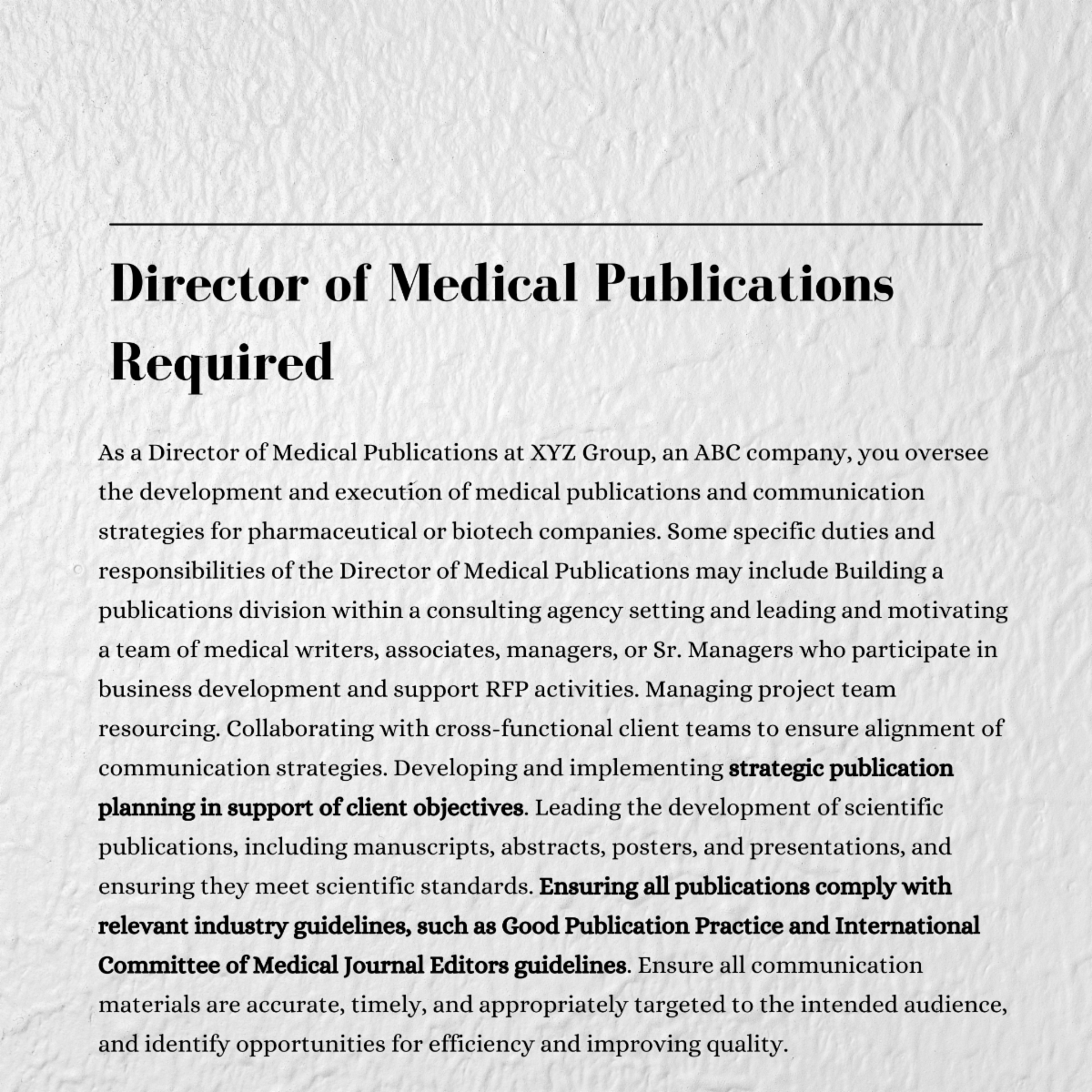
Let's break down an actual job ad in publications to discover what you might be missing and how you can start adding those crucial deliverables to your portfolio.


Here is the job advertisement.

Here are two examples of the key deliverables you can identify from the above advertisement:


Strategic Publication Planning


Job Ad Insight: The job ad specifies that a Director of Medical Publications is responsible for developing and implementing strategic publication planning to support client objectives.


What's Expected: Strategic publication planning is a critical deliverable in the pharmaceutical and biotech industries. Clients don't just want isolated deliverables like manuscripts—they expect medical writers to think ahead, plan for multiple publications, and align the timing and content with overarching business goals.


How to Add This Deliverable:

  • What You Need: Experience in developing and executing strategic publication plans.
  • Understand Strategy: Start by studying real-world examples of publication strategies. These often include timelines for manuscript submissions, presentations, and abstracts, all mapped out over a period of months or years. Take courses or shadow experienced writers to gain insights into publication planning. Practice translating research findings into potential publications that address different audience segments.
  • Pitch to Clients: Show clients that you know about strategic publication planning and how it can align with their goals.

Publication Compliance and Efficiency


Job Ad Insight: The Director of Medical Publications must ensure that all publications comply with relevant industry guidelines, such as Good Publication Practices (GPP) and the International Committee of Medical Journal Editors (ICMJE) guidelines, and identify opportunities for efficiency and improving quality.


What's Expected: Clients expect freelance medical writers to be up-to-date on industry guidelines and to be proactive about improving the quality and efficiency of the publication process.


How to Add This Deliverable:

  • Master the Guidelines: Ensure you're familiar with GPP, ICMJE, and other relevant publication guidelines. Offer to review your client's publication process and suggest ways to ensure compliance and streamline workflows.
  • Be Proactive: When reviewing or developing manuscripts, posters, or presentations, flag areas for improvement. Look for ways to enhance clarity, reduce redundancy, and improve turnaround times.
  • Audit for Quality: Consider offering clients a "publication quality audit," where you review past publications for adherence to guidelines and propose changes to improve quality and efficiency.

Job ads are an underutilized resource for freelancers looking to expand their skill sets. By analyzing job descriptions, you can pinpoint deliverables you may be lacking and take steps to fill those gaps—one deliverable at a time.


Word of the Month


Evolve

Develop gradually from a simple to a more complex form.

Folks, the growth of your freelance medical writing business is directly proportional to your ability to adapt to new challenges and evolve!


Please Note


This is a free Newsletter.

Copyright © Intelligible Scientific Writing LLC


PRIVACY STATEMENT: We do not share your information with anyone.

Intelligible Scientific Writing LLC | Ceder Creek Community | Columbia, MD 21044 US