The November elections will be among the most consequential presidential contests in living memory, while also posing myriad challenges to voters seeking to cast a ballot. Now more than ever, reporters are feeling a civic imperative to produce timely, nuanced watchdog journalism so that the American public is equipped with the information it needs to press for a free and fair voting process and vote tabulation.
But how do you prepare for the unpredictable? Join the National Press Club Journalism Institute’s “What if” workshop, which will bring journalists together with experts to generate unanswered questions and unanticipated scenarios that can guide coverage.
Registration is now open for the free workshop, which will be held Thursday, Sept. 3 from 11:30 a.m. – 1 p.m. Following opening remarks by FEC commissioner Ellen Weintraub, participants will join small breakout groups on one of four topics:
-
Voter suppression, polling access and Election Day pandemonium led by Sylvia Albert, director of voting and elections at Common Cause
-
Mail-in ballots and US Postal Service readiness led by David Becker, executive director and founder of the Center for Election Innovation & Research
-
Foreign interference, led by Maria Barsallo Lynch, executive director of the Defending Digital Democracy Project
-
Contested election results, led by Rick Hasen, Chancellor’s Professor of Law and Political Science at the University of California at Irvine
Following the breakout discussions, participants will reconvene to learn about story ideas and reporting tips generated by each group. Spots are limited for this program to ensure its hands-on value.
|
|
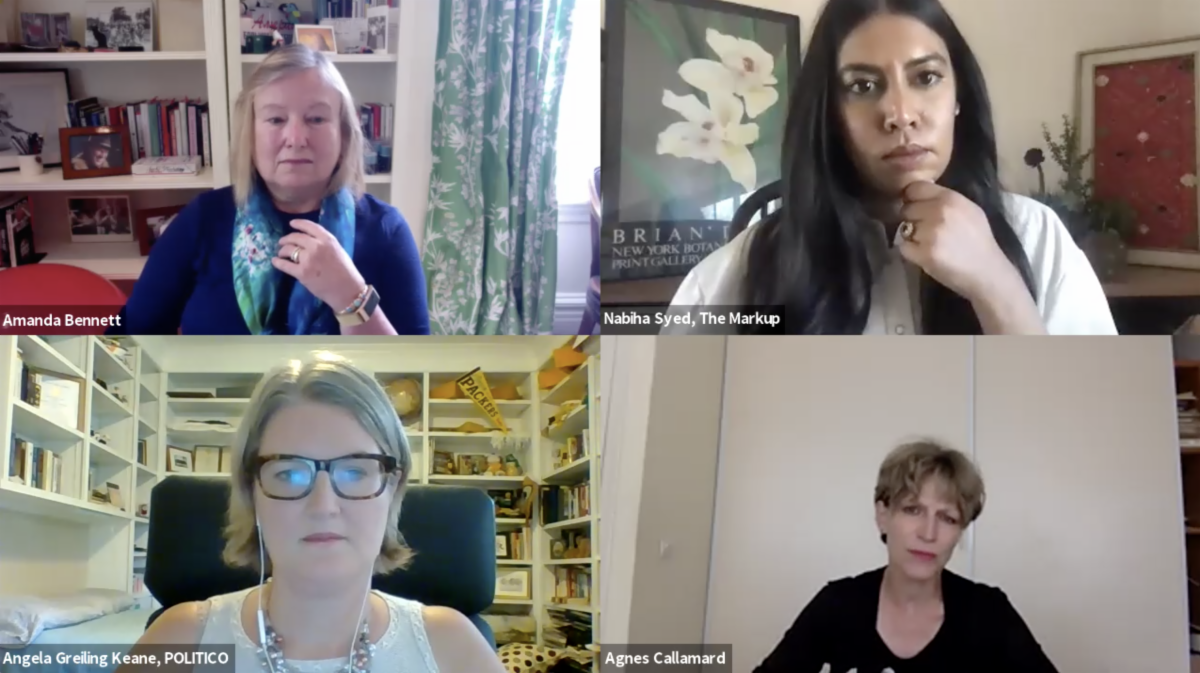
"Investigative journalism is more important than ever today," said Angela Greiling Keane, editorial director of states and Canada for POLITICO. "And also today more than ever, powerful forces around the world are seeking to prevent journalists’ access to information."
Bennett: I think the greatest threat to investigative journalism right now is speed and the lack of tenacity, because so much of investigative journalism, even before this period, requires so much pushing, so much legal help. So much patience, so much time.
Syed: I refer to this moment as having the four horsemen of the press freedom apocalypse. So there's lawfare, violence, trust and something I'll call the snuffer. It's really about the moment that we're in and the interplay between them.
Callamard: One thing that we cannot do is let the lies go unchallenged. Whether it's about one of us, or whether it's about the state. … Whether it's about the killing of a Black man by the police. Not one lie should go unchallenged, and that should apply to all journalists who are being attacked.
|
|
The IRE conference is for journalists, educators and students. Early bird pricing ends Monday, Aug. 31. A schedule with more information is available at ire.org/ire20.
|
|
Bill Plante Chair in Leadership & Media Integrity, Loyola University Chicago
Freedom Forum Fellow in Women’s Leadership
A colleague tells you he’s feeling more stressed as the weeks go by.
Do you:
- Tell him it’s normal these days and not to worry.
- Explain what you do when you feel anxious.
- Ask him to tell you more.
Trust me, #3 is your best option. It allows you to be an informed coach, rather than an advice-giver who’s commenting on an incomplete picture.
Good coaching is built on questions. Open-ended, non-judgmental questions help both people identify core issues and options.
These are open-ended questions:
- How does the stress manifest itself?
- Have you spotted any patterns to the stress?
- What have you tried so far to deal with it?
- What approaches seem to work better than others?
While asking these questions, listen carefully. Repeat back to the other person what you’ve heard, to make sure you are on the same page. Often, people may say, “That’s not what I really meant,” or “You understand perfectly.”
You can also reflect: “I think I’m hearing you say you’ve taken on a lot of additional responsibilities and aren’t sure you can talk with your boss about it. What would it take for you to do that?”
You can also reframe: “You’ve said your boss should know how difficult things are for you right now, and you’re sure she doesn’t care. Are there other reasons she might not be aware of your situation?”
I think you see where I’m going here. The more questions you ask, the more options you reveal. You learn things that weren’t evident at the start of a conversation – information you now know would make you regret having said, “It’s normal” or “Here’s what I do” right out of the blocks.
Those responses may actually be valuable at some point in the conversation, but only after you’ve used the power of questions to know precisely when and why to share them.
Here’s what I teach aspiring coaches: The first story you hear is never the full story. The power of questions helps you find it – and helps everyone find better answers.
This article was originally published on May 5. Click here to read Jill’s previous posts.
|
|
|
By Lauren Walck, senior news editor at the Biloxi Sun Herald
I think I'm like most journalists: bad at self-care. We've been talking about it a lot this week, trying to brainstorm solutions, because across newsrooms everyone has hit a wall. I've noticed an extra day off or two really isn't helping much because the first day back it's like you never left. Work seems inescapable when it's in your home.
One solution for me is to get outside. I go walk or sit on the beach near sunset when it's not sweltering. But in order to find solutions that will benefit everyone, we need to feel comfortable enough to talk openly about the problem and experiment with ideas to solve it. 2020 is the year of figuring it out on the fly!
|
|
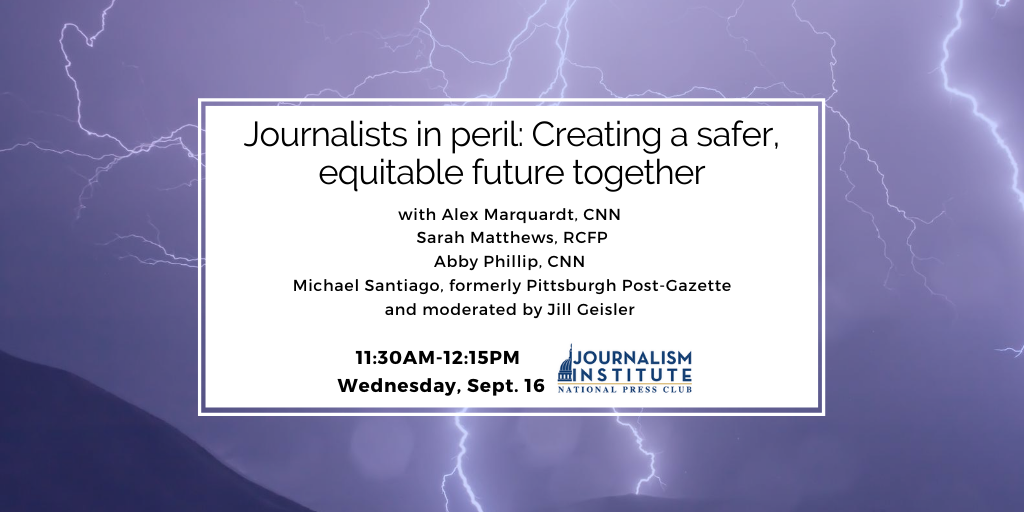
Safety for journalists has taken on a renewed sense of importance as newsrooms grapple with the convergence of hostility toward those in the field and systemic racism that pervades even the most revered journalistic institutions. It seems journalists have more reason than ever to be allies for each other as the industry confronts itself while serving conflicted communities.
Registration is open for this program, which will take place from 11:30 a.m. to 12:15 p.m. Wednesday, Sept. 16, 2020.
|
|
This newsletter is written & edited by the National Press Club Journalism Institute staff: Beth Francesco, Holly Butcher Grant, and Julie Moos. Send us your questions and suggestions for topics to cover.
|
|
|
|
|
|
|