NFHS Swimming and Diving Comments on the 2023-24 Rules
July 2023
3-3 NOTE - Moves the note to the beginning of Section 3 and adds language prohibiting accommodations altering compression, buoyancy, or competitive advantage.
Moving the note to the beginning of the section will make it clear this provision applies to all articles in Section 3. Requests to state associations for waivers of Rule 3-3 are driven by a wide range of motivations, including the need for additional physical support and desire for additional body coverage. Some suit design parameters can be waived while others cannot be altered without creating a competitive advantage for the athlete.
3-3-2 - Removes language which specifies that a competitor shall only be able to compete in a suit that is of decent appearance.
The concept of “decent appearance” is highly subjective. Removing the sentence in the rule, which specifies that a competitor shall only be able to compete in a suit that is of decent appearance, eliminates the subjectivity of “decent appearance” for an official when making an illegal suit determination.
8-1-3d PENALTY 2, 8-1-6 PENALTY - Added the requirement of a written record for dual confirmation of a false start.
The requirement of a written record for dual confirmation of a false start is consistent with the already existing requirement for relay takeoff violations. The change provides an additional level of accountability. Adopting this new requirement will closely align it with the current requirement that, when dual confirmation is used, the officials are required to report in writing any violations to the referee.
8-2-1g - Removes the language about some part of the body at or above the surface during a backstroke finish.
Removing the language about some part of the body at or above the surface may prevent lunging immediately prior to the finish, which reduces risk. The change aligns with national trends and allows the official to concentrate on the backstroke finish. The backstroke flags are positioned at the 5-yard mark in 25-yard pools and at the 5-meter mark in 25-meter facilities and shall be used as the point where the swimmer may resubmerge once their head is at or beyond this mark.
8-2-2d-h - Requires the arms and legs to move simultaneously but does not require the arms and legs to be in the same horizontal plane. Also requires separation of the hands during the touch at turns and finish.
Changes provide clarity, consistency and alignment with national trends and do not provide a competitive advantage. The rule now requires the arms and legs to move simultaneously but does not require the arms and legs to be in the same horizontal plane. The specific effect of this change will now permit swimmers to begin their pullout without being perfectly level on the breast. Removal of the phrase addressing knee flexion and extension during the kick creates more clarity for officials. Separation of the hands during the touch at turns and finish is now required.
8-2-3c, e, g - Requires the separation of hands and a simultaneous touch with the hands during the turns and finish.
Changes provide clarity, consistency and alignment with national trends and do not provide a competitive advantage. Separation of the hands during the touch at turns and finish is now required.
9-5 Diving Table - Removes dives 104A, 304A and 402A from the Diving Table.
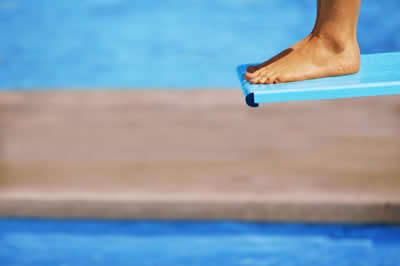
Risk minimization for the athlete is emphasized with the removal of these three dives in the straight position. When each dive is performed slightly short of vertical, the diver’s head may be precariously close to the diving board. The risk of hitting the board in these cases is far greater than any other dive on the chart.
9-7-4c - Adds a penalty for when a diver’s head is too close to the diving board. The diving referee shall make the determination and inform diving judges to score the dive as unsatisfactory
Addition of this element provides the diving referee with a sanction that is imposed to encourage diver safety and minimize the risk factor of the diver performing the dive in a way that brings the diver’s head too close to the board (within 6 inches). A dive that is performed with the diver’s head unsafely close to the board is at least equally important as a diver touching the board with their hands or feet. In keeping with national trends, NFHS rules focus on preventing the diver’s head from coming too close to the board. The diving referee will be responsible for making the call and will instruct judges to score a maximum of two points. The diving referee shall be seated in line with the end of the board to have an accurate line of site for judging this new requirement.