Vol VI, No 9 - September 17, 2024 | |
|
Some brick-and-mortar schools started last month and others this month. For weeks now, social media posts have been filled with cute, first-day pictures featuring children wearing sparkly new backpacks and sporting fresh haircuts.
Homeschoolers don't really have a "first day." So in honor of NOT back to school, the GHF Board has come up with some tips for families who may be starting homeschool for the first time, those who are getting back to more 'schoolish' homeschool after a fun summer, or veterans who are rolling along at a steady pace and still appreciate community and support.
Many of our board members have homeschooled their children for their entire elementary, middle, and high school years. That's a lot of time to log tips and tricks. Read below for their nuggets of wisdom. I am fond of the one that advises fort building. (I hope adults are allowed. Tea time in an under-the-table fort sounds lovely.)
Wishing you a very happy NOT back to school for all of those who participate. And for those home educators who blend brick-and-mortar school with home projects and enrichment, you get to be back to school and NOT back to school as it suits you. This could be perplexing, or practically perfect, depending on how you look at it. I'm getting Alice in Wonderland meets Mary Poppins vibes from this whole intro. Now I have some new read-aloud ideas. Thank you for that.
-Marna
| |
|
Marna Walthall Wohlfeld is a mom of four, a former non-profit director and journalist, and now a doctoral student at Bridges Graduate School of Cognitive Diversity in Education. She has deschooled, unschooled, and homeschooled various kids at various stages. She loves learning about and championing kids' unique brains and learning styles. She hopes to use her graduate degree to support parents and caregivers of twice-exceptional children as they move through the journey of parenting their wonderfully complex kids. She also hopes to advocate for 2e students by creating greater understanding about the need for strength-based approaches and support for vulnerable nervous systems in education and life. Marna is a trained SENG facilitator. She has presented at NAGC and WCGTC and has written for 2e News.
| |
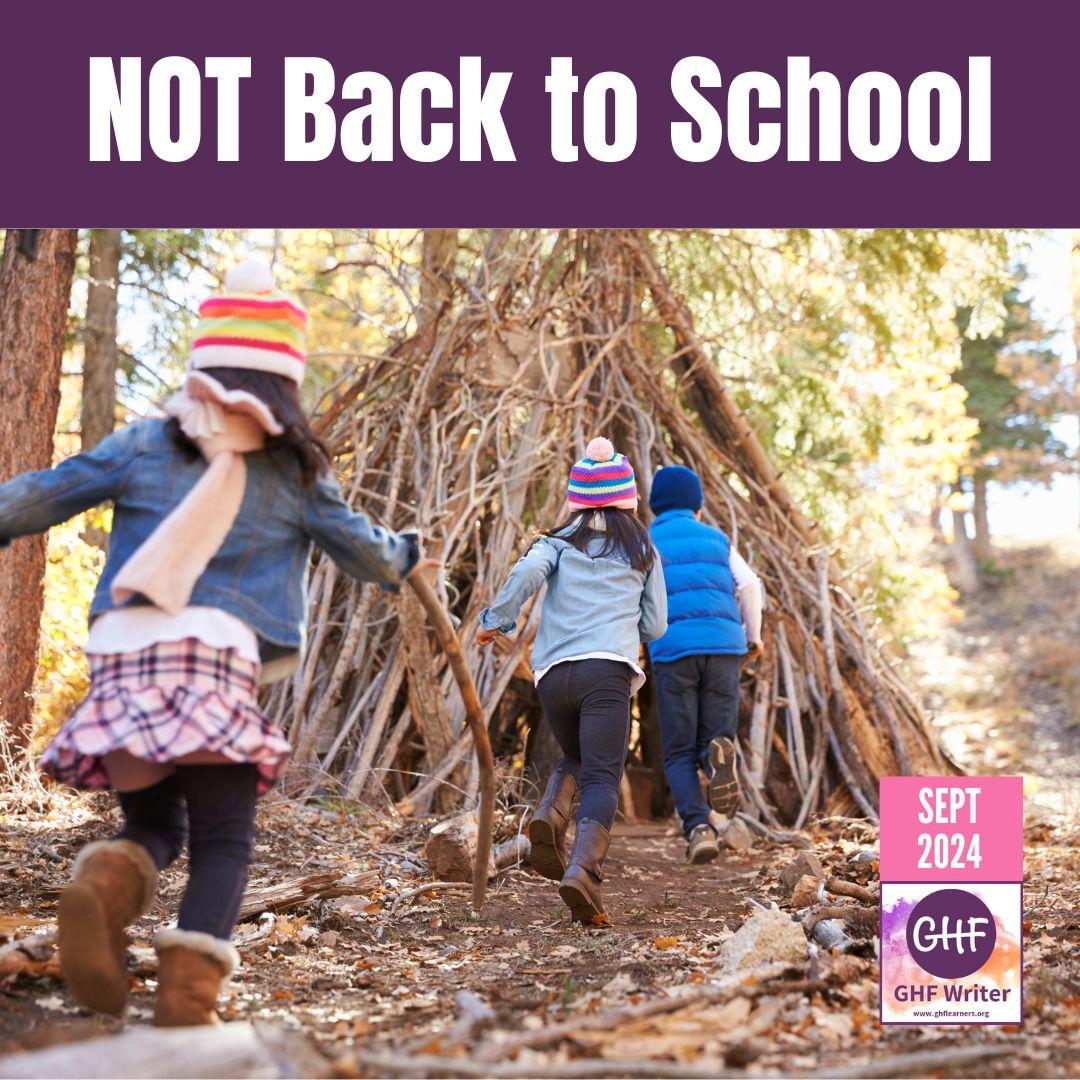 | |
NOT Back to School
Homeschooling Tips for G/2e Kids from the GHF Board Members
- Don't try to recreate school at home. Homeschooling is quite efficient. What might take a classroom teacher an entire hour to get through might take 15 minutes at home. Don't worry! You don't have to fill that extra time with more work. Your kids will enjoy the freedom to learn in non-traditional ways.
- Take some time to discover your child's strengths and interests. Exposing them to new opportunities, field trips, and family travel are wonderful ways to explore together.
- Get creative with your workspace. Kids don't have to be sitting at a desk or a table. If they are not getting work done or don't seem focused, ask them what kind of space would help them work best and create that. Maybe it's a fort under a table, curled up in bed, or outside on the grass.
- Find a community of parents who have made the same choice for homeschooling and use them as a source of support to talk about parenting 2e children and to learn new, effective homeschooling strategies.
- Find a community of support for your 2e child. Having fellow uniquely gifted peers provides your child a source of comfort, support, and engagement.
- Access gifted homeschooling resources/research to learn current and best practices to support your 2e child.
- Take your time purchasing curriculum. Crowdsourcing can be a good start, but there are numerous resources that work well for gifted-2e learners, and what works well for one may not for another. Providers will often offer a free trial when requested.
- Embrace an expanded view of what "learning" looks like. It can be much more expansive than what is typically taught in schools, and it need not be reading/writing focused. Hands-on projects, podcasts, documentaries, subscription kits, maker space materials, tinkering, arts, cooking, and collaborative discussion are all engaging ways to learn.
-
Collaboratively set a scheduled time to build a positive parent-child relationship with each of your children through an enjoyment-based activity. Note this is NOT academic, but enjoyment-focused, i.e. joint reading time, hiking. Allow your child to share their views/perspectives within a safe environment.
- Investigate safe spaces to build social skills and connections - it may come in person, virtual, through volunteer opportunities, offering to host an interest group, or through mentorship. It is okay to be involved in different groups that connect with one aspect of our complex selves so our whole self is nourished through a community approach.
- One of the toughest things for families with kids in brick-and-mortar schools is getting out the door in the morning on time and with all the necessary items. Enjoy the freedom to create a schedule that suits your family’s preferences and needs.
- Take advantage of the opportunity to access museums, zoos, libraries, and other favorite exploration sites during the school day when things are relatively quiet. (Call ahead to make sure busloads of kids aren’t scheduled to show up on the day you plan to visit!)
- Build in some time for self-care. Remember that how you take care of yourself shows your kids how to take care of themselves. It’s not selfish, it’s an important life skill.
- If your child is 2e, lean into their areas of strengths and figure out what supports they need related to their learning differences or neuropsychological wiring. Homeschool is an ideal place to create an environment that best suits your unique 2e student's needs.
- Lastly, don't forget to play. Children, and humans of all ages, learn well through play.
| |
|
Parents today lead busy lives and it’s difficult to “get it all done.” Gayle and Lin have created a guide encouraging parents to strengthen their connection with their youngsters using shared reading time. This book provides a selection of carefully curated picture books that can be used by parents to address important issues with their children, such as worry, perfectionism, and managing “big feelings.” Gayle and Lin also provide expert advice to gently guide parent-child conversations using simple, science-backed methods, including ways to help your child develop empathy, self-regulation, and self-acceptance. All of this is artfully accomplished as the authors share both research-based strategies and their own parenting experiences to bring out the very best in children using a strength-based approach.
Purchase Using Picture Books to Help Little Ones Learn About Themselves here.
| |
A Supportive Community for Gifted Learners | |
Come join us in the GHF Forum, our online community where we share all of our services and resources. | |
FREE ACCESS to:
- Discussion groups
- Parenting Gifted
- Professionals
- Parenting 2e
- Homeschoolers
- Live Gifted Home Ed Conference
- Live GHF Conversations Mini-Cons
- Live Monthly GHF Expert Series
- DIY Education Homeschooling Parent Course
UPGRADE to GHF Choices Membership:
- GHF Expert Series Library
- GHF Member Discounts
- Forever Access to Gifted Home Ed Conference & Conversations Recordings
| |
|
For those of you who can give at least $500 we have created a special recognition program where you will be listed on the GHF website and in our monthly newsletter, The GHF Journey, as valued members of the community. Donations may be kept anonymous.
- Tricia Delles, CPA
- Catherine Gruener, M.A., M.A., LCPC, LCMHC, NCC, BC-TMH, Gruener Consulting LLC
- Rosemary Guillette
- Kelly Hayes, Wonder Homeschool Center
- Dr. Melanie Hayes, Big Minds Unschool
- Jen Merrill, Laughing at Chaos
- Heidi Molbak, Seed Starter Educational Consulting
- Dan Peters, Summit Center
- Kasi and Rob Peters
- Magalie Pinney, State Street’s Do More Grant
- Deborah Reber, Tilt Parenting
- Elizabeth Ringlee, The Champion Project
- Jade Ann Rivera
- Lin Lim-Goh, The Quark Collaboration
- Debbie Steinberg-Kuntz, Bright and Quirky
| |
MISSION
To empower every gifted family to make strategic, proactive, and intentional educational choices.
VISION
A diverse world of multi-generational families, educators, and professionals supporting each other through community, education, and creating content relating to gifted home education.
#GIFTEDHOMEED
Empowering gifted families to make strategic, proactive, and intentional educational choices.
VALUES
GHF values the uniqueness and humanity of each person in our community. We treat each other with love and kindness and particularly abhor bullying and negativity of any kind. We accept that it is our job to examine each day with a fresh perspective and continue to improve the organization to pursue our mission.
| |
GHF is a 501c3 organization. Please consider supporting our community with your most generous gift today. For more information on our organization, please feel free to contact us. Thank you!
| | | | |