Elmo Peeler Note-for-Note Piano Transcriptions
| |
|
Today is the first day of September - and time again for my monthly newsletter, to keep you informed of recent transcriptions and other news of the last month.
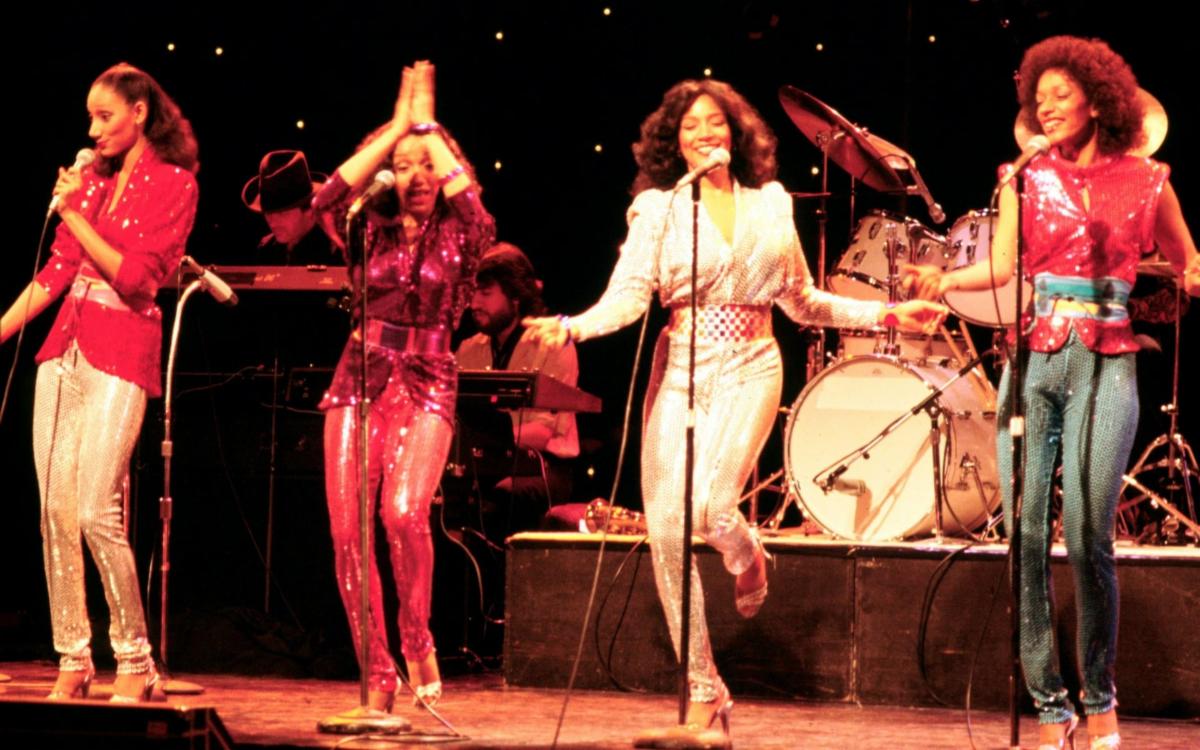
This month I've transcribed the entire piano part for the long version of Sister Sledge's "We Are Family". Even though I don't like most disco music, I've loved this piano part for years - a great piano track.
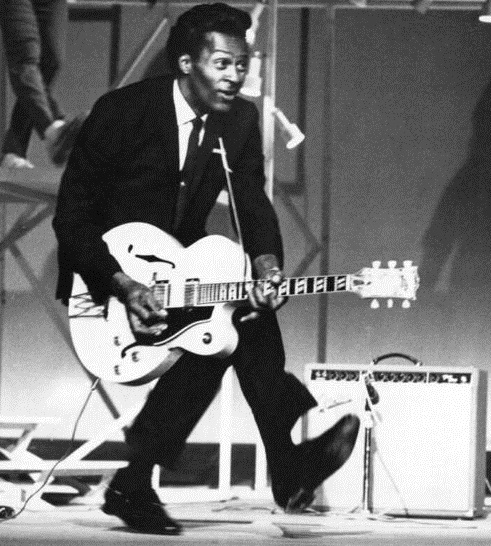
And, in some regions a TV commercial has been airing for Amazon Prime 2-hour grocery delivery service, using a short section from Chuck Berry's "It Wasn't Me" - one of the coolest, tinkliest boogie-woogie piano parts I've heard in a long time. So naturally I had to transcribe the entire song.
Plus, a new fairly-challenging finger exercise to help your ability to play fast, articulate right-hand runs.
BTW, to make sure that my email doesn't end up in your Spam folder, please add me to your Contact list and/or mark my email as "Not Spam".
Note that every Title Heading is clickable.
Elmo Peeler
|
|
|
ALL of the Sheet Music listed on my website has been personally transcribed by me, and guaranteed to be note-for-note perfect. Whether you: -
have a cover band and want to get your keyboard parts exactly correct,
-
are a professional who wants to study the styles of rock's greatest keyboard players, or
-
are a hobbyist that wants to learn how to play pop/rock and great piano music,
...these note-for-note transcriptions will prove extremely helpful. And as always, if you ever need any help, just drop me a note at: elmo@manymidi.com
|
Plus Chuck Berry's "It Wasn't Me" (Amazon Prime TV commercial)
 |
| |
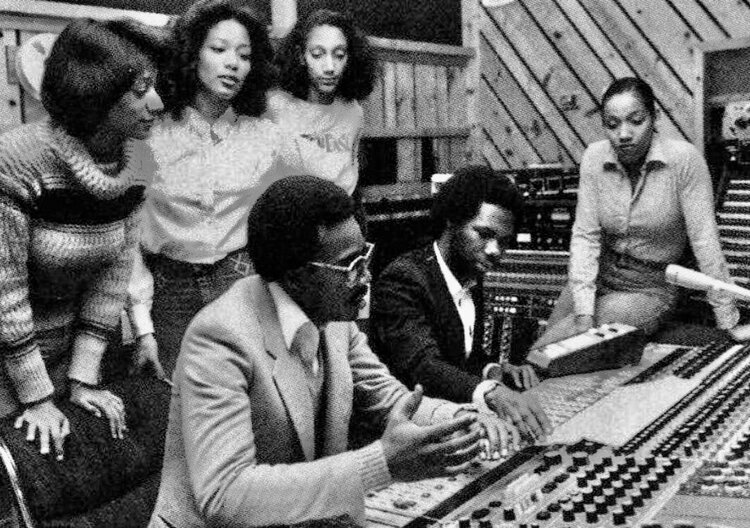
Sister Sledge - in the studio with
Bernard Edwards, Niles Rodgers
|
Recorded by American vocal quartet Sister Sledge, "We Are Family" was composed by Bernard Edwards and Nile Rodgers. Offered to Atlantic Records, the record label initially declined. Later the track was released as a single from the album of the same name in April 1979, began to gain club and radio play, and eventually became the group's signature song.
"We Are Family" went platinum, becoming the #1 R&B and #2 pop song on the American charts in 1979, and reaching #1 on the Billboard Dance Club Songs. In 2017 the song was selected for preservation in the National Recording Registry by the Library of Congress as being "culturally, historically, or artistically significant." Billboard magazine named it #20 on their list of 100 Greatest Girl Group Songs of All Time.
"We Are Family" was
|
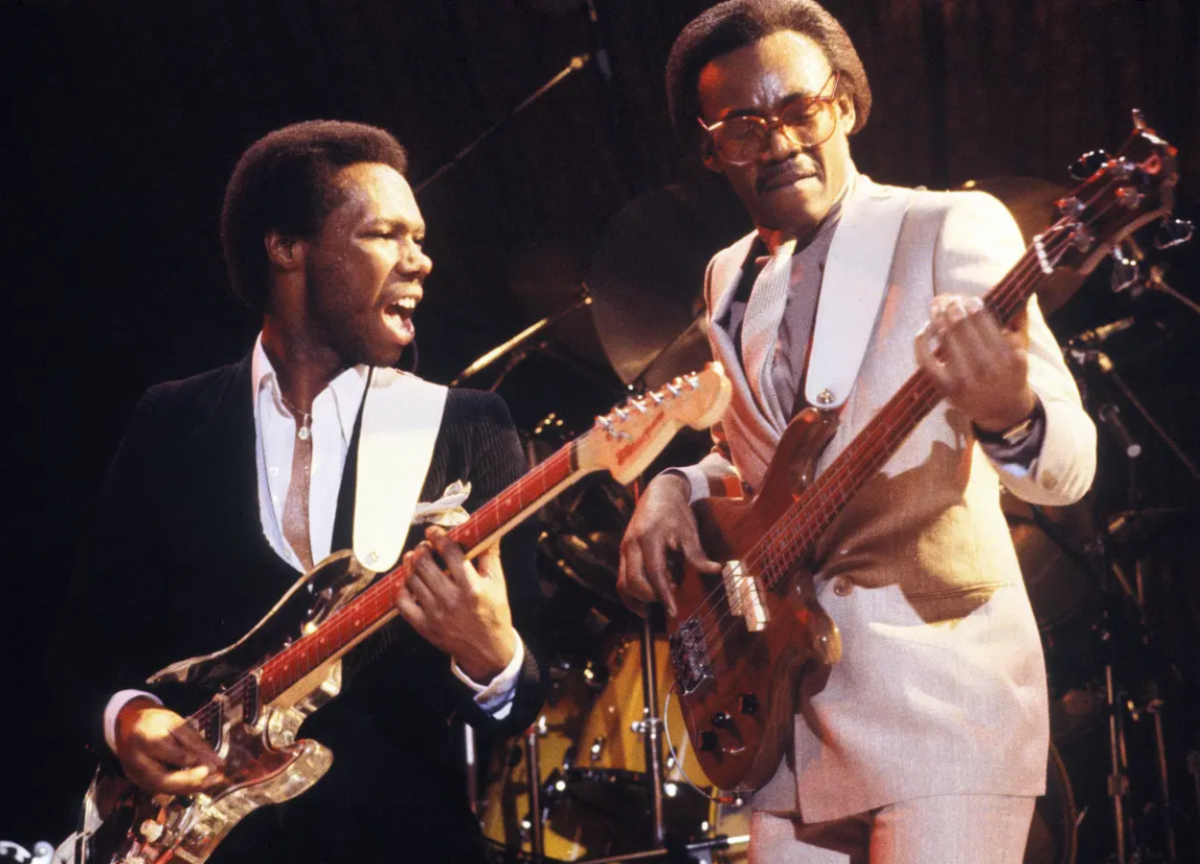
| | Niles Rodgers & Bernard Edwards
| |
the first song that Nile Rodgers and Bernard Edwards wrote for any act other than their own band Chic. After their first hit, "Dance, Dance, Dance (Yowsah, Yowsah, Yowsah)", Atlantic Records President Jerry L. Greenberg wanted the pair to write and produce for other acts on the label. However, Rodgers and Edwards did not feel confident enough to work with big, established recording artists and performers, such as The Rolling Stones, Bette Midler, etc.
They also felt that if they worked as Greenberg had suggested, credit for a hit would go to those established people, and Rodgers/Edwards would not gain proper notice as songwriter/producers. So the pair suggested that they write and produce a song for the label's least established act; if they got a hit record, then they could take the challenge of writing for someone bigger.
According to Rodgers, the verses were based on how Greenberg described Sister Sledge to them when first commissioning the work. Rodgers/Edwards then simply walked immediately to the studio, rearranged their notes from the meeting into lyrics, and wrote a song melody underneath them. The chorus (and title) makes reference to the fact that the group are the four sisters of a family.
The lead vocals to "We Are Family" were recorded in a single take by then-19-year-old Kathy Sledge.
Here is my new Sister Sledge transcription:
This year a teasingly-short 30-second version has been aired on TV as Amazon Prime's 2-hour grocery delivery service commercial. Upon first hearing it I assumed it might be Johnnie Johnson or Lafayette Leake, but it turned out to be yet another master tinkler of the 88's, Sonny Thompson.
Sonny Thompson was born in 1916 in Centreville, Mississippi in Wilkinson County - the most southwesterly of Mississippi counties, not far from New Orleans.
In his teens he moved to Chicago and attended the Chicago Conservatory of Music. Influenced by Earl Hines and Art Tatum, in his late teens he secured a job playing with Erskine Tate.
For a time Thompson attended the University of Chicago, and also had gigs with Red Allen, Stuff Smith, and his own combo called The Rhythm Masters.
In late 1942 he enlisted in the army and suffered a serious injury which left him hospitalized for a while, then recuperating at home.
He resumed his musical career in late 1944 and in the spring of 1945 landed a top job playing at the Hotel Pershing with a fourteen piece orchestra. The band broadcast nightly remotes live, continuing for a number of months.
In early 1946 he disbanded the orchestra and began to work again as a solo performer. His first session in the recording studio was for a small Detroit label called Sultan Records, and he then recorded with a combo backing up vocalist June Richmond for Mercury.
After joining Miracle he mainly played behind other artists throughout 1947. It
was the instrumentals he cut at the tail end of these sessions for various singers that set his career off in another direction.
The first of them, "Long Gone (Part 1 & 2)", became the biggest hit of 1948, in the process launching the two-part single and establishing the slow seductive groove of rock instrumentals in contrast to the more flamboyantly honking sides that were popular at the time.
He followed it up with another #1 hit later that year, but soon settled into a career that took himself largely out of the spotlight, preferring instead to back other artists in the studio - most notably for King Records in the early 1950's doing sessions for everyone from Wynonie Harris to Little Willie John and Otis Williams and The Charms - and to also produce the records.
In 1952 he hired Lula Reed, a new female vocalist, to front his own touring/recording band, and ending up marrying her as well as having hit records together, the biggest being "I'll Drown in My Tears", which he wrote (later recorded by Ray Charles as "I'll Drown in My Own Tears").
After overseeing Henry Stone's Chart Records operation in the mid-50's followed by an A&R stint at Chess Records, he eventually returned to King Records as their A&R man and top producer, overseeing the bulk of their recordings in the late 50's and early 60's. At King Records he helped shape blues-rock guitarist Freddie King's early successes, writing "I'm Tore Down".
As a songwriter he penned some of the most enduring classics of that time, and the number of hits he played on behind other artists were equally notable, but it was Thompson's early instrumental hits and the influence they had on rock's early course which remained his most lasting legacy. He died in 1989 just shy of 73 years old. In 1965 Leonard and Phil Chess produced Chuck Berry's Fresh Berry's album, which included "It Wasn't Me" with Sonny Thompson on piano, Bryce Roberson on bass, and Walter Ben Ruffin on drums. Thompson's piano part is an extraordinarily cool, tinkly boogie-woogie that is almost all in thirds from beginning to end - and when not in thirds he uses sixths (flipped 3rds, of course).
My Chuck Berry transcriptions:
|
"It Wasn't Me"
Note-for-Note Accuracy
Two versions of "We Are Family" by Sister Sledge were released, the single edit at 3:35 and the album version at 8:06. Guess which version I decided to transcribe? :)
Yes, this month I've transcribed the entire acoustic piano part for the long version of "We Are Family", the huge 1979 hit.
This transcription is from the 24-track multitrack master's isolated piano part, thus making a perfect note-for-note transcription possible.
Although I've loved the piano part ever since first hearing it years ago, some might think it is too repetitive. I don't find that to be the case. Starting simply, it gradually adds notes, building slowly. Some of my favorite parts are the Left Hand/Right Hand drum paradiddle-type licks occasionally thrown into the turn-arounds. They are all included, of course.
On the album version the rhythm section breaks down for 32 bars with the entire rhythm section muted (except bass and electric piano pads), including the acoustic piano. But during the recording session, the pianist didn't stop playing. His part during those 32 bars was just muted in the final mixdown. Those missing 32 measures of acoustic piano are included in this 208-measure complete transcription.
My other new transcription this month is the wonderful, high, tinkly, bouncy piano part in Chuck Berry's "It Wasn't Me". It's been aired on TV this year as the track on Amazon Prime's 24-hour grocery delivery service commercial.
Although it's not as well known as "You Never Can Tell" and "Nadine", "It Wasn't Me" has a piano part that's every bit as remarkable. At first listen it sounds like Johnnie Johnson's high-register tinkling, but research indicates that it was Sonny Thompson, a very strong Chicago-based session player.
The entire recording is underpinned by a terrific boogie-woogie piano part that happens to be almost completely in thirds in the right hand, spanning the registers from below middle C to the highest octave. Occasionally the thirds are flipped and sixths are used, but it could well be titled "boogie-woogie in thirds".
One of this track's defining characteristics is the detached, bouncy touch. Although never a sharp staccato, the right hand part is always detached, never legato, and very 'bouncy'. Its feel is one of the best of Chuck Berry's recordings, and that's saying something.
This contains the entire recording - all 98 measures - not just the 30 seconds used in the Amazon commercial.
If you'd like to study how a well-done Chuck Berry piano track is constructed, and perhaps incorporate some of the licks into your own playing, this piano part is an excellent tutorial.
(listen to the classic piano part in "We Are Family" here)
(listen to "It Wasn't Me" here)
(watch the Amazon TV commercial here)
|
Finger Exercise in Three Parts
Playing 6ths in rock, blues, boogie, and jazz can be a little challenging, whether they're solid 6ths or broken. My new exercise this month is a finger exercise in broken 6ths, primarily for the Right Hand, that will help increase strength, articulation and independence of the 1st/2nd and the 4th/5th fingers.
It includes fingerings and is in three parts: 1) preparatory exercise 2) main ascending/descending exercise 3) mirror image of the preparatory exercise, for the Left Hand
(BTW, if you need other good, effective technical exercises, please check out the other 78 exercises available.)
|
Roy Bittan (the E-Street Band) Played the Piano Part
'Custom' (to-order) transcriptions can be expensive because of the time required. And when a recording is particularly long and/or complex, the expense can be too much for one person.
Fortunately, "CrowdFunding" (I use the term generically) has now succeeded four times with important transcriptions: first Ethel Caffie-Austin's "Amazing Grace", then Don McLean's "American Pie", then Johnny Rivers' "Rockin' Pneumonia". and Chuck Berry's "You Never Can Tell". Thanks very much to everyone that contributed.
The way it works is simple: No contributor will be allowed to pay in advance, but only after the transcription is finished and distributed to all the contributors and everyone is happy with it.
Last month I asked for support for a very long transcription, the piano part on Bonnie Tyler's classic, "Total Eclipse of the Heart" (click here to listen).
I'd always assumed that it was played by Jim Steinman or some other good piano-player. What I've discovered is that it was played by no less than The E-Street Band's Roy Bittan, and really is a superior rock piano track - six-and-a-half minutes of Bittan at his best!
But therein lies the problem - it's very long and transcribing it would require a lot of time, perhaps a month or more. Having listened to it a lot recently, I feel it's almost up there with "Bridge over Troubled Waters" as an iconic rock piano track rarely surpassed.
Unfortunately only one individual has expressed interest in helping. Are any others out there?
if you'd like to help 'crowdfund' Roy Bittan's superior piano track on Bonnie Tyler's "Total Eclipse of the Heart".
My 'CrowdFunded' transcriptions to-date:
|
|
Class Size = 1
Most of us hate to see the summer end - I surely do. But since September is here again, put it to good use and go back to school. No, not in a class of 30 people or more that's a half-hour drive from your house. Enroll yourself in one-on-one individualized instruction at your own keyboard with someone that can help you achieve your musical goals. I'll be happy to help you. By means of Skype lessons, I can coach you and help you to improve your technique, your rhythm, your knowledge of music theory, and to develop relative pitch.
I've had the good fortune to have toured the world playing keyboards and arranging/conducting for these Rock and Roll Hall of Fame Artists:
- The Beach Boys
- Rod Stewart - All 'Unplugged' concerts
- Ricky Nelson - Stone Canyon Band
And I've also won classical piano competitions performing Beethoven, Rubinstein and Saint-Saens' Piano Concerti. See me playing here. "Josie's Boogie" is quite the virtuoso dramatic minor-key showpiece; check out the ascending double-octave run at the ending... :) Thanks to the internet, I can help you play piano better - rock or classical, by ear or by note. Perhaps all you need is just an hour on Skype discussing rock keyboards. If you'd like to improve, drop me a note at info@manymidi.com. Tell me three things: 1) Your musical background 2) Where you are currently, musically-speaking 3) Your musical goals
My students include members of:
- Weezer (Rivers & Brian)
- Vampire Weekend (Ezra & newest addition, Greta)
- Incubus (Mike)
- The Strokes (Nick)
- Rooney (Robert)
- Jason Schwartzman ("Mozart in the Jungle")
- Courteney Cox
|
|
|
|
|