Timely Information and Points (TIP) for public health community providers from the Center for Health Innovation, New Mexico's Public Health Institute. |
|
Greetings from the Center for Health Innovation (CHI), New Mexico's Public Health Institute. You've been recognized as one of the leading public health professionals in our state, which is why you have been sent our newest publication TIPbits. Every month, we will be sending out timely information and points to aid your efforts to foster better public health in the state. Feel free to share them with your networks and community. Thanks for all you do for New Mexico, and let us lend you a helping hand with TIPbits!
|
|
Policy: Deeper Dive into Public Health Resources
|
New Mexico Community Data Collaborative |
The New Mexico Community Data Collaborative (NMCDC) hosted by the Center for Health Innovation, is a consumer-driven, place-based, geographical information systems (GIS) database that maps cross-sector health, economic, social, education and other data down to the zip code level in this state. This data commons is a key tool for public health and community stakeholders to: understand their neighborhood context in detail; identify gaps and assets in health/social services; compare health patterns and services across communities; measure health or economic outcomes; and gain critical insights either to plan neighborhood-level interventions or support policy/advocacy campaigns. NMCDC is essential for identifying upstream social determinants of health at the local level. It has staff who listen to community-client data needs, then respond and/or collaborate to address those needs. As public health practitioners work toward eliminating disparities and improving racial equity, NMCDC-mapped data improve neighborhood-level assessments that reveal geographic differences.
|
|
Example: NMCDC Use in Public Health Policy Work |
|
Broadband/Internet: New Mexico is the third least broadband-connected state in the nation. Few New Mexicans—especially those facing inequities, such as low-income, Tribal, colonias, and rural populations—have access to reliable, affordable broadband. Given the COVID-driven need for broadband to support population health (telehealth), education (school learning at home), and economic growth, reliable broadband is now an essential service.
|
|
Senate Bill 93 (SB93), “Broadband Access and Expansion Act,” sponsored by Senators Michael Padilla and Elizabeth "Liz” Stefanics, would establish an Office of Broadband Access and Expansion, to: (1) set quality service standards; (2) assess and map broadband access gaps in the state; (3) request input from local, regional and Tribal communities; (4) structure a 3-year state broadband plan; (5) provide technical and planning assistance; (6) identify/seek funding opportunities; (7) and allow utilities to share easements/right of way and facilities to enable broadband transmission.
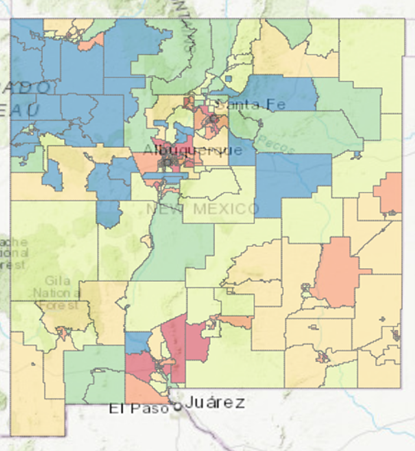
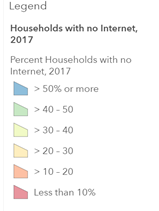
The NM Community Data Collaborative (NMCDC) map, “Households with No Internet Connection” seen to the side, can be used by advocates for this legislation to show how many state households do not have access—for health, education, working, and other needs—to quality Internet.
|
|
New Mexico Households with No Internet Connection, 2017 |
|
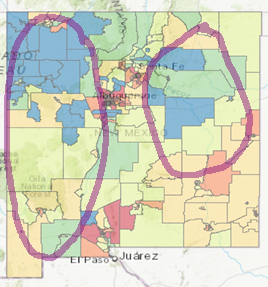
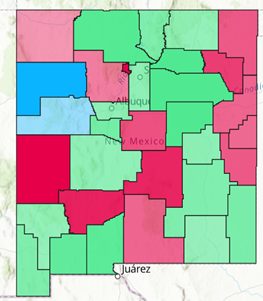
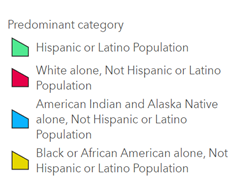
Advocates can also stress that this lack of broadband access is also a racial equity issue in our state. For example, note the circled geographic regions of this same map, and compare them to predominantly Hispanic/Latinx, rural, Tribal (or areas of the state with a larger Native American population). |
|
Predominant Racial/Ethnic Populations and Where They Live in New Mexico |
|
|
|
|
|
|