The U.S. has reached an important milestone in the pandemic, according to federal health officials.
Going forward, COVID-19 could be treated more like the flu, with one annual shot offering year-long protection against severe illness for most people.
"Barring any new variant curve balls, for a large majority of Americans we are moving to a point where a single, annual COVID shot should provide a high degree of protection against serious illness all year," said White House COVID response coordinator Ashish Jha at a press briefing Tuesday.
|
|
Register today for the CALSIPP Annual Meeting and join us for an Evening Cruise on the Bay!
Saturday, October 15 | 7:30 pm
|
|
Enjoy an entertaining three-hour yacht cruise around Newport Bay on a two-level contemporary yacht. Take in the beautiful sights from the outdoor viewing areas on the large bow, aft deck, or by strolling the walk-around decks.
Limited tickets are available, so do not wait! Tickets are $100 per registered meeting attendee or guest and must be selected on the registration form.
Register for the meeting and select the Cruise Add On.
|
|
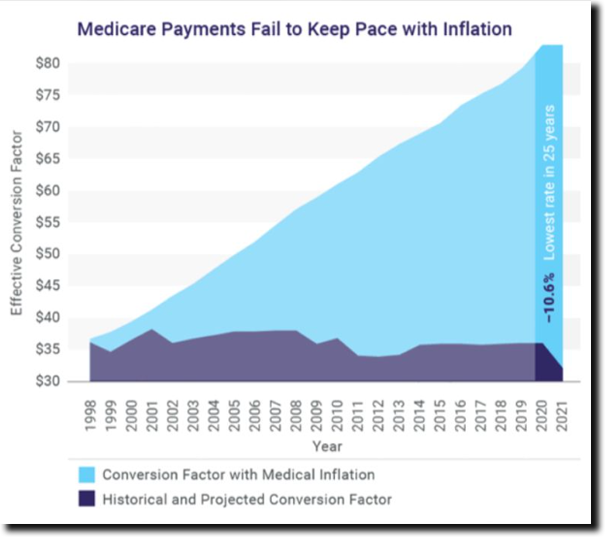
Compounded by an escalating 9% inflation, this equals a 20% cut!
This is worse than we expected. Your survival is at stake - respond now!
Join ASIPP's effort to reverse these alarming trends by clicking here.
|
|
|
To see sample rates compared to 2022, click here. In addition to the 4.4% cuts, some codes have faced higher reductions with very few codes facing increases. The same applies to 10.4% cuts.
In reference to ASCs, as of now, they are not proposing any cuts; however, a 6% cut will remain in effect unless the 2% sequester cut from ACA and 4% statutory PAYGO from the American Rescue Plan Act are eliminated.
The fee schedule remains stable except for a few small increases. Some of the procedures that received major increases include sacroiliac joint arthrodesis and moderate increases for peripheral nerve stimulators.
|
|
Federal health officials are starting to push new, variant-targeting vaccines that they say will curb a winter coronavirus wave and protect America’s most medically vulnerable people. The question is whether Americans feel any urgency to get them.
The updated vaccines from Moderna and Pfizer and BioNTech, authorized Wednesday by the Food and Drug Administration, are tailored to fighting back the dominant BA.4 and BA.5 strains. Biden officials hope the fresh doses can push down coronavirus case rates that have plateaued at roughly 400 deaths and more than 5,000 hospitalizations a day — and then stave off an all-but-assured case surge in the coming months.
The administration is “planning a robust public education campaign, building on lessons we’ve learned, and focusing on those most at-risk,” a White House official told STAT. Those efforts include a weekly survey of at least 1,500 people on the fence about getting a booster, outreach to community leaders, and text alerts from pharmacies to encourage boosters, they added. The Centers for Disease Control and Prevention will convene an expert panel Thursday to discuss recommending the vaccines to the broader U.S. population, which they are expected to do.
|
|
Revamping the CDC would require more than simply reconfiguring the organizational chart, according to public health officials, but no one should totally dismiss everything the CDC did in response to the COVID-19 pandemic and other outbreaks, nor the dedication of the many people who work at the agency.
“The ‘COVID bus’ kind of swerved from one side of the highway to the other, and we should not throw the CDC under the wheels of that bus. It’s not their fault that we kept getting new information,” said Rebecca Wurtz, MD, MPH, the director of Public Health Administration and Policy (PHAP) MPH Executive and Distance Programs at the University of Minnesota School of Public Health Division of Health Policy and Management, in Minneapolis.
“There are things that went wrong that are within the CDC’s control, and there are things that went wrong that are not in the CDC’s control. And there has been a little bit of a piling onto CDC,” said Tom Frieden, MD, the president and CEO of Resolve to Save Lives.
|
|
NEXT EXAM DATES:
Part I
September 17, October 22, November 19, & December 17
Part II
September 23
|
|
In the first two years of the COVID-19 pandemic, the estimated American lifespan has shortened by nearly three years. The last comparable decrease happened in the early 1940s, during the height of World War II.
Centers for Disease Control and Prevention officials blamed COVID-19 for about half the decline in 2021, a year when vaccinations became widely available but new coronavirus variants caused waves of hospitalizations and deaths. Other contributors to the decline are longstanding problems: drug overdoses, heart disease, suicide, and chronic liver disease.
|
|
The abstract submission deadline is September 23.
Submit yours today!
|
|
ACIP swayed by long-existing update process for seasonal flu vaccines
The CDC's vaccine advisors on Thursday recommended updated COVID-19 booster shots from Pfizer/BioNTech and Moderna that target the latest Omicron subvariants, setting aside concerns about the lack of clinical trial data with the newly formulated vaccines.
In a pair of 13-1 votes, the Advisory Committee on Immunization Practices (ACIP) recommended the bivalent vaccines from Pfizer (for individuals 12 and older) and Moderna (for individuals 18 and up) be administered a minimum of 2 months following a primary series or previous booster shot.
The updated mRNA shots contain components targeting Omicron's BA.4 and BA.5 subvariants, along with the ancestral strain of SARS-CoV-2; prior ACIP recommendations supporting the companies' monovalent mRNA vaccines as boosters have been revoked.
|
|
|
|
Please plan to join us at the
2023 ASIPP Annual Meeting
March 16-18 National Harbor, Maryland
Register Early
More details will be posted on our website at asipp.org.
Registration begins November 2022.
|
|
For meeting or exhibitor/sponsor information:
|
|
Draft report chapter on the subject is the "shock and awe" chapter, commission member says
"Shock and awe." "Almost like reading a dystopian science fiction novel."
These were some of the comments made Thursday by members of the Medicare Payment Advisory Commission (MedPAC) responding to a presentation by MedPAC senior analyst Rachel Burton, MPP, on the current financial state of the Medicare program. The commission was discussing a draft chapter from its upcoming March 2023 Report to Congress that describes Medicare's overall financial situation.
Burton began by noting that COVID-19 has had a "disproportionate impact" on Medicare beneficiaries, with 75% of U.S. COVID deaths occurring in patients over 65. In addition, end-stage renal disease (ESRD) patients, who are also covered by Medicare at any age, have been six times more likely to be hospitalized for COVID-19 than older beneficiaries, she said.
|
|
- ASIPP Members Only Site Information - |
|
-
To log in for the first time you will need to click “forgot password” at the bottom of the login window.
- Check your email and then log in as directed.
-
If you have problems logging into your account, click here.
|
|
Pain Medicine Case Reports (PMCR) and Editor-in-Chief Alaa Abd-Elsayed, MD, PhD would like to invite you to submit case reports and case series to the PMCR journal. Your article will be published free of charge.
Open access journals are freely available online for immediate worldwide open access to the full text of published articles. There is no subscription fee for open access journals. Open access journals are no different from traditional subscription-based journals: they undergo the same peer-review and quality control as any other scholarly journal.
Interested in becoming a member of the PMCR Editorial Board?
Editorial board members are asked to review 2-6 manuscripts per year. Please submit your most up-to-date CV to sgold@asipp.org for consideration.
For more information or to submit your articles, click here.
|
|
| CASE REPORT |
Sameeh Al-Maharbi, MD, Muath Al-Naabi, MD, Salama Al-Harthi, MD, and Maiya Al Mahrami, MD
Abstract
BACKGROUND: Lingual neuralgia may benefit from radiofrequency modulation. Only one paper we came across reported successful treatment of lingual neuralgia with pulsed radiofrequency modulation. The use of gasserian ganglion radiofrequency ablation for lingual neuralgia has not yet been reported, as far as we could find, and this is what we are reporting in this paper. The patient provided HIPAA compliant consent for the inclusion of their clinical information in this report.
CASE REPORT: A 64-year-old woman suffered from lingual neuralgia for more than 3 years with an initial presentation of electrical and shooting pain in the left side of the tongue. Left gasserian ganglion radiofrequency ablation was done and resulted in complete pain relief.
CONCLUSION: Gasserian ganglion radiofrequency ablation was used for the treatment of lingual neuralgia in this case. Further investigation and research are required in this modality of treatment for patients with lingual neuralgia.
KEY WORDS: Lingual neuralgia, radiofrequency ablation, pulsed radiofrequency ablation, radiofrequency neurotomy, lingual nerve, trigeminal neuralgia, case report
|
|
| CROSS-SECTIONAL STUDY |
Zhirong Zheng, MD, PhD, Tian Tian, MD, Guanhua Wang, MM, Yuhan Geng, MM, Shiqi Cao, MD, PhD, Zhen Zhang, MM, and Xuesong Zhang, MD, PhD
Abstract
Background: The 39-item ROwan Foot Pain Assessment Questionnaire (ROFPAQ) has affective, cognitive, and sensory dimensions to evaluate chronic foot pain. However, to date, the ROFPAQ has only been validated in English and Spanish versions. A simplified Chinese version of ROFPAQ is still not available, even though China has a large population of patients with foot pain.
Objective: This study's aim was to translate the ROFPAQ into a Chinese version and assess its reliability and validity in Chinese patients with chronic foot pain.
Study design: A cross-sectional, multicenter descriptive study.
Setting: This study took place at the Chinese PLA General Hospital, PLA Strategic Support Force Characteristic Medical Center and Wenzhou integrated traditional Chinese and Western Medicine Hospital Affiliated to Zhejiang traditional Chinese Medicine University.
Methods: The ROFPAQ-C (Chinese) was developed by a forward/backward translation protocol and cross-cultural adaptation from the United Kingdom to China, and from English to Chinese Putonghua. A total of 194 patients from 3 centers with chronic foot pain were recruited for test-retest measures from July 2020 through September 2021.
Results: Adequate internal consistencies (Cronbach's Alpha) in 3 domains ranged from 0.875 to 0.799 for the cognitive, from 0.795 to 0.629 for the affective, and from 0.801 to 0.811 for the sensory, as well as for the total score from 0.880 to 0.815. Adequate test-retest reliability by intraclass correlation coefficient (ICC) were shown in the cognitive 0.712 (95% CI 0.636 to 0.775), the affective 0.929 (95% CI 0.906 to 0.946), the sensory 0.753 (95% CI 0.685 to 0.808), and the total score 0.932 (95% CI 0.910 to 0.948). Adequate item-total correlations were shown for the cognitive from 0.848 to 0.825, the affective from 0.918 to 0.908, and the sensory from 0.943 to 0.855.
Limitations: The original ROFPAQ with 39 items was developed from a podiatry department of the health care national service of the United Kingdom.
Conclusions: The ROFPAQ-C can be used as a valid and reliable tool for chronic foot pain in the Chinese population.
Keywords: ROFPAQ; health impact assessment; validation studies; Chronic pain foot.
|
|
| PROSPECTIVE STUDY |
Martin Avellanal, MD, PhD, Antonio Ferreiro, MD, PhD, Irene Riquelme, MD, Andre P. Boezaart, MD, PhD, Alberto Prats-Galino, MD, PhD, and Miguel A. Reina, MD, PhD
Abstract
Background: There are patients with limiting low back pain (LBP) with or without radicular pain in whom conventional supine magnetic resonance imaging (MRI) show no causative pathology. Despite the limitations of dynamic axially loaded MRI examinations, these imaging studies have shown a striking ability to diagnose pathology unrecognized by conventional MRI. The difference in findings between supine and prone MRI with patient symptom correlation has not been studied.
Methods: Nineteen patients suffering from chronic moderate-to-severe LBP and/or radicular pain nonresponsive to conventional therapy or interventional treatment, were included in this study. Both supine and prone MRIs were performed and analyzed by a neuroradiologist. Specific supine and prone measurements were registered, including spinal canal area, lateral recess diameter, foraminal area, and ligamentum flavum thickness. Three-dimensional MRI reconstructions of varying pathology patterns were created.
Results: The mean patient age was 48.7 years (range [R]: 30-69), 63% of patients were women. The mean numeric pain score was 6.5 (R: 4-8). In 52.6% of cases, disc pathology/increased disc pathology was seen only on prone imaging. We observed significant buckling and increased thickness of the ligamentum flavum in 52.6 % of cases in the prone position that was absent from the supine MRIs. We also documented varying grades of spondylolisthesis and facet joint subluxation resulting in significant foraminal stenosis in 26.3% of prone cases not seen from supine MRIs.
Conclusions: Four patterns of pathological findings have been identified by MRI performed in the prone position. These findings were not observed in the supine position. Prone MRI can be a significant and useful tool in the diagnosis and treatment of patients with back pain refractory to treatment whose conventional supine MRIs appeared unremarkable.
Keywords: magnetic resonance imaging; positional MRI; prone MRI; spinal instability; Low back pain.
|
|
Since this malpractice insurance program officially launched in November 2018, ASIPP has signed up hundreds of providers with an average savings of 30%. This is professional liability insurance tailored to our specialty and will stand up for us and defend our practices.
Norcal Mutual is A-Rated by AM best and is licensed in all 50 states. To read a few important points to keep in mind about the program, including discounts, administrative defense, cyber coverage, aggressive claims handling, and complimentary award-winning risk management CME activities, click here.
|
|
ASIPP® has formed a partnership with Henry Schein and PedsPal, a national GPO that has a successful history of negotiating better prices on medical supplies and creating value-added services for independent physicians. Working with MedAssets, PedsPal provides excellent pricing on products like contrast media that alleviate some of the financial pressures you experience today.
|
|
ASIPP® is now offering our members the benefit of a unique revenue cycle management/ billing service.
We have received a tremendous amount of interest in the ASIPP® billing and coding program.
Click here to learn more about the negotiated rate for practices and more!
|
|
|
up-to-date news related to you, your practice, and your patients!
|
|
|
|
|
|
|