The RNA Transcript, July 26, 2021 |
|
"Two years before most anybody had heard of COVID-19 or even RNA viruses, the Biosciences funded a program in RNA biomedicine, recognizing that RNA itself was the next generation in terms of development in both medicines and vaccines."
–Roger D. Cone, Vice Provost and Director of the Biosciences Initiative,
University of Michigan Board of Regents' Meeting, July 15, 2021
|
|
The University of Michigan Biosciences Initiative's mission is to strengthen research and education in the biosciences across the university through strategic leadership, coordination and alignment across the campus. The Center for RNA Biomedicine was the first program to receive funding from this Presidential Initiative. We are very grateful for this support as we move forward hiring more faculty in the field of RNA research and expand RNA research training and mentoring at the University.
Four Center for RNA Biomedicine's faculty members are on the Biosciences Initiative Coordinating Committee (BICC). Sponsored by the president and provost, the BICC makes recommendations to the president and the provost for strategic alignment of practices, policies and investments in the biosciences. Read the Biosciences Initiative Report on Progress, June 2020, and in The Record.
BICC members who are faculty in the Center for RNA Biomedicine:
Sally Camper, Ph.D., Professor of Human Genetics and Internal Medicine, Medical School;
Arul Chinnaiyan, M.D., Ph.D., Professor of Pathology and Professor of Urology, Medical School;
Steve Kunkel, Ph.D., Acting Chief Scientific Officer, Michigan Medicine; Senior Associate Dean for Research, Medical School; Endowed Professor of Pathology Research, Department of Pathology
Janet Smith, Ph.D., Associate Director, Professor and Center for Structural Biology Director, Life Sciences Institute; Margaret J Hunter Collegiate Professor in the Life Sciences; Professor of Biological Chemistry, Medical School; Professor of Biophysics, College of Literature, Science, and the Arts
|
|
Let's celebrate AUG1, RNA Day!
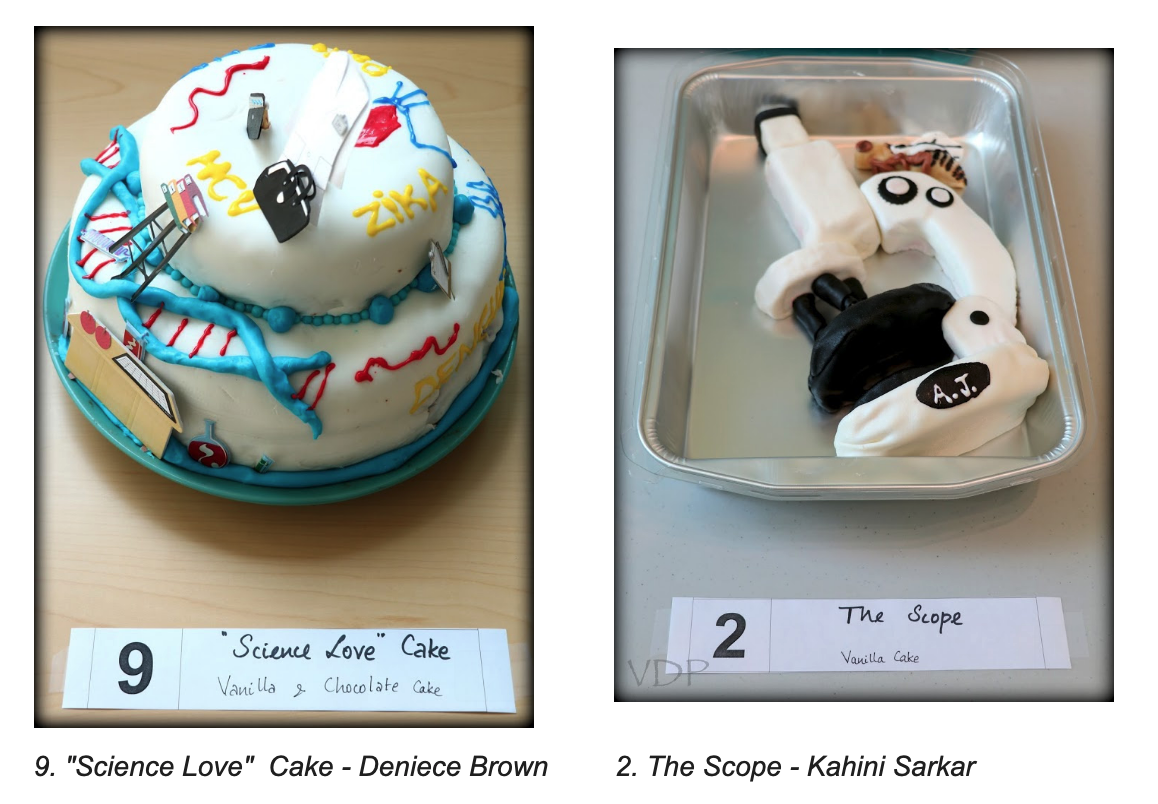
The RNA Society is delighted to announce its Inaugural RNA-themed
Baking Competition, in celebration of RNA Day (AUG1 - August 1st).
|
|
Original RNA-themed confections (cakes, cupcakes, tarts, petit fours, etc.) celebrating RNA biology, therapeutics, scientists, and any aspects of RNA or the RNA Society are welcome. Submissions will be judged in one of three themed categories: RNA structure, RNA function, and RNA technology. One winning submission will be selected in each category from submitted photos as determined by popular on-line voting by RNA Society membership.
The winning bakers will each receive a $100 gift card for their entry and their creation (before digestion) will be highlighted on the RNA Society website.
To enter, please submit a photo of your RNA-themed confection here by midnight EDT, July 31st, 2021. Any aspects of RNA or the RNA Society are welcome!
|
|
Tuesday, July 27, 4:00 pm | University of Michigan, Bioinformatics, Dissertation defense
ZOOM: HTTPS://UMICH.ZOOM.US/J/96729063007 PASSCODE: 071350
"Digital Biomarker Models for Prediction of Infectious Disease Susceptibility"
Yaya Zhai, advisor: Al Hero
|
|
“Conversion of RNA Aptamer into Modified DNA Aptamers Provides for Prolonged Stability and Enhanced Antitumor Activity”
Department of Experimental Therapeutics, UT MD Anderson Cancer Medicine
“New directions in targeting cancer epigenetics”
Santosh Kumar Dasari, Ph.D.
Gyn Onc & Reproductive Med-Rsch UT MD Anderson Cancer Center
Moderator: Gabriel Lopez, MD, Department of Experimental Therapeutics, UT MD Anderson Cancer Medicine
|
|
Thursday, July 30, 10:00 am | University of Michigan, Biomedical Engineering, Dissertation defense
ZOOM: HTTPS://UMICH.ZOOM.US/MEETING/REGISTER/TJYPDU2RRJSQH9LM0C4DZ8BS8UJ0BDGGOEEE
"Microfluidic Assay Development for Diagnosis and Monitoring of Chronic and Acute Conditions"
Alyse Krausz, advisor: Mark Burns
|
|
August 6–7, 3rd International Webinar on Nucleic Acids & CRISPR
"Cracking the code of DNA and RNA: New insights into the structure and functions of nucleic acids"
This event is a broad audience gathering for exploring the advancement in DNA, RNA, epigenetics, and innovative techniques at molecular and chemical levels.
|
|
For press releases and blog articles about your upcoming top journal publications,
|
|
Our members' publications are available through Altmetric. Five queries are currently available: "RNA," "microRNA," "Transcriptome," "Translation," and "Molecule." Please make sure to have at least one of these key words in your title or abstract. Below are recent highlights.
|
|
Microscopic examination of spatial transcriptome using Seq-Scope, Chun-Seok Cho, Jingyue Xi, Yichen Si, Sung-Rye Park, Jer-En Hsu, Myungjin Kim, Goo Jun, Hyun Min Kang, Jun Hee Lee, Cell, June 10, 2021, doi.org/10.1016/j.cell.2021.05.010
Highlights
- Seq-Scope repurposes Illumina sequencing platform for spatial transcriptomics
- Seq-Scope achieves submicrometer resolution and efficient transcriptome capture
- Seq-Scope enabled spatial single cell and subcellular analysis of liver and colon
|
|
Cotranscriptional splicing efficiencies differ within genes and between cell types, Karan Bedi, Brian Magnuson, Ishwarya Venkata Narayanan, Michelle T. Paulsen, Thomas E. Wilson, and Mats Ljungman, RNA July 2021 27: 829-840; doi:10.1261/rna.078662.120
In this article published in the journal RNA, Karan Bedi, a bioinformatician in Mats Ljungman’s lab, Department of Radiation Oncology at the University of Michigan Medical School, investigated the efficiency of splicing across different human cell types. The results were surprising in that the splicing process appears to be quite inefficient, leaving most intronic sequences untouched as the transcripts are being synthesized. The study also reports variable patterns between the different introns within a gene and across cell lines, and it further highlights the complexity of how newly transcripts are processed into mature mRNAs.
|
|
The RNA helicase DHX36/G4R1 modulates C9orf72 GGGGCC hexanucleotide repeat- associated translation, Yi-Ju Tseng, Siara N. Sandwith, Katelyn M. Green, Antonio E. Chambers, Amy Krans, Heather M. Raimer, Meredith E. Sharlow, Michael A. Reisinger, Adam E. Richardson, Eric D. Routh, Melissa A. Smaldino, Yuh-Hwa Wang, James P. Vaughn, Peter K. Todd, Philip J. Smaldino, Journal of Biological Chemistry, 2021 Jun 23;100914. doi: 10.1016/j.jbc.2021.100914
Keywords: C9ORF72; DHX36/G4R1/RHAU; DNA helicase; Dipeptide repeat proteins (DPRs); Fragile X; G-quadruplex; Huntington disease; RNA helicase; Repeat-associated non-AUG translation (RAN); amyotrophic lateral sclerosis (ALS) (Lou Gehrig disease).
|
|
Previously considered “difficult to drug” on a structural and selectivity basis, considerable efforts in academia and industry are now being focused on targeting RNA as a therapeutic modality. These efforts are driven based on both the biological significance of RNAs, as well as a growing number of studies implicating aberrant RNA biology in many human diseases.
While biologic approaches continue to play an impactful and ever-growing role in RNA-targeted drug discovery, considerable efforts are now being devoted toward the targeting of RNAs with small molecules. In the issue, both a diversity of RNA types, as well as strategies for small molecule discovery, are highlighted.
|
|
The Enhanced Program in Biophysics at the University of Michigan seeks exceptional applicants for the LSA Collegiate Fellows Program (LCF) and President’s Postdoctoral Fellowship Program (PPFP). The College of Literature, Science and the Arts (LSA) and the University seek applicants whose research, teaching, and service will contribute to diversity and equal opportunity in higher education. The program is particularly interested in scholars with a demonstrated interest in bringing to their teaching/mentoring, and/or service/engagement, and/or research the critical perspectives that come from nontraditional educational backgrounds and pathways, and/or scholarly understanding of the experiences of groups who are historically underrepresented or marginalized in higher education.
Detailed information about LCF and PPFP are on their respective websites:
|
|
Share your news
and comments,
|
|
|
|
|
|
|
|