|
Dear Friends,
Per usual, as volatility in the market picks up, so do our communications to you. We hope you find this helpful and of value. Please let me know how we can educate, inform and communicate with you to the best of our abilities going forward. We write these pieces with you in mind.
If AI is in fact a bubble, it’s a smaller bubble now than it was just a few months ago. For the first part of the year the semiconductors, AI hardware/equipment companies, data center infrastructure, and operational businesses were carrying the ball while Magnificent 7 stocks took to the bench. As a reminder the Mag 7 stocks are Apple, Amazon, Alphabet/Google, Meta/Facebook, Microsoft, Nvidia and Tesla. Through March the MAGS ETF had suffered a -19% loss from the beginning of the year. It found its footing and recovered back to new all-time highs but has been trading with plenty of volatility since. Presently MAGS is -4.75% for the year whereas the S&P 500 is now +7.8% (down -3% from the index’s high). I spoke to my frustrations with the Mag 7 in my last email (June 29th). Those frustrations remain, but I am optimistic for the future.
Much like the MAGS, the SMH ETF which is a proxy of sorts for semiconductor stocks, had suffered its own -18% loss before recovering some in the last week. After an incredible run, we saw in these areas from the likes of Micron, AMD, GE Vernova, Vertiv and others, the prices simply had to come down eventually and that’s exactly what we’ve seen transpire over the last few weeks. Rather than a bubble, I view AI as a balloon where air can be let in or out from time to time.
It appears the market has been attempting to rotate moderately from the semis to the hyperscalers, but not yet with much confidence or success. One may ask, do we need to own the semis (and other related businesses) and the hyperscalers like Amazon, Meta, Google, Microsoft, and Apple. My simple response is yes. It will come with volatility, uncertainty, rotations and “hot takes from skeptics” but it is quite evident that AI is the modern-day technological breakout akin to the advent of the internet in the 90s. Just like the internet wasn’t a fad, AI isn’t going anywhere either. If this were not the case, I do not believe we’d see Google and others issuing new debt and equity to fund their capital expenditure budget to this technology. Last night Google reported their last quarter’s earnings. While the growth was very impressive, it ‘s the fear of spending (which negatively impacts free cash flow and stock buybacks) that worries analysts the most. As such, the stock is down today by about -7% and it’s bringing down the other hyperscalers today.
A Yahoo Finance article had the following to say: “Alphabet's Q2 success was broad. Google Cloud revenue jumped 82% to $24.8 billion, with operating margins nearly doubling to 35.6%. Nearly 500 Gemini AI enterprise customers each processed over a trillion tokens in the past year. The backlog stands at $514 billion. And the "legacy" business is still thriving, too. Search revenue rose by 17%, defying bearish predictions that AI chatbots would eat Google's search-and-ads lunch.”
I personally can only believe the AI ecosystem, reach, needs, usage, and effectiveness will only grow over time. I’m not alone in this thinking. In fact, between the hyperscalers and semis, some 65% of the S&P 500’s earnings growth in Q1 2026 (up from 52% in Q1 2025) came from these two key “groups.” The earnings have been incredible and yet in some cases the stock prices have not reflected the fundamental soundness and growth. Eventually this will course correct as it has all throughout stock market history. Over the long-term, price follows earnings. If earnings continue to grow, stocks will follow. Already this year we’ve seen record net profit margins and earnings growth for S&P companies. The 1st quarter saw the highest net profit margin reported by the index since FactSet began tracking this metric. The growth estimates for the remainder of the year are even higher. This is encouraging news.
Its worth noting with all the back and forth on the war in Iran, that many investors (really traders) have been flinging to and from energy related stocks this year. The energy sector is the best performing sector of the S&P 500. It seems that President Trump has picked a bigger fight than he may have previously intended. With midterms soon approaching, I’d be hard-pressed to believe he won’t make concessions to get further resolution soon. But then again, Trump is anything but the norm in such matters and his loyalty doesn’t run as strong to the GOP as past party line politicians, so may he’ll dig in and continue to fight. I hope not.
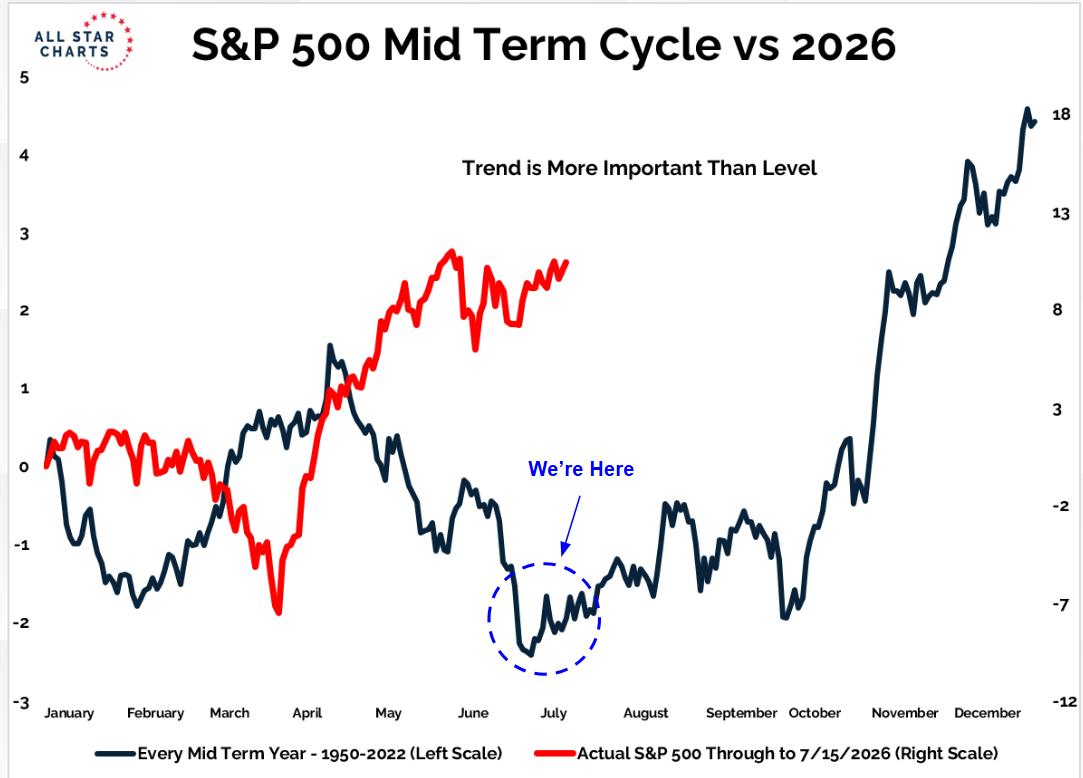
Between the shifting dynamics of AI buildouts, funding, application, and the conflict in Iran (and its impact on energy prices, which also influences inflation, rates, and a new Fed Chair), it seems as if a perfect storm of sorts could be on the horizon. If history is any kind of worthwhile indicator, we can see clearly from the chart below that the few months leading up to midterms are in fact a pivotal stretch for equity investors. I expect more volatility not less in the coming weeks. This doesn’t necessarily mean the market has to have a long fall, but it does mean we have to be sure of what we own, why we own it and the attractiveness of these stocks (companies) not only for the next few days and weeks but more importantly for the years to come. The next few months may get quite bumpy. I encourage you to stay steady and consider your long-term goals. We are in your accounts on a daily basis looking for growth opportunities as well as to how to mitigate unnecessary risks.
No matter which way the market moves, we’re here for you. Please let us know what you need and how we can be of help. We’re committed to helping you continue to reach your financial needs and goals.
Emory
|