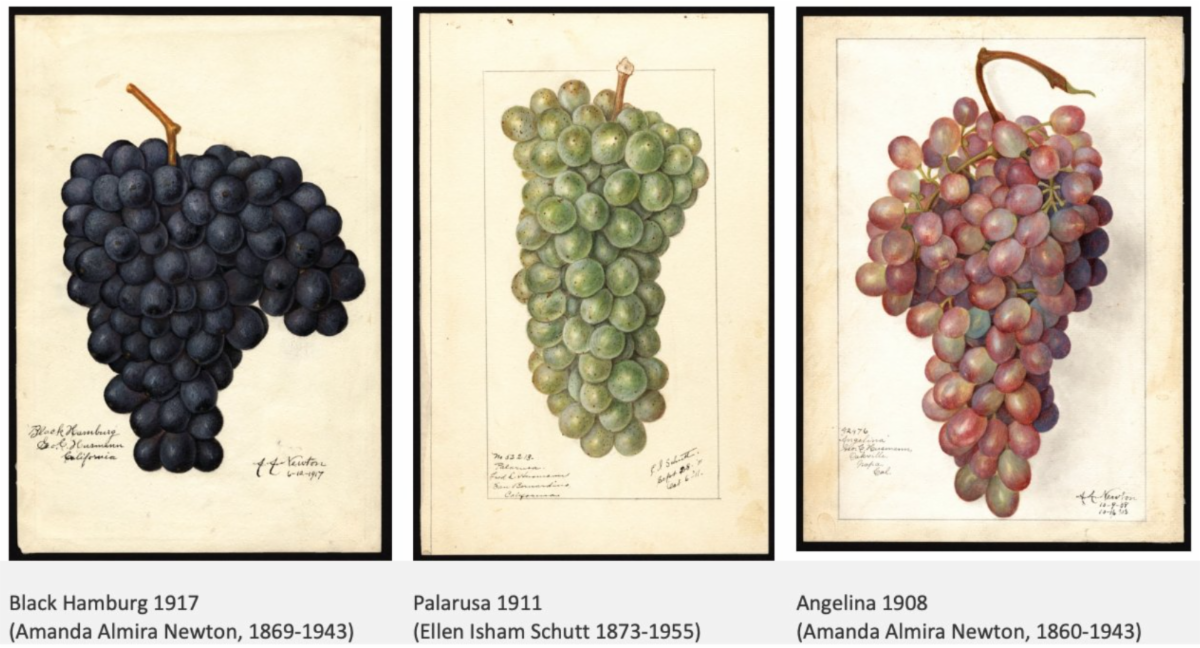
Historic grape images commissioned by the USDA* | |
|
In one of the articles in the In the News section below, the one with the clever title, “Changing Old Viticulture for All the Right Rieslings,” this paragraph caught my eye:
In 2011, scientists and industry experts [in France] launched LACCAVE, a project aimed at examining the future of French winemaking. Sticking to business as usual, they found, was a strategy that “has no future,” says Jean-Marc Touzard, director of research at the Montpellier center of the French National Research Institute for Agriculture, Food and Environment (INRAE), who coordinated the project. The team also steered away from plans that relied solely on technology to save the day, he adds, because “it leads to artificialization of the wine industry” and “disconnection from the terroir.” Solutions will need to incorporate both science and centuries of wine-growing knowledge.
It resonated thematically with two events that bookended this month for me, one celebrating a long history of grape research and the other looking to its future. Both pointed to the need for collective action, the importance of considering the bigger picture when considering solutions, and the fact that, when it comes to enacting change, time is a dwindling resource.
At the start of September, the centennial celebration of the USDA-ARS Grape Breeding Program at the San Joaquin Valley Agricultural Sciences Center (SJVASC) in Parlier, CA (see Research Focus below), featured speakers from industry, academia and government, all of whom included a message of collaboration in their remarks. It became clear as they spoke that the agency’s 100 years of grape breeding was made possible in no small part by a network of people pulling together.
For example, Vice President of UC Agriculture and Natural Resources Glenda Humiston said, “The partnership with UCANR goes back to the earliest days of the program. In the mid-1960s, our Kearney Research & Extension Center [literally across the street from the Center] dedicated 20 acres of land to grow and set trials of new grapes at no cost to the USDA. This partnership has led to many ongoing cooperative trials of new raisin selections, evaluation of new grapevine cultivars, trellis systems and development of mechanization, just to name a few.” Nearby Cal State University (a.k.a. Fresno State) also dedicated vineyard space to trial new varieties as they were developed. The contributions from the two universities, as well as from industry stakeholders and other ARS scientists across the country, helped to spur innovation and grow the table grape and raisin industries to be the global leaders they are today.
Later in the month, at a workshop organized by the California Climate Hub, a small cohort of researchers and industry representatives discussed the future of the industry in the context of climate change. As it was 100 years ago (though perhaps for different reasons), grape breeding is seen as a powerful tool to contend with industry challenges. Today, scientists and industry members alike see grapevine improvement as one solution to the “climate chaos” growers now contend with—that is, to develop varieties that are drought-tolerant, heat- and cold-hardy, disease-resistant, have a shorter growing season or better-adapted root system, and more. But we no longer have a century to adapt. Will the changes brought on by global warming outpace our ability to develop new varieties? Will the pain points even be the same once new selections are market-ready?
Technology, too, is seen as a hedge against an uncertain future, where climate impacts and labor shortages call for more controlled, greatly reduced inputs to manage vineyards. But even technology has its limits, namely that it may be too expensive for most growers to adopt or that grapevine growth habits and/or existing vineyard design may not be amenable to its use. There’s also the fear, as reflected in the quote above, that growers will lose the human connection to the earth and centuries-old tradition of growing grapes and making wine, that the nurturing “shadow of the farmer” will be lost from viticulture.
But as the conversations and media clips of this month have shown, we are bound together in this race to remain resilient against the realities of a warming world. And time is of the essence! Whether stemming from traditional breeding or modern genetics, or from robotics, AI, mechanization and automation, the next 100 years will call for both scientific innovation and grower wisdom. In the parlance of tech developers, there must be a human (or humans) in the loop for solutions to succeed. With industry collaborators from all sectors, university partners from across the country, and federal scientists, funders and advocates working together, as is our NGRA research model, we will boldly step into the next 100 years with open eyes, collaborative intent and hope for the future.
| | |
|
|
*ABOUT THE PHOTO
From 1886 to 1942, the USDA hired artists to create images of fruit and nut varieties for lithographic reproduction in its publications. The collection, stored at the USDA’s National Agricultural Library and viewable online, spans 7,497 watercolor paintings, 87 drawings and 79 wax models; 270 of them feature grapes. See more grape images from the collection.
| |
Nominate an Industry Colleague for the Rich Smith Award | |
|
Nominations are open for the Rich Smith Award of Excellence, which honors the legacy of an icon in the US grape and wine industry. It recognizes an industry representative who exemplifies the passion, commitment and collaboration Rich Smith was known for and who has had a similarly positive impact on the industry. Nominations must be submitted online by October 27, 2023.
Rich was the co-founder, along with his wife Claudia, of Valley Farm Management, Paraiso Vineyards and Smith Family Wines in California’s Santa Lucia Highlands wine region. But he also was integral to the founding of NGRA, WineAmerica and Winegrape Growers of America (WGA), which, respectively, serve to solve industry challenges through research, policy and advocacy. We join with the Smith Family annually to confer the Rich Smith Award of Excellence, each organization’s highest award. The 2024 recipient will be named at the WGA Leadership Luncheon on January 24, 2024, in Sacramento, CA.
| |
UN Releases First Global Assessment of Invasive Alien Species | |
|
Invasive alien species are driving biodiversity loss, and threatening human health and food security in every country, all over the world. A disproportionate number of documented negative impacts have been reported in “terrestrial realms,” such as agricultural lands. In 2019, global annual costs of biological invasions were estimated to exceed $423 billion.
As an issue of international importance, this month, the United Nations released its first global assessment of invasive alien species and their control. (As defined here, “alien species” are those introduced to new regions through human activities. “Invasive alien species” are a subset of alien species—they are animals, plants or other organisms known to have established and spread with negative impacts on biodiversity and local ecosystems.)
Some of the report’s conclusions include:
- Invasive alien species are being introduced by human activities to all regions and biomes of the world at unprecedented rates.
- Globally, invasive alien species and their impacts are increasing rapidly and predicted to continue rising in the future as many human activities facilitate their transport, introduction, establishment and spread.
- Overall, policies and their implementation have been insufficient in managing biological invasions and preventing and controlling invasive alien species. But ambitious progress to manage biological invasions can be achieved with integrated governance.
The report was created by the Intergovernmental Science-Policy Platform on Biodiversity and Ecosystem Services (IPBES), which represents nearly 140 member-states, and the contributions of 86 expert authors from 49 countries. It outlines key responses and policy options for prevention, detection, and effective control of invasive alien species and mitigation of their impacts in hopes of safeguarding nature, people and quality of life worldwide.
| |
USDA to Increase Public Access to Research Results; Listening Session Scheduled | |
|
In late June, USDA launched an implementation plan to increase public access to the results of agency-funded research. The plan is 10 years in the making, beginning with a February 2013 Office of Science and Technology Policy (OSTP) memorandum entitled “Increasing Access to the Results of Federally Funded Scientific Research.” USDA policy and activities were developed from that original plan and, on August 25, 2022, OSTP issued a new public access memo, “Ensuring Free, Immediate, and Equitable Access to Federally Funded Research.” Now, following that directive, USDA is enhancing policy, infrastructure and outreach to make its scientific data and publications more readily available to and accessible by the public. This includes results of research funded wholly or in part by any USDA component agency.
A listening effort allows stakeholders the opportunity to provide feedback on USDA’s plan and to inform details of its policy-making and other implementation. Sign up by October 5 to participate in a listening session on October 12, 2023.
| |
OSU’s Achala KC Achieves Tenure and Promotion | |
Congratulations to Dr. Achala KC, grapevine pathology researcher at Oregon State University’s Southern Oregon Research & Extension Center in Central Point, OR, for her achievement of tenure and promotion to Associate Professor. She joined the department of Botany and Plant Pathology at Oregon State University in October 2016, and is an associate member of the Oregon Wine Research Institute. Her research focuses on integrated disease management of commercially important crops in southern Oregon, including wine grapes. | |
Volunteer as an SCRI Relevance Reviewer | |
USDA-NIFA is recruiting industry representatives (growers, packers, shippers, staff from commissions and trade associations, etc.) to volunteer to review the industry relevance of pre-applications for the Specialty Crop Research Initiative (SCRI) for 2024. Relevance reviewers ensure that SCRI projects address critical needs for the grape and wine industry. The time commitment is about 15 to 20 hours total, spread over two months (January and February) to review and score pre-applications, and to participate in the final 1.5-hour grape panel Zoom meeting the week of February 26, 2024. Learn more. | |
Oregon Wine Board Seeks New Executive Director | |
The Oregon Wine Board (OWB), a semi-independent state agency that manages marketing, research and education initiatives that support and advance the Oregon wine and wine grape industry, is seeking a new Executive Director. The ED leads all OWB marketing, promotion, constituent relations, strategic planning and OWB branding efforts, and is a recognized leader on issues of importance to the Oregon wine industry ranging from research and education needs to market development. For this unique and important role, the OWB seeks a dynamic, highly credible, unifying leader who is deeply committed to raising awareness and demand for Oregon’s grapes and wines through marketing and education. Learn more and apply by November 3, 2023. | |
USDA-ARS CELEBRATES 100 YEARS OF GRAPE BREEDING | |
|
On September 11, 2023, at the San Joaquin Valley Agricultural Sciences Center (SJVASC) in Parlier, CA, the USDA’s Agricultural Research Service (ARS) celebrated the 100th anniversary of the USDA-ARS Grape Breeding Program. Its century of cooperative grape breeding research has impacted the way the world grows, cultivates and consumes grapes—and changed the very grapes themselves.
This historic grapevine breeding program has been developing and introducing high-quality table grape and raisin cultivars with economically important traits for mechanized production (for raisins), disease resistance and more since 1923. Its first invention—a table grape variety—was developed that year in Fresno, CA, at the USDA Experiment Vineyard, part of what was then the USDA Bureau of Plant Industry. In 1972, the program became part of ARS, the chief in-house research agency of the USDA.
Since 1923, the program has developed 21 table grape varieties, including more than half of the top 10 to 15 seedless grape varieties, and 8 raisin varieties, all cultivated worldwide. The red Flame Seedless table grape was developed by ARS scientists in 1973. Prior to its release, seedless grapes were unknown to American consumers. ARS scientists produced seedless black table grapes in 1983 and the green seedless Autumn King table grape in 2006. The release of another red table grape variety, Crimson Seedless, in 1989, further increased table grapes’ popularity. Now grown extensively by domestic and foreign producers, the Flame and Crimson Seedless varieties comprise a significant part of today’s consumer market for table grapes. The Fiesta raisin variety was introduced 50 years ago and remains a major player in the industry.
Stephen Vasquez, technical viticulturist at Sun-Maid Growers of California, and Ross Jones, senior vice president of the California Table Grape Commission, both NGRA member-organizations, spoke at the event. They praised the USDA-ARS Grape Breeding Program, both for its innovation and industry engagement. Proof points of the program’s outsize impact on both industries include:
- The California table grape industry produces 99% of the table grapes grown in the United States and is a major contributor to global markets. In 2021, 97 million 19-pound boxes of grapes worth $2.14 billion were grown in the state.
- The US leads the world in raisin production, accounting for nearly 40% of the global crop. California produces all US raisins. Raisin production in the San Joaquin Valley involves more than 1,700 growers who produce approximately 350,000 tons (dry weight) of raisins per year.
“The phenomenal research conducted by our scientists over the past 100 years created a billion-dollar industry,” said ARS Administrator Dr. Simon Liu, speaking at the event. “As we move into the next 100 years, our collaboration with the San Joaquin Valley Agricultural Sciences Center will continue to deliver innovative research that will produce high-quality, nutritious fruits for future generations.”
This article was adapted from the USDA’s press release, titled “USDA Commemorates 100 Years of Contributions to the Grape Industry,” celebrating this historic milestone. Read it here.
| |
|
NCR-SARE Partnership Grants
The North Central Region Sustainable Agriculture Research and Education Program (NCR-SARE) Partnership Grant program is intended to foster cooperation between agriculture professionals and small groups of farmers and ranchers to catalyze on-farm research, demonstration and education activities related to sustainable agriculture. Individual grants are limited to $50,000 total funding request per application. A total of $1,000,000 is available to fund 20 projects this year. Deadline to apply is October 19, 2023.
Specialty Crop Multi-State Program
This program of the USDA’s Agricultural Marketing Service (AMS) competitively awards funds to collaborative, multi-state projects that enhance the competitiveness of specialty crops by addressing regional or national issues, such as food safety, plant pests and diseases, research, and marketing and promotion. To qualify for the program, proposals must include at least two partners (referred to as “multi-state partners”) located in different states. Deadline to apply is December 22, 2023.
Rapid Response to Extreme Weather Events Across Food and Agriculture Systems
This unique USDA-NIFA AFRI program seeks applications that focus on critical and urgent solutions in rapid response to extreme weather and disaster impacts on agricultural systems with super-short-term deliverables (within 3 months of award receipt). There is no deadline for this grant program. Applications must be submitted within 30 days of an extreme weather event or disaster and will be accepted and reviewed on a continuous basis.
Rapid Outcomes from Agricultural Research
The Foundation for Food and Agriculture’s ROAR program deploys urgent funding to support research and outreach in response to emerging or unanticipated pest- and disease-related threats to the nation’s food supply or agricultural systems. The open-call application process is designed to swiftly deploy funding in response to outbreaks. There is no deadline to apply, but applicants whose concept is accepted will be required to submit a full application within 8 weeks of invitation.
| |
|
Applying for a grant? Request a letter of support!
NGRA is pleased to provide letters of support for research projects that directly address our industry-set research priorities. Request a letter by completing our online request form at least two weeks prior to the grant deadline (or any internal deadline you may have). Requests are reviewed and approved by NGRA Research Committee leadership, so processing times may vary.
| |
|
David Hugel: Will Hemp Grown Near Grapes Skunk the Wine?
September 25, 2023 | Cornell CALS
Research has confirmed that the odors of wildfire smoke and eucalyptus can taint grapes and wine through airborne transmission. Could cannabis be a concern? There are more than 40 hemp plants in a Cornell AgriTech research vineyard with buds “just about touching the grapes.” Grad student David Hugel will use this season’s harvest and the wine made from the hemp-adjacent grapes to assess adulteration.
Changing Old Viticulture for All the Right Rieslings
September 20, 2023 | Nature
Winegrape growers in France have begun advocating for changes to appellation regulations to reflect climate impacts. But they’re finding creative workarounds in the meantime. As one grower says, “We have to react quicker than our governments, because otherwise it’s going to be a real disaster.”
Ponds Release More Greenhouse Gas Than They Store
September 19, 2023 | Cornell Chronicle
A pair of papers from Cornell scientists finds that ponds, including natural and man-made ponds (like those commonly found on farms), are net emitters of greenhouse gases, as the release of methane overwhelms the amount of carbon stored in sediment. But the findings indicate that methane emissions may be tamed with bubblers or underwater circulators.
Delivering Data across Virginia Vineyards
September 19, 2023 | Good Fruit Grower
Virginia’s Sentinel Vineyard Project was created and is managed by Virginia Tech with funding from the Virginia Wine Board, an NGRA member-organization, to help the state’s 350 wineries and 450 grape growers track and share weather, pest and disease, and phenological trends. It scans 13 weather stations and gathers a group of about 15 growers every month to discuss and disseminate the state of the grapes.
How Climate Change Is Transforming the Global Wine Industry
September 5, 2023 | The Drinks Business
From wildfires to ice storms to consistently higher temperatures, climate change is threatening and transforming almost every element of the wine business. As costs related to climate extremes are forecast in the trillions, new rootstock and scion selections, new vineyard design and management practices, new vineyard sites and new approaches like regenerative agriculture are a few of the ways the wine industry is prepping for the future.
NASA Technology Can Spot Wine Grape Disease from the Sky. The World’s Food Supply Could Benefit
September 5, 2023 | Los Angeles Times
Paired with machine learning and grower-led ground-truthing, NASA’s airplane-affixed infrared imaging technology successfully detected leafroll 3 on Cabernet Sauvignon vines before they showed symptoms. Given that the virus has a latent period of one year, the finding could grant growers a significant jump on the disease before it spreads—especially if the technology can be scaled to space, says Cornell’s Katie Gold, who led the study.
Rare Tropical Weather Event Delivers Big Blow to California Table Grapes
September 5, 2023 | Growing Produce
Hurricane Hilary made landfall in California as a tropical storm on August 20, 2023, which was peak harvest for most table grape vineyards. According to the California Table Grape Commission, approximately 30% of the crop had been harvested when the storm hit. It is projected that 35% of the remaining crop—25 million boxes—has been lost. “The revised estimate for the California crop is 71.9 million 19-pound boxes,” Kathleen Nave, President of the Commission, reports. “The last time the crop was under 75 million boxes was 1994.”
Alireza Pourreza: When It Comes to AI, Farmers Will Need to Strike a Balance
September 5, 2023 | CNN Opinion
Alireza Pourreza, director of UC Davis’ Digital Agriculture Lab, weighs in on farming as one of “the jobs AI will impact most.” He writes that artificial intelligence can transform agriculture, revolutionize on-farm decision-making and help farmers address threats like labor shortages, disease outbreaks and extreme weather. But it has limitations. AI relies on the quality and accuracy of data, and often requires wireless connectivity, which can be limited in rural areas. It can be costly to implement. And it can’t replace farmers’ creative thinking and intuition.
Underpinning Terroir with Data: Integrating Vineyard Performance Metrics with Soil and Climate Data to Better Understand Within-Region Variation in Marlborough, New Zealand
September 4, 2023 | Australian Journal of Grape and Wine Research
New research from Rob Bramley (CSIRO) et al. is the first quantitative integration of vineyard performance (crop phenology, harvest date and yield) and biophysical metrics (soils and climate) as a means of evaluating terroir and its regional variation. Here, focusing on Sauvignon Blanc in New Zealand’s Marlborough region, the team found that estimates of vineyard performance in some parts of the region may be used to predict performance in others. Their results validate the value of a coordinated collection of vineyard performance metrics to better understand terroir, “especially,” they write, “as most grapegrowing businesses collect such data as a matter of course.”
Best Weed Management Practices for Winegrape Vineyards
September 2023 | Practical Winery & Vineyard Journal/Wine Business Monthly
What kind of weeds do you have, where are they growing and what (if anything) should you do about them? Here, UC Cooperative Extension (UCCE) Weed Science Farm Advisor Emeritus John Roncoroni imparts wisdom from 40 years of weed management. (Story starts on p. 22)
Rootstock Performance on Young and Mature Autumn King Grapevines
August 30, 2023 | American Vineyard Magazine
In this video, UCCE’s Ashraf El Kereamy and Tian Tian report results from long-term rootstock trials on both young and mature Autumn King table grapes. They compared performance of traditional table grape rootstocks Freedom and Salt Creek vs. those from the GRN series, seeking to give growers more confidence as they transition to rootstocks that offer nematode resistance and other benefits.
Impact of Hail-Netting on Vitis Vinifera L. Canopy Microclimate, Leaf Gas Exchange, Fruit Quality and Yield in a Semi-Arid Environment
August 29, 2023 | Viticulture Data Journal
Hail-netting is commonly used in grape-growing regions where hailstorms threaten tender shoots and fruit. But a three-year study on the Texas High Plains finds that, while netting may protect vines from hail damage, it may promote fungal disease incidence, and adversely impact vine physiology, fruit maturity and yield.
Pleas for Greater Rationalization and Branding in Grapes
August 26, 2023 | Eurofruit
Table grape growers in South Africa have more than 50 newly developed early- to late- season grape varieties, but the cost of switching varieties when new cultivars fade from popularity makes them wary of the risk. More branding by table grape breeders, as is done by Sun World, could help consumers seek out and stick with quality cultivars. Alternatively, backing by third-party brands like SA-based Flavour Burst can be used to identify exceptional varieties, as they now do for nectarines, apples and berries.
Temperature Variation Linked to Trellis Height: An Opportunity for Adaptation to Climate Change?
August 25, 2023 | IVES Technical Reviews
Temperature is closely linked with vine growth and grape composition. But as climate change impacts these parameters in many wine regions, researchers in France discovered that one way to adapt could be to make the vine’s training system taller. Their Bordeaux-based study found that increasing trellis/trunk height decreases the air temperature in the bunch zone on days of extreme heat and increases the temperature during frigid nights.
Removal of Pruned Vine Biomass (PVB) from Vineyards – Examining the Impact of Not Incorporating PVB into Vineyard Soils
August 25, 2023 | Oeno One
Is pruned vineyard biomass (PVB) more valuable as a tool to promote soil carbon in the vineyard or as a renewable biofuel for energy production? A 13-year study by researchers at The University of Adelaide explored the differences in soil carbon when PVB was and wasn't incorporated into vineyard rows. Results indicate that removing PVB has no long-term negative impact on soil carbon sequestration, suggesting that growers could confidently harvest it as a source of biofuel production.
VitisGen3 Variety Trial Enhances Biopesticide Management
August 2023 | Wine Business Monthly
An important objective of the NGRA-supported VitisGen3 project is to develop management guidelines for growers to protect disease resistance in newly developed powdery mildew-resistant cultivars. At the same time, with increases in fungicide resistance and environmental and regulatory pressure on conventional chemistries, interest has grown in biopesticides. VG3 field trials will evaluate how coupling resistant varieties with biology-driven disease management and biopesticides will improve sustainability. (Story starts on p. 40)
Improving the Fruit of the Vine
July 17, 2023 | European Cooperation in Science and Technology (COST)
Did you know that, in 2018, a project (or “action”) called INTEGRAPE was launched to develop data standards and to improve data interoperability across the global grape breeding community? The US and 42 other countries were involved. INTEGRAPE recently concluded but its work will continue via GRAPEDIA, a Grapevine Genomics Encyclopedia. Both projects were funded by the European Cooperation in Science and Technology.
| |
Find these stories and more, published every weekday, on our Facebook and X (formerly Twitter) feeds. You can also find us on LinkedIn. Use #graperesearch to join and grow the conversation! | |
|
October 3-5, 2023
North American Grape Breeders and Vitis-Muscadinia Alliance Conference
Fayetteville, AR
October 5, 2023
CDFA PD/GWSS Workshop
Non-Chemical Technologies for Pest and Vector Management
Sacramento, CA + virtual option
October 18, 2023
New York Wine & Grape Foundation Webinar
Evaluating Vision-Guided Spray Tech for Selective Sucker Control in Grapes
Virtual event
November 6, 2023
New York Wine & Grape Foundation Webinar
Biochar: Observed Vineyard Impact & Practical Insights for Application
Virtual event
November 9, 2023
NGRA Year-End Board Meeting
Beltsville, MD
November 13, 2023
New York Wine & Grape Foundation Webinar
Agrichemical Remote Sensing to Improve Sustainable Grape Disease Management
Virtual event
November 13-15, 2023
Northwest Center for Small Fruits Research Annual Conference
Corvallis, OR
November 14-15, 2023
Sustainable Ag Expo
San Luis Obispo, CA
November 16, 2023
UC Davis Grape Day
Davis, CA
November 16-17, 2023
Washington State Grape Society Annual Meeting
Grandview, WA
November 28, 2023
Learn MyEV: An Open-Access Vineyard Visualization Tool
Virtual event
November 28-30, 2023
SITEVI
Montpellier, France
November 30, 2023
North Coast Wine Industry Expo
Santa Rosa, CA
December 6, 2023
Washington Advancements in Viticulture and Enology
Spotted Lanternfly Webinar
Virtual event
December 8, 2023
Texas A&M AgriLife Viticulture and Enology Research Symposium
College Station, TX
January 22, 2024
NGRA Annual Meeting & First-of-Year Board Meeting
Sacramento, CA
January 23-25, 2024
Unified Wine & Grape Symposium
Sacramento, CA
| |
The monthly NGRA Update is provided as a service to the U.S. grape and wine industry.
| | | | |