Faculty research spotlight | |
|
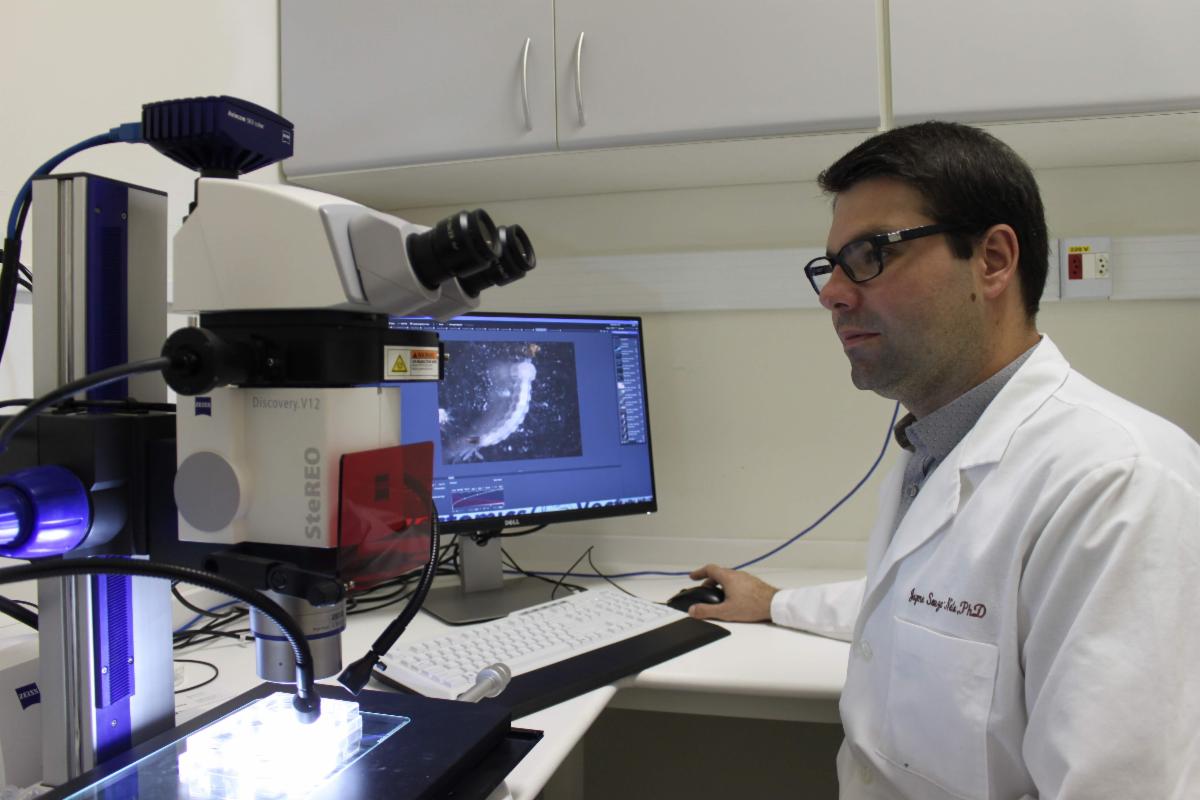
Jayme Souza-Neto, assistant professor of diagnostic medicine and pathobiology
College of Veterinary Medicine
Research overview:
I can divide my current research program in two main areas. The first has its pilar in fundamental research, aiming to understand the molecular interactions between agricultural arboviruses like Rift Valley fever virus and mosquito vectors. The ultimate goal is to identify a mosquito that can be used as a therapeutic target to transmission blocking vaccines and/or manipulated to generate mosquito populations that are refractory to those viruses. In the second area, I’m heavily involved and leading cutting-edge research in partnership with the private sector for the development of deployable Next Generation Sequencing (NGS)-based tools for biological threat detection and surveillance.
| |
|
What motivated you to pursue research in this specific field, and how has your focus evolved over time?
From my early days as an undergraduate student. I was born in Brazil, a tropical country where vector-borne diseases are a major public health issue. With time, my focus evolved from studying basic mosquito physiology to more complex mosquito-pathogen interaction studies and genomic surveillance.
What is your approach to this research?
To study mosquito-virus interactions we use a combination of approaches that range from infecting mosquitos with virus in the laboratory and then using techniques like RNA-Seq, RNAi gene silencing and CRISPR-Cas9 knockouts, to identify genes that play a role in viral replication and transmission.
Have there been any significant challenges or breakthroughs in your recent research, and how have you addressed or leveraged them?
The most recent and exciting one was extending my research program to BSL-3 level agricultural arboviruses. I would also consider it a breakthrough in my career, especially if we consider how much potential we have here with our high containment facilities at K-State and collaborators with NBAF.
What is the potential impact of your research on your field and on broader societal issues?
We can use this knowledge to support the biomanufacturing of next-gen arbovirus control tools, from drugs and altruistic vaccines to mosquito lines that are refractory to infection. These are critical to prevent the introduction, or to allow a fast response in case of an outbreak of such viruses.
Each week The Office of the Vice President for Research will feature one faculty member and their scholarly work in Research Weekly. If you would like to nominate yourself or a colleague, please fill out the online form.
*Please note that not all nominations will be accepted as there are limited weeks each semester.
| | |
K-State events and announcements | |
Journey to Leadership panel discussion | | |
|
|
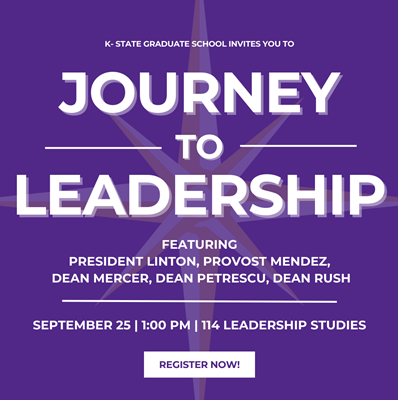
The Graduate School is excited to invite you to attend a wonderful professional development opportunity for you to engage directly with university leaders to learn about their educational and professional journey to where they are today.
Join us September 25, 1 - 2:30 p.m., Leadership Studies Town Hall for “Journey to Leadership,” a panel discussion with President Linton, Provost Mendez, Dean Petrescu, Dean Mercer, and Dean Rush.
| |
National Science Foundation Graduate Research Fellowship Proposal Feedback Sessions | |
|
Beth Powers, Director of Scholar Development and Undergraduate Research, will be conducting two National Science Foundation Graduate Research Fellowships (GRFP) Proposal Feedback sessions to help students prepare their personal statements for a submission to the GRFP program.
Personal statement group feedback session: Thursday, September 19, 3-5 p.m., Register Here
Personal statement group feedback session: Monday, September 30, 3-5 p.m., Register Here
These NSF GRFP group feedback sessions allow students to have their materials reviewed by and to receive feedback from peers and an advisor. In order to participate, students are required submit a draft of their NSF GRFP personal statement to bethpowers@ksu.edu by September 16 for the September 19 session and by September 26 for the September 30 session. Each member of the group is assigned to review a peer’s paper and given a rubric to follow. Feedback is shared during the group feedback session. Past participants report these sessions to have been very helpful. Please direct any questions to Beth Powers at bethpowers@ksu.edu.
| |
Kansas Water Institute interdisciplinary research projects | |
|
The Kansas Water Institute, or KWI, is pleased to announce funding awards to advance interdisciplinary water-related research projects for which we have received additional external funds (USGS and KDA) that are administered through KWI.
KWI State funds:
- Trisha Moore, bio and agricultural engineering: " Life cycle analysis using TAPS data."
- Maria DePaoli, Raelynne Hale, modern languages: "Bilingual Initiatives to Address Pressing Water Sustainability Challenges."
- Jeeban Panthi, Aleksey Sheshukov and Trisha Moore, bio and agricultural engineering: " Refining soil moisture estimation by integrating satellite data with local irrigation practices."
- Gaea Hock, agricultural education and communications: " Creation of Novel Use Case Studies Based on Actual TAPS Data."
- Andres Patrignani, agronomy; Abigail Langston, geospatial sciences: "Wildcat Hackathon: Innovative Solutions for Sustainable Water Use in Kansas."
- Andrew Swindle, Z. Wang and G. Hwang, Wichita State University: "Using Probabilistic Machine Learning to Enhance Access to Drinking Water in Kansas."
- Grady Dixon, Fort Hays State University: " Support three research projects related to rural well contaminant testing, antibiotic-resistant bacteria detection in municipal wastewater, and the curation of a collection of more than 8,000 specimens of freshwater mussels."
USGS State Funds:
- Jeeban Panthi, Aleksey Sheshukov and Trisha Moore, bio and agricultural engineering: "Early Detection of Harmful Algal Blooms in Kansas Lakes and Reservoirs Using Satellite Remote Sensing."
- Terry Felderhoff, Md Abdullah Al Bari, agronomy: "Water-Use Efficient Sorghum Development for Kansas through High-throughput Molecular Marker Discovery and Deployment."
- Logan Simon, John Holman and Jonathan Aguilar, KSRE: " Optimizing variety maturity and deficit-irrigation strategy for thermally limited cotton production in Kansas."
- Gaisheng Liu, Jim Butler, University of Kansas: " Playa recharge characterization by nuclear magnetic resonance profiling."
-
Justin Hutchinson, University of Kansas: " BIOSAFE: Quantifying bioaccumulation of PFAS in photosynthetic organisms for safe reservoir management."
Learn about how the KWI is elevating water to a university-level priority to bring resources and expertise together in a way that tackles our water resource challenges in more impactful ways: k-state.edu/next-gen/key-initiatives/interdisciplinary-institutes/water-institute.
| |
Register for your ORCID iD | |
|
In today’s digital research environment, standing out and ensuring your work is properly attributed is more important than ever. The Office of the Vice President for Research encourages creating an ORCID iD for a simple yet powerful way to enhance your visibility and streamline your academic journey.
Why ORCID?
-
Unique Identifier: ORCID provides you with a unique identifier that distinguishes you from other researchers, even those with similar names.
-
Improved Visibility: ORCID integrates with a variety of platforms, helping your work reach a wider audience and ensuring your contributions are accurately recognized.
-
Easy Management: Automatically link your publications, grants, and professional activities to your ORCID profile, saving you time and ensuring comprehensive documentation of your career.
Take a few minutes today to create your ORCID iD. Visit ORCID.org to get started!
| |
FDA and USRG Programs Now Accepting Applications | |
|
The Kansas State University, Office of Research Development’s Faculty Development Award (FDA) and University Small Grant (USRG) programs provide international meeting travel support and seed grant funding to K-State faculty. The FDA award can also be used to meet with program officers from potential external funders. Awards for the FDA program typically range from $1,000 to $3,500. For USRG awards, the range is now $2,000 to $5,000 which is a $500 increase in the funding ceiling for this program. The proposals for both programs are due by 5 pm on October 7, 2024, and should be submitted via ord@ksu.edu.
Contact either Mary Lou Marino (mlmarino@ksu.edu) or Kate Kennedy (kate40@ksu.edu) for further information on these programs.
| |
K-State CoSearch workshop offers fast-paced collaboration for research teams | |
|
The Kansas Water Institute will host a unique workshop opportunity for faculty October 18 and 19, 2024, in Manhattan. The K-State CoSearch workshop will be an interactive and competitive two-day event where interdisciplinary teams will innovate water-related research projects, plan a complete proposal, and pitch their ideas to a judging panel. You are invited and encouraged to attend.
This intensive two-day competition provides facilitation for interdisciplinary research teams to collaborate and develop research plans that solve real-world problems. This year’s theme focuses on water resources, with a goal to break down academic silos to produce innovative projects that unite the programs and departments at K-State. We’re hoping that this fast-paced and unique event will create unexpected collaborations between faculty from different departments and will push your comfort zones in a fun environment.
Registration links and other details can be found here.
| |
Apply for the open Research/Facility Security Officer position | |
|
As a Research Security Officer/Facility Security Officer at Kansas State University, you will be responsible for implementing NSPM-33 guidance to safeguard our research initiatives. This role requires a bachelor’s degree and 5-10 years of relevant experience, with a preference for advanced degrees and extensive security program experience. Key qualifications include strong interpersonal skills, the ability to manage competing demands, and the capacity to work independently. Applicants must be able to obtain a high-level security clearance and meet other security requirements.
Learn more and apply here.
| |
2025 Active Living Conference | |
|
We are excited to announce the 2025 Active Living Conference, taking place March 17-20 in Manhattan, Kansas! Hosted by Kansas State University, this conference will bring together researchers, practitioners, and community leaders focused on creating active and healthy places for all.
The theme for the 2025 conference is Bridging the Research to Practice Gap. We will explore how to develop strong partnerships and effectively translate research findings into actionable strategies. By working together, we can create evidence-based, culturally relevant programming that meets the needs of diverse communities.
The conference will feature:
- Presentations from leading practitioners and researchers in the field of active living
- Interactive workshops and sessions focused on translating research into practice
- Opportunities to network and collaborate with colleagues from across the globe
- A focus on building capacity to create active and healthy communities
To make the most of your experience, we encourage you to arrive on Sunday, March 16th as there will be a networking social that evening, and the conference will kick off on Monday morning. The local airport to fly into is Manhattan, Kansas (MHK).
Mark your calendars and stay tuned for more information! We'll be sharing details about registration, the conference program, and accommodations in the coming months. A Call for Presentation Proposals will be released on mid-July with a deadline of September 16, 2024.
In the meantime, please visit the conference website for more information. You can also contact Convening Coordinator, Amanda Walker, with any questions or to inquire about sponsorship opportunities.
We look forward to seeing you in Manhattan, Kansas in March 2025!
| |
External events and announcements | |
Jefferson Science Fellowship Program now accepting applications | |
|
The National Academies of Sciences, Engineering, and Medicine is pleased to announce a call for applications for the 2025 Jefferson Science Fellowships (JSF). Established by the Secretary of State in 2003, these fellowships serve as an innovative model for engaging the American science, engineering, and medical communities in the U.S. foreign policy and international development process through a one-year immersive experience at the U.S. Department of State or the U.S. Agency for International Development (USAID). Jefferson Science Fellowships are a mutually beneficial partnership between government and participating U.S. academic institutions. These fellowships are open to tenured, or similarly ranked, faculty from U.S. institutions of higher learning who are U.S. citizens. After successfully obtaining a security clearance, Fellows are embedded in an office at the U.S. Department of State or USAID where they can expect to learn the foreign policy and international development process while contributing their technical expertise to policy formulation and implementation. Note that a JSF Fellowship does not require faculty to “use up” a sabbatical leave. The year spent in Washington counts as one of the seven years needed to earn a sabbatical.
Online applications will be accepted from August 1 through October 15, 2024.
| |
Are You Interested in DARPA Funding? | |
|
Be sure to attend the DARPAConnect outreach event in Omaha at the University of Nebraska on September 18th. This is a one-day event to engage faculty and help you understand the DARPA culture and its internal processes so you are better suited to pursue funding at this agency. You will have the opportunity to engage directly with DARPA leadership, program managers, and staff who will provide invaluable insights into innovation and opportunities within DARPA.
What’s in store at this event?
Direct Access: Gain first-hand knowledge on effectively navigating the DARPA ecosystem.
Interactive Deep Dives: Participate in focused sessions that explore DARPA’s processes and priorities, aligning your work with DARPA’s mission.
Networking: Growing your professional network with DARPA, others in your field and regional organizations.
This is an excellent opportunity for:
Innovators and Researchers: Looking to bring your cutting-edge ideas to life with DARPA's support.
Industry Professionals/Academics: Seeking to collaborate on national security projects.
New Performers: Eager to break into the DARPA community and contribute to its mission.
To obtain more information and register, be sure to go here.
| |
Where can I learn everything about NSF proposals and awards? | |
|
The NSF’s Policy Office is responsible for developing, implementing, and issuing proposal and award policy for the programs of the National Science Foundation. The NSF’s Policy Office Outreach website maintains numerous resources to learn more about NSF including:
-
Upcoming NSF informational events, including a way to sign up to be notified of those events!
-
Postings of past recorded webinar series
-
An amazing Resource Center that also contains numerous recorded informational videos
For example, you can access recordings from the Spring 2024 NSF Grants Conference that was held June 3 – 5, 2024. This conference included various agenda topics such as:
- Introduction to NSF and the NSF Proposal Preparation
- Discussion of the NSF Merit Review Process
- Introduction to the Various NSF Directorates
- Discussion of the Award Management Process
- Proposal and Award Policy Update
- Research.gov and SciENcv Session
- Financial Management Update
- NSF Research Security Policy Updates
- and many more interesting sessions!
We encourage you to visit this website and access some of these great resources to learn more about the NSF and submitting your proposals to the NSF.
| |
NASA STMD Seeks Peer Reviewers for Research Proposals | |
|
NASA’s Space Technology Mission Directorate is seeking subject matter experts to serve as peer reviewers of proposals submitted to the recently released NASA Space Technology Graduate Research Opportunities (NSTGRO) solicitation. These reviews are conducted electronically via NSPIRES.
Through NSTGRO, NASA seeks to sponsor graduate student research that has significant potential to contribute to NASA’s goal of creating innovative new space technologies for our Nation’s science, exploration, and economic future.
If you are interested in serving as a peer reviewer for the NSTGRO solicitation, please fill out the following form: https://forms.gle/xD5riqwdZrqtQo51A. You can also access the form from the NSPIRES homepage under Site News.
If your skills match NASA’s needs for the review, and considerations for any organizational conflicts of interest allow, we will contact you to discuss further steps.
Participating in a review is a service to the community. Eligible reviewers will receive a nominal honorarium.
If you know of anyone else who might be interested, please share this information with them.
Please direct questions to hq-nstgro-call@mail.nasa.gov.
| |
DOE Office of Science Office Hours | |
|
The U.S. Department of Energy Office of Science monthly virtual office hours are opportunities to share information and ask questions about our six research programs and two research and development and production offices. Researchers at all institutions are welcome to attend and learn more about our programs. Topics will vary each month.
Learn more about the programs, dates and times using the links provided below:
The office hour will be in the form of a zoom meeting, starting with a brief presentation on the monthly topic, followed by questions.
| |
NSF Directorate for Technology, Innovation and Partnership Updates Webinar | |
|
September 18, 2024, 1 - 2 p.m.
Please join the U.S. National Science Foundation Directorate for Technology, Innovation and Partnerships (NSF TIP) for a TIP Updates webinar.
During the webinar, Erwin Gianchandani, assistant director for Technology, Innovation and Partnerships, will share exciting new directorate developments, including new programs, awards and funding opportunities.
TIP advances use-inspired and translational research in all fields of science and engineering, giving rise to new industries and engaging all Americans in the pursuit of new, high-wage jobs in science, technology, engineering and math, regardless of background or location.
We invite you to share the Zoom link with colleagues you think may be interested in attending the webinar. More information about the webinar is available on the event summary website.
| |
IOS Virtual Office Hour about the Postdoctoral Research Fellowships in Biology | |
|
Join us on Thursday September 19th, 12 - 1 p.m. for the next IOS Virtual Office Hour where we will be joined by our colleagues from NSF’s Postdoctoral Research Fellowships in Biology (PRFB) program. Our PRFB colleagues will tell you about their program, outline important information related to the application process, and address questions.
Please let later stage graduate students and brand-new postdocs in your lab and at your institution know that they are encouraged to attend this VOH to learn more about the PRFB program. Prospective mentors are also welcome to attend so you can provide guidance to current and future students applying to the PRFB program.
IOS Virtual Office Hours are held on the third Thursday of every month from 12 - 1 p.m.
Register here to participate.
| |
Mathematical Foundations of Artificial Intelligence Office Hours | |
|
September 19, 2024, 1:30 – 2:30 p.m.
October 3, 2024, 1:30 – 2:30 p.m.
Please join Program Officers from NSF's Mathematical Foundations of Artificial Intelligence (MFAI) Program for the upcoming office hour series, which will provide a forum for asking the MFAI team clarifying questions regarding the solicitation. These events are open to researchers who are interested in submitting a proposal to the MFAI Program.
More information and registration can be found here.
| |
STC Informational Webinar: Solicitation Overview & Leadership Insights | |
|
Thursday, September 19, 2024, 2 - 4 p.m.
The U.S. National Science Foundation Science and Technology Centers: Integrative Partnerships program (NSF 24-594) supports innovative, complex research and education projects that require large-scale, long-term awards. Science and Technology Centers (STCs) focus on creating novel scientific paradigms, establishing new scientific disciplines and developing transformative technologies while engaging the full spectrum of diverse talent that society has to offer.
The NSF STC program team is excited to announce an upcoming webinar about the STC program, with an emphasis on key leadership considerations for potential STC Principal Investigators / future Center Directors. Topics will include highlights from the STC solicitation, a presentation on common challenges experienced by Center Directors, and a panel discussion with current STC Directors, followed by a Q&A session.
Register here.
| |
U.S. National Science Foundation Mid-scale Research Infrastructure Activity virtual town hall | |
|
Date: Thursday, September 19, 2024
Time: 1:30 – 3 p.m.
The U.S. National Science Foundation (NSF) Mid-scale Research Infrastructure (Mid-scale RI) Activity serves to provide an agile, Foundation-wide process to fund the design or implementation of experimental research capabilities in the mid-scale range, between the Major Research Instrumentation (MRI) Program upper limit ($4 million) and Major Multi-user Facilities lower threshold (currently $100 million). Recently, the solicitation (NSF 24-598) for the Mid-scale RI-1 program (total project cost of $4 million up to but not including $20 million), one of two Foundation-wide funding opportunities that span the mid-scale range, was published with a deadline of November 18, 2024, for preliminary proposals.
On Thursday, September 19, 2024, NSF will host a virtual town hall outreach webinar with information about the latest Mid-Scale RI-1 funding opportunity. The session will begin at 2:30 p.m. EDT and provide general Mid-scale RI-1 information, followed by a Q&A.
Please register for the Town Hall
| |
Division of Materials Research Open Hour: Serving as a DMR Program Director Q&A | |
|
September 20, 2024, 10 - 11 a.m.
Join Germano Iannacchione, Director of the U.S. National Science Foundation Division of Materials Research (DMR), and DMR Program Directors for our monthly Zoom office hour and Q&A session. September’s Open Hour will focus on the experience of being a program director at NSF, the differences between permanent and “rotator” appointments and open positions in the DMR division.
More information and registration can be found here.
| |
The NSB NSF Commission on Merit Review wants to hear from you! | |
|
Do you want to provide input on NSF’s Merit Review criteria, policy, and processes? The National Science Board-National Science Foundation Commission on Merit Review (MRX) wants to hear from you!
MRX is reexamining the agency’s merit review criteria, policy and processes to see whether they might be revised to increase clarity and alignment with NSF’s statutory mission and improve fairness, competitiveness, and transparency in the process to identify strong projects and advance NSF’s statutory mission.
Provide your response to MRX’s Request for Information to inform its recommendations by Friday, Sept. 20, 2024, 5pm ET.
| |
Alan T. Waterman Award nominations | |
|
The Alan T. Waterman Award recognizes an outstanding early career researcher in any field of science or engineering supported by the U.S. National Science Foundation. The annual award is the nation's highest honor for early-career scientists and engineers. In addition to a medal, the awardee receives a grant of $1,000,000 over a five-year period for scientific research or advanced study in the science and engineering disciplines supported by the National Science Foundation at the institution of their choice. Congress established the award in August 1975 to mark NSF's 25th anniversary and to honor the agency's first director.
NSF is seeking nominations for exceptional candidates that represent the diversity of the U.S. Nominations for the Alan T Waterman Award will be accepted from July 22 – September 20, 2024.
| |
Engineering Research Centers competition | |
|
NSF seeks reviewers/panelists for the 24-576 Engineering Research Centers (ERC) competition! We invite you to consider serving as a panelist by please filling out the survey at the link below by Monday Sept 23.
NSF Engineering Research Centers (ERCs) are prestigious 10-year awards granted to university consortia in partnership with an Innovation Ecosystem (IE). NSF funding exceeds $50 million, further amplified by co-funding from the partner IE. Each ERC adopts a system engineering approach to address high-risk, high-reward challenges with profound societal implications. Panelist participation allows you to assure that these massive efforts get the high-quality review they deserve and helps guide proposing teams as they proceed through the multi-step review process. Participating in the review process also provides a valuable in-depth look at the ERC program for potential future participants (in this or other NSF "center" programs).
Respond to the survey here.
| |
Notice of Pre-Application Webinar for Ethical, Legal, and Social Implications (ELSI) Congress | |
|
Date: Monday September 23, 2024
Time: 12 - 1 p.m.
Please register to participate in the webinar.
During the webinar, NHGRI staff will provide an overview of the ELSI Congress NOFO purpose, goals, and application requirements. NHGRI staff will also answer attendees’ questions. A recording of the webinar, presentation slides, and a list of Questions and Answers (Q&A) will be made available after the webinar on the webinar event page.
Attendees are encouraged to submit questions in advance via the webinar registration page or via email to Dr. Nicole Lockhart at lockhani@mail.nih.gov by Wednesday September 18, 2024.
| |
Webinars and Virtual Office Hours (STEM Ed IPRF 23-544) | |
|
September 25, 2024, 1 - 2 p.m.
October 1, 2024, 12 - 1 p.m.
See additional dates and times on nsf.gov
The Directorate for STEM Education at the National Science Foundation is hosting a series of virtual office hours for the STEM Education Individual Postdoctoral Research Fellowships program (solicitation NSF 23-544) to support PIs in preparing proposals for the upcoming deadline.
Register here.
| |
AI-Ready Testbed Planning Grant Webinar | |
|
September 30, 2024, 12 - 1 p.m.
Please join us for a webinar to explore the AI-Ready Test Bed Planning Grants Initiative. The webinar will focus of the goals of the program and proposal requirements and allow time for proposer questions. The AI-Ready Testbeds Planning Grant program is responsive to the Executive Order on the Safe, Secure, and Trustworthy Development and Use of Artificial Intelligence.
More information and registration can be found here.
| |
NSF Innovation Corps Teams Q&A Webinar | |
|
October 3, 2024, 11 a.m. – 12 p.m.
November 7, 2024, 11 a.m. – 12 p.m.
See additional dates and times on nsf.gov
Please join this I-Corps Teams webinar to ask an I-Corps program director questions and hear updates about the I-Corps program, curriculum, and important dates. Details will be shared at the beginning of each webinar to view real-time captions. Register for the I-Corps Teams webinar to request other reasonable accommodations for the webinar.
Register here.
| |
Grant Notice 24-01 NASA Policy Update | |
|
NASA Grants Policy and Compliance has published Grant Notice 24-01 informing NASA grant and cooperative agreement recipients and applicants about upcoming changes to NASA’s grant policies being released on October 1, 2024, which implement revisions to 2 CFR and National Security Presidential Memorandum-33.
The Grant Notice, published on the Grants Policy and Compliance website, outlines what proposers and grant recipients can expect in the coming weeks, as NASA prepares to release updated grant guidance in the NASA Grant and Cooperative Agreement Manual.
While changes to policy are effective for grants being awarded on or after October 1, 2024, GPC recognizes that upcoming requirements around bio sketch and current and pending (other) support (CPS) disclosures could change for proposers while there is an open Notice of Funding Opportunity (NOFO). As such, if a proposal is submitted that does not comply with the changes, and has been selected for funding, the NASA Shared Services Center will request and collect the new required forms and certifications from entities post-application and pre-award. Please see further guidance below:
| |
Opportunities to Meet NSF Program Directors at Fall 2024 Meetings! | |
|
Staff from the U.S. National Science Foundation’s Directorate for Biological Sciences (BIO) will be attending various scientific meetings this Fall. Please check the meeting programs for more details as we will be hosting informational sessions/workshops at some of these meetings and will have a booth in the exhibit hall at other meetings.
At the meetings (and all the time), we’re happy to answer questions about submitting proposals to NSF, reviewing proposals, serving on panels, rotator and job opportunities at NSF, and much more!
Meeting information:
| |
CyberTraining Program Webinar | |
|
October 7, 2024, 2 – 3:30 p.m.
This webinar will review the NSF Office of Advanced Cyberinfrastructure’s Training-based Workforce Development for Advanced Cyberinfrastructure (CyberTraining) program (NSF 23-520), including all project classes, and the priorities of the participating divisions. The CyberTraining program seeks to prepare, nurture, and grow the national scientific research workforce.
More information and registration here.
| |
Exploring the Ethics and Societal Interactions of Climate Intervention | |
|
Tuesday, October 15, 2024, 10 – 11:30 a.m.
The U.S. National Science Foundation will be hosting a series of workshops in October and November 2024 on the ethical and social dynamics of climate intervention technologies. NSF is looking for social scientists, ethicists, natural and life scientists, and engineers to join the conversation on shaping the governance framework around climate change, focusing on Solar Radiation Management and Carbon Dioxide Removal technologies. While these technologies may offer intriguing and exciting approaches to mitigating climate change, they can result in unintended environmental and societal consequences that require an interdisciplinary approach, weighing the risks of implementing versus the risks of inaction.
Individuals interested in participating should apply online. Please reach out to cdr-srm@nsf.gov with any questions.
| |
Kauffman Foundation grant opportunities | |
|
The Kauffman Foundation has announced new grant opportunities in coordination with the release of their new strategic priorities. Please share.
Grant types (kauffman.org)
Research Grants provide funding to design and implement or scale a research project that builds deeper understanding of our strategic priorities and focus areas, addresses gaps in our research base, and translates research findings into practice.
Strategic priorities
Together with our community, we believe we can shift the landscape in three strategies — college access and completion, workforce and career development, and entrepreneurship — prioritized because of their anticipated power to advance economic mobility.
Focus areas
In alignment with these priorities, we are seeking projects at the intersection of innovation and impact through the focus areas of essential competencies and skills, education and employer connection, participation and belonging, and equitable access.
Letters of interest open Oct. 15.
| |
Division of Biological Infrastructure Virtual Office Hours | |
|
October 15, 2024, 2 - 3 p.m.
See additional dates and times on nsf.gov
Please join us the third Tuesday of each month from 2 - 3 p.m. for the Division of Biological Infrastructure’s (DBI) Virtual Office Hours. Representatives from across the division will be available to discuss specific programs and funding opportunities. There will then be an open question and answer period – questions can be on any NSF or DBI topic. Join us remotely and bring your questions!
More information and zoom links can be found here.
| |
Decision, Risk and Management Sciences Office Hour | |
|
October 16, 2024, 1 - 2 p.m.
November 20, 2024, 1 - 2 p.m.
See additional dates and times on nsf.gov
Please join the Decision Risk Management Sciences Program to discuss questions about the program with the program directors. Office hours take place over Zoom monthly, generally on Wednesdays.
More information and registration can be found here.
| |
|
October 17, 2024, 12 - 1:30 p.m.
The Cyberinfrastructure for Sustained Scientific Innovation (CSSI) program seeks to enable funding opportunities that are flexible and responsive to the evolving and emerging needs in cyberinfrastructure (CI). The program continues to emphasize integrated CI services, quantitative metrics with targets for delivery and usage of these services, and community creation.
More information and registration can be found here.
| |
|
October 21, 2024, 2 - 3 p.m.
See additional dates and times on nsf.gov
ExpandAI office hours are provided for your convenience. NSF Program Directors representing different categories of MSIs will be available on the days and times listed to answer your questions about the program.
More information and Zoom links can be found here.
| |
Register for the STARTUP Central program | |
|
Are you part of a research team with an innovative biomedical product concept? Are you ready to take that next step toward translation and need funding? Register for the STARTUP Central program by October 25, 2024.
STARTUP Central is an NIH-funded grant program featuring funding opportunities for proof-of concept projects. We’ll help you turn your cutting-edge research into a viable product or solution.
Awarded teams receive a grant between $15,000 - 30,000 and will be required to complete an online entrepreneurial education program called InspireU2 iTi.
We're seeking applications from faculty, academic investigators, researchers and students who are...
- Motivated to shift the research focus of your lab to foster a culture of innovative project exploration
- Interested in translating research to a real-world health-related solution or product
- Part of an existing startup looking for support with commercialization, funding and customer development
More information and registration can be found here.
| |
Frontiers Clinical and Translational Science Institute's 2025 Request for Applications | |
|
We are thrilled to announce the release of the 2025 Requests for Applications for the prestigious Frontiers Clinical and Translational Science Institute's training programs. This is your opportunity to advance your career with our respected KL2 Career Development, Postdoctoral TL1, and Predoctoral TL1 Programs.
KL2 Career Development Program:
Letters of Intent Deadline: October 25, 2024
Full Application Deadline: December 20, 2024
For more information and to apply, click here.
Postdoctoral TL1 Program:
Letters of Intent Deadline: October 25, 2024
Full Application Deadline: December 13, 2024
For more information and to apply, click here.
Predoctoral TL1 Program:
Pre-Meeting Requirement: By December 7, 2024
Full Application Deadline: December 13, 2024
For more information, click here.
This is your chance to join a community of pioneering researchers and dedicated professionals who are shaping the future of clinical and translational science. Don't miss this incredible opportunity to drive your research career to new heights.
If you have any questions regarding the KL2 and TL1 programs, please do not hesitate to reach out to Holly Zink, Ph.D.
| |
2025 Higuchi-KU Endowment Research Achievement Awards | |
|
The University of Kansas Office of Research seeks nominations for the Higuchi-KU Endowment Research Achievement Awards. Late Distinguished Professor Takeru Higuchi and his wife, Aya, partnered with KU Endowment to create four awards that recognize individuals for their accomplishments in research, scholarship and creative activity.
Faculty from any Kansas Regents institution are eligible, and your assistance in identifying outstanding candidates is critical. Winners receive $10,000 in support of research activities.
Awards include:
- The Balfour Jeffrey Research Award in the field of the Humanities and Social Sciences
- The Olin Petefish Research Award in the field of Basic Sciences
- The Dolph Simons Research Award in the field of Biomedical Sciences
- The Irvin Youngberg Research Award in the field of Applied Sciences
Submit a nomination here!
Nomination deadline: November 1, 2024
| |
Office Hours: Preparing your Phase I Proposal for America's Seed Fund at NSF | |
|
December 5, 2024, 1 - 2 p.m.
Join this open-ended session to ask questions about what’s needed when creating a Phase I Small Business Innovation Research/Small Business Technology Transfer (SBIR/STTR) proposal. A SBIR/STTR program director will answer questions and point you to resources. Prior to this session, we encourage you learn more about the proposal process on seedfund.nsf.gov/how-to-submit, then come prepared with any questions you have. You will have an opportunity to submit your questions during the Q&A portion of the webinar. We kindly ask that you please hold your questions until then.
| |
Agency news and trending topics | |
|
k-state.edu/research
researchweekly@k-state.edu
785.532.5110
| | | | |