Sonoma Water E-News | March 2023 |
|
Water Supply Levels Update: Reservoir Levels Reach 100% Water Supply Capacity |
|
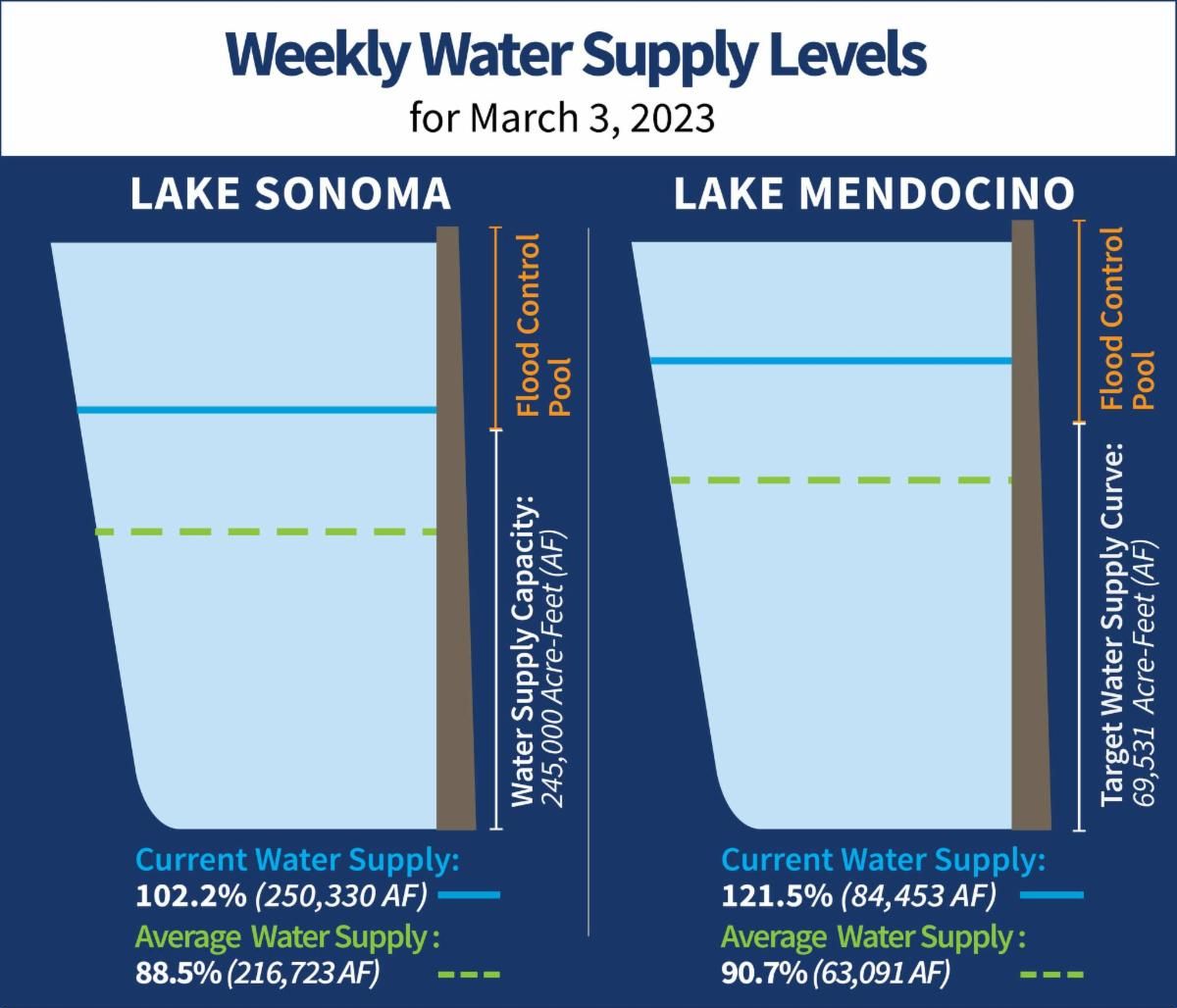
For the first time since 2019, our reservoirs are (more than!) full. Lake Sonoma is now slightly above 100% and Lake Mendocino at 117% percent of water supply capacity, thanks to a program to keep as much water in storage as possible called Forecast Informed Reservoir Operations (FIRO).
FIRO is an innovative approach to reservoir management, and currently in use at both reservoirs. FIRO for Lake Mendocino was developed and piloted over several years with many partners including but the US Army Corps of Engineers, National Oceanic and Atmospheric Administration (NOAA), and researchers at Center for Western Weather and Water Extremes at Scripps Institution. In 2022, Sonoma Water was recognized with the the 2022 Federal Outreach Award by the Association of California Water Agencies (ACWA) for this groundbreaking work. Sonoma Water's Brad Sherwood is pictured here accepting the award with U.S. Bureau of Reclamation Commissioner M. Camille Calimim Toutin and ACWA President Pam Tobin.
FIRO at Lake Sonoma is building on the success at Lake Mendocino and has the potential to store an additional 19,000-acre feet of water. Combined with the additional 11,650-acre feet that can be stored in Lake Mendocino, the “FIRO water” is enough to meet the demands of around 100,000 households.
Sonoma Water and our partners are keeping as much water in storage, while reducing risk of downstream flooding should more heavy rain come to our region. While our recent precipitation has filled up our reservoirs quickly, it takes much longer for the environment to recover from droughts and for groundwater to recharge. Groundwater is an essential, nonvisible resource that our water supply depends upon. You can help by keeping your water-saving habits; there is never enough water to waste!
|
|
Three Sonoma County Groundwater Sustainability Plans Approved |
|
In January, the California Department of Water Resources (DWR) announced approval of all three local groundwater sustainability plans (GSPs): Santa Rosa Plain, Sonoma Valley and Petaluma Valley. The GSPs assess the conditions of the groundwater basins, analyze the basins’ sustainability over a 50-year period, and identify projects and actions needed to ensure the basins are sustainable by 2042.
“Climate-driven swings between drought and flood make it critical that we capture excess water and store it underground, so it is available during drought periods. Adequate preparation by local agencies is essential to do so,” said DWR Director Karla Nemeth. “We appreciate and support the role of local leaders in shaping how to plan for, and oversee, a reliable groundwater supply for their communities through both wet and dry periods.”
The GSPs were developed by Sonoma Water under contract to the Groundwater Sustainability Agencies (GSAs) with significant input from stakeholder-based Advisory Committees and GSA Boards. Over multiple public comment periods, community members submitted hundreds of written and verbal comments to ensure the GSPs reflect local concerns and priorities. The local plans were three of 12 approved out of 51 that DWR has reviewed to date. The GSPs can be viewed at:
Congratulations to the technical team, led by Marcus Trotta, Plan Manager for the GSAs, and principal hydrogeologist at Sonoma Water, and to Board members and Advisory Committee members of the three GSAs.
|
|
Board of Directors Special Meeting |
|
The Sonoma Water Board of Directors met on Monday, Feb. 27, to discuss the challenges and opportunities facing the region’s aging water, wastewater and flood protection systems in a changing climate. The Board received presentations on key issues impacting Sonoma Water’s drinking water supply and transmission system, regional flood management, initiatives to keep our water clean, and Sonoma Water’s efforts to address the effects of climate change. Board members and the public were briefed on efforts to maintain and modernize systems that are 40 to 70 years old and their ability to withstand earthquakes, more frequent droughts and extreme storms. Some of the investments could require future increases in the wholesale price of water that Sonoma Water supplies to nine cities and special districts in Sonoma and Marin counties.
|
|
Upgrading our Infrastructure: Water Storage Tank Maintenance Plan |
|
Water storage tanks are the backbone of our water transmission system. These eighteen tanks provide emergency storage to over 600,000 residents in Sonoma and Marin Counties. This video illustrates the role of these tanks and how Sonoma Water our maintenance and operations team is working to keep these tanks in good condition for years to come. |
|
Participate in Fix a Leak Week! |
|
Are you ready to chase down leaks? Household leaks can waste nearly 1 trillion gallons of water annually nationwide, so each year we hunt down the drips during the EPA WaterSense program’s Fix a Leak Week. This year, Fix a Leak Week is March 20 through 26—but remember, you can find and fix leaks inside and outside your home to save valuable water and money all year long.
Don’t assume your home is leak-free! Here are some tips for finding leaks:
- Review your water usage during a winter month, such as January or February, when automated irrigation systems are off. If a family of four exceeds 10,000 gallons per month, you may have a leak and should investigate further.
- Read your water meter before and after a two-hour period when no water is used. If the meter registers use during this time, you probably have a leak.
- Examine faucet gaskets and pipe fittings for any water on the outside of the pipe to check for surface leaks.
- Don’t forget to check irrigation valves, since water leaking through a valve is not visible on the surface and can occur even when the system is off for the winter.
- Consider bringing in an expert if you are unsure if a leak has been correctly diagnosed and fixed.
- Identify toilet leaks by placing 10-15 drops of food coloring in the toilet tank without flushing. If any color shows up in the bowl after 10 minutes, you have a leak. (Be sure to flush immediately after the test to avoid staining the tank.) Faulty flappers or fill valves are leading causes of toilet leaks that most homeowners can easily repair.
This year, the Sonoma-Marin Saving Water Partnership is encouraging residents to find and fix toilet leaks by sponsoring the Dye Tab Challenge through March 31, 2023. To join the Dye Tab Challenge, check your toilets for leaks and submit your results for a chance to win a $25 Visa Gift Card!
If you have decided to replace a toilet, be sure to check with your water provider before shopping to see if rebates are available and to learn about models that save more water while ensuring great flush performance.
|
|
New Sanitation Public Tours
Sonoma Water is pleased to invite community members to sign up for a free Sanitation Public Tour. Explore Sonoma County’s wastewater treatment facilities, including the lab monitoring millions of live protozoa and microorganisms essential for cleaning and recycling wastewater.
Sonoma Valley County Sanitation District Wastewater Treatment Plant
Saturday, April 8, 2023 (Tour led in English)
10:00 a.m. - 11:45 a.m.
Registration is required: To sign up, please visit www.sonomawater.org/tours .The tours have limited capacity and space is available on a first-come, first-served basis.
|
|
Steelhead in the Classroom Egg Delivery Day!
Michelle Holmstedt’s students at the Santa Rosa Charter School of the Arts were excited to receive a fragile delivery of fish eggs, as another season of the Steelhead in the Classroom Program begins. Sonoma Water has been running program for more than 15 years in partnership with the California Department of Fish and Wildlife and supported by local fishing clubs.
This year’s program includes 95 classrooms in our region and provides students first-hand experience to witness the delicate balance needed for animals to survive in aquatic ecosystems. It all begins with the delivery to local classrooms of steelhead eggs, which come from the Warm Springs Hatchery at Lake Sonoma. Over the next two months, students will maintain an aquarium, caring for and observing the growth and development of the fish until they become young fry. Students take a culminating field trip to release their fish into the Russian River or tributary. Hear more about this program in this video.
|
|
|
|
Looking Closely at Our Russian River Ecosystem
If you follow our social media channels, you may have noticed a new weekly series of very short video reels featuring Sage, one of our Sonoma Water education team members, sharing a variety of different things that make the Russian River ecosystem healthy and filled with life. Many of the things he shares in this series are what students see and learn about on our 5th grade Russian River field trips.
Come along and discover things along the river's edge near our Education Center, and follow along with the Looking Closely at Our Russian River Ecosystem series on Instagram or Facebook.
|
|
Rainfall and Water Storage Update
Current water supply conditions as of 3/6/2023:
Lake Mendocino Target Water Supply Curve: 71,198 acre-feet
Current Storage: 84,470 acre-feet (118.64% of Target Water Supply Curve)
Lake Sonoma Target Storage Curve: 245,000 acre-feet
Current Storage: 253,449 acre-feet (103.4% of Water Supply Pool)
Current rainfall conditions (10/1/22 – 3/5/23)
Ukiah:
Average (1894-2022 water years): 28.45”
Current Water Year: 29.99” which is 105.4% of average
Santa Rosa:
Average (1950-2022 water years): 23.69"
Current Water Year: 28.62” which is 120.8% of average
|
|
 |
Upcoming Events
The Board normally holds its regular meetings on Tuesdays, beginning at 8:30 a.m. and will be facilitated virtually through Zoom and at Board of Supervisors Chambers (BSC) 575 Administration Drive 102A.
•March 14 BSC/Virtual
•March 17 Virtual Special Closed Session
•March 21 BSC/Virtual
•March 28 BSC/Virtual
•April 4 BSC/Virtual
Board Agendas:
|
|
|
|
Fact of the Month
What is Groundwater?
Groundwater is the water found underground in the cracks and spaces in soil, sand and rock. It is stored in and moves slowly through geologic formations of soil, sand and rocks called aquifers. Groundwater is used for drinking water by more than 50 percent of the people in the United States, including almost everyone who lives in rural areas.
Aquifers are typically made up of gravel, sand, sandstone, or fractured rock, like limestone. Water can move through these materials because they have large, connected spaces that make them permeable. The speed at which groundwater flows depends on the size of the spaces in the soil or rock and how well the spaces are connected. Groundwater supplies are replenished, or recharged, by rain and snow melt that seeps down into the cracks and crevices beneath the land’s surface.
|
Employment Opportunities
Sonoma Water has job openings for people with a variety of skills and experience.
|
Now accepting applications for Internship in the following Departments:
- Clerical and Records Management
- Water and Energy Education
|
|
|
|
Sonoma Water | 404 Aviation Blvd, Santa Rosa, CA 95403 | SonomaWater.org |
|
|
|
|
|
|