|
Judge Grants Preliminary Injunction in Probationary Workers Case
On Tuesday, April 1st, U.S. District Court Judge James Bredar issued a preliminary injunction in the case of USDA v. Maryland, ordering the government to rehire probationary employees that it had laid off, but only for employees in the 19 states (and the District of Columbia) that demonstrated harm. Read last week’s Weekly Update for more on the reasoning for and implications of such a limited injunction. Importantly, the order includes not only the employees who work in those states, but also employees who live in them. This could particularly help the D.C. metro area, as employees who work in Virginia but live in Washington, D.C. or Maryland would be covered, which would not have been the case had the injunction been limited just to location of workplace.
It is not yet clear exactly how many of the 24,000 fired probationary employees are covered by the ruling. The administration is due to submit a progress report with the court by Tuesday night, which may contain more information. In a separate case in California, a judge has ordered a nationwide injunction on probationary employee firings in a smaller subset of the 20 agencies under Judge Bredar’s order: the Departments of Veterans Affairs, Agriculture, Defense, Energy, Interior and Treasury. Together, these agencies account for 71% of the fired probationary employees. The Trump Administration has appealed that ruling to the Supreme Court.
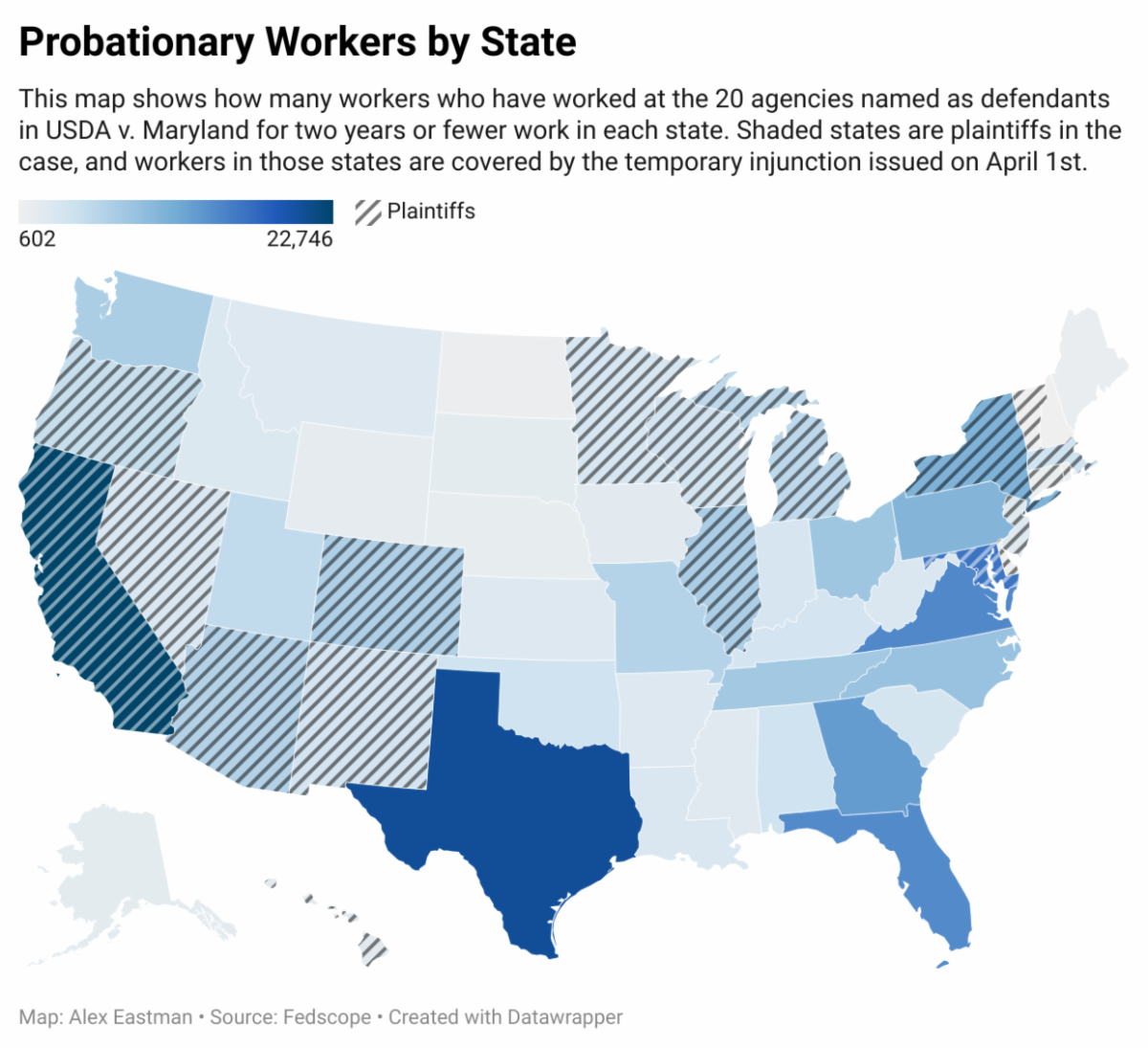
This means that the only workers at immediate risk of being terminated again are those not covered by either order. In the Great Lakes region, Ohio and Pennsylvania are the only states that are not included. Notably, employees in NOAA Great Lakes Environmental Research Laboratory in Michigan and EPA Region 5 in Illinois are covered.
The map below shows the number of federal workers who have worked in the federal government for two years or fewer at the agencies covered by Judge Bredar’s order. Striped states are those included in the order. Because not all workers in the 1-2 year range are probationary, and because the statistic likely does not include promoted workers, this is only a rough estimate of probationary workers. Still, it gives an indication of where these employees are distributed across the country. Approximately 37% of these workers work in covered states, and 63% work in uncovered states.
Click here to view in browser and access the data.
|