|
5 December 2024 — “The first and last of the New York Barge Canal motorships”—the Day Peckinpaugh
On 21 October bidding closed on a property described as “1921 McDougall-Duluth Freight Barge.” In the details provided by the government property auction site Govdeals.com, the reason for the sale given was that the barge “is no longer considered seaworthy due to its physical condition, [and] as a result… was declared surplus and is being auctioned.” The winning bidder was Capt. Dwayne Reith, owner of the Dobbs Ferry, NY, business Custom Marine. The final bid was $5050—$50 over the minimum. According to an article on the Times-Union website, Capt. Reith stated that a thorough marine inspection would have to take place to determine what, realistically, could be done with the vessel. We’ll have to wait for updates on her status. Today in Sea History Today we want to look back on her career.
|
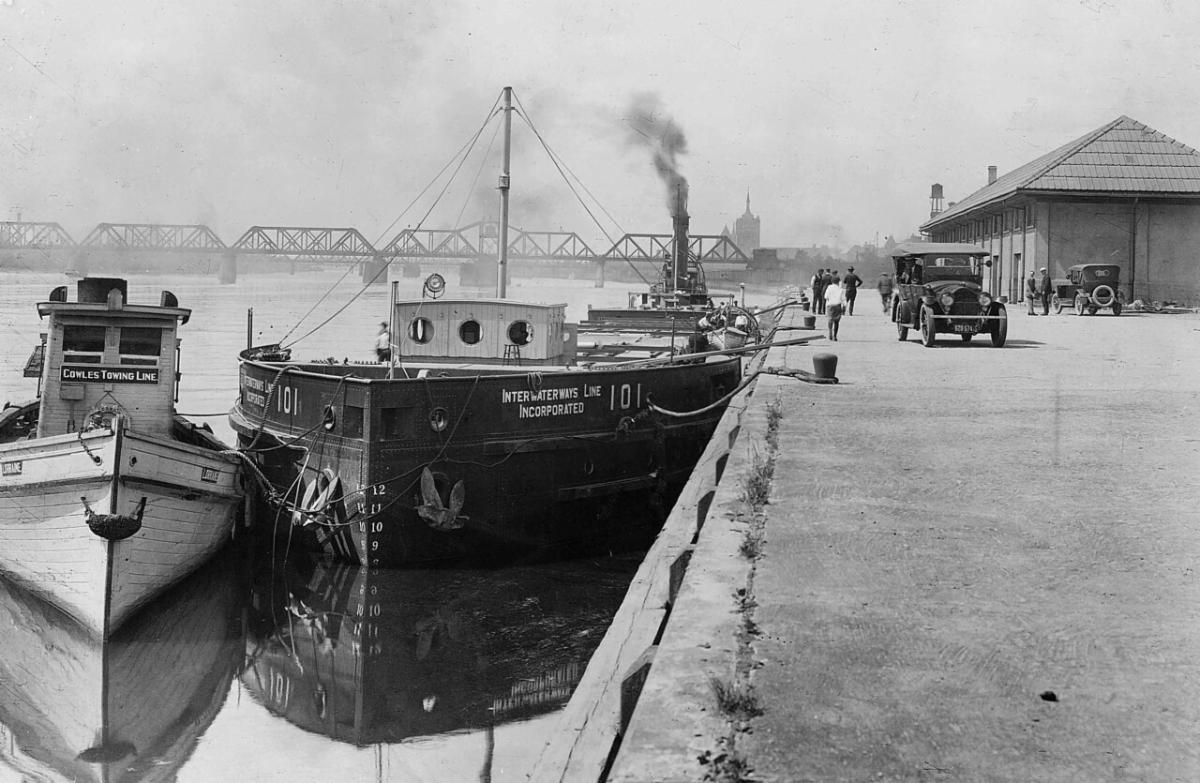
Day Peckinpaugh makes a stop at Albany's Corning Preserve on her maiden voyage in 1921. Photo: PD, New York State Museum. | |
The ship was launched in May 1921 with the unexciting name ILI 101—to reflect the name of her owner company, Interwaterways Line Inc. Her launch was followed in rapid succession by that of four sister vessels, named ILI 102, 103, 104, and 105. The quintet was built at the McDougall-Duluth Shipyard in Minnesota; long-time Sea History Today readers might remember the name Alexander McDougall as the man behind another ship designed to ply the waters around the Great Lakes, the whaleback. With a new design, the ILI 101 was intended to traverse the New York Barge Canal, the New York State canal system that had been enlarged and adapted in a process completed in 1918. The new system was twelve feet deep, with locks 328 feet long and 45 feet wide, accommodating vessels 300 feet long with a capacity of 3,000 tons. Any ship designed for the new system would take advantage of these dimensions, while also possessing a low profile to be able to pass safely under the system’s bridges.
The Marine Journal (9 July 1921) called IL 101 “the advance courier of a fleet of new type of ships”:
At first glance this new craft presents a rather odd appearance, having no towering superstructure, but on examination her utility and efficiency are seen recognized. She is 254 feet over all, with a 36-foot beam and a molded depth of 14 feet. The deadweight carrying capacity is 81,500 cubic feet. She is driven by a pair of semi-Diesel engines of 140 brake horse power each and can easily make eight miles an hour.
|
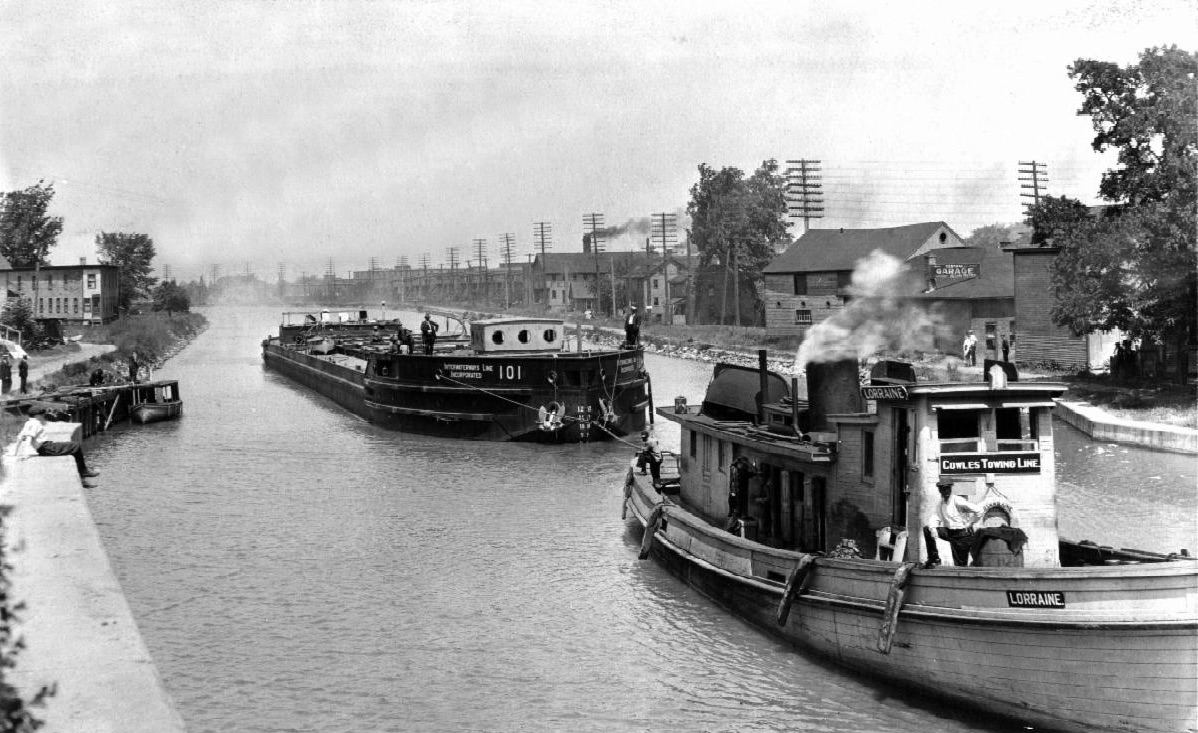
I.L.I. Barge west from Main St., Fairport, June 13, 1921. Photo: PD. | |
On ILI 101’s maiden voyage, from Duluth to the State Canal pier in Brooklyn, she carried 83,000 bushels of oats. She was given a little assistance from a commercial tug on the route from Buffalo to New York City after a bout of engine trouble, but her transit was celebrated nonetheless by the press. The local paper in Little Falls, NY, the location of Lock 17, declared that “the biggest boat that has ever churned the waters of the New York State barge canal went thro this city this afternoon, being put thro Lock 17 at 2:30… It is believed that in a few years the sight of large boats like this one… will be a common occurrence.”
After her first season, the canal motorship was given the name Richard J. Barnes, after a member of the family of Julius Barnes, who owned Interwaterways. Within a few years, the vessel’s ownership was transferred to the Erie and Saint Lawrence Corporation. In 1942, Richard J. Barnes was pressed into service to support the war effort; she was stationed in the waters off the East Coast and as far south as Cuba to refuel cargo ships in convoy. There is an unverified account passed down by former crew members that a German U-boat fired torpedoes at the Richard J. Barnes, but that they passed below the hull because she had such a shallow draft. After the war, the federal government honored its commitment to Barnes’s owners and restored her to her prewar condition, making up for the service in salt water and rough loading/unloading conditions. She was sent to Brooklyn’s Todd Shipyard and the cargo section of the hull was replaced.
|
Scenes from Day Peckinpaugh’s last commercial voyage were captured on video. | |
The Barnes was sold to the Erie Navigation Company of Erie, Pennsylvania, in 1958, and her name was changed to Day Peckinpaugh, after a prominent figure in Great Lakes shipping. At an Erie shipyard she was reconfigured to a self-discharging bulk cement carrier, acquiring a new 140-foot cargo hold with a cable-operated scraper that could pull cement forward towards a hopper, where the cargo could be pumped pneumatically into silos. Thus equipped, she headed out for her first delivery, 1,500 tons of bulk cement destined for Rome, New York. For thirty years she delivered bulk cement to Rome from Picton, Ontario, a round trip of about 70 hours. More and more commercial traffic was shifting away from the canal system, however, and by September 1994, when the Peckinpaugh made her final transit, she earned the distinction of being the last regularly scheduled commercial hauler on the Barge Canal system. The occasion was noted in Sea History 72:
“The first and last of the New York Barge Canal motorships, the MV Day Peckinpaugh, passed out of the canal system in September for what may have been her last time. She traveled to Erie PA, where she will be laid up. Tom Prindle, of New York’s State Council on Waterways, compared her last run to the last day a mule towed a boat on the Barge Canal.”
|
|
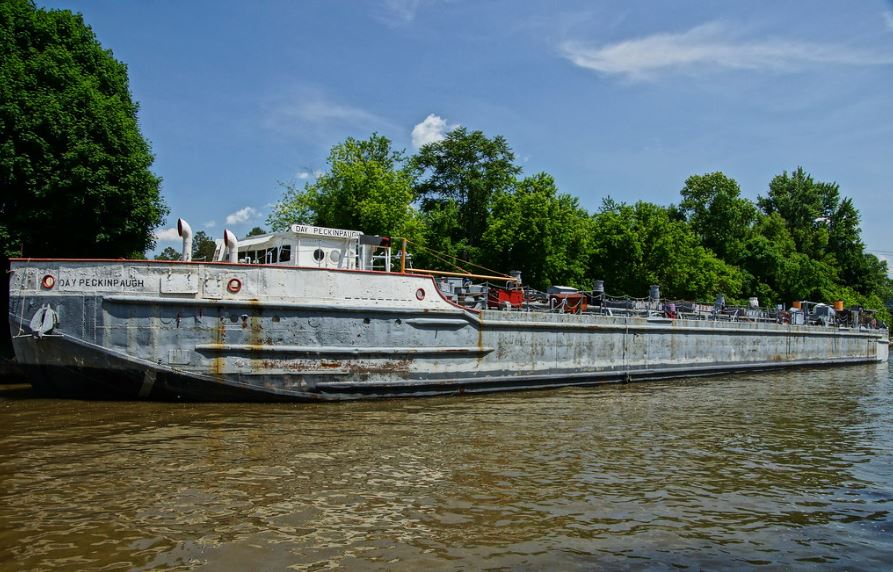
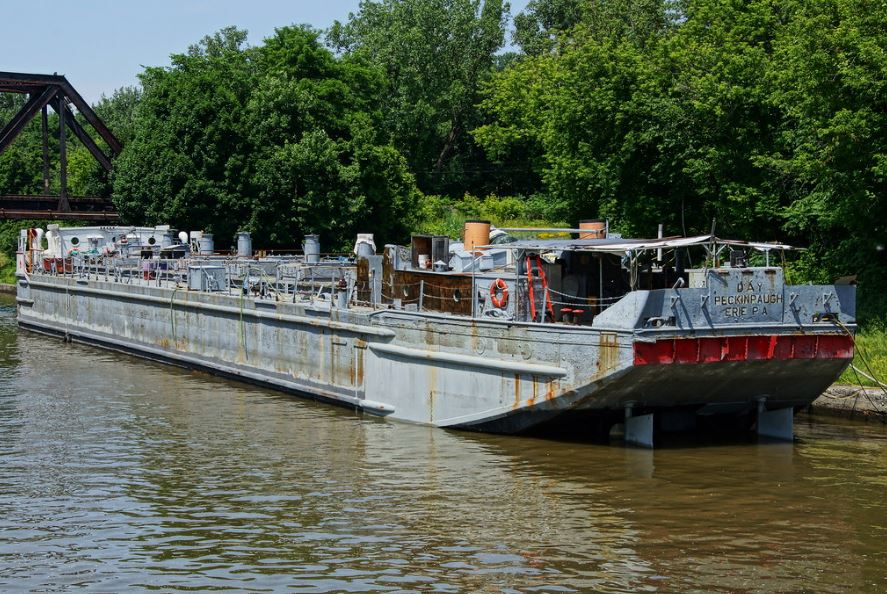
Day Peckinpaugh prior to her recent sale. Photos courtesy of NYS Office of General Services. | |
|
The Peckinpaugh lay idle in Erie for a decade; in 2005, when her owners had already contracted for her disposal, generous donors of the Canal Society of New York State promptly donated $30,000 for immediate costs to pay the scrapper’s prepaid fee and transportation from Erie to New York. A partnership between the New York State Museum; the Canal Corporation; the Office of Parks, Recreation, and Historic Preservation; the Erie Canalway; and the Canal Society was struck to restore her and transform her into a museum vessel and floating classroom. She made the 330-mile journey to Waterford, New York, mostly under tow for safety reasons, with Capt. John Callaghan of the Canal Corporation at the wheel, and Chief Engineer Jim Brennan restored to his post in the engine room, where he had served in the ship’s active years. Slow-but-steady work on the ship followed the move. In 2009 the Peckinpaugh was a key traveling component in the New York celebration of the Hudson-Fulton-Champlain Quadricentennial, her main hold converted to exhibit space. In the intervening years, the ship’s condition deteriorated and funding could not be secured for new rounds of maintenance and other costs, resulting in the recent auction.
This boxy, low-profile canal boat was the first of her design, and the last to carry cargo; she represented an era of optimistic growth in canal traffic competing with overland transportation of bulk goods. She served reliably and well. It was fitting that she also made the last regular commercial run on the canal system, signaling the end of that era.
Extra Credit
A Day Peckinpaugh photo gallery
Erie Canal Museum Lunchtime Lecture: Day Peckinpaugh
Sea History Today is written by Shelley Reid, NMHS senior staff writer. Past issues can be read online by clicking here.
| | | | |