|
Membership dues provide the foundation for NACD's ability to serve conservation districts throughout the year. Without them, NACD cannot support the people, programs, advocacy, communications, training, regional engagement, and resources that members rely on. Dues also give NACD the capacity to respond to emerging issues and opportunities that individual districts cannot address alone. NACD membership is an investment in the infrastructure and collective capacity of the conservation district system. NACD provides a national voice for conservation districts while connecting districts to resources, information, training, and each other.
It has been more than 10 years since the last comprehensive review of NACD’s dues structure, and during that time the cost of providing programs, services, and day-to-day operations has increased significantly. NACD is adjusting membership dues for Fiscal Year 2027 to ensure the association has the resources needed to provide strong, consistent services to conservation districts across the country.
| |
“Membership isn’t just an investment in your district. It’s an investment for the future of all districts.”
– Ryan Britt, NACD Second Vice President
| |
|
NACD recognizes that conservation districts and associations have different financial circumstances. Members are encouraged to contribute at the highest level they can reasonably support; all are valued members of NACD at any contribution level.
The FY27 dues structure will take effect October 1, 2026, at the beginning of NACD's new fiscal year. Invoices will reflect updated membership dues levels approved by NACD’s Board of Directors. Visit the membership webpage to view membership levels, pay dues, and explore benefits and perks.
And though the clock is ticking, it’s not too late to pay your Fiscal Year 2026 dues! Unsure of your membership status? Contact us at membership@nacdnet.org.
| SOUTH CENTRAL REGION LEARNS FROM LA PARTNERSHIPS | |
By Wesley Gibson, NACD South Central Region Representative
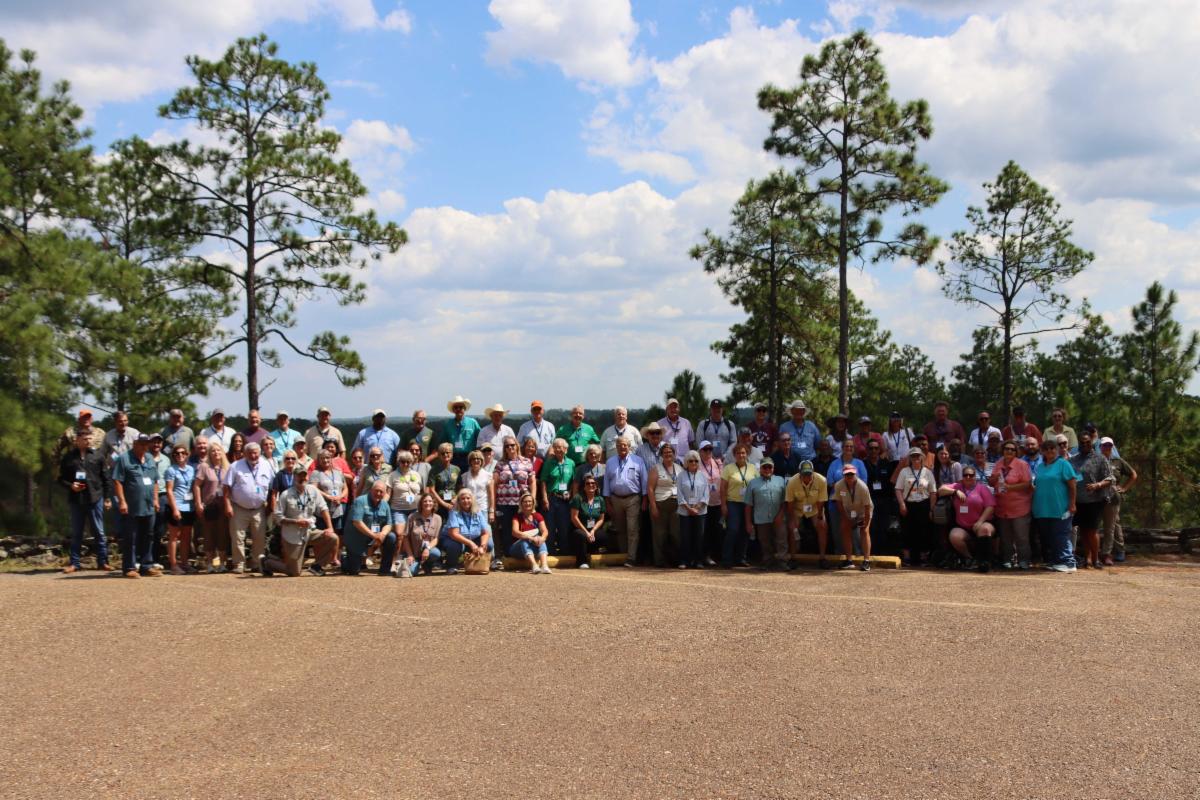
What can happen when federal, state, and local conservation partners combine their people, expertise, and relationships around a shared goal? Conservation district leaders from Arkansas, Louisiana, Oklahoma, and Texas saw the answer during the 2026 NACD South Central Region Meeting in Natchitoches, Louisiana.
Founded in 1714, Natchitoches is recognized as the oldest permanent settlement in the Louisiana Purchase. Its history provided a fitting setting for a meeting focused on another lasting tradition: generations of local families serving on soil and water conservation district boards and building partnerships that strengthen conservation delivery.
Across the meeting, one lesson stood out. No single organization has all the staff, funding, technical knowledge, or landowner relationships needed to address today's natural resource concerns. Louisiana is making progress by combining those strengths and keeping local leadership at the center of the work.
| |
Partnerships at Work in Louisiana
At the Natchitoches National Fish Hatchery, participants learned how the U.S. Fish and Wildlife Service works with partners to conserve native aquatic species, the gopher tortoise, and the endangered Louisiana pearlshell mussel — which is found in only a limited number of cool, spring-fed streams in central Louisiana. Since it depends on healthy habitat beyond the hatchery, the mussel's recovery requires cooperation across property and agency boundaries.
The same partnership model was visible at the Kisatchie National Forest. Through Good Neighbor Authority agreements, conservation districts can hire technicians who expand the capacity available for forest management. Their work helps move timber thinning, prescribed burning, and other projects from planning to implementation.
Those practices support timber production while improving forest health and habitat for species, such as the federally threatened Louisiana pine snake. They also reduce hazardous fuel buildup and wildfire risk on the national forest and neighboring private lands. By sharing staff, funding, and technical expertise, the partners accomplish more than any one organization could deliver alone.
Bringing Lessons Home
For district officials and employees from Texas, Arkansas, Oklahoma, and Louisiana, the meeting was more than a tour of successful projects. It was an opportunity to exchange ideas and consider how Louisiana's approach could be adapted to different resource concerns across the South Central Region. Each state brings its own landscapes, challenges, and experience, but learning from one another makes the region stronger together.
The examples also reinforced what conservation districts contribute to a partnership. Federal and state agencies can provide specialized expertise, programs, and funding, while districts know their communities. Their boards understand local conditions, maintain trusted relationships with landowners, and help keep conservation voluntary, practical, and locally led.
Natchitoches is known for preserving its history, but the South Central Region Meeting was also about building what comes next. By investing in relationships at the federal, state, and local levels, Louisiana's conservation partners are expanding capacity, improving working lands, and producing public benefits that no single organization could deliver alone.
| INDIANA HOSTS ANNUAL GET THE DIRT CONFERENCE | |
By Beth Mason, NACD North Central Region Representative
On Thursday, September 10, the Indiana Small Farms Conservation program—a partnership between the Indiana Association of Soil and Water Conservation Districts (IASWCD) and Indiana NRCS—welcomed agricultural professionals and growers to Noblesville for its fifth annual Get the Dirt: Small Farms Conservation Conference.
This year's event honored the 2026 International Year of the Woman Farmer, blending solo presentations with panel discussions to bring a wide range of community voices and perspectives into the conversation.
Thanks to the generosity of partners, sponsors, farmers, and presenters, the conference was free to attend and featured a networking lunch for participants. The day's formal program closed with a keynote address from Rachel Beyer of Mavourneen Farm, who reflected on her path in agriculture—from her work with the Purdue Student Farm to co-founding the Bloomington Farm Stop Collective, and now running Mavourneen Farm, a plant nursery and year-round vegetable operation she operates alongside her husband.
Following the keynote, attendees traveled to Teter Organic Farm in Noblesville, where Katy Rogers led a farm tour. The day wrapped up with a social hour, light refreshments, and a chance for attendees to network.
The Indiana Small Farms Conservation program got its start in Indiana as the Urban Soil Health program, launched through a collaboration between IASWCD and Indiana NRCS. Its mission is to support small-scale, diversified growers across the state by providing resources, technical assistance, local educational programming, and outreach focused on soil health.
To view the presentations from the conference and related resources for small farm conservation, visit the conference webpage.
| |
WHAT'S UP IN WASHINGTON?
GOVERNMENT AFFAIRS UPDATE
| |
Senate Agriculture Committee Advances Farm Bill
The Senate Agriculture Committee reconvened on September 16 and voted 12–11 to advance the Agricultural Act of 2026 after an earlier 10–11 vote failed prior to the August recess. The committee considered the measure as an unnumbered original bill. The action advanced the proposal out of committee, though no Senate floor vote has been officially scheduled.
The House passed its Farm Bill proposal, H.R. 7567, the Farm, Food, and National Security Act of 2026, on April 30 by a vote of 224–200. To move forward with any bill, the full Senate will need to pass its Farm Bill legislation, after which the chambers would need to resolve their differences and approve identical legislation before a bill could be sent to the president. Conservation districts can review the Senate Agriculture Committee’s Farm Bill materials.
USDA Awards $26.5 Million for Value-Added Agriculture
USDA announced $26.5 million in Value-Added Producer Grant awards supporting 194 projects across the country. The total includes $11.6 million for 80 projects involving beef producers specifically. The grants are intended to help agricultural producers develop value-added products, expand marketing opportunities, and generate additional income. These are completed award announcements and do not open a new application period. Applications for the Value-Added Producer Grant program are typically accepted for processing from agricultural producers between January and May, depending on when program funding is allocated.
USDA Launches New Agricultural Data Tool
USDA’s National Agricultural Statistics Service (NASS) launched AgInsights, a new online platform for accessing and visualizing agricultural statistics. The tool is intended to provide a more streamlined way to search, compare, and display NASS data by commodity, geography, and time period. AgInsights may be useful to conservation districts developing grant applications, assessing local agricultural conditions, or communicating information about producers and land use in their service areas.
EPA Continues Accepting WIFIA Loan Requests
The Environmental Protection Agency (EPA) continues to accept letters of interest on a rolling basis for financing through the Water Infrastructure Finance and Innovation Act (WIFA) program. EPA has announced approximately $6.5 billion in available WIFIA financing and $550 million through the State Infrastructure Financing Authority WIFIA program. Eligible borrowers may seek financing for drinking-water, wastewater, stormwater, drought-resilience, water-reuse, and other eligible infrastructure projects.
EPA’s September 18 announcement of a $251 million WIFIA loan supports a specific drinking-water infrastructure project in California and is not a nationwide grant opportunity. However, the broader rolling WIFIA solicitation remains available to eligible public and private borrowers nationally.
Important Dates
September 28: Comments are due on USDA’s interim final rule concerning certified wetland determinations.
October 1: Comments are due on NRCS’s proposed revisions to 48 National Handbook of Conservation Practice Standards.
October 6: Comments are due on the Forest Service’s proposed rescission of the 2001 Roadless Area Conservation Rule.
October 9: Comments are due on additional alternatives EPA and the Department of the Army are considering for a proposed revised definition of “waters of the United States.”
| FILLING THE GAP: WELL CHLORINATION SUPPORT AFTER A HISTORIC FLOOD | |
By Claire Lane, Hamilton County SWCD
When a historic 1,000-year flood struck Hamilton County, Indiana, many residents with private wells were left with an immediate question: Is my water safe to drink?
Hamilton County Soil and Water Conservation District (SWCD) already offers well-water testing services, so staff first connected with the Hamilton County Health Department to determine what assistance was already available and where the greatest need remained. The Health Department was providing free testing for flood-impacted wells, but only after the wells had been properly chlorinated. Through that coordination, the Hamilton County SWCD identified a clear gap it could help fill: giving residents the supplies and information they needed to chlorinate their wells so they could then access the Health Department’s testing program.
The community response to the flood was incredibly strong, and we wanted to find a way to help that matched our staff and budget capacity,” said Claire Lane, Hamilton County SWCD Urban Conservationist. “After connecting with the Health Department, we realized well chlorination was a gap we could fill.”
Many affected residents did not know how to chlorinate their wells. Some did not know where their well was located on their property, what part of the well needed to be accessed, or what supplies they would need to complete the process.
| |
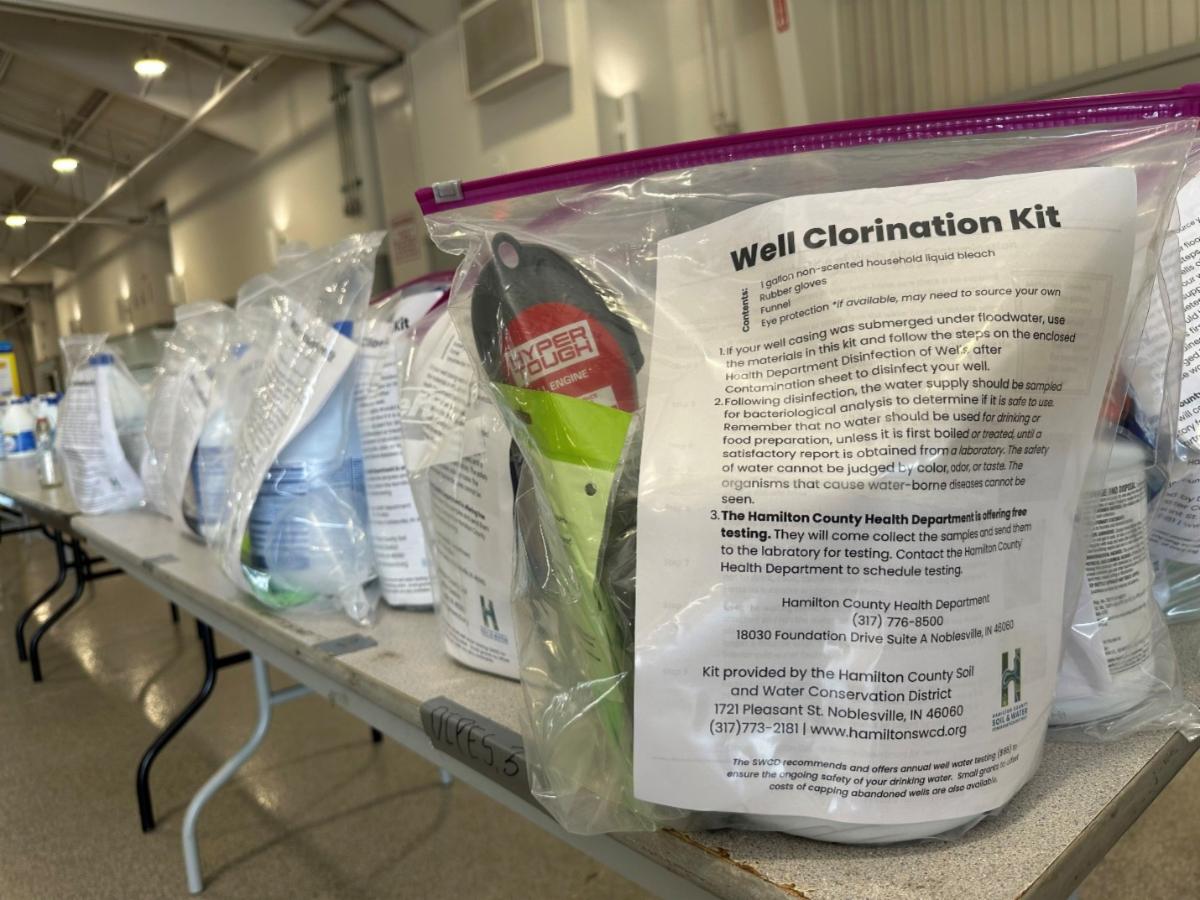
To help residents move from flood impact to safe water testing, Hamilton County SWCD assembled well chlorination kits containing the basic supplies needed to disinfect a private well, along with clear instructions for completing the process and how to access free testing post-chlorination.
“Residents were overwhelmed and often didn’t know how to chlorinate their wells or where to find the supplies, so we were able to quickly put together kits that were simple, affordable, and genuinely useful,” said Lane.
Rather than relying solely on residents to come to the Hamilton County SWCD office, staff worked through existing flood-response efforts to get the kits directly into affected communities. Kits were delivered to a staging area in one especially hard-hit community, and additional kits were provided to the countywide flood relief location, making them readily available to residents already seeking assistance.
The Hamilton County SWCD also coordinated closely with the Hamilton County Health Department to address the need for hands-on education. Hamilton County SWCD and Health Department staff spent a day in one affected community talking directly with residents about their wells, answering questions, helping them understand the chlorination process, and explaining when their water would be ready for testing.
The effort highlighted an important role conservation districts can play during disaster response: identifying practical gaps between existing services and what residents actually need to access those services.
For other conservation districts serving areas with private wells, a simple chlorination kit program can be a relatively low-cost addition to local flood preparedness and response efforts. Establishing relationships with local health departments before an emergency, identifying appropriate chlorination guidance, and having a plan for distributing supplies directly in affected communities can help residents take the steps necessary to safely return their wells to service.
Read the full story on NACD's blog.
| | Join Conservation Coffee on NASA Remote Sensing | |
Join NACD's next Conservation Coffee webinar, hosted in partnership with NASA Applied Remote Sensing Training (ARSET), on November 5 at 3:00 p.m. ET.
ARSET exists to help individuals build skills to use remote sensing data for a range of applications related to air quality, public health, agriculture, disasters, ecological conservation, water resource management, climate resilience, and wildland fires. From “How do satellites work?” to “How can I use satellite data to make a flood map?” there are trainings available for all levels of experience at no cost.
Participants of this webinar will learn more about ARSET opportunities and take part in their newest training geared toward novice remote sensing users. After the webinar, you will receive a link to a self-paced learning module that will prepare you for further remote sensing training and earn you a NASA ARSET certificate upon completion.
| Apply for the NGLI 2027 Cohort | |
Applications for the National Conservation Foundation’s (NCF) Next Generation Leadership Institute (NGLI) 2027 Cohort are open!
NCF developed NGLI as a comprehensive leadership development program to meet the needs and challenges facing conservation district leaders. The NGLI program's learning objectives include advocacy and public policy, effective communication, leadership styles, conflict management, and many other skills that set NGLI Alunni apart in state and national conservation partnerships.
Eligible applicants for the program are appointed or elected conservation district officials serving in the United States or its territories. Apply by October 31 on NCF's website.
| Submit a Session Proposal! | |
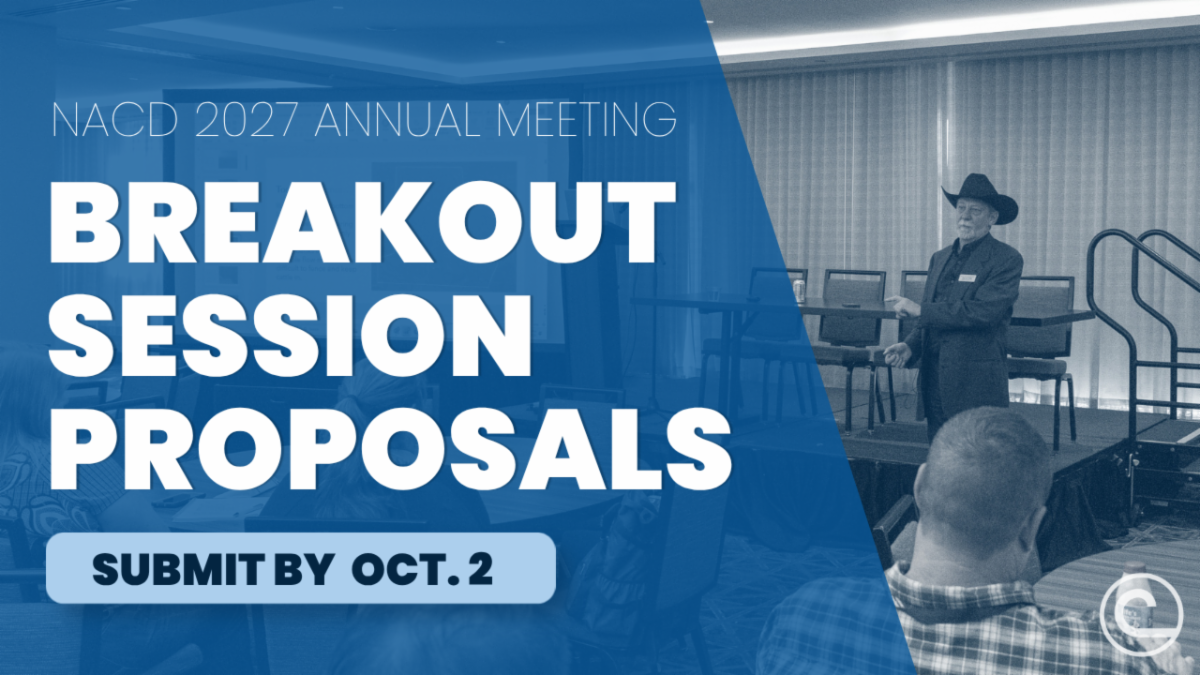
NACD is now accepting breakout and training session proposals for the upcoming 2027 Annual Meeting to be held in Las Vegas, NV, on February 6-10, 2027!
Breakout sessions spotlight the work of conservation districts and partners across the country. We are also accepting proposals for training sessions to help conservation district board members and employees build their skillsets. Sessions typically last an hour and often showcase several speakers.
NACD's breakout and training sessions are some of the most popular activities among meeting attendees and provide a platform for districts to share their initiatives with one another. Spread the word about this opportunity and consider submitting a proposal by October 2!
If you have any questions, or would like to discuss your proposal before submitting, please reach out to the NACD Membership Team.
| NCDEA Hosts Webinar on Building Grant Toolkits | |
The National Conservation District Employees Association is hosting a webinar, Building A Master Grant Toolkit For Your Conservation District, on September 23 at 12:00 p.m. ET.
Join Tanya Fell from the Yuma County Conservation District in Colorado to learn how to build a Master Grant Toolkit that keeps frequently used narratives, district information, project details, key statistics, partnerships, compliance information, and grant documents organized and ready to use.
District employees will receive ready-to-use tools and worksheets to begin building their own district toolkit, helping save time, improve consistency, perserve institutional knowledge, and make the next grant application easier.
Learn more and register for the webinar here.
| Join Sustainable Ranchers Tour in Texas | |
NACD's partner, Trust In Food (TIF), will be hosting a Sustainable Ranchers Tour in Albany, Texas, on October 20.
The tour will visit Law Ranch and Lazy 3 Ranch, where participants will learn from two Texas family ranches about their use of sustainable management practices on their operations, including grassland restoration, rotational grazing, virtual fencing, and other approaches to improving ranch productivity and resilience. Discussions after lunch will include cover grazing management, conservation programs, ranching heritage, and sustainability across the beef supply chain.
Learn more, help spread the word to producers, and register for this free event here.
| |
If you have questions about how to pay dues or how to access your online account or membership benefits, we are here to help! Just drop us an email, and we will respond to you within two days to address your inquiry.
As we approach the end of the fiscal year, we are also happy to check if your district has paid Fiscal Year 2026 dues. We want to ensure that you can keep accessing our membership benefits and that you are eligible for our upcoming Friends of NACD grants!
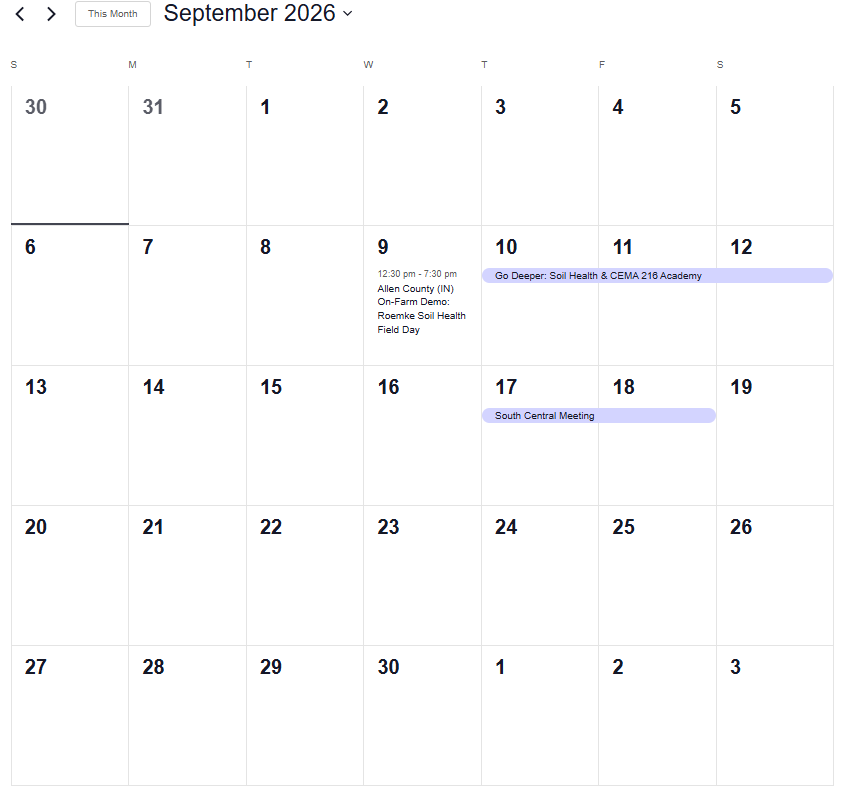
| Promote your conservation district or state association's tree sale, annual meeting, webinar, field day, or other events on NACD's Calendar of Events! | |