Weekly Digest Number 43 - October 25th, 2022 |
|
Welcome to the RWU Rail & Labor News! This news bulletin is produced and emailed out each Tuesday morning. We hope you find each week's news and information useful. If so, please share with co-workers, friends, and colleagues. If you like, you can sign them up to get all the news from RWU HERE. Or forward them the link. Note: If you read over this news bulletin each week, you will be sure to never miss the important news of what is going on in the railroad world from a worker's perspective!
|
|
(Editor's Note: The largest rail union to reject the deal so far is - as expected - snubbed by the NCCC. By 10/26/22, the vote results of the 5th largest union - The Signal Maintainers - will be known. All of this in the lead up to the BIG question: How will the operating crafts - which represent toughly half of rail labor - vote on their TA?) |
|
Railroads Reject Maintenance-of-Way Workers’ Request for Additional Paid Sick Time
Brotherhood of Maintenance of Way Employees negotiating with U.S. Class I railroads after initial rejection of tentative agreement
|
|
The National Carriers’ Conference Committee, which represents the railroads in collective bargaining, on Wednesday told the Brotherhood of Maintenance of Way Employees Division of the International Brotherhood of Teamsters that the railroads would not accept its contract proposal.
“The latest BMWED request for additional benefits is similar to a proposal which was carefully considered and rejected by President Biden’s Presidential Emergency Board and comes weeks after the union entered into a tentative agreement that included the most generous wage package in almost 50 years of national rail negotiations,” the NCCC said in a statement.
Labor leaders had backed the tentative agreement that had been reached with the railroads, noting that it included increases for travel expenses that the union had requested. The rank and file, however, rejected the contract, with 56% of those casting ballots voting against the deal.
|
|
(Editor's Note: This really does take the cake. A day after the NCCC announces no deal with BMWED on sick leave, and the DAY that ballots are being mailed out to the membership of the operating crafts, the largest Class One railroad announces record breaking profits. Not by moving more freight, not by increased customer satisfaction, not by moving freight more efficiently or expeditiously mind you, but by price gouging their customers.) |
|
Despite Record Profits, Rail Companies Reject Union's Demand for Paid Sick Leave
Paid sick leave "has become a norm in this society," said one labor organizer—one that rail carriers "can very easily afford."
|
|
A statement from the United States' major freight rail companies left railroad workers feeling increasingly "disenfranchised and undervalued," according to one labor organizer, as the National Carriers' Conference Committee rejected a proposal from the third largest rail workers union which called for just seven days of paid sick leave per year.
While claiming "the health, safety, and wellbeing of rail employees is a top priority for all railroads," the NCCC said it would not accept the proposal from the Brotherhood of Maintenance of Way Employees Division (BMWED), which was introduced last week.
"They'd still be making record profits if they agreed to provide railroad workers paid sick leave."
The BMWED had demanded the addition of paid sick days—modeled on a system used for federal workers in which employees accrue one hour of paid sick time for every 30 hours worked—last week as its members voted against a proposed contract that was developed with the help of White House officials. That contract included unpaid days off for medical care, but no paid sick days.
Clark Ballew, a spokesperson for the BMWED, noted that having reported more than $10 billion in stock buybacks and dividends in the first six months of 2022, rail companies "can very easily afford" to provide workers with paid leave when they are sick, as they did during the coronavirus pandemic hit before vaccines were available to employees.
"It is not unreasonable... and they'd still be making record profits if they agreed to provide railroad workers paid sick leave," Ballew told the Associated Press, adding that paid sick leave for employees "has become a norm in this society."
Ballew posited that if the two sides can't agree on a contract and Congress has to step in to avoid a strike, lawmakers may impose the proposed deal that excludes paid leave—a possibility that may be keeping the carriers from agreeing to BMWED's terms.
The rail carriers said Wednesday that while workers lack standard paid sick leave, "comprehensive paid sickness benefits" kick in for long-term illnesses after four days of absence, but unions have suggested the companies are capable of providing employees with both long-term disability benefits and comprehensive paid sick leave, as other workers throughout the economy have.
"It's totally asinine," Peter Kennedy, director of strategic coordination and research for BMWED, told CNN of the NCCC's rejection of the union's proposal. "Members are very upset."
Rail worker unions agreed not to call a strike until workers from across the industry, represented by 12 unions, have voted on the tentative deal reached last month.
A work stoppage could begin as early as November 19. The last nationwide railroad shutdown took place in 1992 after just one union rejected a contract and called a strike.
Related Content
|
|
(Editor's Note: We are starting to get support from some unlikely sources. In this case the Association of Chemical Distributors, not exactly known as a bastion of labor supporters. As rail service deteriorates to record low levels, while demurrage fees, surcharges and rates in general continue to climb, shippers are becoming increasingly hostile to the Class Ones.) |
|
Railroads Should Give Workers the Benefits They Seek
It’s time to get freight rail back on track with a stable workforce and improved service, writes the National Association of Chemical Distributors.
|
|
The following is an opinion article written by Eric R. Byer, president and CEO of the National Association of Chemical Distributors.
Over the last several months, U.S. businesses dependent on freight rail have watched negotiations between the railroads and their labor unions become more heated. There could be dire economic ramifications if an agreement is not ratified: A nationwide freight rail shutdown would cost the American economy $2 billion daily.
Why are we in this predicament? Because the freight rail companies put us here.
Anyone who has closely watched railroads over the years knows that even if a labor deal prevails, freight rail service will continue to deteriorate until some wholesale changes take place. Service declines can be tied to a railroading model known as precision scheduled railroading, or PSR, which has directly led to a dwindling number of rail workers that support our critical supply chain.
The freight rail industry has reduced its combined workforce by nearly 30% – almost 45,000 rail workers – over the last six years. These are highly skilled jobs that require years of training, meaning that the railroads will not be able to easily replace the workers who are now quitting the industry in droves.
As a result, PSR has also led rail workers to clamor for the basic benefits held by the average U.S. worker with full-time employment. Meanwhile, rail customers – which have been impacted by enormous delays and more restrictive service conditions due to limited train starts – are left clamoring for reliable service from railroads with billion-dollar profit margins. It’s no wonder benefits are a sticking point in the labor negotiations between railroads and their workers.
|
|
(Editor's Note: The movement to abolish the private police force of CP and CN in Canada is picking up steam. They are the only police force in Canada that has the authority to oversee and investigate mishaps (e.g. derailments, wrecks, fatalities, etc) of the compnay they are employed by, a glaring conflict of interest.) |
|
Canadian Members of Parliament Discuss Protection for Railway Workers |
|
Taylor Bachrach, the NDP critic for transport, and Alexandre Boulerice, the party's deputy leader and critic for Labour, call for greater protection and rights for railway workers. They are joined at the news conference on Parliament Hill by Pamela Fraser and Lori Desrochers, who have both lost loved ones in railway incidents. |
|
RWU Newsletter Editor Speaks to Radio Hosts |
|
In this episode of the Project Censored Show Eleanor Goldfield looks at the potential for a Class I railroad strike. This struggle exemplifies the power of workers and how much corporations and their media lackeys fear collective power – particularly when that collective power represents some $2 billion a day in economic leverage. Eleanor outlines the most recent happenings on this issue and then she sits down with Mark Burrows, Railroad Workers United (RWU) member and a 41-year veteran of the railroad industry. They discuss the ongoing assault on railroad workers, not only from their corporate bosses, but from the corporate media as well. Burrows describes the lived experiences of workers like him, and how workplace demands have risen while safety standards and wages have fallen. |
|
National update on how the nation's dozen rail unions are voting on the tentative contract deal brokered by President Biden with the rail carriers and the unions' leadership. Mark Burrows, a retired locomotive engineer and member of the Railroad Workers United, describes how the drive by owners to reduce crews has put workers at risk as well as the public's safety and the environment. Burrows says RWU is advocating for a "no" vote because the White House deal left the heavy lifting on work rules and time off provisions to further negotiations with the individual carriers
|
|
(Editor's Note: Some of the same employers - and many of the same issues - both North and South of the border.) |
|
Unifor, CN Begin Talks on New Contract |
|
MONTREAL — Unifor, Canada’s largest union, has opened bargaining with Canadian National for a new contract, the union said Wednesday.
The union says it represents about 3,600 workers at CN terminals and headquarters across Canada, including mechanics, crane operators, machinists, electricians, and clericial, administrative, and customer-support workers. The current agreement expires on Dec. 31.
“The fact is that during a time of record inflation, CN is reporting record quarterly earnings,” Lana Payne, Unifor national president, said in a press release. “Without our members at the helm, this company wouldn’t have been able to get even close to that, and they deserve to be compensated fairly and treated with respect.”
The two sides exchanged proposals and agreed to continue negotations in November and December. Unifor said it seeks improved wages and benefits, and to address “the on-going issue of contracting out unionized work.”
|
|
(Editor's Note: In this interview with the online news magazine FreightWaves, locomotive engineer and RWU Steering Committee member Paul Lindsey lays out the case for public ownnership of the rail industry.) |
|
Why Railroad Workers United Wants US Rail Infrastructure Publicly Owned
Railroads ‘use their dominant market power to not compete at all’
|
|
Railroad Workers United (RWU), an independent group of union members who represent different crafts in the industry, in early October adopted a resolution supporting public ownership of railroad infrastructure in the U.S.
The resolution, adopted at the group’s annual convention, is RWU’s response to what it calls a lack of desire by the freight railroads to expand the rail network and invest in it beyond regular maintenance. RWU believes that the railroads have focused too much on reducing their operating ratio, a measurement that investors use to gauge the financial health of a company. As a result of this focus on OR, as well as the deployment of precision scheduled railroading to streamline operations, rail service has suffered, RWU contends.
FreightWaves spoke with Paul Lindsey, a locomotive engineer and a member of RWU’s steering committee, on why his group adopted the resolution.
This question-and-answer interview has been edited for clarity and content.
FREIGHTWAVES: Why did RWU adopt this resolution?
LINDSEY: “You have to really be careful with how you explain it because people’s eyes will gloss over because they have assumptions. What we are not advocating is the government running all the trains, coming in and saying they want all the freight trains to run like Amtrak. …
“What we’re advocating is putting the railroad infrastructure — the physical plant, the tracks — into the same type of situation that our national highways and our waterways and airports, to a large extent, are placed in: They are managed, dispatched, controlled, maintained publicly. … ‘We believe that the rail industry should be growing for the future prosperity of our nation and for the future sustainability of transportation. Traffic volumes should be going up to take a lot of this [truck] traffic that is destroying our highly expensive, highly subsidized highway infrastructure. …
“If you were to actually look at the external costs of trucking to our highway system and count things like highway safety, like congestion, like carbon emissions, then most of the trucking companies that are on the road today — owner-operators, company drivers — they wouldn’t actually be profitable because they’re only profitable using highly subsidized government highway systems. …
|
|
(Editor's Note: Excellent coverage here from Truthout with two RWU Steering Committee members who are quoted extensively.)
|
|
Railroad Workers Threaten to Strike and Call for Public Takeover of the Rails |
|
A potential showdown between organized labor and Wall Street looms over the world of freight trains: An influential railroad workers group is urging fellow union members to reject a tentative labor agreement that has prevented an industry-wide strike, and to fight for public ownership of railroads. Negotiations are tense, and the unions are telling members that every vote counts.
Fearing further stress on supply chains and the economy ahead of the midterm elections, President Joe Biden convened an emergency board to negotiate a tentative agreement between rail carriers and unions threatening a nationwide strike. Railroad Workers United (RWU), an advocacy group of rank-and-file workers, recently called on fellow union members to reject the tentative agreement in a vote scheduled for early December, and to strike if necessary.
The tentative agreement announced in September by two major unions calls for an immediate 14 percent wage increase, but concerns over working conditions, health insurance and medical leave remain. SMART, a union representing sheet metal, air and rail workers, recently told its members that the tentative agreement is still being finalized, and it will be up to the rank and file to vote yes or no on the deal.
A nationwide rail strike would incapacitate shipping and force rail companies and the public to contend with the demands of railroad workers, who say their employers have maximized profits while safety and working conditions deteriorate. BNSF Railway, one of the top freight rail operators, made $23 billion in revenue in 2021 alone.
While RWU is urging the rank-and-file to fight for a better contract with their employers, the group says the ultimate solution to the problems raised at the negotiating table is a public takeover of the railroads for freight trains.
Ross Grooters, a co-chair of the RWU steering committee and a locomotive engineer out of Iowa, said rail workers are facing off against billion-dollar companies that run one of the most profitable industries in the nation. Rail companies, such as Union Pacific and BNSF Railway, have prioritized profits over their workers, leaving skeleton crews to operate massive and potentially dangerous freight trains.
“These companies are making decisions based on speculative financial investment versus running a freight system for what it needs to be run for, which is our supply chain that keeps the economy running,” Grooters said in an interview with Truthout. “When we see that affects workers, we know there are other ways of running infrastructure where you can put those resources into ensuring that you can have adequate safe staffing, ensuring that it is collectively the country or the world benefiting versus just a handful of very rich shareholders.”
RWU is a militant, rank-and-file advocacy group, not one of the multiple craft unions negotiating with rail companies for a new labor contract. RWU panned the tentative contract deal that railroad workers will vote on in December, arguing there has been little improvement to a set of recommendations brokered by the White House. Disputes over staffing and extremely limited paid sick leave remain, and the four major unions party to the tentative agreement are preparing their members for an up or down vote.
“If we are going to win the kinds of things we want to see in the workplace, to make it a better and more healthy place to work, where we can live lives outside of the railroad, we need to think very differently in how we approach our position in contract and bargaining,” Grooters said. “We need to be thinking about these big and bold things, how the ownership model is just extracting wealth and making railroads more unsafe and harming the long-term health of the industry.”
Public ownership could also lead the way for public investments and improvements in infrastructure.
|
|
(Editor's Note: More than 45,000 truckers brought this suit collectively. Perhaps rail workers might consider future class actions suits of this nature. Oh, but the carrier has endless rights to appeal, has deep pockets, and hundreds of pro-business judges in place at every level to protect their interest. They are appealing this ruling, of course.) |
|
BNSF Railroad to Pay $228M to Truck Drivers for Violating Illinois State Law |
|
CHICAGO - A federal jury in Chicago has ordered one of the nation's largest railroads to pay nearly a quarter of a billion dollars to thousands of truck drivers for violating their privacy rights.
The jury found the BNSF Railroad flaunted Illinois' law protecting your biometrics information.
"All I ever wanted was justice for the over 45,000 truck drivers and myself," said Richard Rogers, one of 45,600 truck drivers who were part of the class action lawsuit.
After a one-week trial, a jury on Wednesday ordered the BNSF Railroad to award those truck drivers a total of $228 million for violating their privacy rights "by taking their biometrics, their fingerprint scans, without giving them informed consent," said Attorney Jon Loevy, who filed the lawsuit. Under the Illinois Biometric Information Privacy Act, passed in 2008, companies must get written permission before obtaining biometric records like fingerprints, iris scans and face scans.
The class action lawsuit says truck drivers were required to scan their fingerprints to enter any of BNSF's four Chicago area facilities, but they weren't telling people they were going to maintain it in a database. "They weren't telling people they were gonna maintain it forever. They were supposed to purge it. They weren't doing that, and most importantly they weren't asking people for consent," said Loevy.
|
|
(Editor's Note: Strike possibilities are transcending the Class One freight industry.) |
|
Some GO Transit Workers Could Strike Oct. 31 |
|
TORONTO — The union representing 2,200 GO Transit bus drivers, station attendants, safety officers, and maintenance workers says they will go on strike Oct. 31 if they do not reach a deal on a new contract.
CityNews Toronto reports Amalgamated Transit Union Local 1587 President Rob Cormier said the union will walk out at 12:01 a.m. on the 31st unless a deal is reached.
He said in a press release that GO Transit parent agency Metrolinx has not made an offer “addressing our most important issue on the table, which is protection against contracting out.”
Metrolinx said in a statement to CityNews that negotiations continue and that a strike is “unnecessary and avoidable,” and that it has already agreed to 67 improvements. It said it has a plan in place to continue service and that train operations would not be disrupted by a strike.
|
|
(Editor's Note: If they get their way, anti-union reactionary forces in the UK will cripple the rail unions' ability to take future industrial action. All workers in the UK should consider taking action in their defense, just as should have happened in the U.S. when the President broke the air traffic controllers union.) |
|
The Tories Are Trying to Cripple Rail Workers’ Ability to Strike |
|
On Thursday, the Conservative UK government published a new bill that would impose draconian restrictions on rail workers’ right to strike — aiming to punish rail unions for their recent militancy and make future strikes as difficult as possible. As the Tories continued their implosion, the British government also published its proposed Transport Strikes (Minimum Service Levels) Bill.
Ministers have been briefing that such bills are common through Europe — citing the examples of France, Spain, and Germany, all of which have minimum service level requirements during strikes. It’s true that other countries have these rules, but they sit within a different industrial-relations framework.
In France, the right to strike is protected by law. Unions may strike at any time. The country has no equivalent of the UK’s statutory restrictions on strikes, no mandatory pre-strike ballots, no ban on secondary action, no insistence that strike votes are held by post, no turnout requirement banning strikes unless 50 percent of eligible workers vote, etc.
Even in France, it should be noted, minimum service level laws were highly controversial. The minister who introduced them, Bruno Retailleau, was for twenty years a member of Philippe de Villiers’s far-right Movement for France — the equivalent in French politics of Nigel Farage.
|
|
Residents File Class-Action Suit Over CSX Coal-Dock Explosion
Suit seeks $5 million for impact on Baltimore neighborhood
|
|
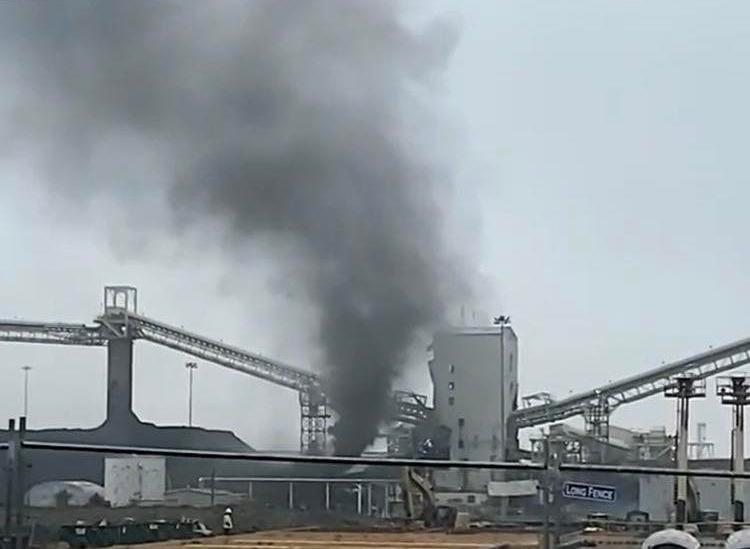
BALTIMORE — Residents of Baltiimore’s Curtis Bay area have filed a class action lawsuit against CSX Transportation over the Dec. 30, 2021, explosion at the railroad’s Curtis Bay Coal Piers, claiming negligence led to the blast that released “poisonous and carcinogenic chemicals” including lead and arsenic.
The suit, filed Tuesday by residents Cheyenna Shongo and Kennett Walker, claims the railroad’s “intentional and unreasonable operation, maintenance, and staffing” of the Curtis Bay facility led to the explosion, and as a result, residents suffered “substantial and unreasonable impacts including discomfort so as to be unable to fully and safely use and enjoy their property.”
No one was injured in the explosion, blamed on the buildup of methane gas in an unventilated conveyor belt. It was reportedly felt miles away and caused broken windows and other damage at nearby residences. CSX has subsequently been cited for federal violations by the U.S. Occupational Safety and Health Administration [see “CSX cited for serious violations in explosion …,” Trains News Wire, July 12, 2022], and by Maryland for violation of air-pollution rules [see “State cites CSX for environmental violations …,” News Wire, July 25, 2022].
|
|
No Injuries Reported as CP Train Derails in Maine |
|
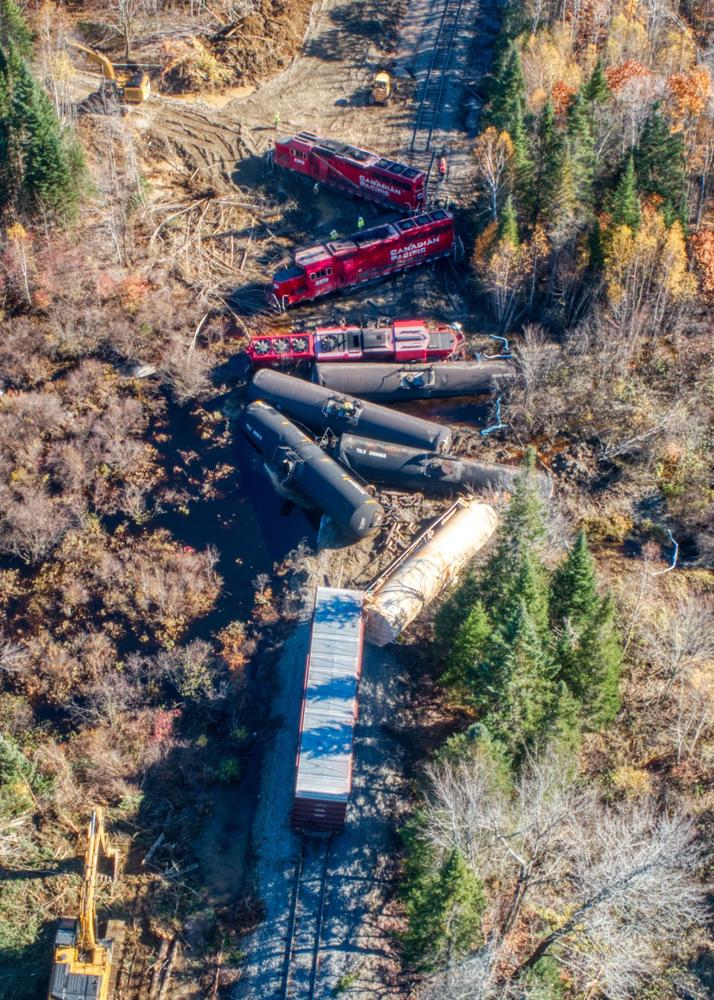
ORNEVILLE, Maine — Three locomotives and six cars of a Canadian Pacific train derailed early this morning (Wednesday, Oct. 19) in Orneville, an uncorporated area also known as Southeast Piscataquis.
WABI-TV reports the incident occurred about 3:15 a.m. and is attributed to a washout. The crew was not injured and no public safety issues have resulted, although asphalt is reportedly leaking into a bog at the scene. A small amount of diesel fuel was also spilled, WGME-TV reports. The Maine Department of Environmental Protection and Milo, Maine, Fire Department have responded.
The accident location, on the former Central Maine & Quebec, is about 30 miles north of Bangor.
|
|
|
|
|
|
|