E-Newsletter | October 23, 2020 |
|
Heigh Ho, Heigh Ho, It's Off to the Chipman Mines We Go |
|
Newbury's Love Affair with Silver
Newbury's first brush with silver was recorded at the turn of the twentieth century in an article in the Scientific American describing a tradition of colonial excavations along the banks of the Merrimack River that enabled the early Moulton blacksmiths to manufacture a few silver buckles and spoons.
Even earlier, Newbury settler John Watts was said to have mined silver on the south shore of the Merrimack about three miles upstream from Newbury's "waterside." The site, known as Watts's Hole, is said to have had enough silver to be used in the money coined by John Hull, treasurer and mint master of the Massachusetts Bay Colony. Hull and his partner, Robert Sanderson, managed a mint in Boston beginning in 1652 that operated for 30 years.
|
|
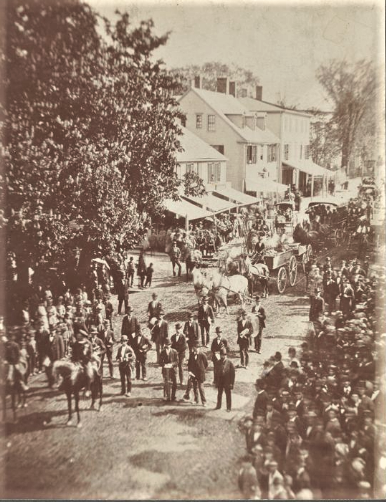
A brass band led a procession celebrating the first shipment of Newbury ore for transport to New York City. From the collections of the Museum of Old Newbury. |
|
It might seem curious that a vein of Newbury silver would come to the attention of Hull, although he had connections to Newbury. In 1659, Jeremiah Dummer became apprenticed to Hull for eight years. When Hull's daughter Hannah married Samuel Sewall in 1676, Hull gave her weight in silver as her dowry.
|
|
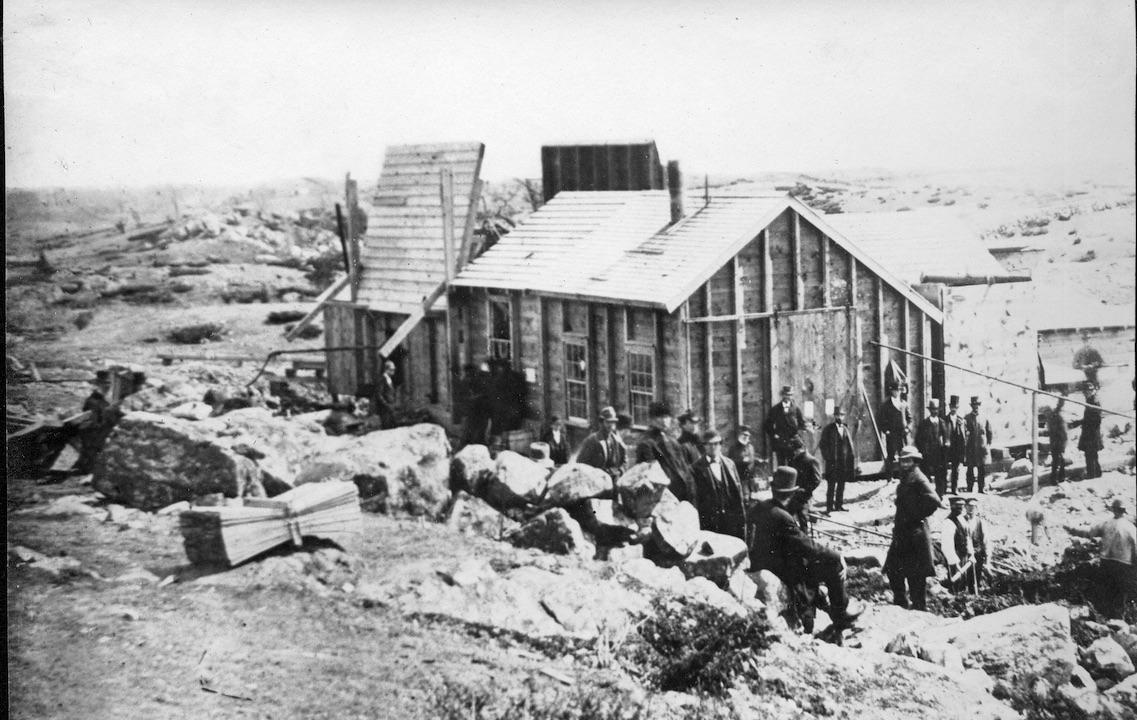
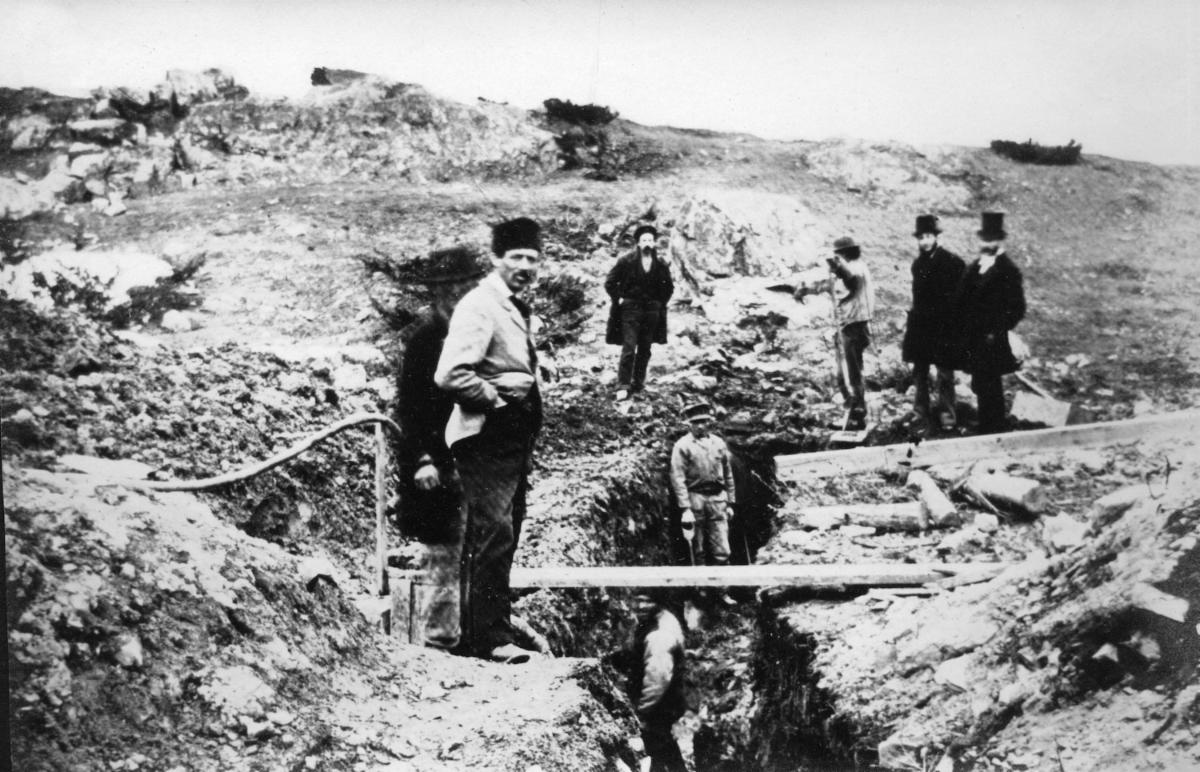
These views of the Chipman Silver Mine on Scotland Road show the workers, circa 1875. The mine was in operation for a short time during the late nineteenth century, but was not as successful as prospectors had hoped. Below, a group of potential investors has gathered at the mine head and office. From the collections of the Museum of Old Newbury.
|
|
It wasn't until the latter half of the nineteenth century that the discovery of silver in a field off Scotland Road gained national attention for Newbury and Newburyport.
Edward L. Rogers of Byfield supported his family by doing odd jobs, many for Albert Adams who lived on Scotland Road. Around 1870, Rogers found fragments of ore in the Highland Pasture that had migrated from the vein outcrop. He and Adams traced the fragments to an area of land owned by Richard Jaques. Adams had that ore assayed by Newburyport chemist, Karl Castelhun, whose reports confirmed that the ore contained silver. In May 1874, Adams purchased the pastureland from Jaques paying him $350 for the acreage, the going price for pasture at the time.
Adams began mining in earnest. Six tons of galena (an ore of lead often mined for its silver) were mined, attracting attention as far away as Boston. Three months after purchasing the land, Adams sold the pasture to William W. Chipman, a Boston entrepreneur, along with E.P. Shaw and Eldridge Kelley of Newburyport. The men paid Adams $100,000 for the land. Soon after, a second mine was opened on a contiguous plot of land belonging to Moody Boynton. Chipman and Boynton consolidated their efforts to establish the Merrimac Mining Company in February 1875.
By May, the recently formed Newburyport Silver Mining Company purchased the Chipman Mine. The purchase price this time was $1,000,000, representing Essex County's largest land settlement up until that time. Two more mines in close proximity followed and were formed by the Lawrence Company and the Bartlett Company.
By June 1875 there were small mining operations in many towns throughout Essex County and as many as 250 mines from the south bank of the Parker River to the town of Salisbury.
Excitement had reached fever pitch, and on June 2, 1875, Newburyport celebrated the success of the silver mining with a parade on State Street stretching to the wharf where 160 tons of argentiferous ore were loaded aboard the schooner Nabob for delivery to New York. Some of the silver from the ore was returned to Newburyport for the production of spoons.
Mining continued until about 1878 with diminishing results and rising costs, and in 1880 the Chipman mine was officially closed.
In 1901, when Route 1 was being built, quarrymen discovered a vein of argentiferous ore, but little came of it. Another attempt at mining was made in 1911 by the Essex Mining and Development Company, again with mostly failed results. By 1925 all mining efforts in Newbury had ceased.
|
|
Want the perfect gift for friends and family this holiday season? Like the idea of supporting the Museum of Old Newbury and enjoying a selection of crisp, clear images from our collections?
We are excited to introduce the first annual Cushing House Calendar. The 8.5"x11" wall piece features heavy grade, high quality, tear off pages for each month and includes a "Notes" section for handwritten reminders.
We are taking pre-orders now and will ship to you when ready (about mid-November).
$16.50 per calendar, shipping included (for orders of more than 4, please contact us to arrange pick up/shipping). Click here to order.
|
|
Register today!
VIRTUAL EVENT: A Newburyport Travelogue
Newburyport has a rich and storied history that connects it to places spanning the globe. Stories of Newburyport can be found in faraway lands like London, the Caribbean, Chile, Oregon, California, Bermuda and Hawaii. Take a virtual tour with Jack Santos as your guide. Learn about Newburyport’s connections to the world and be a Global Newburyport History Explorer – right from your desktop!
Save the date! Part Two: Tuesday, January 12, 2021 @ 6:00 p.m. | Registration to follow.
|
|
Puzzle Me This...Everything Brown!
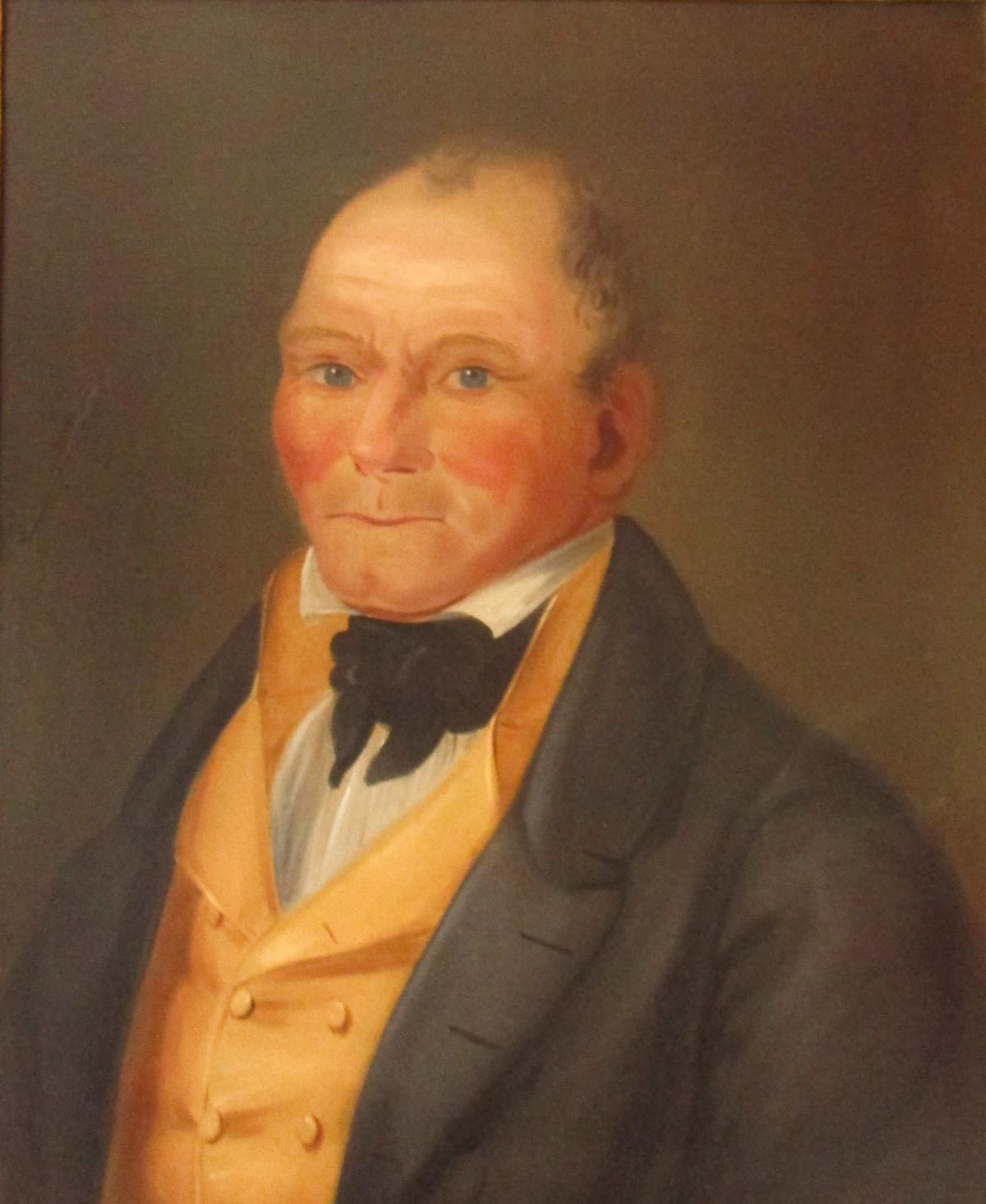
Newburyport Captain Nicholas Brown, younger brother of the noted Captain Moses Brown (1743-1804), was involved in trade and privateering during the last quarter of the 18th century. Privateers were legally authorized to seize British vessels and profit from selling the confiscated goods.
Of his fourteen children with his second wife Lucy Lamprey, at least four sons became shipmasters, and two daughters married shipmasters. Like many of Newburyport’s seafaring families facing the hardships and dangers of working on sailing vessels in the 18th century, Nicholas suffered the loss of five sons and a son-in-law who died while at sea, in a foreign port, or were lost at sea.
In 1819, near the end of his life, an unidentified artist painted this portrait of Nicholas and those of a daughter and granddaughter. These paintings have traditionally been attributed to local artist Moses Dupre Cole, a sign and portrait painter, based on similarities to known, signed Cole portraits.
About Captain Nicholas Brown (1747-1819) - Oil on canvas, attributed to Moses Dupre Cole, Newburyport, circa 1819. From the collections of Museum of Old Newbury.
Click on the image to begin.
|
|
You Can Now Play Along with "Yeat Yeat, Don't Tell Me!" Recording
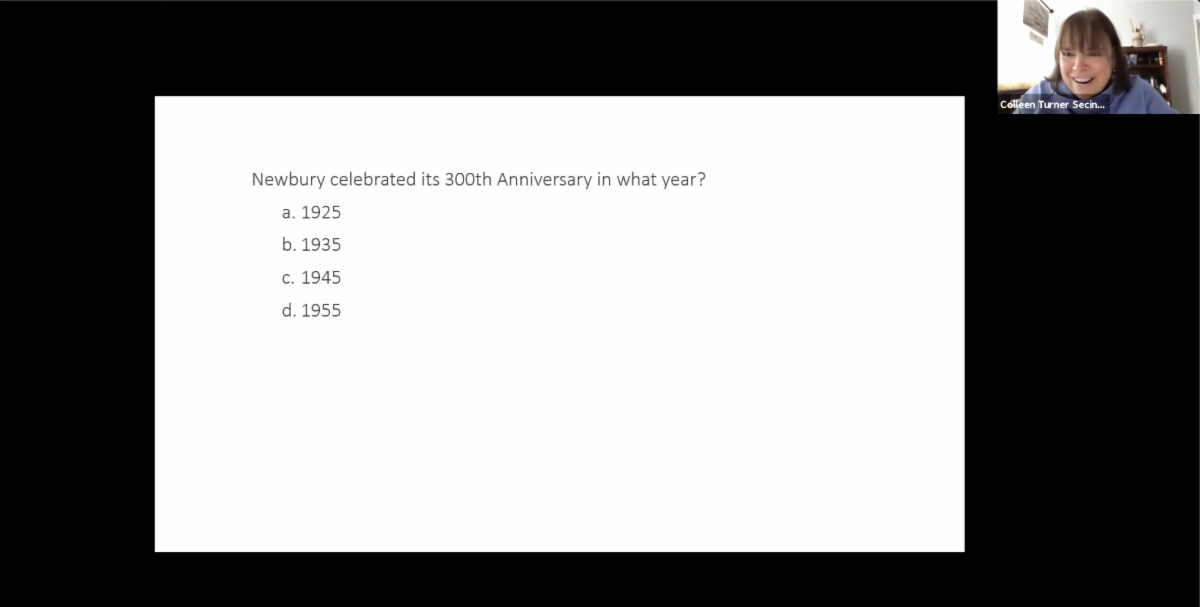
"That Jack Santos is a very savvy man," Colleen Turner Secino happily points out. The pair, co-hosts of "Yeat Yeat, Don't Tell Me!" have finally figured out a way to let people who missed the show play along while watching the recording.
Just like everyone participating during the live event, you have a minute or two to select your answer, then it will pop up on the screen. "It's a real game changer," Turner Secino quips.
Give it a try. Grab pen and paper, then watch last Friday's episode here. Send us an email (info@newburyhistory.org) to let us know how you did. This show's winner had six correct!
Then plan to join us at high noon on Friday, October 30, 2020 for an All Hallowed Afternoon "Yeat Yeat, Don't Tell Me!" featuring only spooky and creepy Newbury-area queries. (Just add this Zoom link to your calendar). |
|
And be sure to follow us on social media!
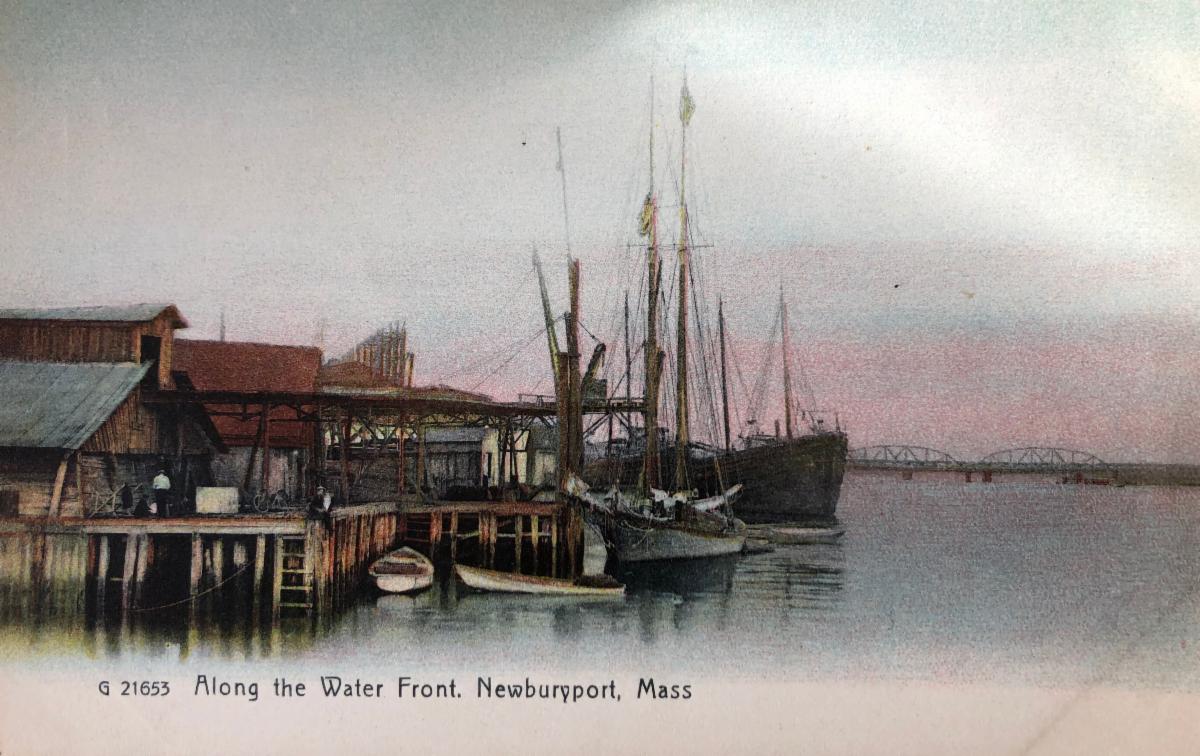
Postcards from the MOON kicked off this week with this lovely image, "Along the Water Front, Newburyport, Mass."
We will be posting a different image every Thursday, but you can only see them on Facebook/ Twitter (@NewburyHist) or Instagram (@Old_Newbury). Find us on your favorite channel and follow the MOON today.
|
|
Something is Always Cooking at the Museum
Crisp air and nippy mornings can mean only one thing...it's apple season! And what warms a heart more than the fragrant scent of cinnamon and sugar wafting from the kitchen? Longtime Museum of Old Newbury volunteer and member, Lindsey Cavanagh, has a winner here.
Deep-Dish Apples
8-10 tart baking apples
1 cup sugar
1 1/2 teaspoon cinnamon
3 tablespoons butter
1/2 cup raisins
1 cup flour
1 cup brown sugar
1/2 teaspoon salt
1/2 cup butter (yes, you need two different amounts)
Preheat oven to 350ºF. Slice apples. Mix sugar with cinnamon. Layer apples in a large buttered casserole dish while sprinkling cinnamon sugar, small pieces of butter (first three tablespoons) and raisins in between layers. Pile high. In another bowl, work flour, salt, sugar and half cup butter together to make a rich dough, patting over apples to make a thick cover, out to the edge. Bake for 50-60 minutes. Serve hot with hard sauce, ice cream or whipped cream.
|
|
|
|
Picture This!
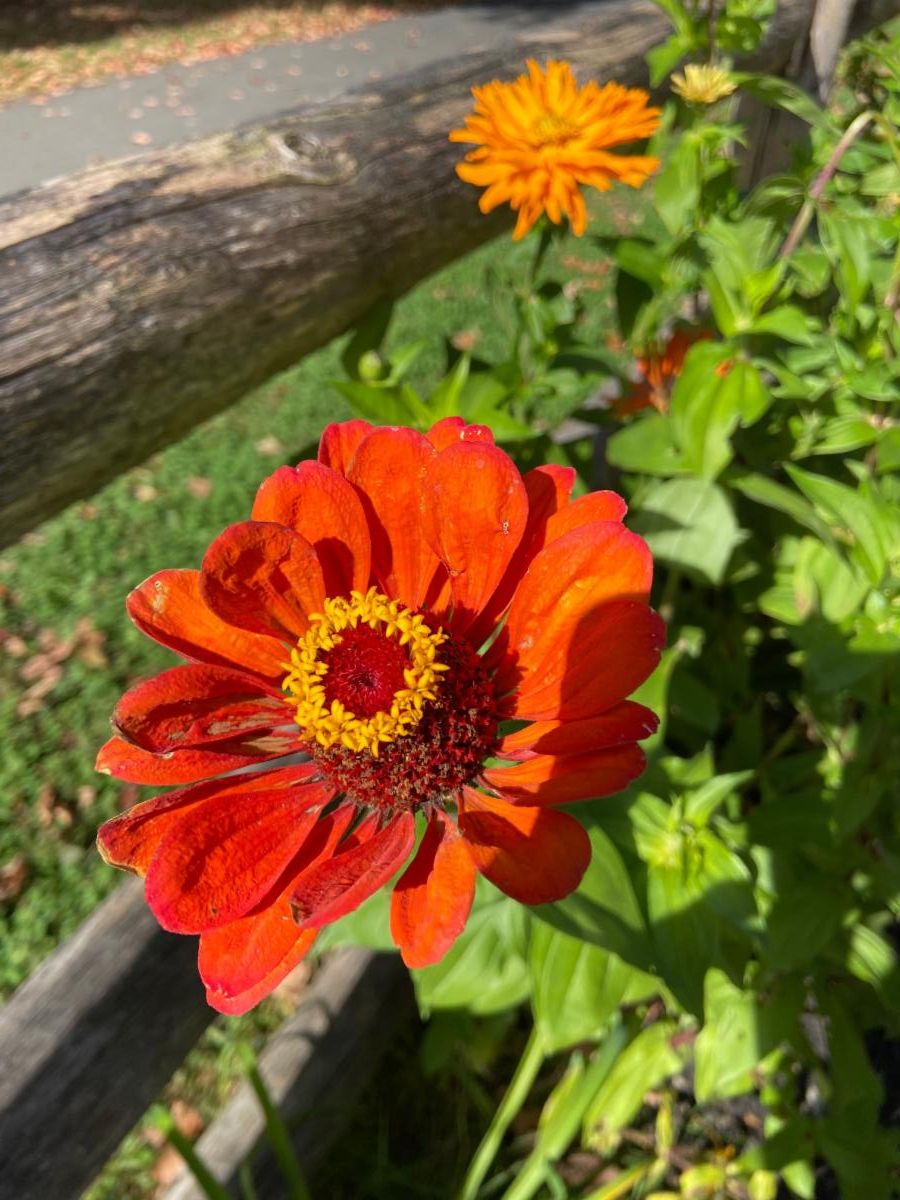
On her morning walk with her husband, Sharyn Dahn of West Newbury captured this lovely fall flower.
This late blooming orange Zinnia is still as bold as a bright summer day.
Sharyn explains, "We walk the Rail Trail from High Street to Parker Street, always stopping to admire the beautiful garden. It is always a joy to see. Many thanks to the volunteers who care for it."
Do you have a particularly wonderful photo? Send your images of Newbury, Newburyport or West Newbury to info@newburyhistory.org.
|
|
During this difficult period of COVID-19, we rely on your support more than ever. We are working to reschedule many of the programs that we have had to postpone, as well as develop new, online programs for you to enjoy and keep us connected. We hope, if you are able, that you will consider a donation to the museum. Thank you for your continued support.
|
|
Museum e-Newsletter made possible through the
generosity of our sponsors:
|
|
|
Museum of Old Newbury
98 High Street
Newburyport, MA 01950
978-462-2681
|
|
|
|
|
|
|
|