As mentioned in our Case Study article at Mass General Brigham Hospital, Abbot sound tested the concrete surfaces to determine areas of delamination of the top layer of concrete from the sub-base. Sound concrete will exhibit a clear ringing sound, whereas a dull or hollow sound indicates delaminated areas. In the early stages of delamination, there is often no visual evidence. For this reason, it is often necessary to sound the concrete prior to performing rehabilitation on project. Typical sounding tools include a drag chain, a sounding rod, or a hammer.
Drag Chain
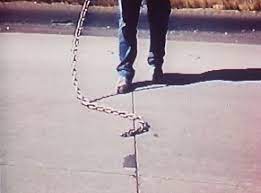
A good choice for sounding a large, flat area is the drag chain. Using this method, the inspector drags a heavy chain in a sweeping motion along the concrete while listening for areas that might sound hollow. Once a suspect area is discovered, the contractor may further investigate the area using the solid end of the chain or a hammer.
Sounding Rod
On vertical surfaces or confined spaces where a drag chain is not practical, a sounding rod is often the method of choice. A sounding rod is typically a long, metal pole that the inspector bounces up and down along the concrete while listening for changes in sound. The sounding rod can be used while standing upright and large areas can be sounded relatively quickly. Note that the sound produced by the sounding rod is generally not a distinct as the drag chain.
Hammer
Hammers are the best choice for vertical surfaces such as columns and cap spaces, or in confined spaces such as the tops of caps. The principal is the same as the sounding rod but the inspector must kneel or bend over to strike the concrete.
-----------------------------------------------
In situations where the inspector may be having trouble determining the delaminated areas, he may benefit from spreading sand or another granular material that will tend to jump up during the sounding process in an area of delamination.