e-Newsletter | February 3, 2023
|
|
Newburyport’s Airship Commander:
Charles Gray “Petit” Little, Part II: “Aerial Dreadnought Explodes”
by Bethany Groff Dorau and Tom Bateman
|
|
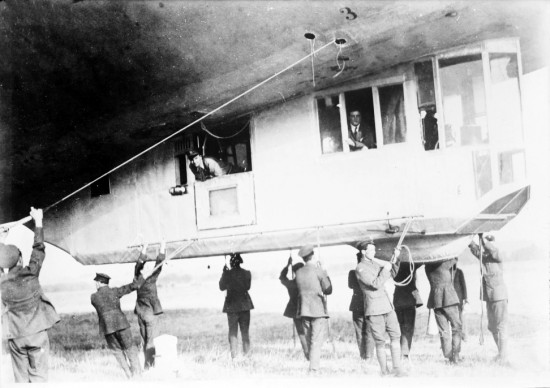
The control car of the R-38 before its fateful last flight.
When we last left Newburyport’s favorite dirigible commander, Charles Gray Little, it was May 16, 1919, and he had just jumped from his aircraft, the C-5, when it was some thirty feet in the air, breaking his ankle and horrifying the assembled spectators. The C-5 floated away across the North Atlantic, never to be seen again.
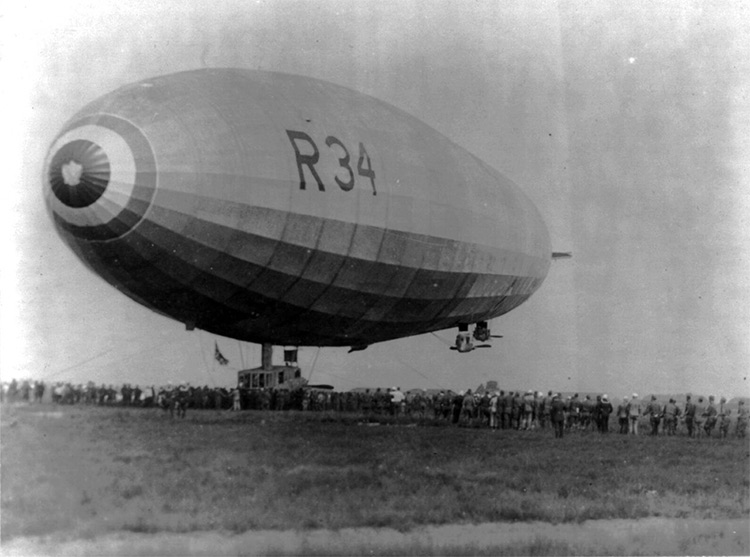
Charles Gray Little had been piloting dirigibles for years by the time he made this leap, first taking command of dirigibles during World War I in France. These massive aircraft were slow and dangerous – easy, flammable targets for German airplanes, but extremely important for observation and reconnaissance. Although the war was over when Charles piloted the C-5 from New York to Newfoundland in 1919, the craze for dirigibles was at a fever pitch. Dirigibles were being tested as an exciting, relatively fast alternative to a sea voyage across the Atlantic, and The Daily Mail, a British newspaper, had established a prize of 10,000 pounds for the first airship to accomplish such a journey. The world watched as numerous dirigibles attempted the crossing and, like Little and his crew, failed. Just two months later, however, the first transatlantic flight was made by an RAF crew flying His Majesty’s Airship R34.
|
|
The prize-winning R34, landing at Mineola, Long Island. Courtesy photo.
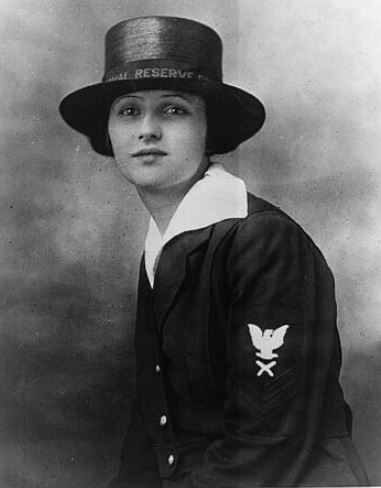
While recuperating from his fall, Charles fell in love. Joy Bright, the youngest daughter of New Jersey State Senator William Bright, was a remarkable young woman whose military service and obsession with naval aviation was a perfect match for her suitor. During World War I, Bright joined the navy as a yeoman in the Naval Reserve Force and served as a courier at the Camden shipyard before being transferred to the Naval Air Station at Cape May, the headquarters of the dirigible fleet on the East Coast. After the war, Bright was kept on at the station as a civilian employee.
|
|
Joy Bright in her Naval Reserve Force uniform.
By early 1920, Charles Gray Little was fully recovered and eager to get back to piloting airships. Meanwhile, the United States Navy was deeply invested in acquiring massive, rigid airships, and had been hoping to acquire German Zeppelins, considered the best in the world, as part of the settlement at the end of the war. The Germans, however, sabotaged the fleet to avoid turning it over to the Allies. The Navy then turned to the British, who sold the United States an unfinished dirigible known as the R38 for $300,000, with the understanding that the airship would be completed to the specifications of the Unites States Navy, and then tested before being flown across the Atlantic with an American crew.
On Wednesday, March 13th, 1920, the Newburyport Daily News announced, “it is quite an honor which has come to Lieutenant Charles G Little of this city, to be selected as one of the group of Navy men who have been dispatched to England to care for the interests of this country in the purchase of the new big dirigible balloon…” The airship, which was to enter U.S. Navy service as ZR-2, was massive – nearly 700 feet long, carrying 70,000 lbs. of fuel. It could cruise along at 70 mph and had a range of 6,500 miles. It was the most advanced airship of its kind, and was seen as the future of cross-Atlantic travel and transport.
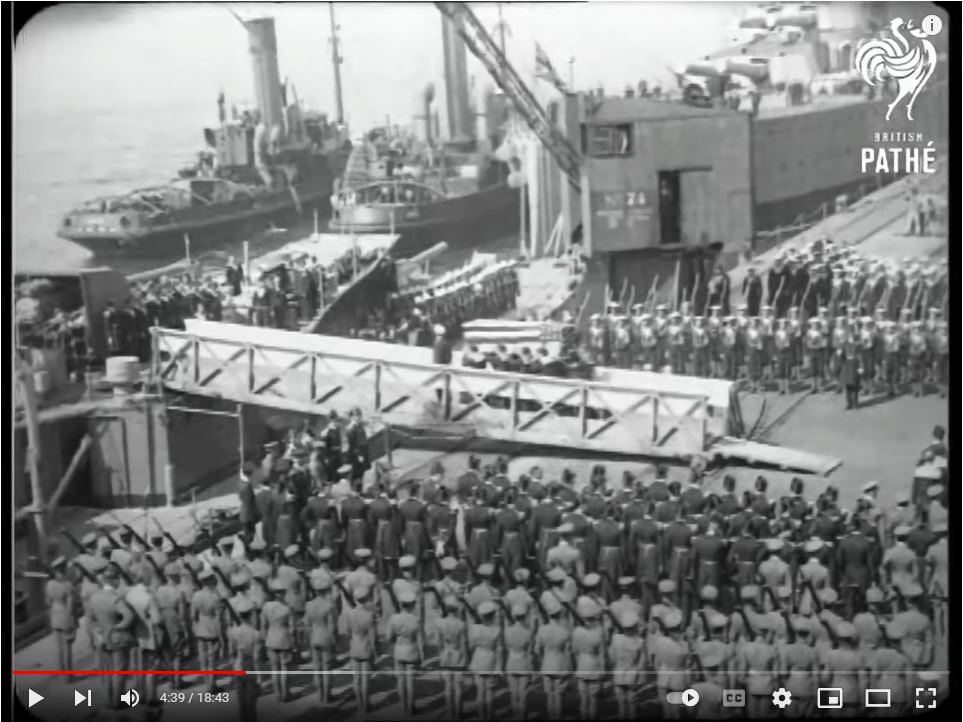
On March 20, Charles Gray Little left New Jersey and sailed for England aboard the United States Army Transit ship Mercury. In July, the New York Times announced Charles’ engagement to Joy Bright, and noted that she and her mother and sister would soon be on their way to join him. The pair married on October 9, 1920 in England, and after their honeymoon on the ravaged continent, they had a few months together in England as Charles and the rest of the crew prepared for the tests needed to ensure the safety of the dirigible.
On June 23, 1921, Joy Bright Little sailed for home aboard the transport ship Somme to await her husband’s return aboard the R38/ZR-2. She would never see him again.
|
|
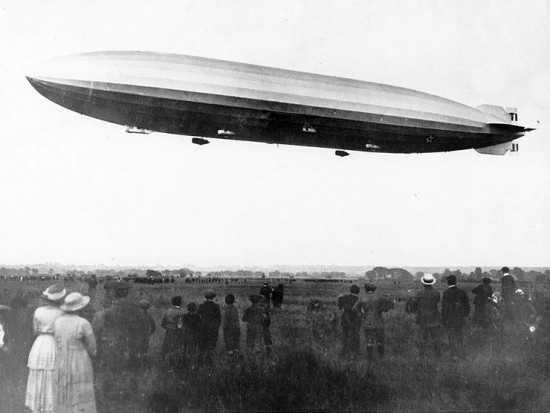
The R38 during a test flight
The first test flight of the R38/ZR-2 took place the same day that Joy Bright Little sailed for home. The flight revealed that the zeppelin was dangerously unbalanced, and revisions to the rudder were made before the second and third test flights on June 28 and July 17. On this third flight, several girders buckled, necessitating a slow return to the base. Questions were raised about the overall design of the airship, with several experts recommending an extended repair and redesign period before another test flight was undertaken. The British Air Ministry assured the Americans that the dirigible would be ready after minor rebalancing, however, and on August 23, 1921, the R38/ZR-2 left its hangar for its fourth test flight.
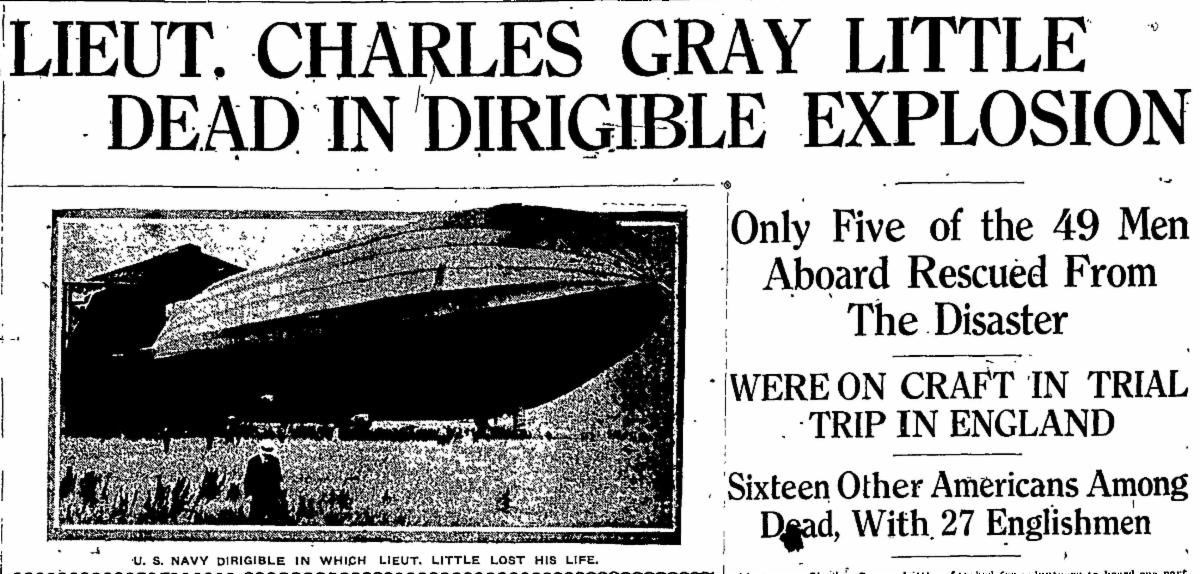
The captain and most of the crew of the August 23 flight of the R38/ZR-2 were British, including its captain, Flight Lieutenant Archibald Herbert Wann. Charles Little was one of 17 Americans in the 49-member crew on board. After clouds obscured its flight on the first day, the airship resumed its journey from Royal Navy Airship Station Howden in York to the RNAS Pulham in Norfolk on August 24. Thousands of people turned out to watch as the dirigible approached the port city of Hull. According to eyewitnesses, the first sign of trouble was a “wrinkle” that appeared in the middle of the aircraft. The nose and tail began to droop and then, to the horror of all assembled, the airship cracked open, spilling men and machinery into the air. There were several powerful explosions, breaking glass throughout the city. The airship broke in two and fell into the Humber River in flames.
|
|
Five crew members survived the fiery crash, including one American. Captain Wann, who was in the control cabin, also survived. The next morning, the Newburyport paper carried the news on the front page that Charles Gray Little, airship commander, was dead.
|
|
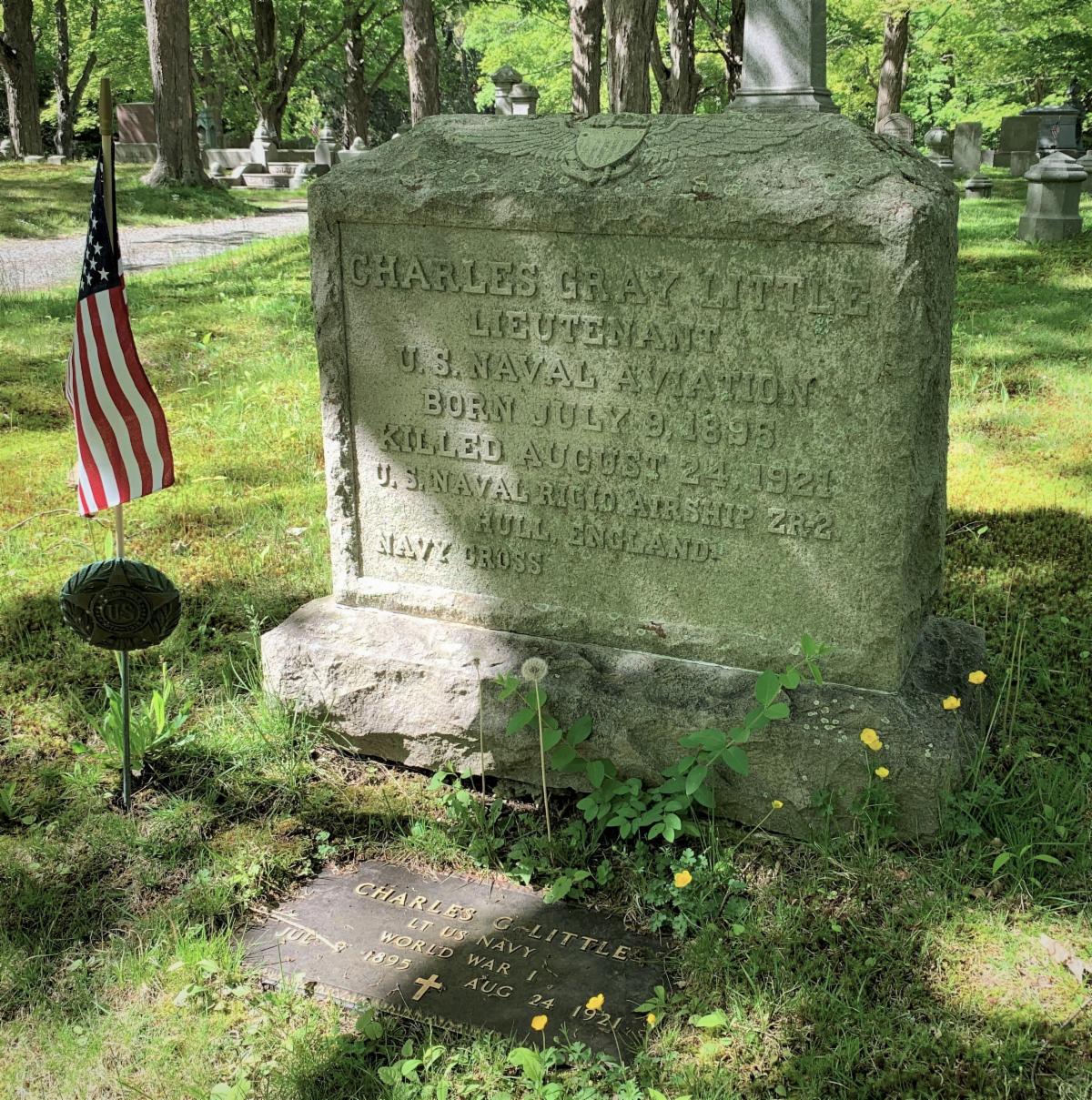
One month later, funeral services were held at the First Religious Society on Pleasant Street. The newspaper reported that “many stores were closed and there was a general display of flags at half-mast on public and private buildings. It was a high tribute to a young officer.” One of his childhood friends wrote to the paper on the day of his funeral, “Charlie Little is home and peacefully sleeps in the bosom of his native land… on the hillside that he knew so well and amongst those that he loved and those that loved him…whose disposition was human sunshine…” Charles Gray Little is buried in Oak Hill Cemetery.
|
|
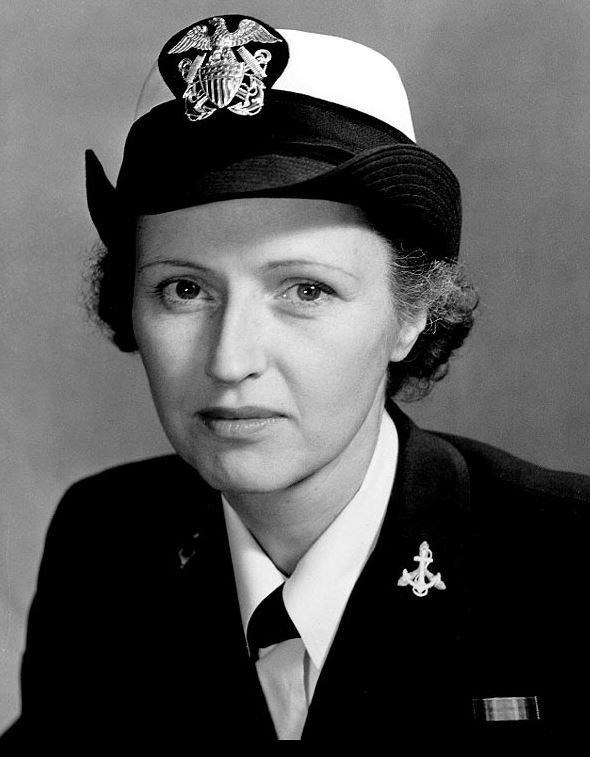
A final note: Joy Bright Little, Charles Gray Little’s young widow, is worthy of several additional volumes. She went on to marry another dirigible pilot, Lewis Hancock, who also died in a dirigible disaster aboard the Shenandoah in 1925. During World War II, Joy Bright Hancock threw herself into the newly formed WAVES (Women Accepted for Volunteer Emergency Service), the women’s branch of the Navy. After the war, she pushed the armed services to enlist women in their regular ranks. She was successful in these efforts, and was the last commander of the WAVES. |
|
"Sailing to Freedom:
Maritime Dimensions of the Underground Railroad"
Friday, February 24, 2023, 7 p.m.
Museum of Old Newbury, 98 High Street
Sailing to Freedom will highlight little-known stories and describe the less-understood maritime side of the Underground Railroad, including the impact of African Americans’ paid and unpaid waterfront labor. This talk will reconsider and contextualize how escapes were managed along the East Coast, moving from the Carolinas, Virginia, and Maryland to safe harbor in northern cities such as Philadelphia, New York, New Bedford, and Boston. While scholarship on the Underground Railroad has focused almost exclusively on overland escape routes from the antebellum South, this new research expands our understanding of how freedom was achieved by sea and what the journey looked like for many African Americans.
|
|
Dr. Timothy Walker, Professor of History at the University of Massachusetts Dartmouth, is a scholar of maritime history, colonial overseas expansion, and trans-oceanic slave trading. Walker is a guest investigator of the Woods Hole Oceanographic Institution, a contributing faculty member of the Munson Institute of Maritime Studies, and Director of the NEH “Landmarks in American History” workshops series, titled “Sailing to Freedom: New Bedford and the Underground Railroad” (2011–2022). |
|
History of Old Newbury in 3 Drinks:
Part I: Beer (1635-1700)
Thursday, March 30, 2023, 6:30 PM
Museum of Old Newbury, 98 High Street, Newburyport
Did you know that Newbury's Dionis Stevens Coffin brewed beer in her Newbury tavern and went to court in 1653 to protect its stellar reputation? Did you know that a low-alcohol "small beer" was brewed to be consumed all day by all Newbury citizens, even children? Court and property records provide rich details of how and what people drank in Newbury in the 17th century, and what sometimes befell them afterward.
|
|
Join Bethany and James Dorau for an illustrated talk and tasting on the history of beer (and cider and perry) in early Newbury, from European settlement to the ascendancy of rum in the 18th century. Learn how taverns, second only in importance to the meeting house, centered our community, and how brewing, fermenting, and serving beer changed over time. Explore how our former neighbors understood not only the benefits of beer, but its potential dangers as well. This event includes a beer tasting. Tickets $10 members, $20 non-members. |
|
Woman on the MOON
...a blog by Bethany Groff Dorau, Executive Director
|
|
Aunt Mary in the MACRIS
When I was a young teenager living in the Poore House with seven other people (and only one bathroom), I often escaped to another Poore house right down the street. In the 1980’s, there were family homes up and down and just off Garden Street in West Newbury. My grandmother’s brother Ray Poore and his wife Jeanette lived at 48 Garden St, just around the corner from my grandmother’s other brother Howard and his wife Mary. Howard and Mary’s daughter Sue and her husband Gordon lived further down Middle Street, and, of course, my grandmother, Charlotte and her sister Emily Poore lived on Poore’s Lane, where I live today, also off Garden Street. Of the six Poore siblings, four lived within half a mile of each other.
|
|
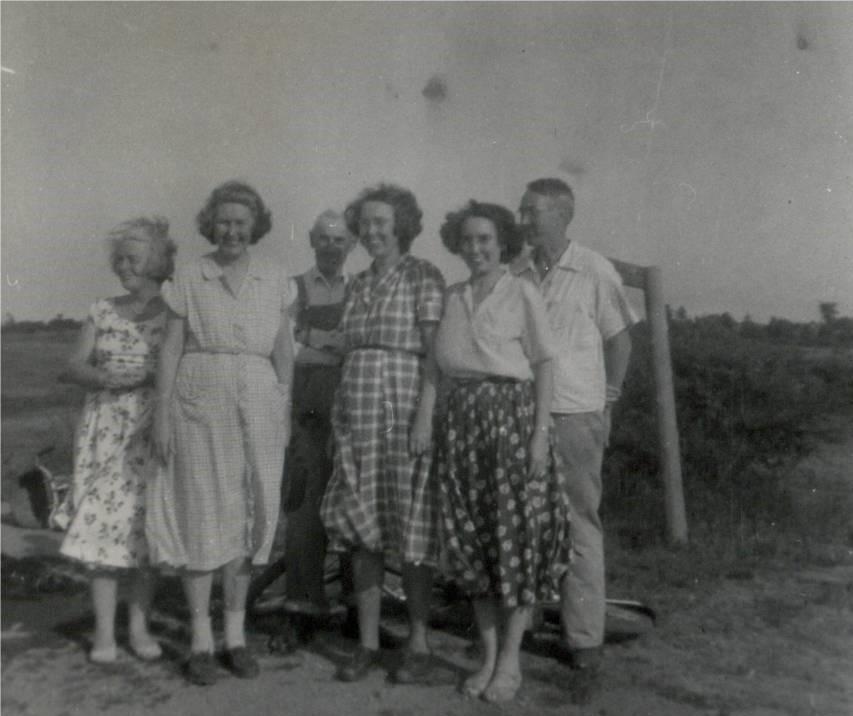
My great-aunt Mary (Anderson) Poore, grandmother Charlotte (Poore) Muzrall, great-grandfather Philip Poore, great-aunt Louise (Poore) Muzrall, great-aunt Emily Poore, and great-uncle Howard Poore in 1955. All but Louise lived on the same street.
I remember Uncle Ray as square-jawed and handsome, not especially friendly to children, but a jokester with his siblings. He owned a large field adjacent to the house where we lived with Aunt Emily and my grandmother, and was a frequent visitor. He stomped into the kitchen smelling of wood smoke and burlap and had my taciturn grandmother laughing about something in short order. I’m not sure he ever spoke directly to me. His wife, my great-aunt Jeanette, was a dragon as well, or so I believed when I was a teenager. Her primary form of communication seemed to be a bit of a growl in my direction, so I steered clear.
|
|
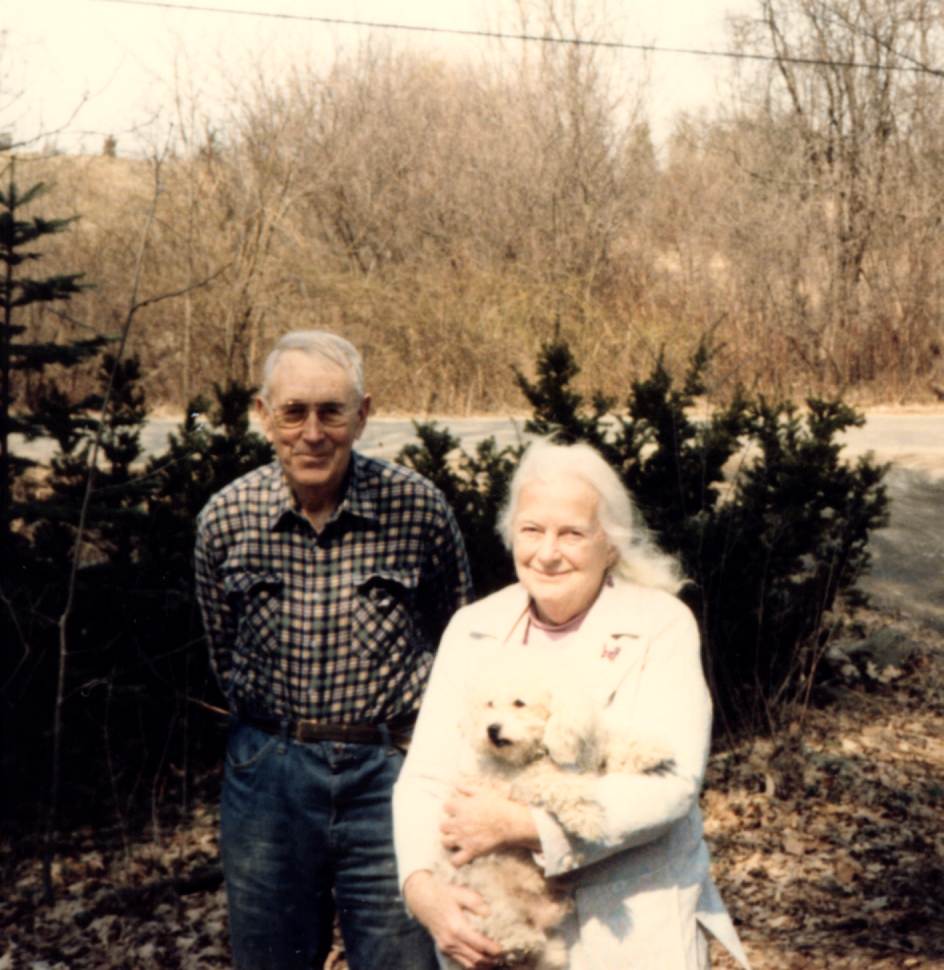
Aunt Mary and Uncle Howard with their last dog, Elmer.
But Uncle Howard and Aunt Mary Poore…to me, they were all things wise and wonderful. When I escaped the madding crowd on Poore’s Lane, I often found myself at their house, or, more particularly, in their barn. Aunt Mary had long, snow-white hair, tied back and loose in puffs around her weathered face. She was kind, but in an active, even boisterous sort of way, ready with encouragement or an instruction. Uncle Howard was gentle and quieter. The pair of them offered me sanctuary during some terrible times as I tried to adjust to life in the United States after a childhood spent in the Canadian wilderness, but Aunt Mary and I understood something fundamental about each other. Some girls need a horse, and if one cannot be offered, a barn will do.
|
|
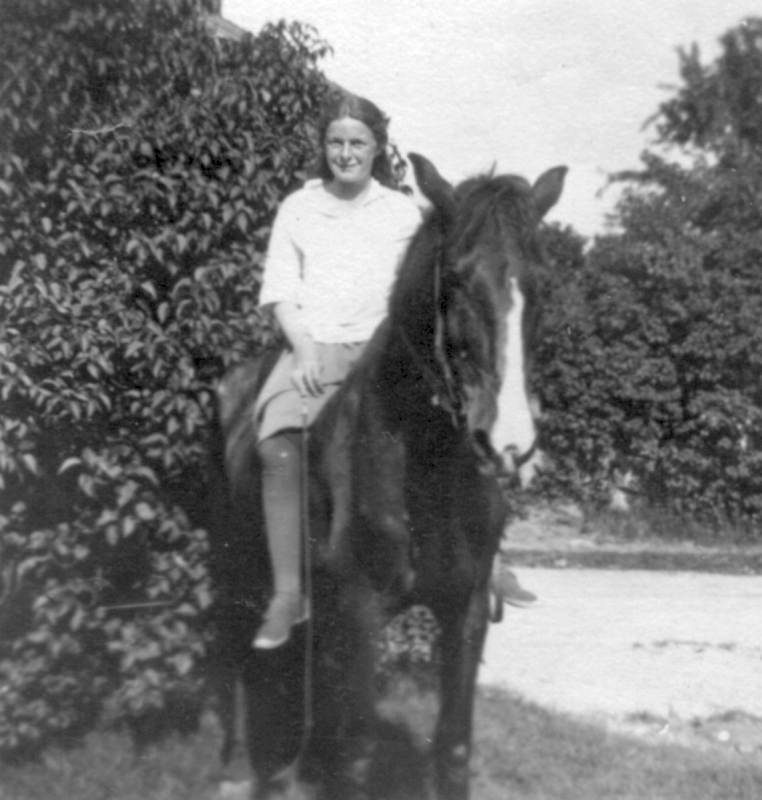
Aunt Mary in the 1920's on her horse, Billy.
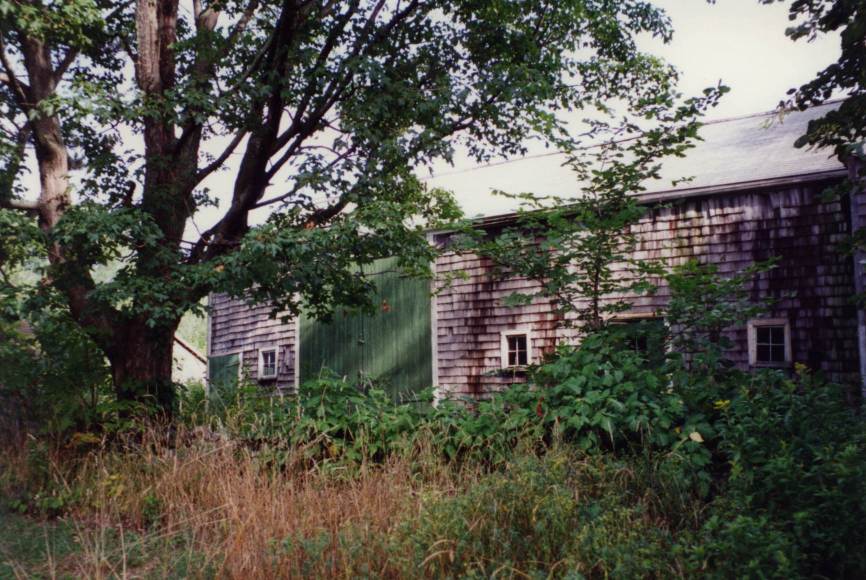
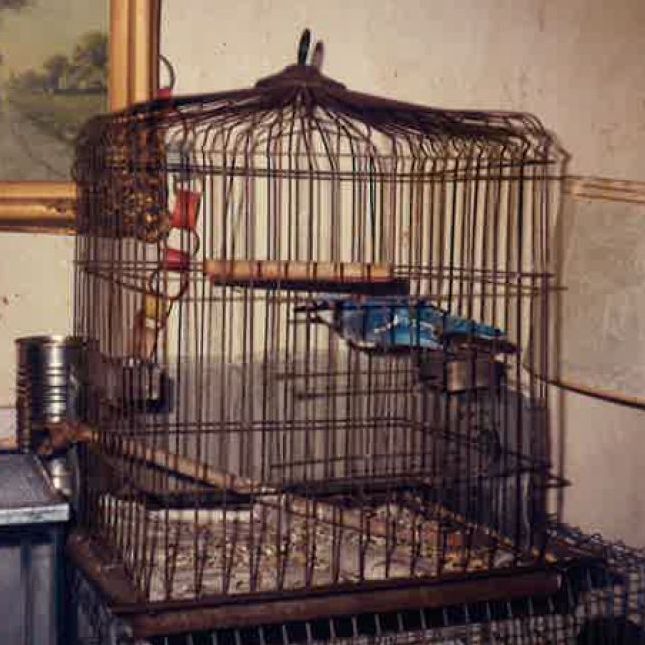
The barn at 406 Middle Street was an ancient timber-frame beauty. I believe there was still an elderly cow in it when we first arrived from Canada, but my memory on this is fuzzy. Even in the absence of animals, however, it was the perfect comfort to a lost farm girl. The smells were right – the hay still in the loft, the feed sacks stuffed with bailing twine. Dusty harnesses festooned the walls. An old wagon sat in the corner. The hay hook dangled like a funhouse toy from its track along the roofline. I went into the dark and cool of that barn in the summer, sat on an old bale in a whitewashed stall and read books about tough girls who proved everyone wrong, and it made me feel better. And Aunt Mary, trailed by one of a series of yellow and white dogs named Honey, would lure me out with cookies and lemonade and we would shell peas or dead head the flowers in her garden while we talked. She was a devoted nature lover and rehabbed wild birds. I helped her care for crows, cardinals, and a red-tailed hawk. She sent me home with an injured blue jay once– laughing about how much noise we both made.
I wonder what she made of me. One day I told her how much I loved coming to the barn and she invited me to take anything from there that made me happy. I took part of an old harness that reminded me of the draft horses I had left in Canada. It became a sort of talisman, reminding me of another time. As the years passed, it reminded me of Aunt Mary.
|
|
Aunt Mary and Uncle Howard's old barn in 1994.
The barn is gone now. After Aunt Mary died in 1988, followed by Uncle Howard in 1996, the barn became a liability, a barrier to the sale of the property, and it was taken down in 2003. The house was sold. Mary’s daughter Sue and her husband also died, and their house was sold, and most recently, in 2018, tough old Aunt Jeanette died. Her house and barn were sold, razed, and four huge houses popped up in their place, seemingly overnight, their gleaming facades turned boldly to the street. No more hayfield. No more old trees. I’m still not quite over it.
I will admit here that I do not think of Aunt Mary as often as I should. Since the collapse of the Artichoke bridge on Middle Street, closing the section between Garden and Hale Streets, I do not ever drive past her house, once a spur to memory. But last week, as I looked up some information about a West Newbury house in MACRIS, there she was.
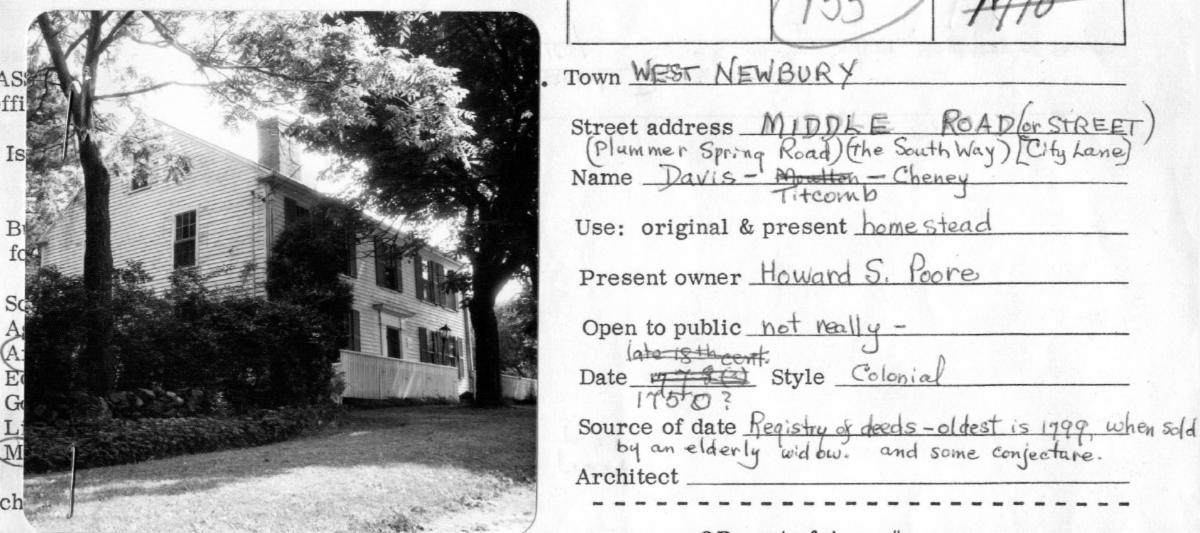
Let me back up. MACRIS is short for Massachusetts Cultural Resource Information System. This database links to the Massachusetts Historical Commission database of historic properties – a goldmine for researchers. Better still, the inventory sheets for individual properties, some filled out fifty years ago, are included with the listing. Aunt Mary, clipboard and inventory form in hand, roamed all over West Newbury in the 70’s and early 80’s recording the built environment. I looked up the house and barn at 409 Middle Street. She had filled out the form for her own house in March, 1973, though she filled out the owner as Howard S. Poore. Some of the other bolder women listed houses under the names of the husbands AND wives – even if only the husband was on the deed – a feminist revolution indeed! Though she did not take ownership of her house, Mary Anderson Poore did sign the sheet with her own name, while many of the other women in town signed their names as “Mrs. John Smith”, etc. So, still her own woman. She first takes issue with the name of her street and lists all possibilities. The street is Middle Road or Middle Street, or Plummer Spring Road, or The South Way, or City Lane. Is it open to the public? Rather cheekily, she answers, “Not really.” To know her is to understand that if you asked, she would show you around the place. Scrupulously honest, she admits that her dating of the house as 1750 is based on an old deed and “some conjecture”, and she lists the condition of the house as “fair”, while most of her peers who inventoried their own homes tended to be a good bit more generous in their assessment.
|
|
The MACRIS form filled out in 1973 by Aunt Mary
Still, the entire form is filled with her singular personality, and with such fondness for her farm that it makes my heart ache. She notes the “secret room on the 1st floor”, the scuttle near the ridgepole of the roof. She measures the center chimney at 9x12 feet in the cellar, on 2 arches. She lists her “Christian door with 2 small lights in it,” accompanied by a pencil sketch, and the “simple, plain, upright boards” of the exterior. The barn and garage are “old”, while the “henpen, outhouse, cornhouse, baler shed, tool shed and manure shed” are newer. The landscape features are “old farm fields, pastures, orchard, white picket fence behind two large horse chestnut trees.”
There is much I could add here, like how the crocuses and daffodils and irises spilled down the hill by the front door, how the watery light came through the wavy glass of the front room windows, and how she opened every trunk in the attic for me. The MACRIS database is not where I expected a visit from Aunt Mary, but I am so grateful to be reminded of her. This morning there were a dozen blue jays, two cardinals, and a crow outside my window. “Birds can live for a very long time,” she said to me thirty-six years ago, when the blue jay she had trusted to me was recovered and released. “Don’t be surprised when they come back.”
|
|
The blue jay just before its release in 1987. |
|
Something Is Always Cooking... |
|
This recipe comes from Sandy Baker, the great nephew of Lt. Little, who helped with our story. It's a great way to serve brunch to a crowd.
Betty's Breakfast Bake
9-12 eggs
3 cups milk
2 cups shredded cheddar cheese
2 tbsp mustard
1 tsp garam masala
1 tsp black pepper
1 tsp garlic powder
2 bags seasoned croutons
Bacon (partially cooked in the microwave)
1) Mix the 1st seven ingredients in a large bowl
2) Spread the croutons in the bottom of a buttered 9x13 pan
3) Pour the egg & cheese over the croutons
4) Top with the bacon strips
5) Bake at 425 for about an hour. I usually cover it for the first 1/2 hour just to make sure it doesn't get too brown
|
|
Click the image to do the puzzle
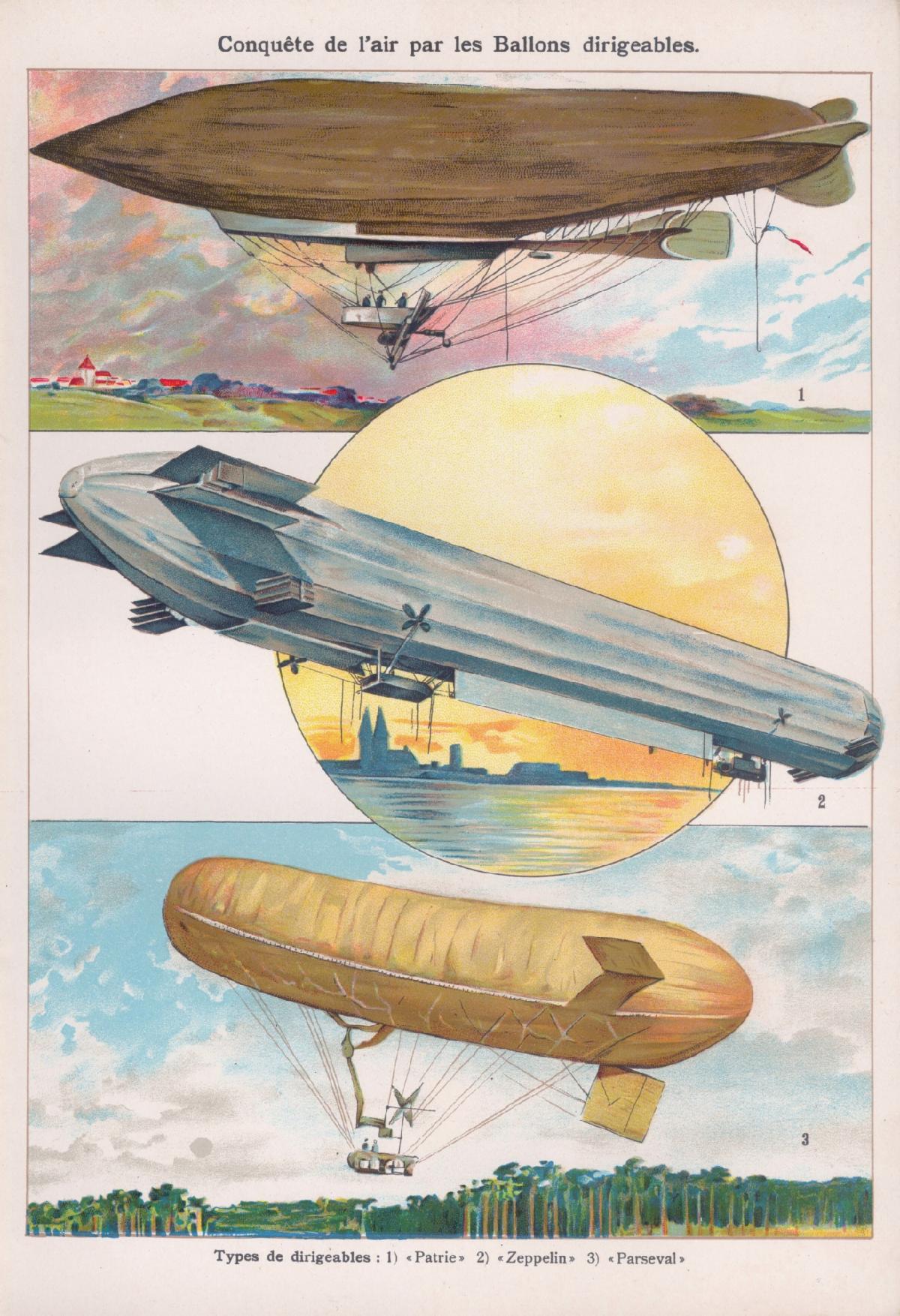
Three examples of early airships. The 1907 Patrie, the 1908 Zeppelin LZ-4, and the 1906 Parseval. Courtesy image.
|
|
Museum e-Newsletter made possible through the
generosity of our sponsors:
|
|
|
Museum of Old Newbury
98 High Street
Newburyport, MA 01950
978-462-2681
|
|
|
|
|
|
|
|