e-Newsletter | January 8, 2021 |
|
Reverend Parker Defends Young Love
by Bethany Groff Dorau
My lovely great-aunt Emily Noyes Poore, when meeting a newly married friend with a newborn, once remarked jovially, “Babies take nine months. The first one can come anytime.” It was a rare moment of moral relativity for this staunch Yankee, who considered spaghetti an ethnic food and frowned on wearing sunglasses, as they were too vain. I recalled this comment several years ago when I came across the case of Peter Cheney and his wife Hannah (Noyes).
In May 1664, Newbury’s own Peter Cheney (yes, former VP Dick Cheney is a descendant) and his wife were on trial for fornication in the Ipswich court. This is not unusual, as a number of otherwise upstanding young couples found themselves unable or unwilling to wait until after the wedding to consummate their love. The Cheneys were married on May 14, 1663, and their child born full-term on November 6. Peter Cheney showed up to court, but Hannah was not present, and the aggrieved court fined her three shilling unless she appeared before the end of the session. The remarkable element of this trial is the star witness – no less than venerable Newbury minister Thomas Parker.
“Honored gentlemen, we crave leave to inform you in some particulars concerning our friend Hannah Chaney, who is summoned to appear before you. Her indisposition of body, she being subject to sore fits (especially upon such occasions as this) calls for your clemency to her so far as justice shall permit. She may not to the manifest hazard of her life be forced to come before you. If you shall please to take notice of the parties concerned she and her husband have ever been of unblameable conversation, never offending in this kind, except in this one particular; they were published according to law, and the time of marriage appointed, but unexpectedly delayed by their parents by reason of extraordinary accidents. We hope you will not think it strange that we intercede for them, and that although she be by the hand of God prevented from going to court, whereby she might express her penitence to you yet there may be no misinterpretation or misunderstanding in your business, but as she humbly submits herself to your judgment, so she may join together with her husband and have what favor your wisdoms shall judge meet to show them.”
Hannah’s “sore fits,” which seemed to indicate panic attacks, as they arose during stressful situations like a court appearance for fornication, did not excuse her absence, but since the Rev. Parker was willing to intercede on her behalf, she and her husband were only fined. This was a relative slap-on-the-wrist when whipping was a common sentence for this offense (though a whipping could often also be paid off).
The Cheneys indiscretion had taken place after their engagement, a key factor in the court’s decision. They also married relatively early in the pregnancy, which bore out their story. The court was not overly concerned with a premarital pregnancy that resulted in a marriage, and the Cheneys may have plausibly argued that the baby was born early except for its size and vigor.
|
|
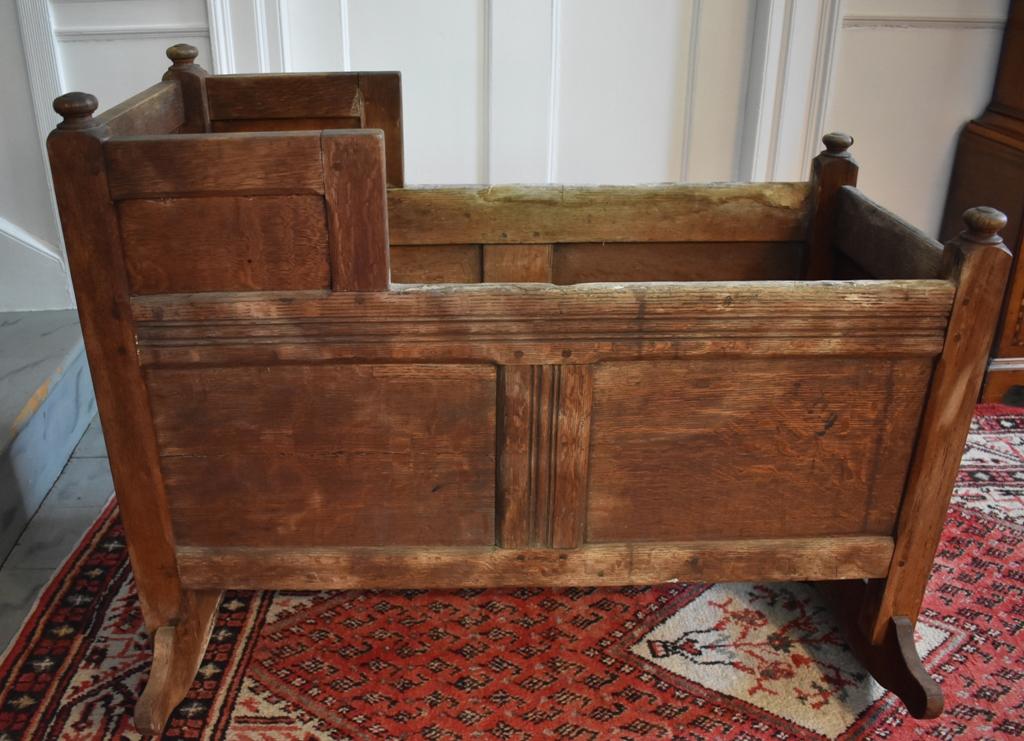
Although not used by the Cheney baby, this oak cradle was made for another 17th century Newbury newborn. The cradle was probably made by Serj. Stephen Jaques, brother-in-law of Ephraim Plumer, for Plumer's first child Mary born in 1681. The cradle descended in the Plumer family until it was purchased by the museum in 2018. |
|
Prematurity was a common argument for births that came too quickly after marriage, and in many cases, these couples were not prosecuted. In cases where prematurity was claimed, midwives present at the birth would be called in to testify about the size and development of the baby.
A case from 1674 in Hampton offers insight into what would have served as proof of prematurity, though it did not turn out as planned for these defendants.
Elizabeth and John Garland’s child was born less than seven months after their marriage, and they were brought to trial for fornication. The only women present at the birth, a time when the house would have usually seen numerous visitors, were the mother of the bride and groom, which heightened suspicion about their testimony.
Elizabeth Robinson, the mother of the bride, testified that the baby was “so weak that we were forced to feed it with a feather. We were the nurse to her, and the baby had no nails to our apprehension upon hand or foot and being a fortnight’s time before it could take the breast, and it had very little skin upon it when it was born.”
In this case, the court did not buy their story, despite its details about feathers and fingernail development, and found the couple guilty.
Hannah Noyes and Peter Cheney and the young Garlands were in good company, though it is difficult to track how many first babies were conceived before marriage because actual prematurity rates are not known. Some studies have indicated that between ten and thirty percent of brides were with child, indicating a correspondingly higher rate of sexual activity.
However they began their courtship, the Cheneys went on to have twelve more children together. The eldest of these, early arrival and namesake Peter Cheney is the first cousin, six times removed, of my venerable great-aunt Emily.
A regular contributor to the Museum of Old Newbury's e-Newsletter, Bethany Groff Dorau is a historian, writer and Regional Site Administrator for Historic New England, based at the Spencer-Peirce-Little Farm in Newbury. Some of the material used in this story is taken from Dorau's book, A Brief History of Old Newbury (History Press).
Editor's note: Inconsistencies in spelling of names, etc., are from the historical record and not a typographical error.
|
|
Museum Programs to Stay Virtual for Near Future
Staying relevant and viable during a pandemic can seem daunting, but the Museum of Old Newbury is embracing the challenge with compelling programs and just a dash of humor.
When Jack Santos, Custom House Maritime Museum, and Colleen Turner Secino, Museum of Old Newbury, started “Yeat Yeat, Don’t Tell Me!” in May of 2020, they both figured it was a short term way to stay in touch with members of both institutions.
Secino shares, “Surely, we figured, people would be able to gather in person again soon, and our museums would no longer have a need for remote opportunities."
That turned out not to be the case.
“Exploring interesting ways to be social together while staying physically apart is a challenge, but it has allowed us to reach more people,” Secino observes.
Not only have online offerings allowed people to continue to “gather,” Secino says, but they have allowed the Museum of Old Newbury, or MOON, to expand its reach. People have joined their Zoom events from all over the country. "Of course, when it can be done safely, the MOON is committed to offering in-person opportunities as well, but we will likely also include a virtual attendance option whenever possible."
Case in point: the popular bi-weekly history trivia show, “Yeat Yeat, Don’t Tell Me!” featured earlier this week in the Newburyport Daily News (read story here).
Secino notes, "As the pandemic continues reducing the possibilities of in-person connections, creative virtual programming is the best alternative."
As a result, the Museum of Old Newbury is busy reconfiguring its 2021 program calendar and is already planning several Governor’s Academy student-led presentations, as well as January 14, 2021’s “Black Flags, Blue Waters” Zoom event featuring best-selling author Eric Jay Dolin. He will captain us through the Golden Age of American piracy (register for the free event here: https://www.eventbrite.com/e/131403313849). More programs are planned and will be promoted here, as well as via social media and the newspaper.
Susan C.S. Edwards, executive director, Museum of Old Newbury, explains, “We have creatively figured out ways to work remotely and still engage directly with our membership. Our weekly e-Newsletter lets everyone get an in-depth look at pieces of the collection and topics of local history; Yeat Yeat offers interesting information and a few laughs; and special programs, like the upcoming Dolin presentation, explore fascinating new areas.”
Both Edwards and Secino agree, while a virtual platform is no replacement for real life, a few of our events in 2020, such as the four-part Virtual Garden Tour, enjoyed very high viewership numbers.
Overall, the museum is finding that online outreach is not only possible but, at times, even preferred, particularly when it comes to planning events in New England in the winter. Secino quips, “At least we don’t have to worry about snow cancellations!”
She concludes, "Even in a post-COVID world, at some level, we envision virtual programming to continue."
|
|
Learn about upcoming programs, register, find Zoom links and catch up on previous presentations here. |
|
Hot off Monday's front page of the Daily News, Newburyport's Jack Santos, Custom House Maritime Museum, and Colleen Turner Secino, Museum of Old Newbury, kick off Season 2 of "Yeat Yeat, Don't Tell Me!" today.
Click here to see what all the buzz is about (and learn some really cool historical facts about the Newbury area).
Want to catch up on previous episodes, watch Season 1 here.
|
|
|
Black Flags, Blue Waters:
The Epic History of America's Most Notorious Pirates
Thursday, January 14, 2021 @ 7:00 p.m.
|
|
In this virtual event, best-selling author Eric Jay Dolin will take us through the Golden Age of American piracy when lawless pirates plied the coastal waters of North America and beyond.
Dolin will explore how colonists at first supported these outrageous pirates in an early display of solidarity against the Crown, and then violently opposed them.
Legendary pirates such as Blackbeard, the ill-fated Captain Kidd, and sadistic Edward Low, who delighted in torturing his prey, will all be discussed.
Black Flags, Blue Waters was chosen as a "Must-Read" book for 2019 by the Massachusetts Center for the Book.
This is a virtual event and is free of charge; register here. Donations graciously accepted.
|
|
Something is Always Cooking at the Museum
Peter Wiggin knows a thing or two about pork (as well as beef and chicken). His dressed chops are easy, delicious and are the ideal meal for filling up your tummy before a nap on a snowy winter's day.
Baked Dressed Pork Chops
2 loin pork chops
1 tablespoon butter
3 slices fresh bread, crumbled
2 slices of large onion, diced
1 teaspoon rosemary
2 tablespoons sherry
1 cup cider
4 McIntosh apples, cut up
Melt butter in skillet. Turn off heat. Mix in bread crumbs, onion, rosemary and sherry until well combined. Put dressing on top of chops in skillet. Place apples around chops and cover with cider. Bake at 350ºF for 1 hour. Serves 2.
|
|
|
|
Puzzle Me This...
"Saying you don't look good in a hat is like saying you don't look good in shoes." –Anonymous
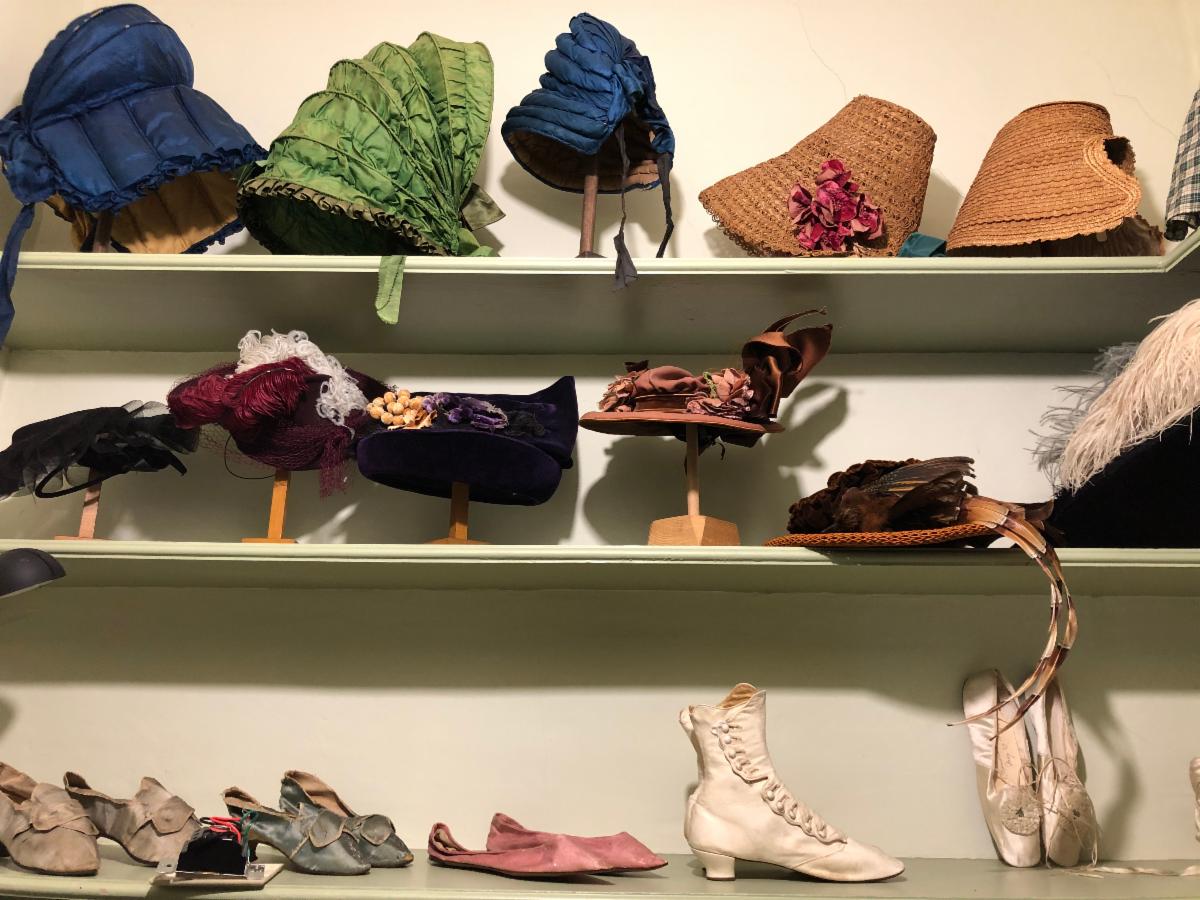
The Museum of Old Newbury holds broad collections of hats and shoes spanning the eighteenth and nineteenth centuries. Pictured here are some favorites from those collections. Click on the image to begin.
|
|
During this difficult period of COVID-19, we rely on your support more than ever. We are working to reschedule many of the programs that we have had to postpone, as well as develop new, online programs for you to enjoy and keep us connected. We hope, if you are able, that you will consider a donation to the museum. Thank you for your continued support.
|
|
Museum e-Newsletter made possible through the
generosity of our sponsors:
|
|
|
Museum of Old Newbury
98 High Street
Newburyport, MA 01950
978-462-2681
|
|
|
|
|
|
|
|