SEPTEMBER 2025 | VOLUME 2 ISSUE 3


September 2025 Newsletter


Join our Practice Resources page here!


Check out our Training and Events Calendar!


All current and active cases should be entered into LegalServer.


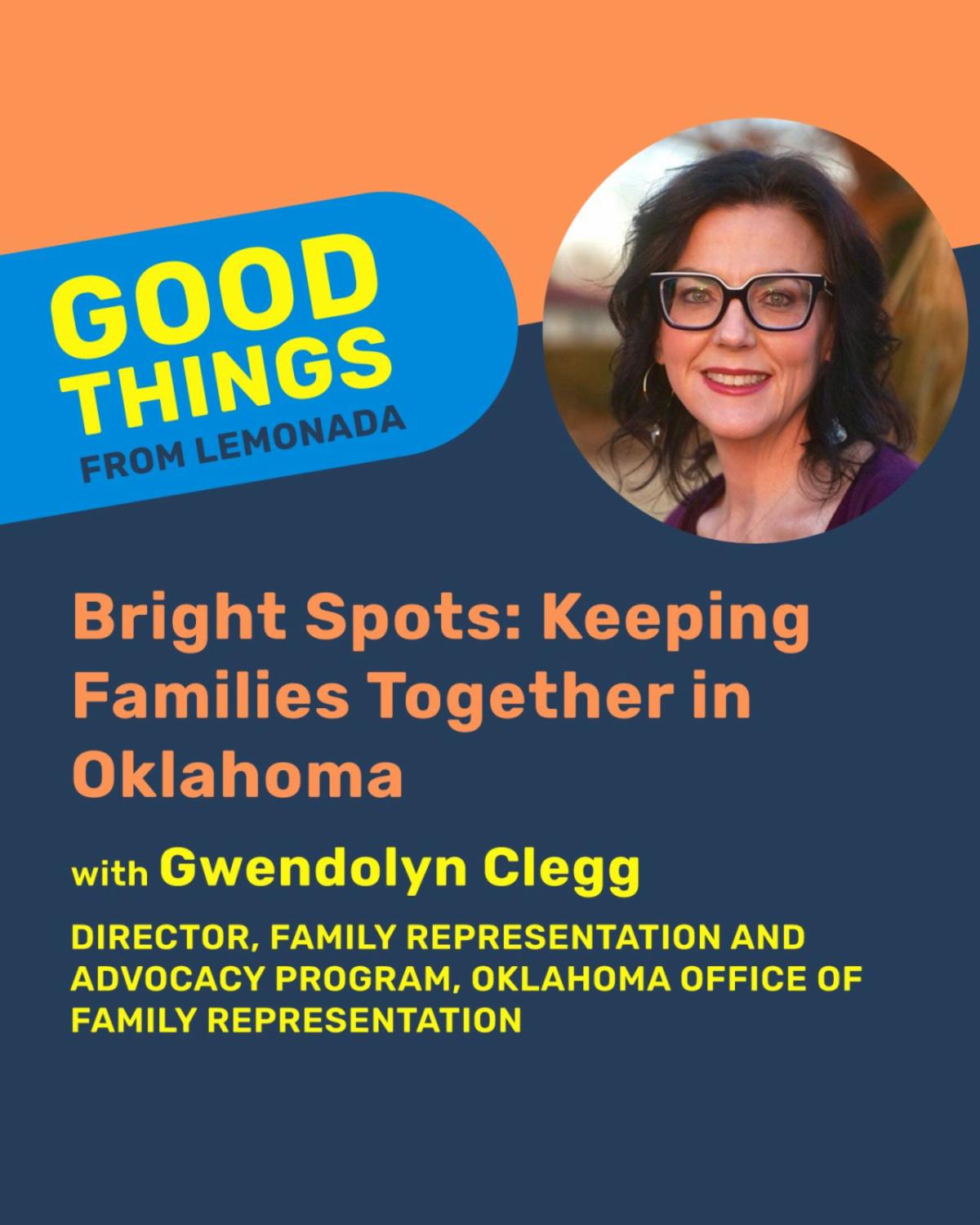
Listen to the Good Things podcast, featuring our director, Gwen Clegg, and OFR! Click the photo below to listen on your preferred platform.


Upcoming!


September 25: What’s New? – 2025 Statutory Updates


October 15 and 16: Norman CIP at the Embassy Suites


October 29 and 30: Tulsa CIP at the Southern Hills Marriot


November 6: Effective Representation of Incarcerated Clients


November 14: Domestic Violence in Deprived Cases with Shannon Prescott


November 19: How to Communicate with Clients that have Mental Health Concerns


March 29-April 1, 2026: National ICWA Conference in Oklahoma City


Director's Corner

Gwendolyn Clegg


How many of you know about the national organizations that support us in our work? How many of you know that many of these organizations hold an annual conference to bring us all together in fellowship and learning? 


This summer I was extremely fortunate to be able to attend four (4) national conferences representing OFR and the great state of Oklahoma. Let’s talk about why these conferences are so important, not only to enlighten our practice but to assist with the impact our work has on our own mental health. 


The first conference I attended with Region 5 Managing Attorney Kim Rebsamen, Region 5 Director of Social Work Priscilla Minor-Thoms, Region 2 attorney Daniel McClure, and Region 5 social worker Andrea Russell was the American Bar Association’s Center for Children and the Law, Bi-Annual Multi-disciplinary Family Defense Conference in St. Paul, MN. This conference’s focus is on interdisciplinary parent defense and prioritizes lived experience and interdisciplinary team members, i.e. social workers and mentors. This conference curated by the ABA’s Center for Children in the Law is fantastic and attendees leave the conference fired up. Topics such as Immigration, Integrating Lived Experience Experts in Family Defense, Leveraging Tribal Relationships to Mobilize the Spirit and Standards of ICWA for Parents, Are we Doing Enough for Fathers, and Family Time/Parenting Time/Visiting center our thoughts on how to include interdisciplinary team work in our representation of families. This convening strengthens our resolve and our skills to defend families with creativity and zeal!  

The second conference I attended was the National Council for Juvenile and Family Court Judges. (www.ncjfcj.org). This conference was in Chicago, IL. I presented at a breakout session with Your Case Plan App developer Ryan O’Donnell, Tulsa County Special Judge Theresa Dreiling and OFR Parent Mentor, Rachelle Ali. This presentation entitled “Leveraging Technology to Improve Client Engagement & Legal Representation in Dependency Courts” allowed us to demonstrate how Oklahoma is utilizing the YCP app (www.yourcaseplan.com). We gathered to understand how technology helps us provide high-quality legal representation to our parent and child clients. The YCP app allows for instant communication between our attorney-led interdisciplinary team members. The app allows the clients to easily keep all the information about their case in one secure and confidential cloud-based repository. Clients can upload, via a screenshot, evidence of their hard work on their individual service plans, i.e. their lease, paystubs, drug test results, letters and certificates of service work or completion. The App allows attorneys to communicate easily with their clients in a safe and secure manner all within one App. The audience was inspired by the presentation as well as immediately recognizing how its use would be a game changer in providing high-quality legal representation. 

The third conference I attended with OFR Region 5 Managing Attorney Kim Rebsamen was the Safe Babies, A Program of Zero to Three, Cross-Sites Annual Conference (zerotothree.org) in Portland, OR. This short but informative conference’s focus was to bring together jurisdictions who are actively implementing and exploring the team-based Safe Babies approach. The Parent Child Center of Tulsa first brought the Safe Babies Court Team to Tulsa in 2014. Further efforts to implement additional Safe Babies Court Teams in Oklahoma include efforts in Wagoner County. 

The fourth conference I attended with OFR Region 5 Managing Attorney Timothy Michaels-Johnson, Region 2 Managing Attorney Holly Iker, Region 5 attorney Kacie Cresswell, Region 2 attorney Graham Fishburn and Your Case Plan developer Ryan O’Donnell was the National Association of Counsel for Children (naccchildlaw.org). The NACC Annual conference is a favorite of mine. The leadership at NACC is superb and brings high-quality content for the attendees to improve their practice and learn innovative strategies to sustain our work. Ryan O’Donnell and I presented at a plenary session on the topic of “Digital Advocacy: Harnessing Mobile Apps to Empower Families and Youth in Child Welfare.” The plenary was a resounding success with many audience members excited about the use of the Your Case Plan App with their clients. While NACC’s focus is on child representation, NACC includes many parent representation sessions. This year’s conference was centered around lived experience and we heard from many experts who had spent time in the foster care system. Their expertise not only moved the attendees but left each attendee with the deep-seeded notion that we can and must make sure representation of our clients includes their voice.

These conferences not only serve to educate and enlighten us on best practices to improve our work, they also provide a space to commune with like-minded professionals who understand the very hard work we do. The camaraderie experienced in these spaces serves to lift the heavy load of our work, providing a space to breathe, relax and share. When we come together, I always leave feeling rejuvenated and reinvigorated to return to Oklahoma with new skills and an uplifted spirit to better serve our families.  


If you are interested in attending a conference, reach out to your Managing Attorney and let them know of your interest. I would also encourage you to visit the websites of the organizations provided above and dive deep into their free resources. I look forward to a day when Oklahoma attorneys and interdisciplinary team members can attend these conferences together in large numbers. 

Shoutouts!

Shoutout to Dani Dezort!

Dani received a text from a client that said: "Also, I wanted to thank you, I have felt defeated for months now! And just knew I wasn't going to get him back, this is the first time in months my anxiety hasn't swallowed me alive!!! And I feel like I'm going to get my son back."

Shoutout to Michelle Gutierrez!

For obtaining a court order for OHS to file a written family time plan as required by statute in a county where they are rarely, if ever requested.

Shoutout to Larra Williams!

Larra Williams received a great compliment from one of her clients who said: "God bless her, she's amazing and I couldn't ask for better support than her right now."

Shoutout to Leah Terrill-NesSmith!

For advocating for a child by requesting an order requiring OHS to move forward with enrolling the child in the Seminole Nation to obtain benefits for the child even though Leah represented the child's father, not the child.

Shoutout to Teressa Williams!

For fantastic out of court advocacy in getting the sexual abuse allegations removed from a petition and for obtaining optimum visitation for her client.

Shoutout to Anne Darnell and Michalah Andersen!

Anne and Michalah have done an excellent job with their motion practice. They recently filed/requested a no reasonable efforts finding in 3 cases - all 3 were granted!

Shoutout to Sue Johnson!

For a successful appeal resulting in reversal! Amazing work protecting due process rights for families in Oklahoma.

Have you done something awesome? Do you have a good story? Share it here!

Practice Tip

Evan Humphreys, Managing Attorney of Appellate Practice


In every newsletter, OFR provides a practice tip, often highlighting a rule related to juvenile law. In this practice tip, we are going to learn to break rules.


Not legally binding rules of course! You still have to follow those. Instead, this practice tip will focus on certain “rules” about legal writing that many of us adhere to, but which may not always be the most persuasive way to write.


Whether you are writing appellate briefs or trial motions, take a look at these common legal writing conventions; if you follow any of them, think about how well they serve you and your clients:


Facts must be delivered chronologically


Outside of a few exceptions, any piece of legal writing is invariably telling a story. There is something your client needs and you must provide a reason why the court should give them that.


Such legal writing often starts with a recitation of the procedural and factual history of the case. It might first list the names and designations of the parties, the dates of birth of the children, the date the children were taken into state custody, the date the petition was filed, and so on. Even if those events are only tangentially related to the relief being sought, there seems to be a compulsion among lawyers to write this way.


But would you tell any other story like that? If you wanted to send a message to your friend about a funny thing that happened on the way to work, would you start with, “I was born on Wednesday, May 15, 1985, at 9:33 a.m. in Kalamazoo, Michigan…”?


You probably wouldn’t (and if you would, you should not). We know that those details are irrelevant to the story of the funny thing that happened on the way to work. Sure, we might want to briefly establish that we were on our way to work, but we would want to get to the funny thing that happened as soon as possible because that’s what the story is about.


Why should legal writing be any different? If, for example, you are writing a motion to restore your client’s visitation rights, your story probably begins with an event connected to visitation. It might begin with the last visit that occurred and the joyous time that parent and child spent together. Or it might begin with the client entering rehab and their journey towards sobriety. But it probably doesn’t begin with the child’s birth.


Where you begin a story is up to you. But think about the most effective way to begin that story rather than the conventional way.


Facts must be given dispassionately


Law school did not teach us to be emotional. If anything, it taught us that a cold, neutral tone is the most persuasive way to write for impartial judges.


There’s some truth to that. Judges rarely respond well to hyperbolic language. If you are appealing a minor procedural violation, do not tell the Court that, if it affirms, it might as well throw the rules of evidence and the Constitution into the trash (trust me on this one). Passion should also never excuse a lawyer’s failure to adhere to the Rules of Professional Conduct.


But emotion and passion have a critical place in legal writing, particularly in juvenile law. We deal with rights that are fundamental, not in spite of their emotional nature, but because they are deeply tied to emotions.


Parents have a fundamental right to their children because of the love a parent has for their child. Children also have a right to be with their parents and siblings because of those affectionate bonds. Children have an equally important right to be free from fear for their safety. We can even have an emotional connection to procedural rights because they implicate feelings like fairness and justice.


Injecting emotion into your writing does not need to be grandiose. It can be as simple as the way in which you talk about your client. For example, is it more humanizing to refer to them as “the Appellant” or “Minor Child” or is it better to call them “Mother” or by their first name? It’s a small thing, but it can be an effective means of emotionally connecting the court to your client.


While the facts of the case and the applicable law will always lead our work, we must recognize that it is impossible to separate these cases from their emotional aspect. Nor should we want to. Because it is most effective for our clients to show judges not only why ruling in our favor is legally correct, but why they should feel good about doing so.


Lawyers have to write a certain way


Beyond the substance of our writing, there is an endless list of conventions we follow simply because “that’s how lawyers are supposed to write.” But ask a few non-lawyers if they want to read a motion for fun and be amazed at the lack of volunteers.


It’s not just the dryness and complexity of legal writing that turns readers away. We often write in ways that would be unnatural in any other context.


Think about something as simple as a quote and citation. Which of the following is easier to read?


“…[L]ack of education or of culture alone[] are never sufficient justification [sic] for severing the ties that bind families together.” Matter of Sherol A. S., 1978 OK 103, ¶ 34, 581 P.2d 884 (citing In re Kebler, 51 N.D. 698, 200 N.W. 786 (N.D. 1924) (internal quotations omitted) (emphasis added).


“Lack of education or of culture alone are never sufficient justification for severing the ties that bind families together.” Matter of Sherol A. S., 1978 OK 103, ¶ 34, 581 P.2d 884.”


The latter is as accurate as the former, but takes up less space and reads much cleaner. Is it really so important for the reader to know that “lack” was not capitalized in the original sentence? As long as you are not omitting important context and are not subject to a rule that says otherwise, quotations often work best when they are easy to read.


The takeaway is that we should write for accuracy and clarity. We should not write something just because it sounds lawyerly.


Be open to trying new things, but use what works for you


Everyone writes differently. You may do all or none of the things that have been discussed. You may have other writing habits that could be improved or you may be comfortable with your style.


Because everyone writes differently, writers must decide for themselves what works for them and what does not. The key is being open to new ideas and willing to take chances to improve our writing. This openness allows us to serve our clients as effectively as possible.


They deserve nothing less.

DSW Corner

Why OFR IDT Members Attend Court 


10 O.S. § 801 (OFR’s enabling statute) 

The Legislature has expressly authorized the establishment of interdisciplinary teams to assist in deprived proceedings. Under 10 O.S. § 801, the purpose of these teams is to bring together professionals from different disciplines to ensure that the needs of children and families are addressed comprehensively. The statute envisions coordinated collaboration between attorneys, social service providers, and other professionals, with the goal of improving outcomes in child welfare cases. 


Importantly, § 801 requires that interdisciplinary teams operate under procedures which protect client confidentiality. This reflects the Legislature’s recognition that effective collaboration must still safeguard the sensitive information entrusted to counsel and other team members. 


In alignment with this statutory framework, OFR is responsible for developing, training, and overseeing IDTs throughout the state. OFR ensures that all team members—whether attorneys, social workers, or peer mentors—are trained to function within the bounds of confidentiality and privilege. By doing so, OFR fulfills the statutory directive to implement IDTs in a manner that both supports families and protects the integrity of the attorney-client relationship. 


Oklahoma Rules of Professional Conduct (ORPC) 5.3 requires lawyers to supervise nonlawyer assistants. 

Social workers and peer mentors are part of the attorney’s team and act as supervised nonlawyer assistants and are expressly contracted to serve as members of the OFR’s legal interdisciplinary team supporting the client and counsel. 


Oklahoma Rules of Professional Conduct (ORPC) 5.3 requires lawyers to supervise nonlawyer assistants to ensure their conduct is compatible with the lawyer’s professional obligations, which is exactly how OFR utilizes social workers and mentors. 


Their involvement does not waive privilege; they are covered by attorney-client privilege and confidentiality. 

  • OFR contracts incorporate confidentiality and supervision provisions aligned with ORPC 1.6 and 5.3; team members must maintain confidentiality and follow attorney direction. 
  • The mentor contract reiterates that team members must maintain attorney-client privilege and work-product protection. 


Court-facing duties are specified in the OFR contracts. 

The mentor’s scope specifically includes helping prepare clients for hearings, debriefing after court, and attending court hearings and court staffings with clients. 


The social worker’s scope includes court staffings and regular attorney-team staffings; they are embedded in case preparation for court. 


Neither the social worker nor peer mentor may be called to testify or provide information directly to the court or parties.  


Mandatory-reporting obligations are preserved without undermining privilege. 

Oklahoma law requires every person to report suspected child abuse or neglect (10A O.S. § 1-2-101); our contracts acknowledge and implement that duty while preserving attorney-client protections for legal representation. 


Oklahoma juvenile-deprived hearings are closed to the general public, but the Court may admit persons with a direct interest or “necessary participants.” 


By statute, persons with a direct interest shall be admitted; the Court may admit others as appropriate. 10A O.S. § 1-4-503(A)(1)(a). The statute also contemplates “others deemed to be necessary participants,” including facility staff, when holding telephonic/video hearings—underscoring the Court’s discretion to admit non-party participants who aid the proceedings. 10A O.S. § 1-4-503(A)(4). 


Given their contracted roles within counsel’s team and the protections above, the OFR social worker and mentor qualify as persons with a direct interest in the proceedings and necessary to effective representation. 


Oklahoma Child Welfare policy embraces family- and support-inclusive decision-making; the IDT aligns with that framework. 

Permanency-planning family meetings are expressly designed to include parents, caregivers, relatives, service providers, and “other appropriate community partners.” OAC 340:75-6-31.1. 


Child Safety Meetings encourage families to invite supports (family, friends, faith/community members). This statewide practice model favors meaningful supports at critical junctures. 14-46.pdf 


How IDT presence helps the Court and the client 

  • Better-prepared hearings & fewer delays: IDT members synthesize service/behavioral-health information for counsel, ensure service linkages, and help address barriers before hearings—reducing continuances. 


  • Clearer, trauma-informed communication: The mentor (lived-experience support) and the social worker reinforce counsel’s advice, increase client understanding, and stabilize emotions during proceedings, which improves decorum and informed decision-making. 


  • Faster problem-solving in real time: When issues arise at docket, IDT can immediately coordinate with the attorney and DHS/providers about services, transportation, treatment access, and safety-plan details so orders are workable the same day. 

This month, we have been so fortunate to be given an outpouring of donations for our clients. We are so happy to now be able to boast a Resource Room - a space for our IDT teams to grab games, snacks, art supplies, and more to meet the needs of our clients.


We have items for our IDTs to give to parents ahead of visitation to help with bonding, items for our youth mentors to take to make their child clients feel more comfortable, and backpacks to help transport everything.


We are so excited about this resource room and we hope to keep it growing!


A HUGE thanks to:

United Methodist Small Group - Maranatha - Provided games, snacks, journals, crayons, markers, coloring books for children and adults. 


Tulsa Mustang (Car) Club - Provided Backpacks for Parent Visitation 


Glenpool Community - Games

August Case Summaries

In The Matter of A.D., Alleged Deprived Child

The Court of Civil Appeals reversed and remanded this case for further proceedings. Mother appealed the trial court's order denying her Motion to Vacate Order of Termination. Mother asserts she was not given notice that failure to appear at a Permanency/Review Hearing constituted consent to termination of her parental rights. COCA finds that even if Mother did receive notice for the hearing via proper in-person service, which was NOT discernable from the record, the Permanency/Review Order does not contain the proper language for a hearing on termination of parental rights as required by statute. Therefore, the Order denying Mother's Motion to Vacate Order of Termination as well as the underlying default judgment terminating Mother's parental rights were reversed as a matter of law for abuse of discretion and violation of Mother's due process rights. Read full opinion

In the Matter of I.N. and K.N., Alleged Deprived Children

Mother appeals the order terminating her parental rights. She argues: the standard for ICWA was not met, failure to prove termination was in the best interests of the children, and that the court erroneously denied her motion for a separate trial from Father (as a victim of domestic abuse, she argued a joint trial would cause trauma and would prejudice the case before the jury). She argues the expert's testimony does not show a causal relationship between the conditions that exist and the harm that is likely to result (as required by ICWA guidelines), but COCA found the expert testimony was sufficient. COCA found there was clear and convincing evidence that termination was in the best interests of the children. Finally, despite the claim that witnesses belittled the actions of Mother for failing to leave her abuser, COCA was unconvinced by the trial transcript that the trial court abused its discretion by denying the motion for separate trials. COCA affirms the termination of parental rights. Read full opinion

In the Matter of the Adoption of H.M.L., Minor Child

This stepparent adoption proceeding was governed by ICWA. Mother claims the district court erred by determining that Father and Stepmother made active efforts to prevent the breakup of the Indian family. Mother also claims abuse of discretion in determining adoption to be in the best interest of the child. Active efforts are "Affirmative, active, thorough, and timely efforts intended primarily to maintain or reunite an Indian child with his or her family," but COCA states "'active efforts' in a case will necessarily differ depending on whether a state actor,

public agency or private party initiated the child custody proceeding." The standard they apply to Father as a private party is whether the efforts "cross the line between passive and active." COCA determined it was in the best interest of the child for the AWOC to take place. Read full opinion

In the Matter of V.B., Alleged Deprived Child

Mother appeals the grant of a permanent guardianship placing the child with paternal grandparents. Mother alleged the trial court erred in ruling that she failed to "substantially correct" the conditions and that the State did not meet the requirements of ICWA. Mother asserts three issues: the trial court erred in finding that all of the requirements for permanent guardianship were substantially met, the trial court erred in finding active efforts had been made and that continued custody would result in serious emotional or physical harm, and the trial court erred by taking judicial notice of Mother's past deprived cases and considering them in entering the guardianship. COCA finds that while Mother had been completing components of the ISP, there was no error in the conclusion of failure to correct. COCA also finds that active efforts were made (but does not address that active efforts must be shown to have been made AND failed), and that testimony by the ICW was sufficient to fulfill ICWA's heightened evidentiary standard. Finally, COCA finds that it was within the trial court's discretion to admit or deny evidence of past deprived cases. COCA affirms. Read full opinion

In the Matter of I.N. and K.N., Alleged Deprived Children

Father appeals the termination of parental rights. He argues the children were required to be released from emergency custody because the adjudication hearing was not held within 90 days after the petition was filed, that the State did not meet its burden to prove a ground for termination, that the requirement of ICWA to prove serious emotional and physical harm was not met, and ineffective assistance of counsel. COCA found that the State's interest in protecting the children outweighed the statutorily required time limitation for an adjudication hearing. COCA found testimony of the expert to be sufficient to fulfill the requirements of ICWA. While it reviews the conduct of Father's Counsel at several points in the trial, COCA ultimately does not find deficient performance such that the result would have been different. COCA affirms the termination of parental rights. Read full opinion

In the Matter of the Adoption of W.A.J.R., Minor Child

Father appeals an adoption without consent. He proposed he had no opportunity to support or form a relationship with his child because she was concealed from him. While COCA's primary focus is on the claim of concealment and whether or not Father knew or should have known of the child, there is also an ICWA consideration. Father proposes adoptive parents did not comply with the requirements of ICWA and did not file an Affidavit of Active Efforts. Additionally, the tribe objected to the AWOC. Because there was no order that addressed the applicability or compliance with ICWA, COCA chose not to opine. The AWOC was affirmed. For cases where ICWA applies, it is crucial to address ICWA compliance on the record. Read full opinion

IN THE MATTER OF THE DISCIPLINARY PROCEEDING CONCERNING EMILY MUELLER, SPECIAL JUDGE, POTTAWATOMIE AND LINCOLN COUNTIES, OKLAНОМА - Read full order

Interested in being notified as appellate decisions are made? Sign up for OSCN's mailing list using this link.

Welcome!

Karrie Fields Mills - Trial Attorney, Tulsa

Karrie Fields Mills graduated from TU in 2015. Shortly thereafter, she established her own practice in Tulsa, focusing on family law. She was soon invited to serve as a volunteer attorney with Tulsa Lawyers for Children. In 2017, she became a member of the Cherokee Nation Bar Association and began serving as a contract attorney, representing both parents and children in deprived cases. Following the McGirt and Hogner decisions, she expanded her practice to include criminal defense. In 2023, she joined the Cherokee Nation Attorney General’s Office as a criminal prosecutor. Karrie is now transitioning into the role of OFR contractor, returning to her passion for helping families.

Welcome to Cynthia Boettcher - Trial Attorney, Tulsa


Welcome to Stephanie Marston-Younge - Appellate Attorney

Resources

Oklahoma Access to Justice Foundation: Priced Out of Justice: An Examination of Fee Waivers in Oklahoma District Courts


Priced Out of Justice Executive Summary


Family Regulation's Consent Problem


Oklahoma legislators to examine child well‑being in 2025 interim studies (Capitol Update)

How did you like this email?
Positive            Neutral            Negative
Facebook      Instagram      LinkedIn      Web