|
President's Message
He Fed Them with Quail and Manna
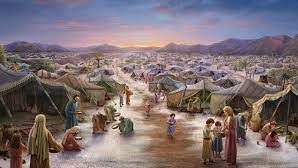
“In the evening quail came up and covered the camp, and in the morning dew lay around the camp. And when the dew had gone up, there was on the surface of the wilderness a fine, flake-like thing, fine as frost on the ground.” (Exodus 16:13)
The day the Israelites left Egypt was the fifteenth day of the first month. Thus, it took exactly one month for them to journey out of Egypt and arrive at the Wilderness of Sin. The Israelites were an enormous multitude—about six hundred thousand fighting men alone. Therefore, no matter how much food they had brought with them, by this time their provisions would have been almost completely exhausted. After enjoying a time of happiness at the oasis of Elim, like a paradise, they reentered the wilderness, and various new hardships began to confront them.
Remembering the Taste of Meat and Bread
The Israelites complained that it would have been better not to have come out of Egypt and even grumbled that it would be better to die. However, contrary to these words that nostalgically recall life in Egypt as if it had been good, the Israelites had never actually sat comfortably by pots of meat while they were suffering under the harsh toil of forced labor in Egypt. Nor had they lived in such abundance that they could eat bread to their fill. Nevertheless, their exaggerated longing for life in Egypt reveals a pitiable slave mentality that regarded even slavery—so long as there was some food—as better.
When the people encountered their first difficulty in the Wilderness of Sin, they repeated the same accusations as before, showing that they had learned nothing. The expression “the pots of meat of Egypt” later became, in the West, a proverb describing opportunism—selling freedom for comfort.
Feeding Them with Quail
The feeding of quail is often treated as a one-time event and mentioned only incidentally. An interesting point here is that rather than simply promising to satisfy the people’s immediate hunger, the LORD said that He would make them know that it was He who had brought them out of the land of Egypt. At that time, the Israelites knew that they had come out of Egypt by the LORD’s guidance, but they did not yet have complete faith that this LORD alone was the one who could permanently satisfy both their physical and spiritual needs.
Thus, when God sent quail in the evening so that the Israelites could eat meat, it was, first of all, to relieve their physical hunger. Yet beyond that, through this provision of food, God intended once again to demonstrate that the One who had led Israel out of the land of Egypt in the past was the LORD alone, and that in the future as well, the only One who would protect and guide them was none other than the LORD Himself.
Feeding Them with Manna
The phrase in the text, “you shall see the glory of the LORD in the morning,” suggests that a supernatural phenomenon would occur each morning. This phenomenon is the appearance of manna. The sudden emergence of manna, which had never been seen before, can only be understood as an event caused by God’s supernatural power; therefore, the provision of manna reveals God’s glory.
Moreover, giving manna each morning to satisfy the people’s hunger is not merely for physical sustenance. It is intended to lead the Israelites to spiritual maturity, affirming their faith in God’s glory. Manna, as food sent from heaven, points beyond itself to Jesus, who offered Himself as the Bread of Life.
Reflection
When God said, “In the evening you shall eat meat, and in the morning you shall be filled with bread” (Exodus 16:8), He was addressing the Israelites’ exaggerated complaints about the past—sitting by the “pots of meat” and eating bread to their fill in Egypt. God was showing that such abundant provision would now become reality through His daily supply. God gives just enough each day. Those who do not trust that He will provide again tomorrow and try to provide for themselves in advance will face disappointment.
|