PacIOOS Tools and Instruments |
|
Hilo Water Quality Buoy Redeployed, Providing Data |
|
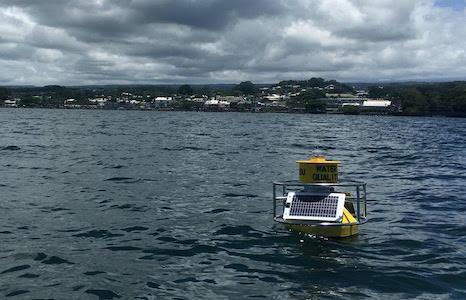
The Hilo Bay Water Quality Buoy, located inside Hilo Harbor, was redeployed recently and is now providing data including temperature, salinity, turbidity, chlorophyll and oxygen levels. The buoy was pulled out of the water for repairs and to replace the communications and data logger. Moored one-half mile offshore, within the plume of the Wailuku River, this buoy monitors coastal water conditions to help provide early indications of potentially polluted run-off from storm drainage, sewage spills, and soil erosion from land-based waterways that lead directly into the ocean. The Wailuku River is the largest watershed in Hawaiʻi, draining from the tops of Mauna Kea and Mauna Loa all the way to the shoreline. The river has a complicated impact on the Hilo Bay estuary. The Wailuku River brings sediment and nutrients from the watershed, creating poor water quality in Hilo Bay after storms. On the other hand, the organic matter brought into the bay and the algae growth stimulated by nutrient inputs support nearshore fisheries. |
|
Ocean Biodiversity Information System Workshop |
|
Sarah Bingo, a biological data standards specialist with PacIOOS, helped organize and lead a Marine Biological Data Mobilization Workshop aimed at migrating marine biological observation datasets to the Ocean Biodiversity Information System (OBIS). This workshop was a hands-on, interactive, virtual experience focused on helping data providers standardize their data using Darwin Core, a common vocabulary to facilitate sharing information about biological diversity. In addition to introducing the Darwin Core terms, the instructors provided resources and tutorials for cleaning, formatting and organizing data; outlining basic metadata required; and examples of quality checks to perform prior to submission to OBIS. The workshop, attended by 60 participants, was aimed toward satisfying the IOOS directive to identify biological monitoring data that can be incorporated into OBIS and the Marine Biodiversity Observation Network.
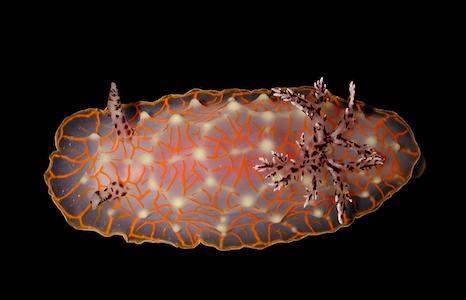
“As a workshop attendee, I thought this training was a great opportunity to learn how to wrangle a wide variety of biological observations into a standardized and publicly-accessible database, and become familiar with the resources available to support researchers seeking to do this,” said Thomas TinHan, PacIOOS data manager for the Pacific Islands Region Acoustic Telemetry Network. [Photo: Golden lace nudibranch. Credit: Cory Pittman, NOAA, PIFSC, NHIMN]
|
|
Invited presentation at Tropical Cyclone Conference |
|
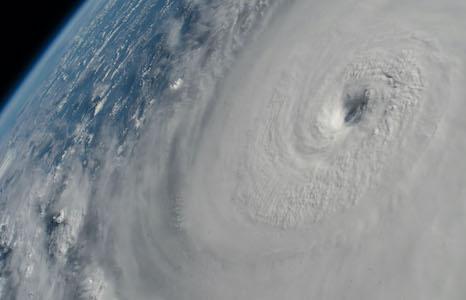
Yi-Leng ‘Dave’ Chen, PacIOOS co-investigator and lead for atmospheric modeling, was invited by the Joint Typhoon Warning Center to present at the 2022 Tropical Cyclone Conference. The conference, hosted by the U.S. Indo-Pacific Command, was held at the East-West Center in Honolulu, Hawai‘i on April 26-28. The focus of Yi-Leng's presentation was the formation of tropical cyclones and subsequent heavy rainfall over southern Taiwan. Yi-Leng, who is also professor of atmospheric sciences at University of Hawai‘i (UH) Mānoa, oversees the improvements and maintenance of the PacIOOS atmospheric forecasting system. The PacIOOS Weather Research and Forecasting model provides 6-day, hourly forecasts of air temperature, wind and rain for the region surrounding the main Hawaiian Islands, the Western North Pacific, including Guam and the Commonwealth of the Northern Mariana Islands, and the region surrounding the islands of Samoa. |
|
New Addition to Nearshore Sensor Team |
|
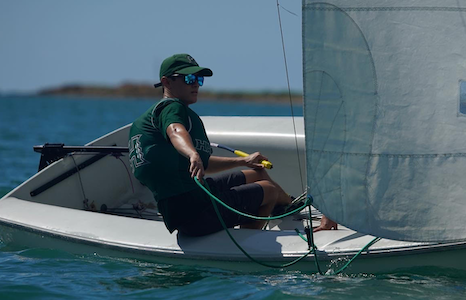
Trey Summers, an undergraduate student in the UH Mānoa Physics program, joined the team as an oceanographic technician assistant. Being from San Diego, California, the ocean has been a part of Trey’s life from an early age. In high school Trey was the team captain of the varsity sailing team, and he’s worked as a sailing coach for the last four years. In addition, his studies in physics taught him much about the fundamental forces that govern our oceans. What interests Trey about his work with the nearshore sensor team is being able to combine his skills as a waterman with his interest in science. “Many of the daily tasks and the fieldwork I do involve the skills I use when surfing and sailing,” said Trey. “Being able to overlap many of my interests in one place has made a great learning environment for me, and every day brings a new and exciting challenge!” Outside of work, Trey loves to surf, freedive, sail, fish, and do anything ocean-related. |
|
Olivia Hughes, Oceanographic Technician With Wave Buoy Team |
|
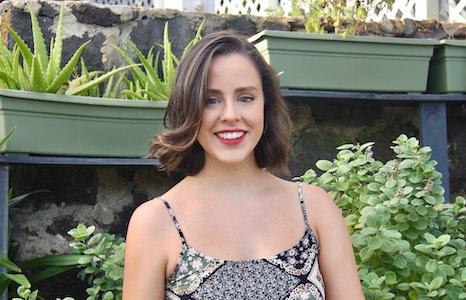
Having worked with the PacIOOS wave buoy team for several years while she pursued her undergraduate degree at UH Mānoa, it was a seamless transition for Olivia Hughes to join the group as a full-time oceanographic technician. As a Global Environmental Science student at UH Mānoa, Olivia was hired to help Dr. Margaret McManus’s lab and for her senior thesis, she analyzed data collected from the Hawai'i-stationed PacIOOS buoys. In her new position, Olivia supports operations including buoy and device maintenance, mooring fabrication, logistics, and field operations. “I enjoy the hands-on experience that this job provides,” said Olivia. “On top of maintaining the buoys at the lab and working on the water to deploy/recover the buoys, I also have experience analyzing the long-term data from these buoys, and hope to use these skills to share trends about the ocean with the public in the future.” In her free time, Olivia enjoys making art (usually painting or drawing), and sailing; and she hopes to get scuba certified this year. |
|
PacIOOS Undergraduate Student Selected for Prestigious NOAA Scholarship |
|
UH Mānoa undergraduate student Sonja Giardina was selected for the prestigious NOAA Hollings Scholarship. The program provides students with academic assistance for two years and a paid internship at a NOAA facility during the summer. As a double major in Global Environmental Sciences and Computer Science, Sonja hopes to be placed with the National Environmental Satellite Data and Information Services branch of NOAA to learn about large-scale satellite monitoring of our oceans and hopefully get experience working with big data applications.
Working with PacIOOS co-investigator Brian Powell, who leads the ocean circulation modeling effort, Sonja has been producing water quality forecasts for the Ala Wai canal area. The goal of this project is to create a robust model that can predict future streamflow into the Waikīkī area using streamflow and rainfall data from the surrounding Mānoa valley area. Going forward, this model will be readily available for beachgoers to observe forecasts and avoid turbid days, when bacteria and debris will be highest.
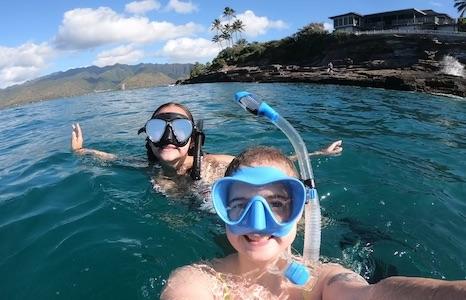
Sonja is currently participating in the IOOS Code Sprint, a hackathon style event organized by the Great Lakes Observing System and IOOS. Teams of researchers, developers, and community members work on projects related to data, data management, and information with the goal being to contribute to higher quality ocean and coastal information and management tools that can be used for stewardship of these areas. [Photo: Sonja Giardina (foreground) and friend Mariko Quinn]
|
|
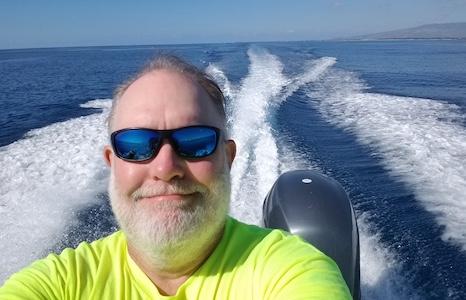
We fondly bid a hui hou (good-bye, until we meet again), to Joe Gilmore, PacIOOS Data System Management Specialist, as he embarks upon a new adventure with the UH Applied Research Laboratory. Having joined PacIOOS in 2011, Joe just celebrated his ten-year anniversary with our team. He was hired to develop our data and computing architecture and networking, and he quickly became critical to all of our real-time data streams. Joe helped the team install near-shore sensors, an automated weather station at Honolulu Harbor, and two different web cameras that are still in operation. Not only was he qualified with certifications to maintain secure networks, he was also a research diver and small boat operator. One of the most important things he did for PacIOOS was to convert our single machine for data into a "virtual cloud" in UH Information Technology Services. We are sorry to see him go, but congratulate Joe on his new position! |
|
|
|
|
|
|