|
Dear CDOC Community,
Our hearts are with everyone impacted by the devastating Southern California wildfires. We extend our deepest gratitude to the firefighters and first responders who continue working tirelessly to protect lives, homes, and businesses. Our partners at Triage Cancer have compiled a list of essential tips and resources to support those whose homes have been destroyed or damaged during this challenging time. If you know someone who has been affected, please share this information linked here.
January is National Cervical Cancer Awareness month, with the crucial reminder for those with a cervix, ages 21-65 years old to get screened. Anyone with a cervix is at risk for cervical cancer. It occurs most often in people over age 30 (CDC, 2024). Long-lasting infection with certain types of human papillomavirus (HPV) is the main cause of cervical cancer. HPV is a common virus that is passed from one person to another during sex. At least half of sexually active people will have HPV at some point in their lives, but few will get cervical cancer. Screening tests and the HPV vaccine can help prevent cervical cancer (CDC, 2024). When cervical cancer is found early, it is highly treatable and associated with long survival and good quality of life.
By the end of this year, we will be completing the 2026-2035 State Cancer Plan. We invite you to check out the Cancer Plan Revision Corner listed below to stay up to date with all cancer plan revision activities.
Happy new year (January 1st) and happy lunar new year (January 29th)!
| |
|
Sincerely,
Sora Park Tanjasiri, DrPH, MPH
CDOC Chair
University of California, Irvine
Chao Family Comprehensive Cancer Center
Alison Herrmann, PhD
CDOC Co-Chair
UCLA Fielding School of Public Health Jonsson CCC, Kaiser Permanente Center for Health Equity
| |
|
|
CDOC Evaluation Team (CET) Recruitment Open!
Volunteers Needed!
Do you have evaluation experience or a strong interest in evaluation? CDOC is recruiting volunteers for its evaluation team! The volunteers will assist in the Comprehensive Cancer Control Program's evaluation plan, data collection tools, analysis, and contribute to the report. Commitment for the CET is typically one meeting a month (one hour) in the spring months and as needed throughout the rest of the year.
If you are interested or would like to recommend a colleague, please email us directly at cdocshare@gmail.com.
| |
|
“The Continuing Impact of COVID-19 on Cancer Incidence, Early Detection, and Survival in California, 2021”
Feb 18, 2025 from 12:00 – 1:00 pm
The webinar will explore the continued impact of the COVID-19 pandemic on cancer incidence, screening, and survival in California in 2021. Highlighting missed early detection, racial/ethnic disparities, worsened survival outcomes, and strategies to mitigate these impacts.
Presenters:
Rita M. Villazana, M.P.H.
Data Disclosure Coordinator, CalCARES Program
UC Davis Health, UC Davis Comprehensive Cancer Center
&
Julianne J. P. Cooley, M.S.
Statistician, CalCARES Program
UC Davis Health, UC Davis Comprehensive Cancer Center
| |
|
Recording Available:
December 3, 2024: “Disparities in Stage at Diagnosis and Quality of Cancer Care in California by Source of Health Insurance" View the recording here | Password: Mujt6%5d
To view past CDOC webinars, click here.
| |
|
Cancer Plan Revision Corner
CDOC hosted the second Quarterly Cancer Plan Revision Check-In Webinar on December 10th. Subcommittees provided high level updates and identified areas of alignment, duplication, and collaboration. In case you missed it, view the recording here.
The first draft of strategies and action steps from all subcommittees was due December 6th. Feedback will be delivered to the subcommittees by the week of January 27th.
General Revised Guidance Document:
-
Please review the updated General Guidance document here.
Upcoming Dates (view more detailed timeline):
-
Week of January 27: Subcommittees receive feedback on draft content from CDOC Team
-
March 10: Quarterly Cancer Plan Revision Check-In Webinar @ 12pm
-
April 30: Final strategies and action steps due
Cancer Plan Subcommittee Roster:
-
Please notify Joyce Paraico Ceja (joyce.paraico@cdph.ca.gov) if there are any changes of participation in your subcommittees.
| |
|
Let Us Know How You Use
The State Cancer Plan!
| | |
|
|
State Cancer Plan Implementation Reporting Tool
Have you implemented a project, plan, or other relevant work that relates to content in the State Cancer Plan?
If so, we want to know about it! Please click here to fill out our 10 min reporting tool.
Your submission will provide insight on how the State Cancer Plan is being utilized.
| | |
UPCOMING
CDOC
MEETINGS
AND
EVENTS
(to read more click here)
| |
|
HPV Vaccination Learning Collaborative
Wednesday, January 15, 2025, 12-12:45pm
Cancer Centers Collaborative
Wednesday, January 22, 2025, 12:30-2pm
Survivorship Workgroup
Monday, February 3, 2025, 12-1pm
Colorectal Cancer Workgroup
Tuesday, February 4, 2025, 12-1pm
Cancer Surveillance Data Webinar Series
Feb 18, 2025, 12-1pm
Cancer Plan Subcommittee Quarterly Check-In
Monday, March 10, 2025, 12-1pm
Executive Committee
Monday, March 17, 2025, 1-3pm
Health Equity Workgroup
Thursday, April 10, 2025 2-3pm
| | |
2021-2025 State Cancer Plan Corner
January 2024 Cancer Plan Corner Highlight
Chapter 8:
Early Detection and Screening: Cervical Cancer
In 2021, the latest year in which incidence data are available, 12,536 new cervical cancers were reported in the United States (CDC, 2024). For every 100,000 individuals, 7 new cervical cancers were reported (U.S. Cancer Statistics Working Group, 2024). In 2022, the latest year in which data are available, 4,051 individuals died of cervical cancer (U.S. Cancer Statistics Working Group, 2024). Because of health service disruptions throughout 2020 and 2021 due to the COVID-19 pandemic, cervical cancer screening, diagnosis, and central cancer registry reporting may be delayed, and actual cancer occurrence may be underreported (GW TAP, 2024).
Please visit the CDOC website to read more on the cancer plan's Early Detection and Screening strategies and objectives for cervical cancer in California. You may also access the chapter here.
Contact info: cdocshare@gmail.com
| |
MEETINGS, CONFERENCES & EVENTS
| |
OTHER RESOURCES & OPPORTUNITIES | | |
|
|
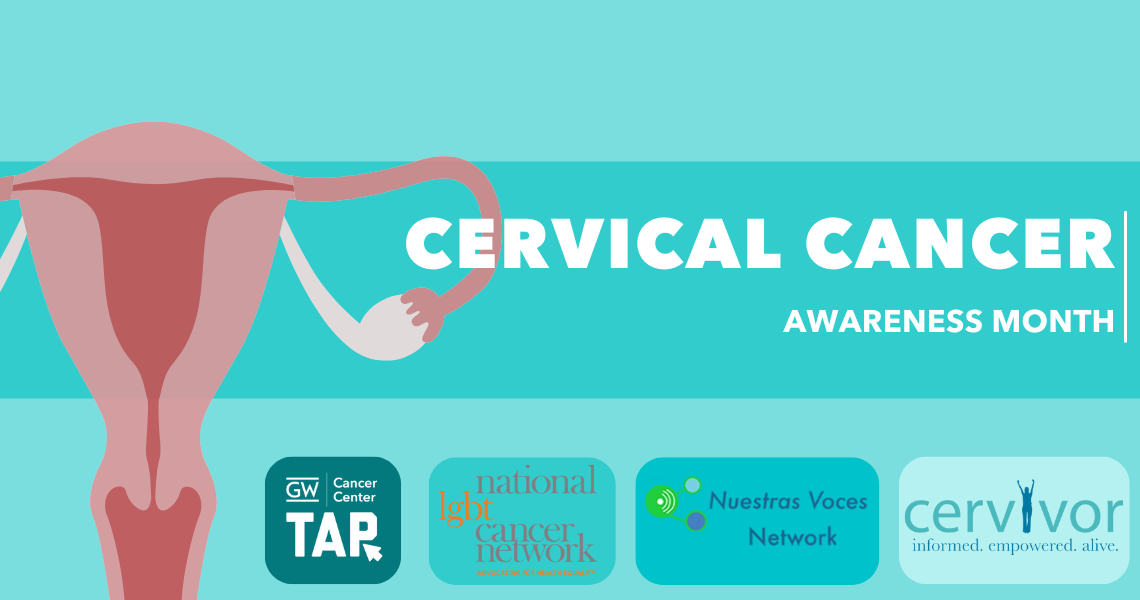
January is Cervical Cancer Awareness month. To assist CCC programs with media content, the GW Cancer Center Technical Assistance Program is working on launching an updated version of the Cervical Cancer Awareness Toolkit. This updated toolkit was made in collaboration with national partners Nuestras Voces Adelante, National LGBT Cancer Network, and Cervivor.
Visit the GW Cancer Control TAP website to learn more.
| |
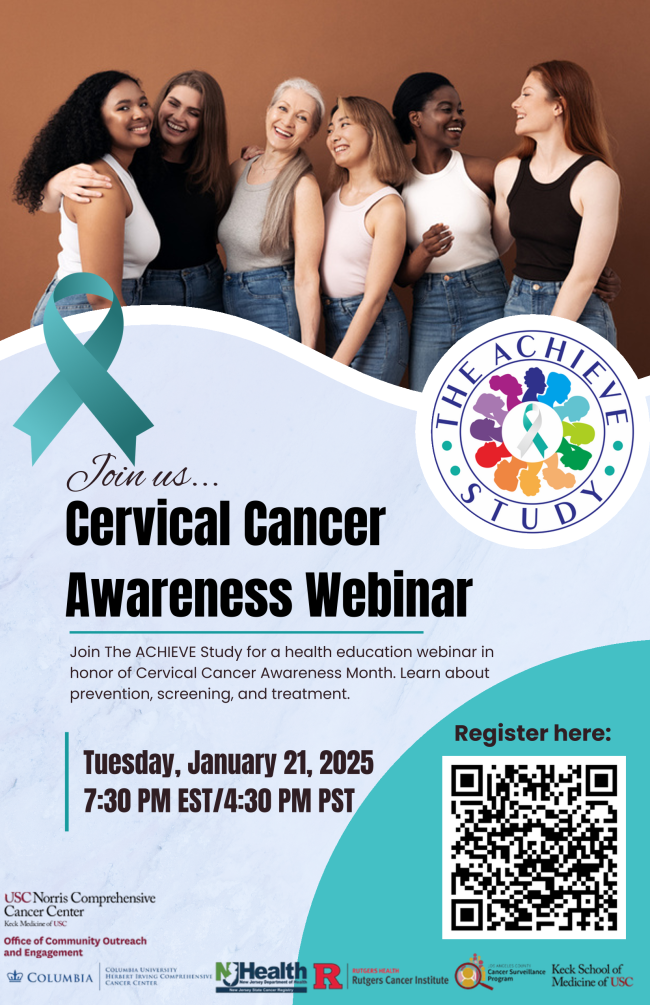
To learn more about The Achieve Study, click here. | |
|
The Upstream Research Center is pleased to announce its second round of fellowship opportunities. Uniting diverse community partners and scientists from Stanford University, the University of California, Davis, and the University of California, San Francisco, the Center is evaluating and scaling innovative income supplementation programs and policies that can address the fundamental causes (e.g., upstream factors such as housing, income, structural racism) of cancer inequalities in these areas.
The goal of the Upstream Research Center Fellowship Program is to develop a diverse cadre of interdisciplinary early-career scholars committed to advancing cancer health equity through research, practice, and capacity building in persistent poverty areas. Applications are due February 14, 2025, 5:00 pm Pacific Time. Appointments are for one year with the option to renew for a second year.
Fellowships are open to full-time post-baccalaureate, graduate, medical, predoctoral, postdoctoral students, instructors/assistant professors at Stanford, UC Davis, and UC San Francisco and require a primary mentor at these institutions by the due date of the application. Three scholars will be funded, one from each participating institution.
The Program offers unique learning and networking opportunities:
Mentored research experience. Fellows will receive support and mentoring from a transdisciplinary team (e.g., social and cancer epidemiologists, sociologists, health economists, behavioral scientists, and methodologists) at Stanford, UC Davis, and UC San Francisco.
Opportunities to conduct community-engaged research. Community engagement is the spine of the Center, integrated throughout its projects, cores, and activities. Fellows will have the opportunity to collaborate with the Center’s extensive network of community partners.
Vertical and peer networking within the Upstream Research Center and across the Persistent Poverty Initiative Network. Upstream fellows will be part of a cross-institution transdisciplinary peer cohort. Fellows will be encouraged to participate in the Center’s research projects and cores, monthly seminar series, journal club, pilot grant program, Persistent Poverty Initiative Network annual meeting (travel costs will be covered by the Center), and the Upstream Research Center’s annual retreat.
Access to career and professional development activities across institutions. Upstream fellows will be able to participate in an integrated set of career and professional development activities at Stanford, UC Davis, and UCSF (e.g., grant and science writing online workshops, team science training sessions, leadership development programs, and workshops on utilizing real-world data).
| |
|
Science of Community Outreach & Engagement (SoCOE) Conference
Save the Date: May 7-9
CDOC partners at City of Hope and UCSF invite you to attend and present your community engaged program and research at the SoCOE Conference 2025.
Please share with your networks. Abstracts must be submitted to
conference@socoealliance.org
| |
HEALTH EQUITY, CANCER & HEALTH DISPARITIES | |
|
CDOC Newsletter and Announcement Content
Submission Process
| | |
|
CDOC is made up of a diverse group of stakeholders that engage in important and impactful work we'd like to showcase. We have a new process for submitting your trainings, events, articles, grant opportunities, and more.
We kindly ask you to email us any content by the 5th of each month to cdocshare@gmail.com. If there is time-sensitive information (e.g. upcoming training) that you would like to share, we will do our best to include, but cannot guarantee that it will make the newsletter or announcements.
Submission requirements:
- Include a title
- Include the exact verbiage you'd like for us to include. Please do not include an attachment and ask us to share, a title and verbiage must be included.
- Include a contact person for any inquiries
- Include any attachments in a pdf file if possible
We appreciate your patience and support at this time, and we look forward to your submissions.
| | | | |