Twin Cities Walleyes Unlimited - Monthly Newsletter |
|
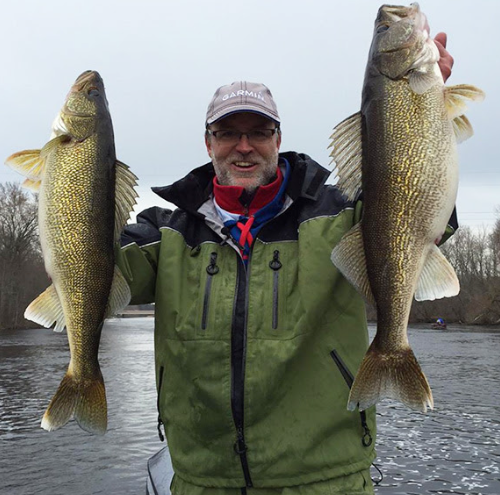
We are excited to host Steve Pennaz at our club meeting on Thursday October 5th. Steve is a two-time hall of fame angler who specializes in developing and building enthusiast media brands across various platforms. His credits include the successful launch of more than a dozen national outdoor television series, an award-winning national magazine and several digital properties.
He is known internationally as a skilled multi-species angler who specializes in breaking down new waters, the driving force behind his popular national television series Lake Commandos airing on Outdoor Channel, World Fishing Network and myoutdoortv.com.
Pennaz is a founding board member of the non-profit MN-FISH Foundation and currently serves as the organization’s secretary.
Pennaz lives in Independence, Minnesota with his wife Karen.
Learn more about Steve, Lake Commando's and more on Social Media Pages
|
|
Membership has it's advantages
Join TCWU or renew today by registering on-line at:
You can find out more information about Twin Cities Walleyes Unlimited and our Events by going to our website and on Facebook
|
|
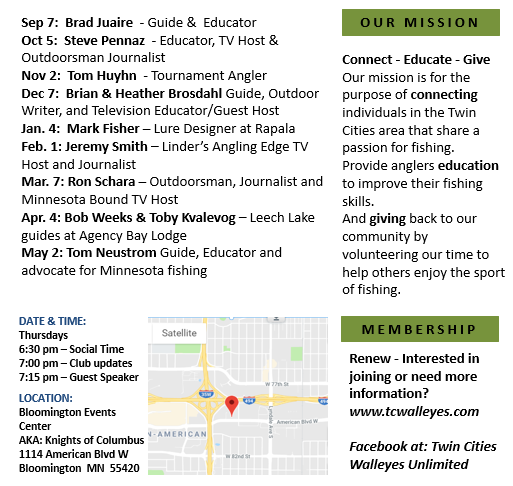
TCWU Guest Speaker line up 2023-24 |
|
TCWU partners with Centennial Lakes Park
to host Fraser Fishing Friends Event and Picnic
|
|
TCWU partnered with Centennial Lakes Park to host our Fraser Fishing Friends picnic on September 16th and what a Great Day! We had an awesome club turn out with 10 club volunteer's and 15 fishing friends. This event was really a big deal for our Fraser friends. It was cool to hear how they all were looking forward to fishing. They had a count down and they made sure to remind the Fraser Staff every week for weeks! |
|
|
Why is this event important and what is it that makes fishing so special?
Fishing is one of a few outdoor activity's that gives back in so many ways. Fishing creates some of our fondest memories, amazing life long friendships, gives us something to brag about, and the best pictures in the photo album are always fishing moments. Fishing connects us to our past, our parents, grand parents and so on. I can't think of anything better than going back and fishing in those favorite fishing holes that were handed down to us. Its so special that we plan for months in advance and count down the days. Its one of the things we all look forward to doing.
|
|
Special thanks
To Fraser Staff for everything you do to support this event and more. Most importantly the Fraser residents you support every day. We at TCWU are all honored to be your friends.
And to the Centennial Lakes Park Team on providing an amazing venue. You are amazing community champions, thanks for supporting Inclusion!
Thank you to our TCWU Volunteers: Paul Gerber, Brian Krefting, Ben and Harris Roach, Brad Dybdahl, Dale Meinders, Russell Nelson, Dan and Sarah Camp, Dave Penfield, Luther Overholt
|
|
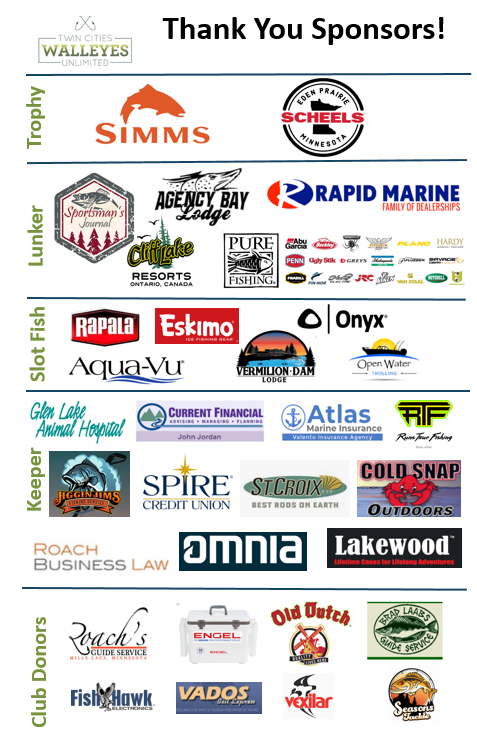
Special Thanks to all our Sponsors |
|
Sponsor Spotlight
Jiggin Jim's Fishing Guide Service and Taxidermy
|
|
Club member and sponsor Jim Ryks affectionately known as Jiggin Jim, offers Fishing Guide service to many of our west metro lakes. Based out of Buffalo Minnesota, Jim has 40 years of experience of creating special moments on the water and preserving them by creating once in a lifetime mounts for you to cherish.
Jim provides years of skilled expertise as an avid hunter and fisherman to aspiring outdoorsmen. His services include taxidermy and guided fishing expeditions out onto the freshwater lakes and rivers of Western MInnesota aboard his 690-series Ranger watercraft. On those picturesque waters, he shows his clients how to use bait, spin casting, and trolling methods to pull up prime largemouth and smallmouth bass walleye and others. Open water fishing season lasts from April to November, and taxidermy of the fish is half off when coupled with his guide service. When not catching fish, Jim expands his taxidermy services to land-roaming animals such as whitetail deer, antelope, bears, elk, moose, and even bison. Let Jiggin Jim’s Taxidermy preserve that moment when you pulled the trigger, let the arrow fly or set the hook by creating a once in a lifetime mount you will be proud to display.
|
|
Check out the Minnesota DNR Fishing Home Page
The Fishing Home Page on the Minnesota DNR website is loaded with all the latest updates, tools such as Lake finder, regulations, helpful tips and more all on one easy to navigate page. Take a look If you haven't had the chance to check it out. We recommend bookmarking this to your web favorites. It is a one stop shop for all MN fishing information. Click on the link below to learn more.
Walleye slot limit expands Aug. 1 for Mille Lacs anglers
Allowing harvest of smaller fish offers more opportunity to keep a walleye.
The minimum length of walleye Mille Lacs Lake anglers can keep drops from 21 to 20 inches beginning Tuesday, Aug. 1. Mille Lacs’ one-fish limit will remain in place, but the change allows anglers to keep one walleye between 20-23 inches or one longer than 28. The previous limit was one walleye 21-23 inches or one longer than 28.
|
|
TCWU Pro-tip of the Month |
|
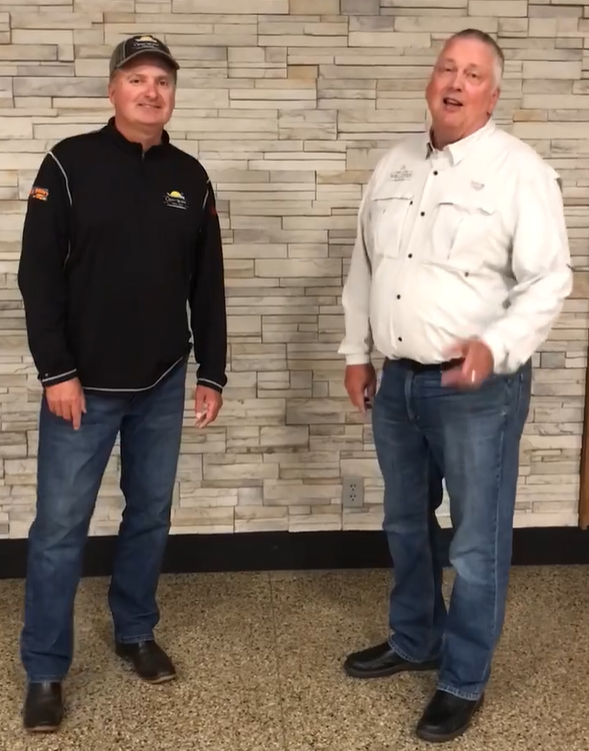
TCWU September guest speaker and educator Brad Juaire of Lake Mille Lacs Area shared this “Pro Tip of the Month“ with Club President Dale Meinders, that will help you catch more fish in early spring!
Thanks for the great meeting!
Click on the photo below to hear what was shared!
|
|
Guest Speaker re-cap
Featuring Brad Juaire
|
|
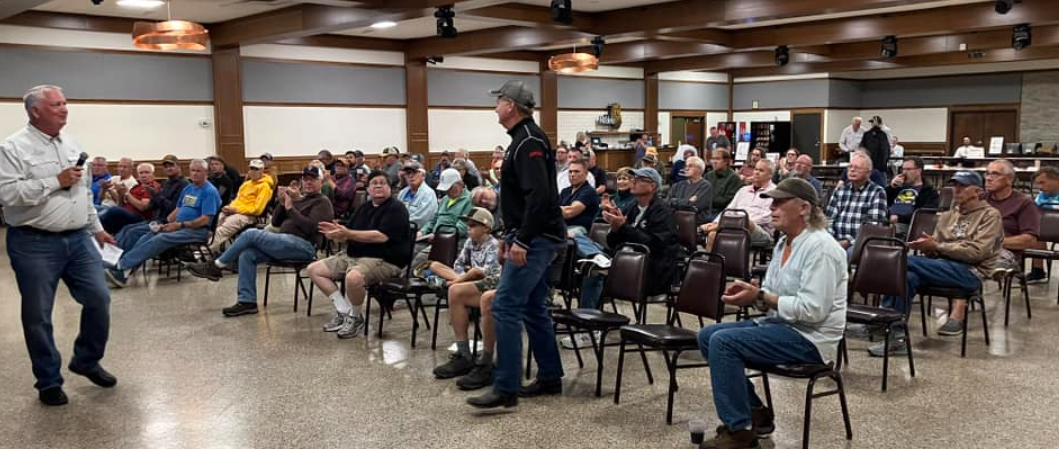
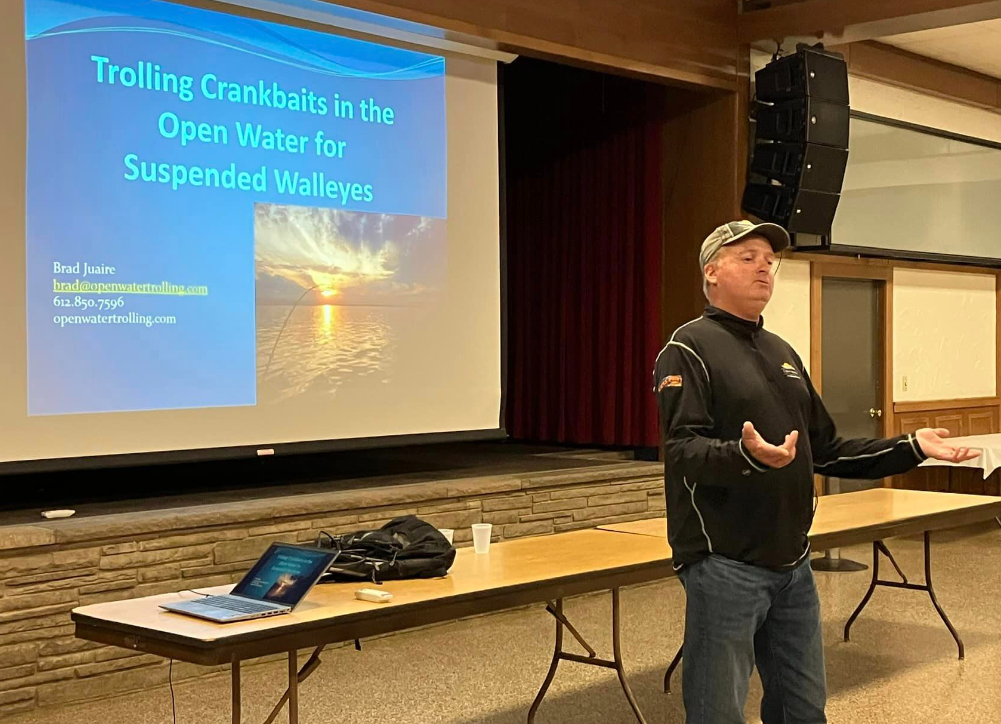
TCWU welcomed Brad Juaire at our club meeting on September 7th. We were excited to host Brad as he specializes in teaching anglers how to catch big suspended walleyes on in deep water basins on large lakes such as lake Mille Lacs. This method consists of fishing deep diving crankbaits, planer boards, line counter reels and long trolling rods. He has been trolling the open water basin of Mille Lacs for over 20 years from Memorial Day weekend up to Labor Day weekend. The focus of our seminar was on learning the open water trolling system so you can go back to your boat and be successful.
For those who missed the meeting you will find a recap of Brad's presentation that featured insightful fishing tips to use on Lake Mille Lacs, Enjoy!
|
|
What is Open Water Basin Trolling?
Fishing for walleyes that are not relating to structure but to a food source (Tullibee) that congregates in the cooler water of the deep basins of a lakes.
Why should you try it?
- There are big fish that relate to schools of these bait fish
- No down time – you crank baits are always in the water and in the strike zone
- Time of day does not matter, you can catch fish all day long
- Live bait bite is more difficult in late summer – but basin fishing is firing up
- Just have to find the zone the fish are in and not the spot on the spot
- It’s a Big fish presentation
|
|
When do you use this presentation?
- When the water temperatures are over 60 degrees. Best fishing months are June, July and August
- Time of day – Tullibee’s feed early mornings and at night
- Fish your cranks higher during feeding times and lower them during non-feeding times mid-morning to late afternoon
How do you locate suspended Walleyes?
It is all about breaking down the lake and devising a game plan
- Start with a lake map and ask yourself these questions
-
What is the forage base? – Pick lakes with Tullibee’s or Cisco’s You want to mimic them with your cranks
-
Where are they located? Factors such as sustained wind, time of year will dictate location
-
What is the water temperature? It will dictate where they are in the water column.
- They will be in the coldest oxygenated water
- Use a FishHawk to measure water temp at you crank bait level
Grid Searching for suspended walleye
- Based on the factors above here’s how you start the Grid Search
- Using your lake map and lay a grid over your it to target the section of the lake you are fishing
- Use one mile increments on your grid sections. Brad’s grids on Mille Lacs are often times 3 miles wide and 4 miles long, which seems huge but he doesn’t scout every inch of the grid. He scouts sections of each square
- Start by marking a waypoint in the area of your starting point and then scout 100 yards of each section at slower speeds (5 mph or less)
- Why only 100 yards in each one mile section? - It is sufficient length to determine if there are fish present
- You can stop and perform a search every half mile
- Set your Side Imaging at 100 - 200 feet
- Looking Fish arcs 3-5 feet off the bottom and bait fish (Tullibee’s) above them
- Use the Grid function on your Hummingbird to track your trolling pattern
- Then speed up to the next mile mark on your grid and repeat
- Always scout with the wind
- Repeat until you reach the end of your grid or until you runout of basin
- Then move one mile to the east and repeat
- When you get on the fish adjust your trolling runs based on your fish catching pattern
- If the fish stop biting move your trolling runs. Move left and make a run, and then to the right to expand your search to find where they moved
|
|
Four Keys of for fishing success
1. Water temperatures and types of crankbaits
-
Colder Temps – Use a slow side to side swimming profile – Husky Jerk, Original Rapala, Rip Stick 700
-
Moderate Temps - Shad Rap, Flicker Shad, Bandits have a loud rattle Brad love’s these baits
-
Warm Temps – Rapala Tail Dancer 11, Salmo Freediver 12, Reef Runner 800’s go down 30 feet on their own using braid
- Note: Your lures must be tuned and run properly through the water
- Try big 13 inch baits to entice big fish to bite
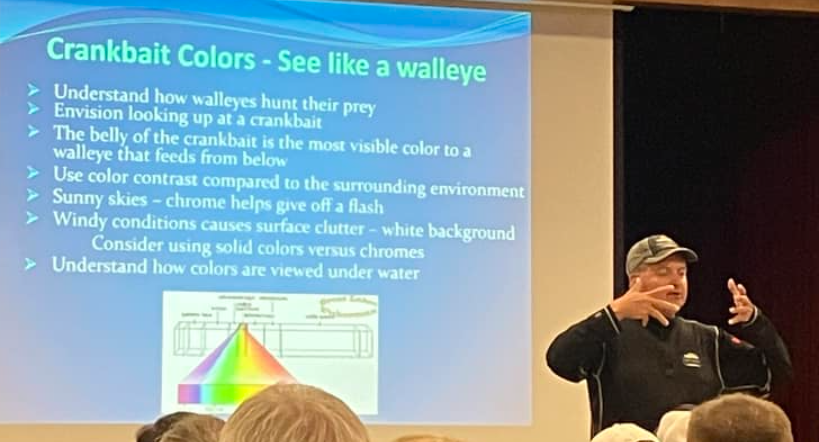
2. Crank Color
- Belly Color is the most important because that’s what the fish see above them
- Sunny days use Chrome
- Cloudy or wavy days move away from Chrome
- Dirty green water use contrasting colors Orange, Black, Purple
3. Speed
- Troll at slower speeds if water temps are cooler .8 mph
- Increase your trolling speed in warmer water up to 2 mph. Brad pushes speeds up to 2.8 mph to find the sweet spot of the best action and to cover more water
- You need to be able to troll down to slow speeds, if you are using your big motor you can throw out two drift socks to slow you down
4. Depth – How high should I fish my crank baits above the fish?
- Early morning start your baits higher about half way up the water column
- Mid-morning thru mid-afternoon drop your baits lower in the water column
- Late afternoon, raise the baits again
- Clear water allows you to fish higher above the fish 3-5 feet
- Dirty water, lower bait closer to the fish depth 1 – 2 feet above
|
|
Equipment
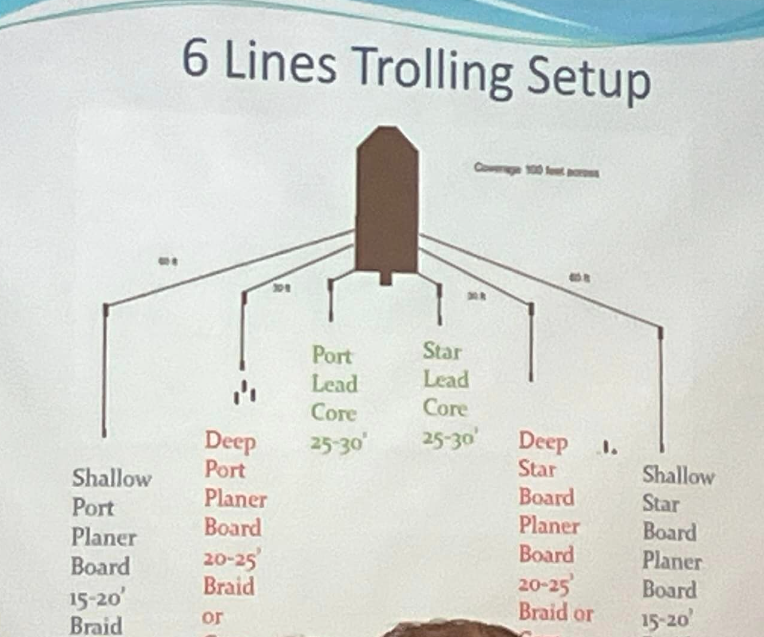
- Trolling Rods, Line Counters, Lead Core, Braid and Planer Boards
- 9 foot rods are common, you'll need to work as a team to manage planer boards and net fish
- Use Lead Core behind the boat and braid on the Planer Boards. Set your Planer Board baits higher in the water column
- Lead Core is speed sensitive and depth of your lure is impacted on your speed Speed doesn't impact baits on Braid or Mono
- Don't use Lead Core on your boards, it's too hard to detect if you have a small fish
- Boards act as a cushion for the lack of stretch not found with Braid line, which helps prevent you from pulling the hook out of aggressive big fish mouth
- Set your rod/rod holder angles at 45
- Stagger your depths when fishing multiple rods
- Typically catches his best fish on Planer Board's with Braid
- Slowly pull your rod out of the rod holders to keep constant pressure and don't change the angle of the hook
- Set your drag as loose as possible with Braid, even to the point where it almost lets out line
- Brad use's a Troll Master to keep a consistent speed with his big motor. .2 mph is a 10% difference and inconsistent speed can result in less fish caught
Fishing tips
- Doesn’t fish the edges of Mud Flats because of the varying depths that can bottom out your crank baits
- Target a consistent depth of 35 – 38 feet for 2 mile trolling runs
- Go deeper if the water is hotter
- If the weeds stop growing at 20 feet, fish your cranks at 20 feet. Fish have a tendency to relate to this depth.
- Fish consistent shelves
- Troll with the wind if waves are one foot or higher for boat control, which prevents wave surging. Surging will pause your baits, and impact your presentation
- If you find them and catch one, you got a starting point to work with
- The Precision Trolling app is an amazing application for understanding how deep your crankbaits will drop based on how much line you let out
- Use two drift socks to help you slow down your trolling speed. Two help you keep a straight line
- Use your electric trolling motor on calm water
- Water Clarity – Fish dirty water when temps are high. It’s cooler and has less light penetration
- Keep a fishing log and track weather, wind, sky, trolling speed, lure colors, etc, to use as a reference for future outings
- Brad's favorite bodies of water are Mille Lacs, Lake of the Woods, Columbia River, Erie, Green Bay
- If you want to learn this technique you need to commit to the process, it takes practice, leave your live bait at home and practice all day
Special thanks to Brad for joining our club to talk fishing. We had an amazing meeting and appreciate all the walleye fishing tips along with the different techniques and presentations you shared. We recommend that you check out Brad's social media link below to learn more and join Brad on one of his On The Water clinics. If you’ve never experienced this type of fishing or if you want to improve your open water trolling skills, Brad will be glad to hook you up.
To contact Brad click on the links below.
|
|
TC Walleyes Unlimited, Inc. |
|
|
|
|
|
|
|