The voice for pharmacy compounding | April 16, 2021

A special word from APC’s CEO…

This coming week is set to be a big, big week for pharmacy compounders and the patients you serve. Not only will APC launch its cBHT media campaign with a roll-out of compounding.com, but the Pharmacy Compounding Foundation will release a much-anticipated critical analysis of the NASEM cBHT report by the Berkeley Research Group.
Here, briefly, is what you need to know:
- PCF will host a free briefing on the Berkeley white paper at 3:00pm EDT Tuesday, April 20, after which the report will be made available for download at a4pc.org. You’ll find registration info for the briefing below.
- The cBHT media campaign landing page at compounding.com is set to “go live” this week, likely Tuesday or Wednesday (fingers crossed!). It’s where our upcoming digital advertising campaign will direct patients and prescribers of compounded hormones to tell their stories — and to share those stories with their members of Congress. The site also includes details about the threat to compounded hormones and what we’re doing to confront it.
- Also next week, we’ll launch a MEMBERS-ONLY resources page that includes plenty of downloadable items — patient testimonial videos, bag stuffers, poster, window slicks, etc. — for use in your pharmacy and sharing with prescribers. We’ll also share step-by-step instructions about how to use those resources to inform patients and prescribers about the threat to cBHT and our campaign to confront that threat.
Like I said: A big, big week. So stay tuned ... and pay attention! We’re counting on you to be engaged in this campaign. Your ongoing ability to care for your compounded hormone patients may just depend on it.
— Scott Brunner, CAE
scott@a4pc.org

From APC’s President
I would walk 500 miles
Dear A4PC,

Michael Blaire, RPh, FIACP
APC President
Before you judge a man, walk a mile in his shoes.* It’s an old proverb — a reminder to practice empathy. For pharmacy compounding professionals, though, it might read: Before you judge a compounder, gown up, scrub in, and put on a pair of booties.
This past Monday evening I had the pleasure of attending an event at MedQuest Pharmacy in honor of Congresswoman Cathy McMorris Rodgers. MedQuest is a state-of-the-art facility, and CEO Jeffrey Bray is no novice when it comes to hosting a congressional visit. Rep. McMorris Rodgers (or CMR, as her friends on Capitol Hill now refer to her) was provided a tour of the facility followed by a lengthy question and answer session culminating in dinner and schmoozing.
One of the most impactful moments of the tour was when Jeff's team, rather than try to explain the hundreds of thousands of dollars invested in the facility to comply with USP <800>, actually gowned up along with CMR and her staff and ran through the process of compounding a hazardous product. USP <800> was no longer an amorphous buzz word, it was a concrete set of rules and guidelines with visible costs for compliance and consequences for non-compliance.
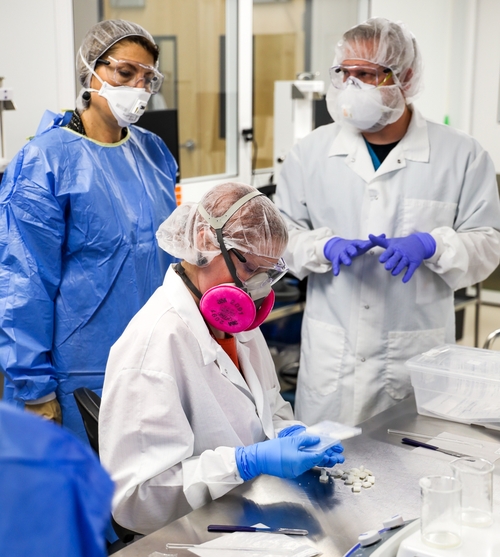
Rep. Cathy McMorris Rodgers (in blue)
watches the compounding process at MedQuest Pharmacy.
While learning that bio-identical hormones were considered hazardous drugs, CMR and her staff were educated about the NASEM report on cBHT. Actually meeting the employees that would be out of work if FDA were to act on the NASEM recommendations was far more impactful than any story or number on a PowerPoint slide.
While Jeff did have numbers as to how many patients and physicians he served in CMR's home state of Washington, seeing the actual volume of prescriptions being compounded and packaged for shipping gave life to the number of patients that would lose access to their medications. It was also a perfect segué to bring up the MOU and the potentially devastating effects it would have on pharmacies and patient access.
And, although MedQuest does not perform any veterinary compounding, I did have the opportunity to spend about 20 minutes post-tour with CMR, explaining the FDA's assault on compounding for animals from bulk drug substances.
Following the tour, APC presented CMR with a "Friend of Pharmacy Compounding" certificate, and I was able to share insights that will help the congresswoman strategize a path forward for our legislative priorities.
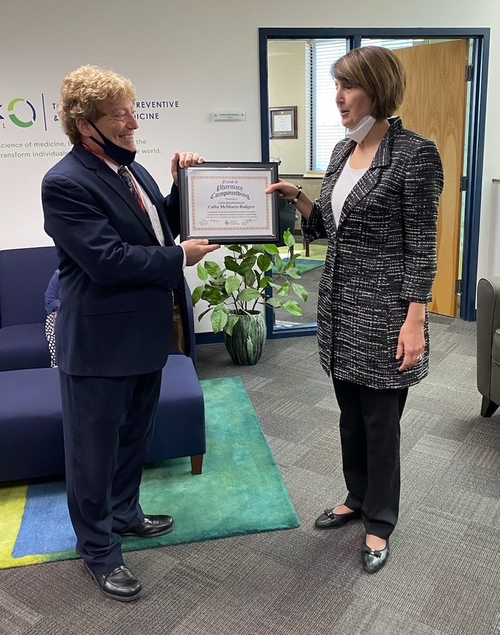
APC President Michael Blaire presents CMR with
a Friend of Pharmacy Compounding certificate
In all, CMR and her staff spent about three hours with us, along with patients, prescribers and other area pharmacists. You do not get that kind of face time during a hill visit, a PAC function, or even an in-district fundraiser. So, if you haven't guessed by now, I am going to encourage everyone, once again, to step up and host a congressional visit at your pharmacy. They are the most effective advocacy tool that we have. Congress will be on recess the first week of June, the first week of July, and all of August. Call your representative's scheduler now and get a site visit on the calendar.
To make it easier, the State Legislative and Regulatory Committee has prepared a guide for planning and hosting a visit. Host a visit soon, and remember to take plenty of pictures. Just remember to remove your booties before entering the common areas.
* “That way, when you do criticize him, you'll be a mile away and have his shoes." —S. Martin
Michael Blaire is APC’s president, but his day job is vice president for government and regulatory affairs at Wedgewood Pharmacy in Scottsdale, Arizona. You can reach him at mblaire@wedgewoodpharmacy.com.
This Week
Associations ask FDA to delay MOU enforcement
APC, APhA, the National Alliance of State Pharmacy Associations, and NCPA, have submitted a joint letter to FDA asking that it delay enforcement of the final MOU until at least October 26, 2023.
We have learned that a number of states — including large ones such as Florida and Texas — are unable able to sign the MOU without their respective state legislatures amending state laws to comply with the final MOU’s requirements ... assuming they choose to.
For all the MOU’s flaws (and FDA’s overreach in crafting it), the implications of states not signing it could be catastrophic for patients, compounders — and even local economies.
That’s why we’ve asked for what we consider to be a reasonable postponement.
NASEM report on cBHT is tainted, analysis shows
Briefing this Tuesday on PCF’s bombshell report
A tainted process. Built-in bias. Faulty conclusions based on selective research. That's what a professional analysis found in an FDA-commissioned report on compounded hormones.
That report came from the National Academy of Science Engineering and Medicine (NASEM), paid for by taxpayers. It was supposed to be objective and impartial.
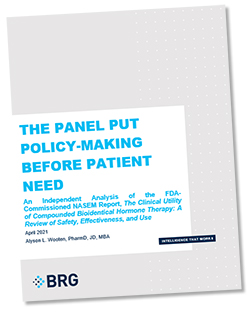
Instead an independent third-party analysis by the non-partisan Berkeley Research Group found a laundry list of obvious flaws in NASEM’s process and recommendations, making the report so thoroughly compromised it is useless in any discussion of compounded hormone therapy.
From reliance on a small fraction of the available studies, to "experts" with a demonstrated history of anti-compounding bias, to ignoring input from the clinicians most familiar with the subject, the NASEM report used outdated references, non-standard definitions, and a limited, cherry-picked selection of clinical data.
But perhaps most surprisingly for a medical study, it ignored the critical and well-documented body of patient-outcome data. The result is a study rife with bias.
This Tuesday, the Pharmacy Compounding Foundation will host a briefing on the Berkeley analysis of that NASEM report — and will detail the scope of the factual issues, as well as that inappropriate FDA interference.
Please join us — the briefing is free and open to all.
Tuesday, April 20
3:00pm EDT via Zoom
Please click here to register.
APC on the road
Down at the AMMG conference in Miami, CEO Scott Brunner and Director of Membership Drew Floyd were spreading the word to prescribers about the threat to compounded hormones — and convincing them of the need to invest in our cBHT media campaign. (We're still about $600,000 short of the funds we'll need to launch that campaign!)
Scott and Drew had a chance to connect with IACP past president (and continuing fan) Ray Mareno and staff. Ray's Universal Arts Compounding Pharmacy happened to be in the booth across the aisle. (That's Ray on the right, with Scott next to him. Drew, being a vampire, does not show up in photographs.)
Other APC members exhibiting at the AMMG meeting include Belmar, College Pharmacy, Medquest Pharmacy, University Compounding, and Wells Pharmacy.

Coming Up
June 10–11, 2021 — PCCA ACT Conference (virtual)
June 16–17, 2021 — Compounding Pharmacy Compliance Virtual (APC members: Use code APC10 for 10% off registration!)
July 13, 2021 — APC CE: Reading a Certificate of Analysis: Calculations Based on C of A Data
September 14–15, 2021 — Compounders on Capitol Hill (mark your calendars!)
September 22–24, 2021 — Compounding Pharmacy Compliance East
Short Takes
Don't skip the survey. Please don't forget to take the APC/University of Mary Washington Compounding Profile Survey — we need your help to pain the the first comprehensive picture of the breadth and depth of compounding in the U.S. Go to A4PC.org/2021survey, and it should take less than 10 minutes. If you're a member of the compounding community, take the survey now!
1 in 1.2 million. From the Washington Post, "The problem with the Johnson & Johnson vaccine pause: "Longtime FDA watchers, however, saw the agency doing what it almost always does: erring on the side of caution, no matter what."
CDER leader. Patrizia Cavazzoni, until now the acting director of FDA's Center for Drug Evaluation and Research, has been named director, period.
FDA commish? The Biden administration expanded its short list of candidates to lead the Food and Drug Administration and several women of color are now in the running, the Wall Street Journal reports. "Acting Commissioner Janet Woodcock was once considered likely to be nominated for the job permanently, but that prospect is clouded by senators calling on President Biden to bring in new FDA leadership."