|
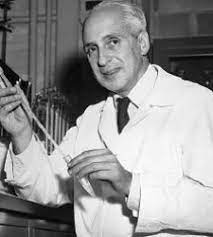
Severo Ochoa, MD
Severo Ochoa, was born September 24, 1905 in Luarca, Spain. Inspired by the work of Spanish neurologist, Ramón y Cajal, Ochoa decided to pursue a medical degree at the University of Madrid where he earned his M.D. in 1929. After graduating Ochoa spent two years studying biochemistry and physiology at the University of Heidelberg. There he was mentored by German biochemist, Otto Meyerhof.
In 1942 he moved to the United States where he would become a citizen in 1956. While in the U.S. he worked at New York University (NYU) as a professor, becoming the chairman of its biochemistry department in 1954. The following year, Dr. Ochoa discovered a bacterial enzyme that could synthesize the vital life substance, ribonucleic acid (RNA), from its chemical units. He named this enzyme polynucleotide phosphorylase. It was later discovered that the enzyme’s function is to degrade RNA, not synthesize it; under test-tube conditions, however, it runs its natural reaction in reverse.
Ochoa’s discovery was vital in learning more about the human genetic code. Because of his work, he was awarded the Nobel Prize in physiology or medicine in 1959. This recognition made him the first Hispanic American to win a Nobel Prize in this category. He shares the award with Dr. Arthur Kornberg, who is cited for discovering a different bacterial enzyme that could to synthesize another vital life chemical, deoxyribunucleic acid, or DNA.
Throughout his life Dr. Ochoa made a number of distinctive, important, and impactful contributions to science. On November 3, 1993, at the age of 88, Dr. Ochoa passed away from pneumonia in Madrid.
Learn about other nine other Hispanic pioneers that brought about advances in medicine and research.
|