CLOSING THE CIRCLE - SUMMER 2023


HOME | NEWS | PUBLICATIONS | RESOURCE LIBRARY


National Collaborating Centre for Indigenous Health (NCCIH)
3333 University Way, Prince George, BC, Canada, V2N 4Z9
T: (250) 960-5250 | F: (250) 960-5644
nccih@unbc.ca
nccih.ca


Follow the NCCIH on Twitter Like the NCCIH on Facebook Connect to the NCCIH on LinkedIn Watch NCCIH videos on Vimeo Watch NCCIH videos on YouTube Listen to NCCIH on SoundCloud Read NCCIH knowledge resources on ISSUU


Welcome


A central tenet of Tsek’ehne teachings, shared by many nations, is that if you don’t have a proper relationship with the land, the land may simply reject you. This teaching might seem irrelevant to health if we don’t view health wholistically. Switching our lens, however, allows us to bring the eroded relationship between us and the land into sharp focus and more closely examine how a decline in wholistic health has been shockingly regulated. At the National Gathering of the NCCIH last May, we reinforced the gravity of revitalizing wholistic approaches to health, with both Academic Co-Leads directly speaking about its importance. There was also much discussion about the smoke caused by the numerous wildfires raging in Western Canada in May and continuing to threaten the country today—a popular topic of conversation in the news media as well. We asked, have we become complacent in our views of climate change, normalizing changes as mere seasonal occurrences and disregarding how our actions of burning fossil fuels, manufacturing goods, and deforesting the earth impact our lands and ultimately our health?


The land, consistent with Tsek’ehne teachings, appears to be rejecting all of us. Climate change has contributed to a situation that negatively affects everyone’s health. Deforestation, the removal of wetlands, and other alterations to the landscape (e.g., paving) have made flooding worse. The colonial suppression of Indigenous silviculture practices has had serious ramifications on the health of the land and all living things. Natural disasters are abundant, and they affect everyone—even those who live in good relationship with the land. As always, our hearts go out to the victims, families, and communities affected by every natural disaster. At the NCCIH, the Academic Co-Leads’ shared vision is to unearth the teachings of our ancestors so as to revitalize and enact the importance of the relationship with the land and the interconnectedness of culture and wholistic health.


Summer is an ideal time to build relationships, not only with the land but also with each other. In academia, this season is also often a period of intensive research and knowledge mobilization. Both Drs. Blackstock and Sims can attest to this, as we have attended numerous conferences and engaged with our respective communities. Summer is here, and it has been a busy one!


Dr. Blackstock began June with a keynote welcome to the Canadian Association of Schools of Nursing, a workshop on othering and allyship followed by a presentation on Decolonizing Nursing. She also presented on “Weaving strength: Indigenous determinants of health and wholistic health and well-being” at the Network for Sharing Indigenous Information and Research (NSIIR) meeting. The presentation reviewed the relationship of the social determinants of health with associated health care systems. It examined processes available to Indigenous peoples today and considered how those structures deconstruct wholistic Indigenous health into separate entities. Following this event, she connected with Indigenous health researchers at the BC NEIHR gathering in Terrace, BC. The next month, Dr. Blackstock travelled to Montreal, where she presented the e-poster, “Decolonizing nursing: The role of self-determination in the health and well-being of Indigenous peoples exploring factors related to enacting anti-racism practice” at the annual International Council of Nurses (ICN) Congress.


In June, Dr. Sims ventured north to Whitehorse, in the Yukon territory, to participate in an Indigenous Cultural Heritage Advisory Council (ICHAC) meeting. Members had the opportunity to provide advice on Parks Canada and Historic Sites and Monuments Board of Canada policy and Indigenization efforts, as well as on cultural heritage-related projects and initiatives. Back in Prince George, BC, Dr. Sims continues his work, leading four workshops over the summer months for Indigenous Studies 201 at the First Nations Centre Gathering Place on the University of Northern British Columbia (UNBC) campus. The series of workshops, in partnership with UNBC and Northern Health, focus on helping faculty decolonize and Indigenize course content. Between September 2023 and April 2024, Dr. Sims will host a series of webinars exploring Indigenous topics from an Indigenous perspective and providing a venue for faculty, staff, and students across the country to learn about Indigenous topics they may have missed in their educational journey.


If you are interested in knowing about other publications, please see our visit our web site or subscribe to our mailing list to receive notifications of newly released NCCIH resources, upcoming webinars and our regular seasonal newsletters. Please enjoy and share our knowledge resources with your community and networks, and if you have not already done so, join us on Twitter (X), Facebook, LinkedIn, Vimeo, YouTube, SoundCloud, or ISSUU to participate in updates as they happen.


So, while the bears have their fun (sas ‘ukədis’əsneh), the berries ripen (mai ‘udijihlneh), and we await the “animals to getting fat” (ghədi nanehtsənneh) in preparation for yəsk’e (winter), we both, along with the staff at the NCCIH, look forward to autumn—the season of “letting go,” just as the trees let go of their leaves. It is a time to study and reflect on the structures underneath in order to appreciate the richness of wholistic health and gain wisdom from our relationships with the land and with each other.


Mussi cho/Ham i yaa,


Dr. Sheila Blackstock, Academic Co-Lead,
National Collaborating Centre for
Indigenous Health (NCCIH)


Anko,


Dr. Daniel Sims, Academic Co-Lead,
National Collaborating Centre for
Indigenous Health (NCCIH)


NCCIH news and promotions

What constitutes quality care of young First Nations children?

Currently, the NCCIH is seeking First Nations project participants from across Canada to share their insights and perspectives on matters related to the early learning and development of young First Nations children residing on reserve. More information about participating in this project can be found in the PDF poster. Deadline to request to participate is 4pm (PST) September 15, 2023. Participant interviews are available in French on request.


Webinar: Pathways to Indigenous health

Truth before reconciliation: How to identify and confront residential school denialism. Pathways to Indigenous health is a series of webinars hosted by Dr. Daniel Sims, NCCIH Academic Co-Lead. Between September 2023 and April 2024, Dr. Sims and his guests will explore a variety of topics related to the health and well-being of First Nations, Inuit, and Métis Peoples. The series intends to strengthen the links between knowledge, policy, and practice, by supporting the educational journeys of healthcare workers, public health audiences, and beyond. Tuesday September 12, 2023, 1 PM - 2:30 PM PST / 4 PM - 5:30 PM EST. Zoom webinar registration.


Former Academic Lead Dr. Margo Greenwood elected Member
of the RSC

Former Academic Lead of the National Collaborating Centre for Indigenous Health (NCCIH) Dr. Margo Greenwood O.C. has been elected Member of the Royal Society (RSC) of Canada. She joins a cohort of 58 new College Members of the RSC chosen by their peers in recognition of outstanding scholarly, scientific, and artistic achievements. Founded in 1882, the RSC promotes knowledge and innovation in the Arts, Humanities, and the Sciences, in Canada and around the world. Read the NCCIH web story.


Have you requested publications from the NCCIH?

We have recently been made aware that our web site forms were not reaching our inbox due to a Microsoft Outlook 365 technical issue. This issue has now been resolved. If you have recently submitted a form, but have not received confirmation from us, we ask you please re-submit your request using the online form, or submit your request by email to nccih@unbc.ca, or call us directly at (250)-960-5250. We sincerely value your support and continued interest in NCCIH knowledge products and publications.


Attended events


Network for Sharing Indigenous Information and Research (NSIIR), Virtual, June 1, 2023.


Indigenous Cultural Heritage Advisory Council, Whitehorse, Y.T., June 7-8, 2023. parks.canada.ca/culture/autochtones-indigenous/conseil-council


BC NEIHR Gathering for Indigenous Health Researchers (GIHR), Terrace, B.C., June 8-9, 2023.


International Council of Nurses (ICN) Congress, Montréal, Que., July 1-5, 2023. icn.ch/events/icn-congress-2023-montreal


Upcoming events


9th Healing Our Spirit Worldwide, Vancouver, B.C., September 11-15, 2023. fnha.ca/wellness/healing-our-spirit-worldwide


Weaving Wisdom Gathering, Prince George, B.C., October 5, 2023.


New NCCIH publications and resources


Voices from the Field podcast series

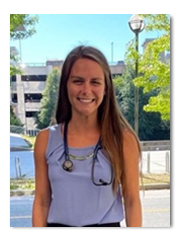
Kara Ruff is a Métis student, currently studying medicine through the University of British Columbia on the ancestral, traditional and unceded lands of the Sylix Okanagan Peoples at the Southern Medical Program in Kelowna, BC. She is entering her second year of medical school and has an interest in Indigenous and rural health care due to her familial ties and background of growing up in Campbell River on Vancouver Island. At the Southern Medical Program, she is the Indigenous Health Representative for her site and continues to advocate for improvement in culturally safe health care for Indigenous peoples in Canada.


The four-part mini-series A Medical Student’s Journey in Learning about Indigenous Health was developed with supervision and mentorship from Dr. Sheila Blackstock, a Gitxsan scholar and Academic Co-Lead for the NCCIH, and Dr. Viviane Josewski, a Research Associate with the NCCIH and Assistant Professor at the UNBC School of Nursing.


Episode 26 – A medical student's journey – Part 1: Introduction to Kara Ruff


Episode 27 – A medical student's journey – Part 2: Cultural safety and humility in practice


Episode 28 – A medical student's journey – Part 3: Immersive learning in Lower Post, BC


Episode 28 – A medical student's journey – Part 4: Health supports and services for Indigenous patients


Voices from the Field


Kara Ruff


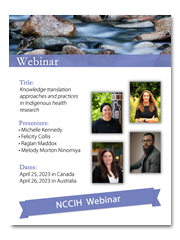
Knowledge translation approaches and practices in Indigenous health research


The webinar resources for "Knowledge translation approaches and practices in Indigenous health research" (held April 25, 2023) with presenters Michelle Kennedy, Felicity Collis, Raglan Maddox, and Melody Morton Ninomiya are now available online.


Watch on Youtube | Listen on SoundCloud


Webinar - Knowledge translation approaches and practices in Indigenous health research


Request NCCIH knowledge resources


Did you know you can request NCCIH publications free of charge? Send your request to us by filling out the “Request this Publication” form found at the bottom of each online publication page, indicate how many copies you’d like, a note about how you will utilize the resource, your name and mailing address. We will do our best to accommodate your request based on our current available printed inventory. If you have multiple publication requests, please use the “Request Publications” text link found in the top right hand corner of the NCCIH web site.


Online resources


In support of creating a health community focused on knowledge synthesis, transfer and exchange we have chosen a sampling of current online resources to share. Please note the links provided in the NCCIH newsletters are for general interest only and do not indicate an endorsement. The views expressed in the linked resources do not necessarily represent the views of the NCCIH or our funder the Public Health Agency of Canada.


Send us an email to nccih@unbc.ca with "Online resource" in the subject line if you have an online resource you would like added to our next newsletter.


AlterNative: An International Journal of Indigenous Peoples, Vol. 19, Issue 2, June 2023


Cultural Survival, Indigenous Arts - Weaving Together our Communities: Past, Present, and Future, Vol. 47, Issue 2, June 2023


International Journal of Indigenous Health (IJIH), Vol. 17, No. 2, August 7, 2023


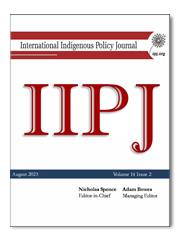
International Indigenous Policy Journal (IIPH), Vol. 14, No. 2, August 2023


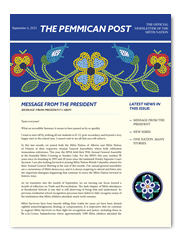
Newsletter of the Métis Nation, September 6, 2023


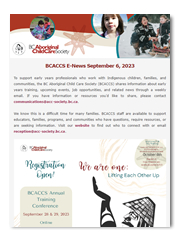
BC Aboriginal Child Care Society (BCACCS) E-News September 6, 2023


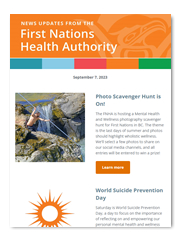
News and Updates: First Nations Health Authority (FNHA), September 7, 2023


National Indigenous Diabetes Association (NIDA), Summer 2023


ITK - Building A Partnership For Transformational Change: Evaluation Of The First Five Years Of The Implementation Of The Inuit-Crown Partnership Committee


Statistics Canada – The Daily – Indigenous peoples, 5 publications released in 2023


Government of Canada - Glossary on Climate Change and Public Health “Indigenous knowledge"


Statistics Canada - Police-reported Indigenous and Racialized Identity Data Through the Uniform Crime Reporting Survey: Progress Update and Next Steps


Government of Canada - United Nations Declaration on the Rights of Indigenous Peoples Act Action Plan 2023-2028


CPHA - Final Report: A Public Health Approach to Substance Use Survey of Public Health, Public Safety, Health and Social Service Professionals


CPHA – Annual Report 2022


NCCHPP - Towards a HiAP Approach for Canada’s Federal, Provincial and Territorial Jurisdictions?


NCCDH - Language and health equity: A curated list


HQBC - Sharing Concerns: Principles to Guide the Development of an Indigenous Patient Feedback Process


Online multimedia


This section features infographics, interactives, apps or videos that we found interesting or educational. Please note the links provided in the NCCIH newsletters are for general interest only and do not indicate an endorsement. The views expressed in the linked resources do not necessarily represent the views of the NCCIH or our funder the Public Health Agency of Canada.


Send us an email if you have multimedia resources you would like included in our next newsletter to nccih@unbc.ca with "Multimedia submission" in the subject line.


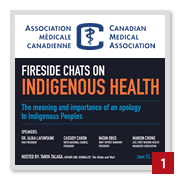
1) Fireside Chats on Indigenous health: The CMA’s journey of reconciliation - “Trust comes before reconciliation. This was the overwhelming message of the Canadian Medical Association’s (CMA) Fireside Chat series, which brought together Indigenous patients, providers and leaders to talk about how we can move forward, together, on reconciliation.” View the video.


2) BC NEIHR - Research DE-Colonized: Ethical, Indigenous-Led Health and Wellness Research in Canada! “Join BC NEIHR Indigenous Health Research Facilitator, Laura McNab-Coombs, as she connects with inspiring Indigenous health and wellness scholars, healthcare professionals, and communities sharing their stories of how they’re decolonizing health and wellness research, changing healthcare and academe along the way.” Listen to the podcast.


3) The Auntie is in: Paulina Johnson – “Dr. Paulina Johnson, an Assistant Professor in Sociology at the University of Alberta, shares realities and stories from her home First Nation and people, the Nehiyawak (Four Spirit), as she tackles what it’s like to be Indigenous in Settler Canada.”


The NCCs of NCCPH

Established in 2005 and funded through the Public Health Agency of Canada (PHAC), the six National Collaborating Centres (NCCs) for Public Health (NCCPH) work together to promote the use of scientific research and other knowledge to strengthen public health practices, programs and policies in Canada.


A unique knowledge hub, the NCCs identify knowledge gaps, foster networks and provide the public health system with an array of evidence-based resources, multi-media products, and knowledge translation services.


NCC for Indigenous Health (NCCIH), University of Northern British Columbia, Prince George, BC


NCC for Determinants of Health (NCCDH), St. Francis Xavier University, Antigonish, Nova Scotia


NCC for Healthy Public Policy (NCCHPP), Institut national de sante publique du Quebec (INSPQ), Montreal, Quebec


NCC for Infectious Diseases (NCCID), University of Manitoba, Winnipeg, Manitoba


NCC for Environmental Health (NCCEH), British Columbia Centre for Disease Control, Vancouver, BC


NCC for Methods and Tools (NCCMT), McMaster University, Hamilton, Ontario