February 22, 2023

Top stories

■ NPR to cut about 100 workers in one of its largest layoffs ever (Washington Post) / ‘CEO John Lansing says ad revenue for podcasting shriveled even as general economy seems on mend. He promises NPR will build on its mission and values but adds, "This will be a major loss." ’ (David Folkenflik) / ‘Last time NPR faced a big shortfall - the pandemic year of 2020 - NPR staff gave back a lot of pay to avoid layoffs. But that was a short term crisis — the company asserts this shortfall seems longer term.’ (Steve Inskeep)


■ Don Lemon doesn’t address Nikki Haley comments in ‘CNN This Morning’ return, but apologizes again on Twitter (The Wrap) / Don Lemon is back on 'CNN This Morning.' But can he last? (Los Angeles Times)


■ Dozens of ‘New York Times’ journalists hit staff union for its defense of trans coverage criticism (Vanity Fair)


■ They risk it all to cover war in Ukraine. Are people still watching? (Washington Post) / International Journalists Federation suspends Russian union (Associated Press) / Preparing for war: Media groups provide gear, training for reporters in Ukraine (VOA) / Coming March 2: Living Under Threat: Ukraine, Russian journalists share struggles of wartime reporting (NPCJI)


■ Democrats see security threat in McCarthy sending Jan. 6 video to Tucker Carlson (The Hill) / House Speaker McCarthy gives Tucker Carlson exclusive access Jan. 6 riot footage (Washington Post) 


■ ‘After the 2020 election, a producer for Tucker Carlson wrote, “We're threading a needle that has to be thread... We can’t make people think we’ve turned against Trump. Yet also call out the bullshit.” That perfectly describes Fox's legal mess.’ (Bill Grueskin) / ICYMI: Fox News feared losing viewers by airing truth about election, documents show (Washington Post) 


■ Jen Psaki, once the voice of Biden, moves to an anchor chair (New York Times)


■ Gayle King reminds us that she is not signing off from the news anytime soon (Oprah Daily)


■ Profits vs. safety? 10 cartoons that speak volumes about East Palestine train derailment (Columbus Dispatch)


■ A Puerto Rican journalist is helping crowdfund independent journalism on the island (Nieman Journalism Lab)


■ We should be better by now at talking about grief in the workplace (Quartz) 


Press freedom 


■ Another Kazakh journalist attacked as early parliamentary elections draw near (Radio Free Europe)


■ ‘Equality of injustice for all’: Saudi Arabia expands crackdown on dissent (New York Times) 


■ Turkey blocks online forum Eksi Sozluk in latest social media clash (Bloomberg) 


■ Bangladesh shutters newspaper run by political opposition party (CPJ)

“If your job requires that you cover Native American issues or communities (and this advice can go for any community you are not a part of), start by being in the community. Don’t parachute in and helicopter out. Don’t come in with questions. Sit and listen. Even if it takes weeks, or months. Or years.”


-- Valerie Vande Panne, award-winning reporter and editor, “Here are some tips for covering Indigenous communities, for non-Natives”

5 ways leaders can become better listeners

Jill Geisler

by Jill Geisler


For some people, good listening comes naturally. That’s especially the case for introverts, who like to process information before commenting. Extroverts get energized by the words of others and often chime right in with their thoughts, including while others are speaking.


Whatever your personality type, if you’re a leader, you need to be a good listener. Listening is a gift to your teammates. It’s an important tool in your tool kit. It can help you succeed, whatever your role.


Here’s a checklist for better listening:


Do you refrain from cutting people off? 


If you’re extroverted or impatient, you really have to work at this. Make a commitment to let people express a complete thought to you. If you have people on your team who meander and can’t get to the point, have a talk with them about that rather than interrupting them day after day. Tell them you’re working to get better at listening and you need them to help by starting with a headline or a lead.


Do you repeat back to people what you heard them say? 


One sure way to prove you’ve paid attention is to restate the other person’s message. It need not be word for word, but a good summary. If you’re not really listening, it’s hard to do this. By making it a habit, you are training yourself to be a better listener. You’re also giving people a chance to tell you whether you did indeed hear them correctly.


Do you ask good questions, building on what you’ve heard? 


Good questions demonstrate your interest in the subject and the person. That’s especially the case if you truly stay on topic. Often, people known for poor listening skills quickly redirect the conversation toward their own agenda. That leaves people feeling shut down — and unheard.


Are you “all in”? 


Good listeners are fully present. Eye contact. Body language. Intentionally ignoring distractions (“I’ll let that call go to voicemail so we can finish”). Using emotional intelligence to match or change the mood and pace of the other person. All of these actions signify your commitment to truly tuning in to others.


Do you follow up?


Good listening isn’t measured only in the moment. What you do after a conversation is equally important. The span of time between a conversation and your followup action is often the way people measure whether you got their message and it really mattered. Even when you can’t take immediate action on something, you can send a followup note to say you’re working on it, rather than leaving that person wondering or worse yet, worrying. 


One final tip: If you’re working on being a better listener, let people know, especially folks for whom you know it really matters. Ask them to give you feedback — negative and positive — on how you’re doing. It will keep you honest — and, if you’re making progress, you’ll get the credit you’ve earned.


© Jill Geisler


Jill Geisler is the Bill Plante Chair in Leadership & Media Integrity, Loyola University Chicago. Jill has spent decades hiring, coaching, and mentoring journalists at all stages in their careers. Her first career was in broadcast journalism, where she became one of the country’s first female TV news directors at WITI-TV in Milwaukee. After 25 years on the front lines of news management she joined the faculty of the Poynter Institute, where she guided its leadership and management programs for 16 years.

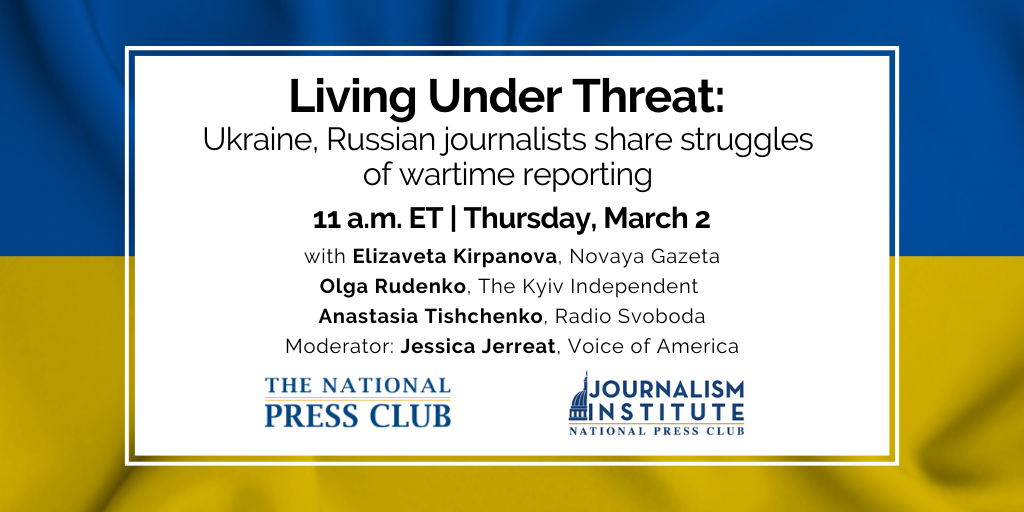
Living Under Threat: Ukraine, Russian journalists share struggles of wartime reporting

One year into Russia’s full-scale war of aggression against Ukraine, journalists in both countries have responded valiantly in insisting on their right to provide independent, accurate, and piercing news coverage that serves the public’s interests. 


As so many of the region’s journalists have pushed themselves to the limit in covering the war and its many ramifications, the physical, mental, and emotional toll is growing. Ukrainian journalists have worked to provide coverage of the war’s ruinous impacts on their communities despite risks to their personal safety, emotional trauma, and uncertain financial prospects. And Russian journalists have made the difficult decision to leave their families, flee Russia, and make a new life abroad rather than submit to the Kremlin’s propaganda machine demands.


On Thursday, March 2, the National Press Club’s Press Freedom Committee and the National Press Club Journalism Institute will host a virtual discussion with Russian and Ukrainian journalists to discuss the ongoing challenges to their work, including: 


  • their daily struggles under fire,
  • threats from the Russian government, and
  • efforts to seek asylum abroad and maintain a journalism practice. 


Registration for the virtual discussion, which will be from 11 a.m. to 12:15 p.m. ET on Zoom, is open. 

Register now

Confirmed speakers include:


Elizaveta Kirpanova, who worked as a special reporter of the Russian independent newspaper “Novaya Gazeta” for the past five years. In her articles, she covered problems in health care, education system, charity, and immigration. The Russian government recently revoked the newspaper’s media license for its position on the war in Ukraine.


Olga Rudenko, the editor in chief of The Kyiv Independent. Prior to 2022, she was the Managing Editor of The Kyiv Post.


Anastasia Tishchenko, a human rights reporter and news presenter with Radio Svoboda, RFE/RL’s Russian Service based in Prague since 2021. She joined RFE/RL in Moscow in 2017 as a reporter covering the deteriorating rights situation in Russia. She also has spent significant time in Ukraine. 


Jessica Jerreat, who leads Voice of America’s award-winning press freedom coverage, will moderate the discussion. With a background in press freedom and international news, Jerreat has worked for organizations including the New York-based Committee to Protect Journalists and The Times of London. She has a master’s degree in War, Media, and Society from the University of Kent at Canterbury, with a focus on propaganda, the press, and conflict.


More panelists to be added.

Resources

This newsletter is written & edited by the National Press Club Journalism Institute staff: Beth Francesco and Holly Butcher Grant. Send us your questions and suggestions for topics to cover.


Get this from a friend? Subscribe, and view the archives.


If you value this newsletter, consider supporting The Latest with a tax-deductible, recurring gift to the Institute: Even $5 a month will help fund the technology and time it takes to provide this important service.  

Facebook  Twitter  Linkedin  Youtube  

The National Press Club Journalism Institute promotes an engaged global citizenry through an independent and free press, and equips journalists with skills and standards to inform the public in ways that inspire a more representative democracy. As the non-profit affiliate of the National Press Club, the Institute powers journalism in the public interest.