Dear Friends,


We're always looking for divergences between what people are thinking and what the market is actually doing. Recently, there has been a plethora of reasons to be bearish or at least cautious in the U.S. stock market, yet we’ve seen a number of new all-time highs, the most recent coming on July 31st. Again, despite some weak sentiment, markets have marched higher. And while we enjoy the gains, we’re always looking ahead.


With school starting back next week here in Greenville County, there is no better reminder that we’re entering a new season of the year. Soon swimsuits will be traded out for vests, beach vacations for football weekends and sometimes, bearish activity in the market takes the place of bullish activity – akin to what we’ve been seeing and participating in for the last several months.


S&P 500 Seasonality


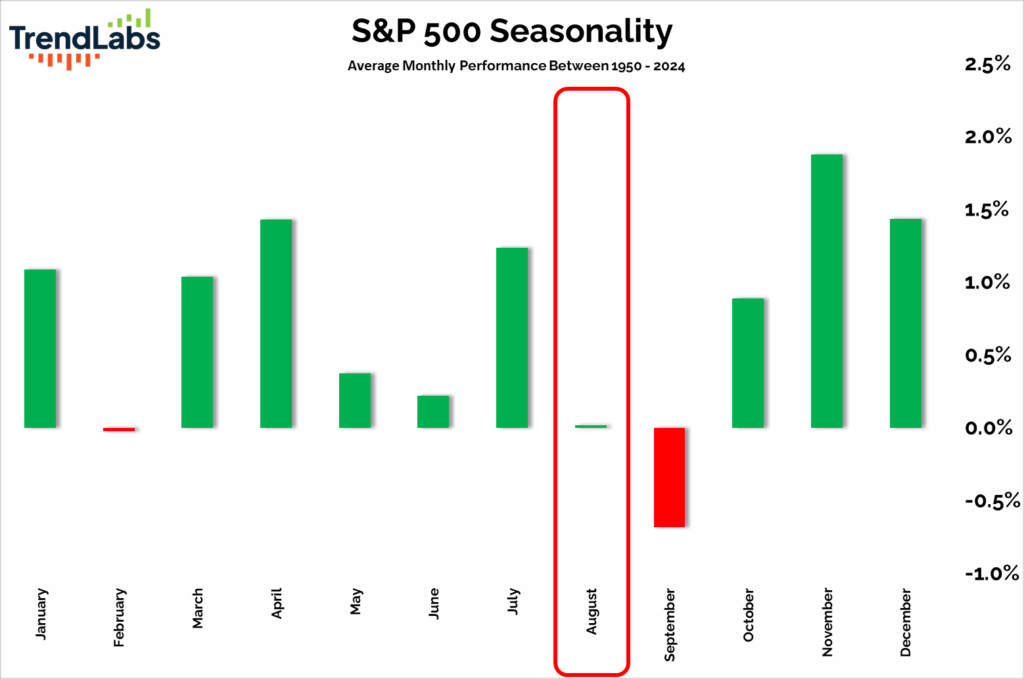
This bar chart shows the annual seasonal pattern for the S&P 500 going back every year since 1950:

Source: TrendLabs

As you can see, the market's seasonally strong period is coming to an end this month and a historically a few weaker months are ahead of us.


Historically, August and September account for the worst two-month period for the stock market throughout the year as it prepares for that historically strong year-end season beginning sometime in October.


We want to make something perfectly clear: Seasonality is not something we generally want to position for ahead of time.


In other words, just because the market is supposed to be strong from a seasonal standpoint doesn't mean we blindly buy stocks. The same is true to the downside. Just because we're entering a seasonally weak period doesn't mean we blindly sell our stocks.


In our experience, the value of seasonality is in looking at the market after the fact and asking, "Did the market ignore these seasonal trends, or did the market acknowledge them and act accordingly?"


When stocks are strong during a seasonally weak period, that's evidence of underlying strength in the market. Conversely, when stocks are weak during a seasonally strong market, that's evidence of underlying structural problems in the market.


Opinions like this are not novel, yet we see most of our peers in this industry investing in asset allocation style models – hoping that things will turn out this time around as they have in the past. History and historical evidence are compelling, but they’re just one arrow in our quiver of portfolio management and daily decision making.


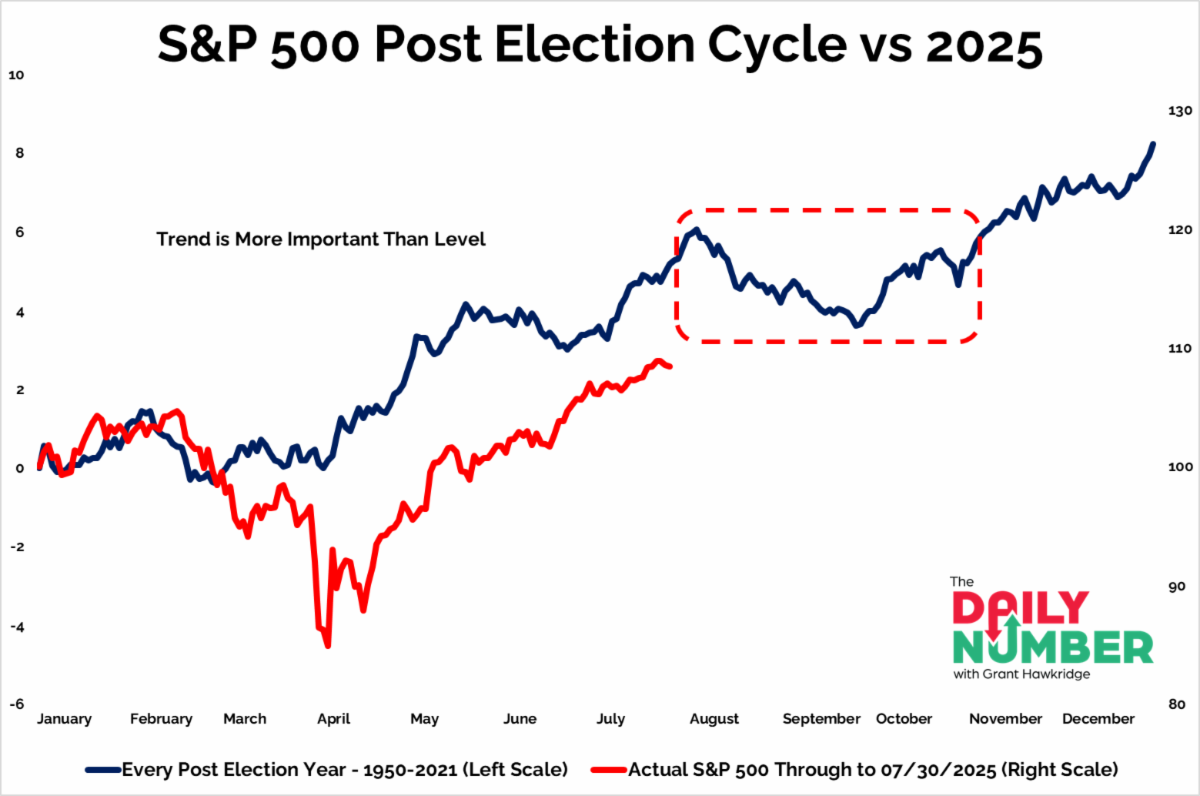
If we couple what we know about seasonality with what we know about a Presidential cycle related to the market, we get further evidence that some turbulence could be on the radar sooner than later.


Historically, during post-presidential election years, the August-to-October period is flat at best, volatile at worst. See the blue line as a historical reference and the red line to this current Presidential cycle.

Source: All Star Charts

There is a possibility that “something will break" in the near future.


  • a reckoning on high to stretch valuations (prices exceed fundamentals)

  • tariffs talks/negotiations unwind or break


  • the Federal Reserve doesn’t follow the data and holds interest rates (despite rising unemployment, rising inflation, a housing dilemma (home buying remains unaffordable for a large population)) - Will the unimpressive Jobs numbers and revisions reported last Friday be enough to support a rate cut? We’d like to think so.


  • a geopolitical or a Black Swan event comes to bear


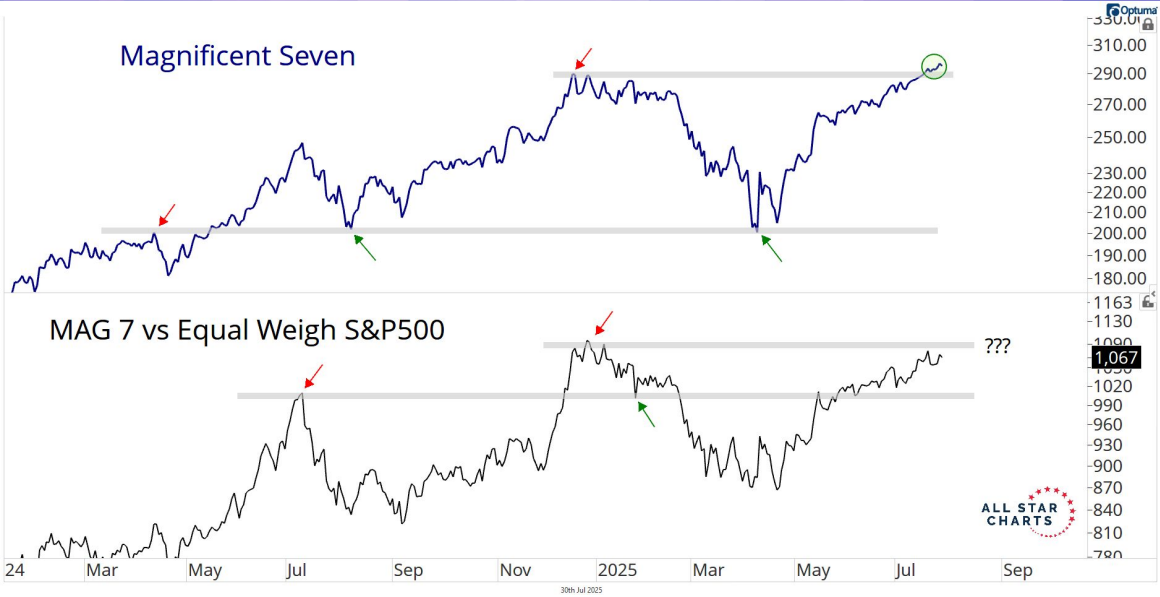
Furthermore, when we look under the hood at some of the largest and most innovative businesses – typically comprised in the “Mag 7” we see said stocks are at a key point of interest. The question is at such a juncture “Can they breakout or will they breakdown?”

Source: All Star Charts

Considering the seasonality, the Presidential cycle, the current environment on tariff negotiations, the Federal Reserve’s resistance to cut rates and the loss of steam in buying strength and price appreciation in some of the Mag 7 stocks, our research suggests that the patient, nimble and cautious investor/portfolio manager can be rewarded in their efforts.


There is not strong enough evidence to suggest a rational exuberance to sell or buy this market currently. We will remain diligent and will act accordingly to any and all material changes in the market for the betterment of your portfolios and overall financial wellbeing.


We look forward to hearing from you. Please respond with any personal thoughts or questions you may have for us.


Emory

Emory G. Hendrix, Jr., AAMS®, CEPA® 

Managing Director / Crescent Wealth Management

A: 124 Verdae Blvd., Ste. 105, Greenville, SC 29607

D: 864.729.4288 O: 864.464.9626   

E: emory@crescentwm.com   W: www.crescentwm.com

Advisory services offered through NewEdge Advisors, LLC, a registered investment adviser. Securities offered through NewEdge Securities, LLC. Member FINRA/SIPC. NewEdge Advisors, LLC and NewEdge Securities, LLC are wholly owned subsidiaries of NewEdge Capital Group, LLC.


NOTICE: This email communication including all attachments transmitted with it may contain confidential information intended solely for the use of the addressee. If the reader or recipient of this communication is not the intended recipient, or you believe that you have received this communication in error, please notify the sender immediately by return email and PROMPTLY delete this email including all attachments without reading them or saving them in any manner. The unauthorized use, dissemination, distribution, or reproduction of this email, including attachments is strictly prohibited and may be unlawful.