How Did H.R. 1319 Pass?
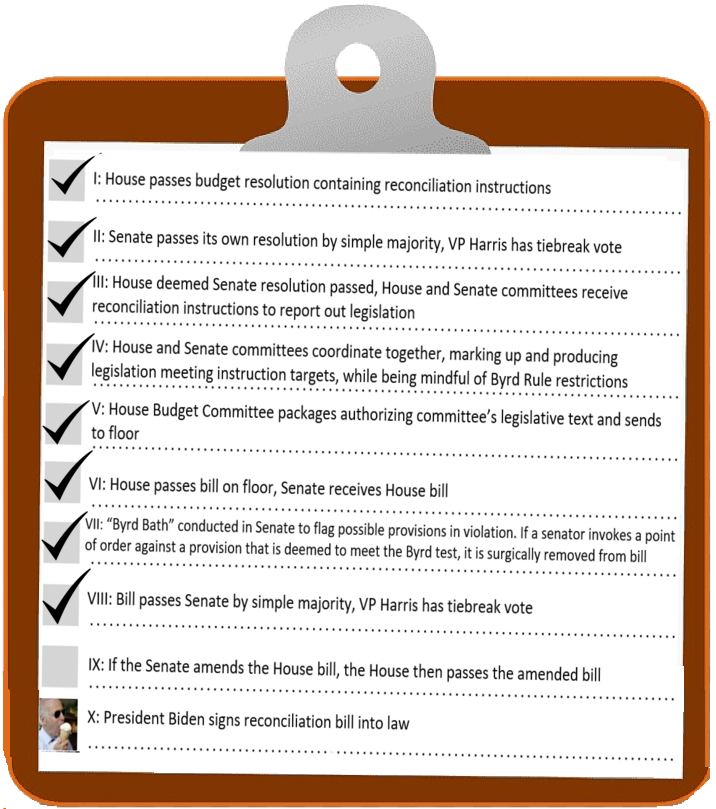
As with most bills passed on a party line vote, there were delays. The bill was initially delayed after the Congressional Budget Office (CBO) “score” of the bill – the nominal, objective cost estimate of how the bill affects the deficit – took longer than expected, meaning Democrats could not vote on a motion to proceed to the consideration of the COVID-19 package until Thursday, March 4. Once the score was ready, Majority Leader Schumer (D-NY) motioned to proceed to consideration of H.R. 1319, then offered a substitute amendment to replace the entirety of the bill with new language carefully negotiated by Senate Democrats. Because Democrats knew the minimum wage provision in the bill was unlikely to survive a point of order, money was freed up to be moved around, which made the score take longer than expected.
To stall, Sen. Ron Johnson (R-WI) objected to a consent request to skip the reading of the full 628-page text of the Senate substitute amendment; this reading is required by Senate rules, but, by tradition, it is normally skipped with unanimous consent. This delayed the vote by another 10 hours as the clerk read each page out loud. (A quick aside, former Rep. Henry Waxman (D-MI) once brought a speed reader to an Energy and Commerce Committee hearing after Republicans threatened to use a similar dilatory tactic.)
Once read, the Senate started three hours of debate on H.R. 1319, equally split by party. Upon the expiration of the three hours, the Senate began voting on amendments without debate, the process known as a Vote-a-Rama, starting around noon on Friday. After hitting a few speedbumps that elongated the process further, the Senate voted to pass the bill just after noon on Saturday morning, over 24 hours after initially starting the Vote-a-Rama.