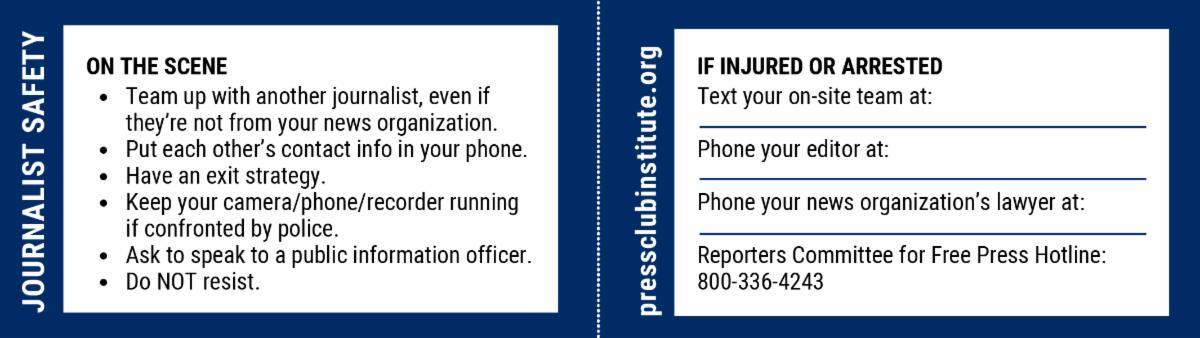
From avoiding loaded language to planning ahead, four journalists offered practical tips for covering Inauguration Day events and beyond during an Institute and Resolve Philly program on Jan. 19.
“Our fight now is to maintain our authority as conveyors of accurate facts,” said Eric Deggans, author of “Race-baiter: How the media wields dangerous words to divide a nation” and TV critic at NPR. “And we have to be very careful about being good stewards of that because, as we’ve seen over the Trump years, it is one of the slender threads that has kept this nation from falling into authoritarianism.”
Joining Deggans to discuss breaking news coverage in the wake of the Capitol insurrection were Danielle K. Kilgo, the John & Elizabeth Bates Cowles Professor of Journalism, Diversity and Equality in the Hubbard School of Journalism and Mass Communication at the University of Minnesota; Michael McCarter, managing editor for standards, ethics & inclusion at USA Today; and Aubrey Nagle, Reframe editor at Resolve Philly. Cassie Haynes, co-executive director of Resolve Philly, moderated the program.
“Planning ahead is key.”
McCarter shared how his newsroom gathered on a Zoom call during the events of Jan. 6: “We were able to have multiple voices weigh in as things unfolded. And we were able to quickly transition.”
Tip: Assemble a team to consult in advance of your coverage that will help provide accurate historical context and correct language.
“Who are we deciding is the expert? What definitions are we using? And who is getting to define those terms before we use them?”
Nagle cautioned against assuming the neutrality of the people in power that journalists are covering, whether it’s an elected official, organization leader or executive.
Tip: Consider the agenda or motives of the person or organization sharing information with you.
“When we make these decisions about language, we have to make sure that we can defend them based on evidence that we can present.”
Deggans reflected on how the Trump administration lied to the media so often that many journalists assumed much of what they heard from officials was untrue. He reiterated the importance of questioning accuracy as the Biden administration takes over.
Tip: Continue to check your assumptions even under a new administration that says it will be friendlier to the press.
“Calling a mob a mob is important. Calling a siege a siege is important.”
Kilgo recommended preparing language in advance and including the dictionary definitions of words within reporting to provide a perceived objective source.
Tip: If your newsroom has a style committee, consult them before you go out in the field. If not, check with your editor or ask the AP Stylebook on Twitter.
“Hammering home context, context, context as things unfold.”
Nagle emphasized that first impressions in headlines will stick with an audience and set the tone for how readers will interact with and share the story.
Tip: Journalists should work in real time to tie live events back to their historical antecedents.