Weekly Digest Number 42 - October 19th, 2021 |
|
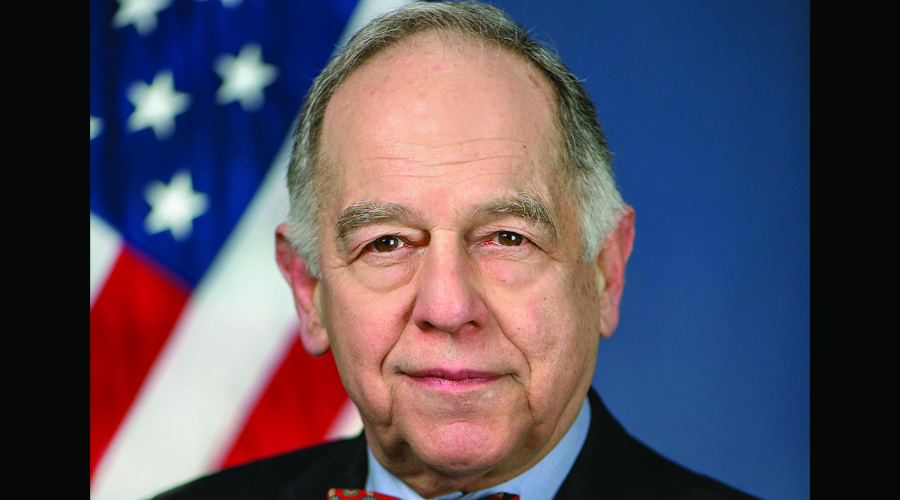
(Editor's Note: In recent weeks we have been reporting on Surface Transportation Board Chair Marty Oberman's remarks criticizing the Class One rail carriers and his suggestions that some form of oversight may be in order. More than 30 organizations - including Railroad Workers United - have signed on to a letter commending the Chair for his bold words, and urging bold action by the STB. |
|
Surge of Public Support for STB Chair Oberman’s Statements on U.S. Railroads |
|
Solutionary Rail (“SR”), a project that advocates for electrification and the expanded use of US railroads and rail corridors for greater public benefit, delivered a letter to the Surface Transportation Board Chair Martin Oberman and other policy makers around the US Capitol on Friday. The letter thanks Chairman Oberman for standing up to the large Class 1 railroads and raising important questions about the adequacy of their stewardship for this critical national infrastructure.
In his speech Oberman criticized the seven major Class 1 railroad corporations for spending only minimally on capital projects, for regular upkeep of the rail infrastructure ($138 billion) but not substantial expansions or improvements to the system. Instead, payouts for stock buybacks and shareholder dividends were far larger, at $191 billion. Oberman asked his audience, “Where would rail customers, rail workers and the public be if a meaningful portion of that $191 billion have been re-invested in expanding service and making service more predictable and reliable?”
SR considers Oberman’s bold public stance a historic opportunity to pivot the U.S. approach to rail infrastructure away from extractive profiteering and toward investing in broad public benefits. The sign on letter was created to demonstrate to Oberman, his regulatory colleagues, and policy makers receiving copies that this approach could generate support that transcends typical issue silos, false dichotomies about jobs or the environment and dangerous rural-urban partisan divides. The 35 national and regional organizations that endorsed the letter and the more than 100 individual leaders who signed on represent a diversity of policy advocates, political approaches and geographic representation that is rarely seen.
Signers onto the letter include labor, environmental, climate, and community based environmental justice organizations, from Railroad Workers United, Warehouse Workers for Justice, United Electrical, Radio & Machine Workers of America (UE) to Sierra Club and EarthJustice, to Harambee House/Citizens for Climate Justice, Indian Land Tenure Foundation, the Rural Coalition, Honor the Earth, People’s Collective for Environmental Justice from California’s Inland Empire, among many others. Add rail specialists, progressive policy, public health, anti-monopoly and renewable energy organizations and more than 100 leaders spanning all the above including world renowned climate activist Bill McKibben and the letter becomes a testimony to how railroads literally and figuratively connect us all.
“We are proud to bring together this unconventional alliance representing a spectrum of geographic, policy and political perspectives,” said Solutionary Rail campaign director Bill Moyer, the co-author of the 2016 book of the same name. “It is essential that rail regulators and policymakers hear from all those impacted by our rail system - not just shippers.”
|
|
(Editor's Note: After months of being told how "essential" we were in the depths of the pandemic, workers from many sectors of the economy have had enough of words ... and the crappy working conditions offered by corporate America. Many are quitting their jobs, others are opting out of the labor market, while other are electing to use their inalienable right to strike!) |
|
Is America Experiencing an Unofficial General Strike? |
|
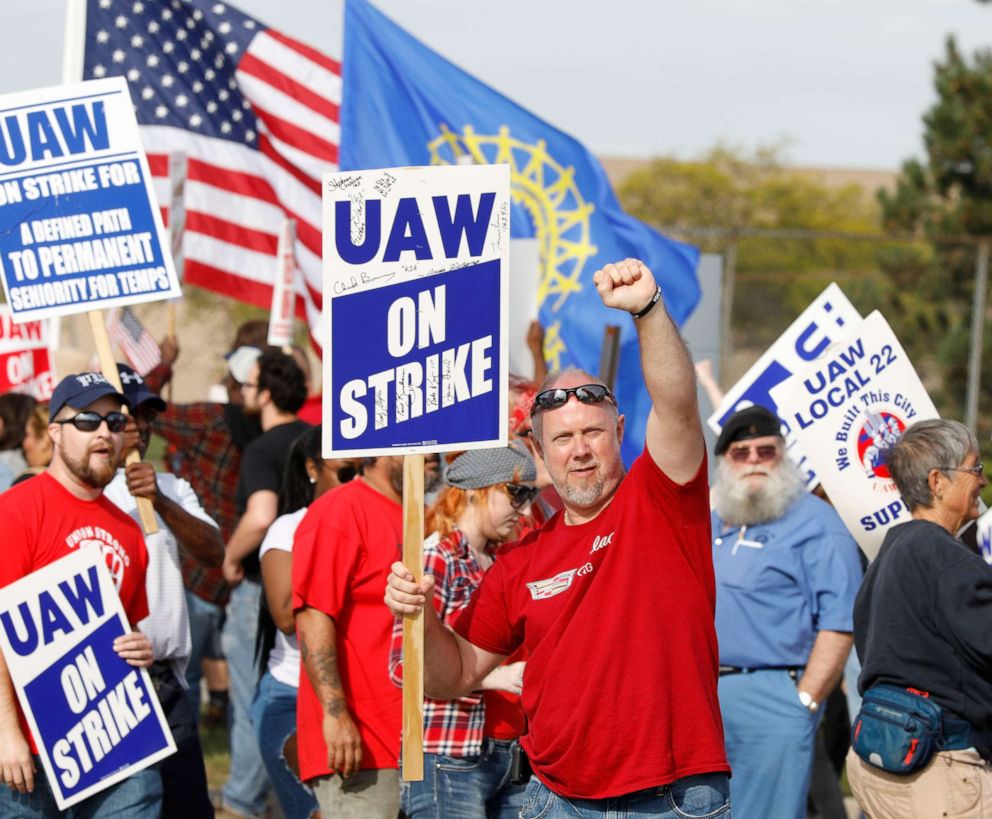
American workers are now flexing their muscles for the first time in decades. You might say workers have declared a national general strike until they get better pay and improved working conditions. |
|
Last Friday’s jobs report from the US Department of Labor elicited a barrage of gloomy headlines. The New York Times emphasized “weak” jobs growth and fretted that “hiring challenges that have bedeviled employers all year won’t be quickly resolved,” and “rising wages could add to concerns about inflation.” For CNN, it was “another disappointment”. For Bloomberg the “September jobs report misses big for a second straight month”.
The media failed to report the big story, which is actually a very good one: American workers are now flexing their muscles for the first time in decades.
You might say workers have declared a national general strike until they get better pay and improved working conditions.
No one calls it a general strike. But in its own disorganized way it’s related to the organized strikes breaking out across the land – Hollywood TV and film crews, John Deere workers, Alabama coal miners, Nabisco workers, Kellogg workers, nurses in California, healthcare workers in Buffalo.
Disorganized or organized, American workers now have bargaining leverage to do better. After a year and a half of the pandemic, consumers have pent-up demand for all sorts of goods and services. But employers are finding it hard to fill positions. Last Friday’s jobs report showed the number of job openings at a record high. The share of people working or actively looking for work (the labor force participation rate) has dropped to 61.6%. Participation for people in their prime working years, defined as 25 to 54 years old, is also down.
Over the past year, job openings have increased 62%. Yet overall hiring has actually declined. What gives? Another clue: Americans are also quitting their jobs at the highest rate on record. The Department of Labor reported on Tuesday that some 4.3 million people quit their jobs in August. That comes to about 2.9% of the workforce – up from the previous record set in April, of about 4 million people quitting. All told, about 4 million American workers have been leaving their jobs every month since the spring.
These numbers have nothing to do with the Republican bogeyman of extra unemployment benefits supposedly discouraging people from working. Reminder: the extra benefits ran out on Labor Day. Renewed fears of the Delta variant of Covid may play some role. But it can’t be the largest factor. With most adults now vaccinated, rates of hospitalizations and deaths are way down. ...
... Corporate America wants to frame this as a “labor shortage.” Wrong. What’s really going on is more accurately described as a living-wage shortage, a hazard pay shortage, a childcare shortage, a paid sick leave shortage, and a healthcare shortage.
Unless these shortages are rectified, many Americans won’t return to work anytime soon. I say it’s about time.
|
|
(Editor's Note: If this type of plan were to come to fruition, it would mean thousands of good paying rail union jobs for Midwest rail workers. Once again, will passenger rail be the future of rail employment in the U.S.?) |
|
FRA's New Midwest Regional Rail Plan |
|
The Federal Railroad Administration’s Midwest Regional Rail Plan, released today, is a milestone achievement that should be celebrated and heeded on three fronts. First, it lays out a compelling vision for a network of high-speed trains that would transform travel across the Midwest. Second, it makes a strong case for fast, frequent trains that are coordinated and well-integrated into a network. While speed gets most of the spotlight when people talk about trains, frequency and coordination are key to leveraging the full power of a rail network. Third, it points out the urgency of regional cooperation and big-picture planning.
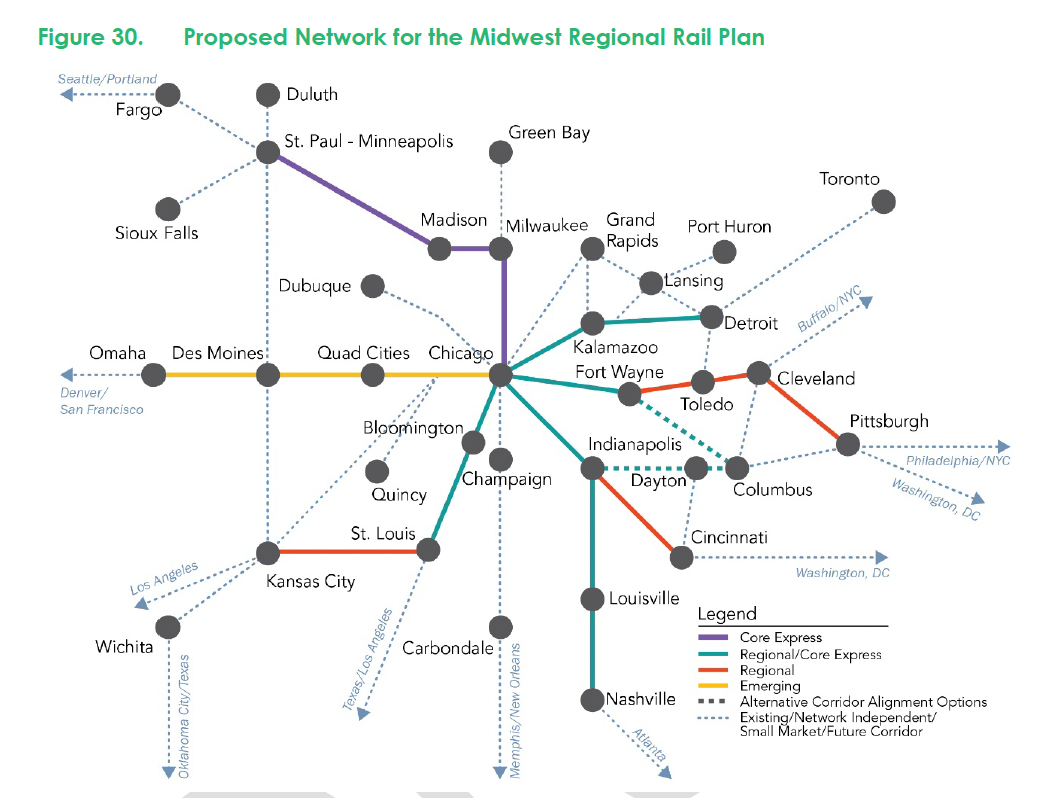
The plan envisions a network that consists of of four “pillar corridors” radiating out from Chicago, with endpoints in Minneapolis-St. Paul, St. Louis, Indianapolis, and Detroit. These corridors are the system’s backbone. Their real power, though, isn’t that they would move people at high speeds from point to point within each corridor. Their power lies in the way they would make connections much faster and easier between hundreds of cities throughout the Midwest.
That’s because the “pillar corridors” would be integrated with transit systems and regional lines that connect mid-sized and major cities—like Indianapolis and Cincinnati, and Kansas City and St. Louis. There would be 24 trains per day on the “pillar” lines and 16 trains per day on the regional lines - a vast increase over current service levels on U.S. passenger trains.
Incorporating these different lines into a single vision and coordinating them - as the Midwest Regional Rail Plan envisions - gives travelers lots of new options.
The report notes, for example, that there are 189 connections between city pairs if the corridors in the plan are considered as standalone entities, independent of the others. But in a network model - i.e., a model in which travelers can transfer easily between two corridors - the city-pair connections increase to nearly 1,100.
|
|
Supply Chains: Broken Beyond Repair? |
|
Supply chains are a critical component of life today. I’d argue this is not a new phenomenon. One great piece of advice my dad gave me (possibly the only one I actually listened to) when planning my career was “People will always need stuff!” He worked in army logistics. He’d seen how important it was to keep the front line supplied with munitions, but also with food, coffee and tobacco!
Are today’s supply chains broken? To answer this question, I’ll point out that supply chain people (those in procurement, operations and logistics including transportation) have been studiously working hard behind the scenes fixing supply chains since long before the modern term was invented (c. 1973 at MSU and other collaborating universities globally).
When all goes well, nobody notices. Yet there’s always been fervent activity to get the right stuff to the right place in the right quantity at the right time and for the right cost. Supply chain people rarely were praised publicly because “It’s their job.”
The same is true for railroads the world over. Passengers don’t complain when the train is on time (except when it is overcrowded, too hot or too cold etc.). Shippers and freight customers likewise, unless their product arrived damaged.
Supply chain management developed scientific methods to remove guesswork and elements of chance from the equation. Just-in-time (JIT) became a common descriptor enabling manufacturing to minimize inventory. Safety stocks were reduced to improve top- and bottom-line financial performance. Quality control was improved by adopting Six Sigma principles. Lean manufacturing enabled efficiency improvements and better asset utilization.
So, what has changed and why? First, the fat has been squeezed out of supply chains. Safety stocks are minimized. JIT evolved to precisely on-time. Early deliveries were as bad as late ones. Second, data enabled a lot more visibility within an operation and then along the supply chain. But visibility has turned out to be not enough. Data for its own sake is worthless. It must be used for management and improvement. Numbers must have meaning. We are now beginning to recognize that there’s a big difference between ‘visibility’ and ‘transparency’.
|
|
(Editor's Note: RWU has vociferously opposed PSR from the beginning. Now in the face of the supply chain meltdown, drastic declines in rail employment, and mass shipper complaints, PSR is coming more and more under scrutiny.) |
|
The Perils of Precision Scheduled Railroading |
|
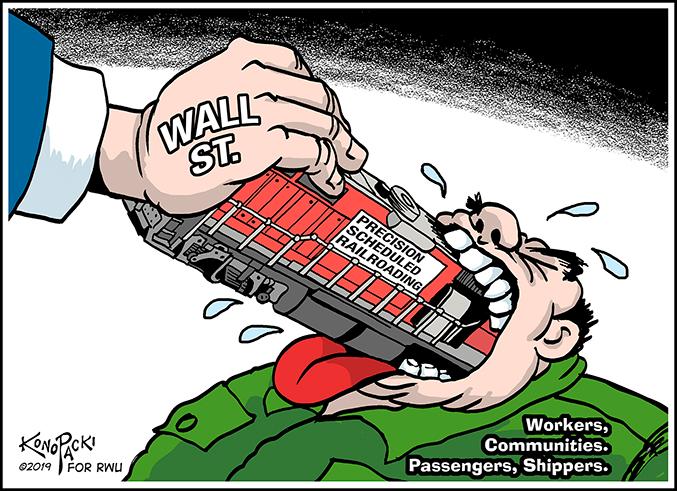
Although almost all of the Class One railroads have been deploying precision scheduled railroading (PSR), an operational model that seeks to streamline operations, for several years already, a number of issues keep the debate over its value alive.
The railroads have argued that PSR provides shippers with consistent and reliable service. Proponents of PSR contend that shippers previously had to wait until a train was long enough in order for them to receive service, making service more erratic. Having that stability helps freight rail become more trucklike, they say. Implementing PSR has also helped the railroads lower their operating ratio, a gauge derived by a formula that helps investors determine the financial health of a company.
But the unions representing craft employees and train and engine crews — the Brotherhood of Locomotive Engineers, SMART-TD, Transportation Trades Department of the AFL-CIO, the Brotherhood of Maintenance of Way Employees, among others — generally have been skeptical of PSR, in large part because the operational model also seeks to cut costs, and one way to cut costs is to reduce employee headcount. Since 2016, the yearly average of those employed by the U.S. operations of the Class I railroads has fallen roughly 25%, according to data submitted to the Surface Transportation Board.
The rail unions argue that PSR’s emphasis on adhering to a strict train schedule jeopardizes the ability of workers such as signal maintainers and carmen from doing a thorough inspection. They also argue that the job cuts have been too deep, resulting in a freight rail industry that doesn’t have enough network capacity for when rail volumes grow or when congestion issues arise in the supply chain.
“They want to run the leanest railroad they could possibly run to produce historic operating revenues to entice investors,” said a freight rail policy expert with one of the unions. But “the railroads are running themselves so lean that they are only capable of the railroad of today. They are not capable of running railroads when there are economic shocks or changes in shipping patterns.”
Union members also believe that rail derailments, such as the September fatal derailment involving an Amtrak train running on track owned by BNSF (NYSE: BRK.B), have increased in recent years.
|
|
(Editor's Note: We have been covering this story closely for a month now. (See lead article, this issue). The rail industry and its mouthpieces have been largely silent. Here is their first official rebuttal. Notice how the AAR's front man Jeffries sidesteps the issues that Oberman has raised, and sticks closely to the official script the Class One rail carriers have so carefully crafted.) |
|
AAR Challenges Points Made in STB Chairman’s Speech to Shippers |
|
WASHINGTON – Association of American Railroads CEO Ian Jefferies has taken issue with many of the points Surface Transportation Board Chairman Martin J. Oberman raised his speech to a shipper conference last month.
Oberman told the North American Rail Shippers that the railroad industry’s drive for ever-increasing profits resulted in a loss of market share to trucks over the past 15 years and is restraining growth today [see “Top regulator urges railroads to focus on growth,” Trains News Wire, Sept. 9, 2021]. The STB chief said Wall Street’s influence has put shareholder interests above those of other key railroad stakeholders, including customers, employees, and the public. And he was critical of railroad stock buyback programs and dividends that have put more money in shareholders’ pockets than into maintaining and expanding the rail network.
But Jefferies says AAR data shows that rail ton-miles were up 9% from 2006 to 2019 when coal is excluded from the tally. “Making up for the loss of coal volume will take time, but to imply that railroads have not worked to grow volumes, especially in the face of steep coal declines, is simply not the case,” he wrote.
|
|
(Editor's Note: Rather than simply "blame the worker" when catastrophes ensue, the workplace needs to be designed to lessen or remove the prospects of "operator error." The author makes the point well in regards to the track worker protection system known as "Train Approach Warning.") |
|
Progress Requires Assessing and Reducing Vulnerabilities |
|
I’ve received some comments, what is called “feedback” these days, on my most recent post regarding NTSB’s report on a fatal incident on Amtrak’s Northeast Corridor. Some of the commentators agree with my assessment of TAW (Train Approach Warning) as an inadequate form of roadway worker protection, for which I am grateful. Some disagree with me, for which comments I’m equally grateful because at least people are reading and thinking about this. Disagreement is the source of progress, and by that measure I am one of the most progressive souls ever. Just ask anyone on any railroad I ever worked for.
I know I’m getting older and older and older, with less and less and less practical impact on any one railroad’s train operations. The truth, however, is that the same compulsions that motivated me then when I was younger (and better looking) still wind my clock—like 1) a sense of urgency, as in “we absolutely positively have to take care of this right now,” and 2) a bit of the excessive self-confidence, as in “we absolutely can do this better than we are doing it now.”
Those twins, the Gemini of my railroad career, compel me to take up TAW once again. If you read the NTSB report of the Amtrak fatality, you will come across this: In the NTSB’s investigation of a June 10, 2017, accident in Queens Village, New York, in which the foreman of a work crew for the Long Island Rail Road was killed when he stepped into the path of an oncoming train, the NTSB found that “TAW regulations do not ensure protection for roadway workers to inspect and work on tracks where trains are allowed to continue to operate (NTSB 2020).” As a result of the Queens Village accident investigation, on May 14, 2020, the NTSB issued Safety Recommendation R-20-6 to the FRA: Define when the risks associated with using TAW are unacceptable and revise Title 49 Code of Federal Regulations 214.329 to prohibit the use of TAW when the defined risks are unacceptable. (R-20-6)
This recommendation applies to all uses of TAW in all territories and is on the NTSB’s 2021-2022 Most Wanted List of Transportation Safety Improvements in the issue area “Improve Rail Worker Safety.”
On April 21, 2021, the FRA replied that it disagreed with R-20-6. The FRA stated that the findings from the Queens Village accident, which were the basis for this recommendation, were faulty. The FRA said that roadway workers involved in the Queens Village accident did not comply with basic requirements of FRA regulations governing TAW because they failed to occupy or even discuss a predetermined place of safety from oncoming trains. Therefore, the FRA stated that it believed that these failures were the cause of the accident, not the decision to use TAW.
Got that?
|
|
(Editor's Note: While RWU has not taken a formal stance on Covid 19 vaccinations, as an organization of rank & file rail workers that organizes and fights around worker health and safety issues, we urge all rails to mask up, follow CDC guidelines, and get vaccinated. This is a union issue, this is a solidarity issue. You are your brothers' keeper. We must take care of each other. That said, no employer - UP or otherwise - has the unilateral right to implement changes in work rules and conditions of employment without bargaining them with the union. Period!) |
|
Unions Join to Fight Union Pacific on COVID Orders |
|
The Transportation Division of the International Association of Sheet Metal, Air, Rail, and Transportation Workers (SMART-TD) and the Brotherhood of Locomotive Engineers and Trainmen (BLET) are jointly taking on Union Pacific Railroad (UP) over a series of unilateral and unlawful actions taken by the carrier recently.
SMART-TD President Jeremy Ferguson and BLET National President Dennis Pierce issued the following joint statement regarding their action:
“Over the past two weeks, the Union Pacific Railroad seems to have forgotten that it is not Walmart. The railroad has unilaterally changed pay provisions for vaccinated employees who experience a breakthrough COVID infection due to workplace exposure. It has ordered all UP employees to report that they are fully vaccinated by December 8th, or risk being medically disqualified from work. And, instead of negotiating with us as the law requires, the Carrier is directly dealing with its employees by offering a ‘financial incentive’ for compliance with its unilateral mandate.
“We generally support our members getting the vaccine. However, we have several objections to UP’s unilateral implementation of their policies mandating them and illegally dealing directly with its represented employees. The members of our Unions — including members who already are vaccinated — are irate over UP’s outrageous conduct.
“We have been in contract negotiations with UP since November of 2019, and federal law absolutely bars railroads from changing rates of pay, rules and working conditions while negotiations are ongoing. Not only is UP in violation of the law, it has explicitly spurned our demands that these matters be bargained. We have filed suit today in the United States District Court for Northern District of Illinois, Eastern Division, in an effort to stop UP’s lawlessness in its tracks.”
|
|
U.S. Rail Traffic Dips Again in Week 40 |
|
U.S. railroads logged 506,642 carloads and intermodal units for the week ending Oct. 9, a 2.6% decrease compared with the same week last year, according to Association of American Railroads (AAR) data.
Total carloads for the week were 239,821 units, up 4%, while intermodal volume was 266,821 containers and trailers, down 7.8%. Six of the 10 carload commodity groups that AAR tracks weekly posted an increase. They included coal, up 5,736 carloads to 67,680; metallic ores and metals, up 4,896 carloads to 22,369; and nonmetallic minerals, up 2,606 carloads to 33,087.
Commodity groups that posted decreases included grain, down 3,483 carloads to 24,037; motor vehicles and parts, down 3,047 carloads to 13,058; and petroleum and petroleum products, down 837 carloads to 9,395.
|
|
(Editor's Note: The RMT union has selected their strike action to coincide with the big international conference known as COP26 in order to have a greater effect and to draw international attention to their cause. On this side of the Atlantic, would now likewise possibly be good timing for strike action of North American freight rail workers, with the supply chain in tatters?) |
|
Scottish Rail Workers Step Up Fight for Pay Justice |
|
The Rail, Marine & Transport Union (RMT) said that Scotrail members are continuing their fight for pay justice and equality today after announcing strike action throughout COP26 this week in a parallel fight that involves all Scotrail and Caledonian Sleeper grades.
General Secretary Mick Lynch said
"Our members are standing firm across Scotland again in this on-going fight for workplace justice. It comes at the end of a week when our members voted by a massive majority to strike throughout COP26 right across Scotland in a company-wide battle for fair pay. Our Caledonian Sleeper staff will also be taking action alongside their Scotrail colleagues over the crucial pay issue.
"It's about time those calling the shots in Scotland took responsibility for Britain’s longest running industrial disputes which are over the basic issue of pay equality and justice on Scotrail and the sleeper services.
"With the prospect of a total rail shutdown during COP26 looming large it's time to settle the pay disputes which shame Scotland."
|
|
WEBINAR: The Future of Commuter Rail in the Capital Region |
|
VHSR Town Hall #4: Crossing the Potomac: The future of Commuter Rail in the Capital Region featuring Rich Dalton, Virginia Railway Express; Joe McAndrew, Greater Washington Partnership; and Jay Corbalis, JBG Smith.
Oct 26, 2021 01:00 PM Eastern Time
|
|
(Editor's Note: Rail workers throughout history have been at the forefront of the labor movement, and have fought bravely against fascism and tyranny. Here is a recent example. Makes you proud to be a railroad worker!) |
|
The Train Driver Who Died Defying Myanmar’s Dictators |
|
Text in Arial Narrow, 16 pt in boldWin Ko Oo gave up his career—and lost his life—because he couldn’t bear to see his country fall under military rule again
On an August morning at a wet market in Mandalay’s industrial suburbs, a 50-year-old man was selling noodles and cheerfully greeting fellow vendors and customers alike.
Win Ko Oo was well-known for his friendliness. But not everyone who had grown familiar with his smiling face knew that he had once had a very different life. When the year began, Win Ko Oo was a train driver with 25 years’ experience. But then the army seized power, and everything changed. As someone who had lived through the aftermath of a similar coup in 1988, he knew he had to resist the return of military rule.
A month after Myanmar’s elected civilian government was overthrown, Win Ko Oo made up his mind to join the Civil Disobedience Movement (CDM) that was sweeping the country. “I hesitated at first because I had to think about my family. We had nowhere else to go. But in the end, my hatred for the regime outweighed my concerns about the hardships we would have to face, so I quit,” he told Myanmar Now that August morning.
Mandalay’s railway workers were among the first to join the movement in large numbers. In the department that Win Ko Oo belonged to, 285 of 319 staff members walked off the job in an effort to deny the regime control over state mechanisms.
This resulted in hundreds of railway employees and their families being forced to leave the housing compound where most of the striking workers lived.
|
|
|
|
|
|
|