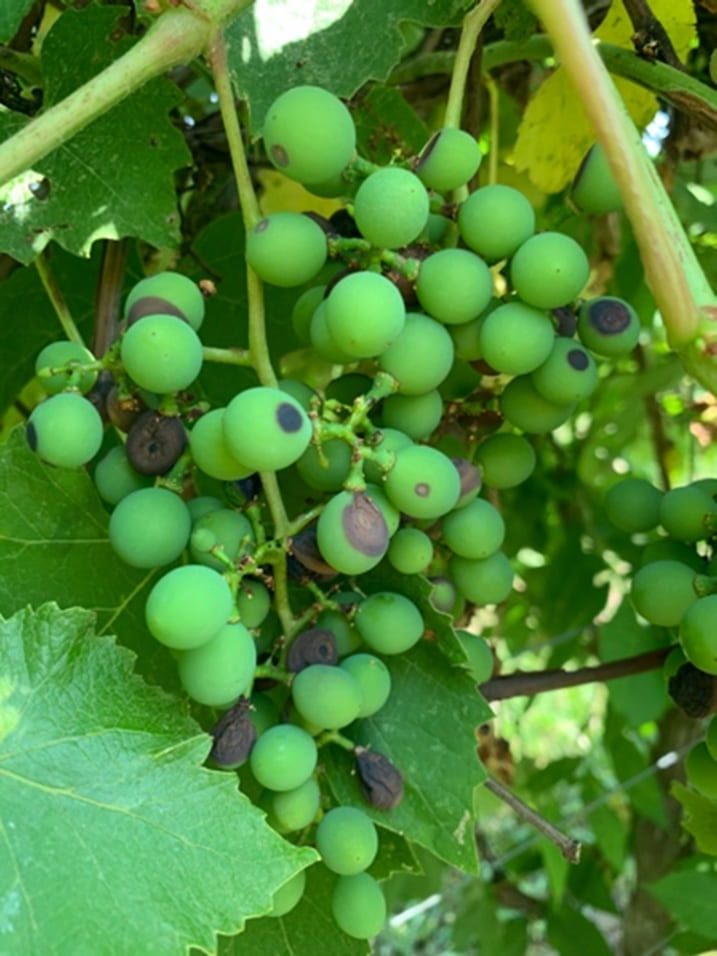
Black rot on a Niagara cluster* |
|
Earlier this month, I attended the retirement seminar for the legendary Dr. Andy Walker, Professor Emeritus in the Viticulture and Enology Department at UC Davis. Although technically known as an accomplished grape and rootstock breeder, hearing his former students speak about him made me think that perhaps those nematode-resistant rootstocks and Pierce’s disease-resistant grape varieties he developed, not to mention the phylloxera research he did, are really only part of his legacy. Maybe not even the most meaningful part. |
|
Every one of Andy’s former students who were asked to speak at the event said yes (though family illness prevented a few from attending). And to a person, every one of them seemed absolutely lit up, not only about their time in the Walker Lab, but about the work they do today.
Having started my career in Corporate America, I can say from experience that it’s really rare to love what you do for a living. For most people, the best part of the workday is NOT working. A typical refrain goes something like:
When is it lunchtime?
When is it 5 o’clock?
When is it Friday?
When’s the next holiday?
When’s my vacation?
When can I retire?
Very seldom is it, when can I go to work? But Andy seemed to have instilled in a generation of grape scientists (80 students!) a true passion for the work—even for those whose original path pointed in other directions.
When I was considering transitioning from my high-tech job to the wine industry (and ultimately to the position I have today), my mom begged me not to. I had a great salary, benefits and retirement, and was advancing up the corporate ladder. But as I told her then, I don’t believe it’s naïve to think that what sustains you financially can’t also be fulfilling. I wanted a job that I wasn’t just good at, but something I love, work that matters. And that’s what I saw in Andy’s former students a few weeks ago.
That seed of purpose and contentment is as real and as valuable as any rootstock or scion. And Andy Walker gave it generously to the young people who were lucky enough to have had him as a mentor. Each has gone on to serve in a research, extension and/or outreach role that’s important to our industry, each in a unique way.
To Andy and countless other professors and role models who have helped to focus bright minds on advancing the grape and wine industry, we are in your debt. In a few days, we’ll be closing the application period for the new NGRA Fellowship (see info below). Maybe with that award to one aspiring grape scientist, we can begin to pay your gift forward.
|
|
|
|
|
*ABOUT THE PHOTO:
This gross photo is one of many images of diseased grapes and vines in the second-annual Grape Disease Control Guide from the Cornell Grape Pathology program. See story below. Photo credit: Katie Gold, Cornell University
|
|
Final Days to Apply for the NGRA Fellowship |
|
Are you or someone you know a promising grape scientist? Apply for our new NGRA Fellowship! Designed to further the work of an aspiring Ph.D. student in grape-related science supporting the NGRA research priorities, the NGRA Fellowship is a competitive award of $30,000 per year for three years, conferred on one doctoral student in 2022. In addition to the monetary contribution for student tuition and/or fees, the award includes mentorship, field tours and networking with our Board of Directors throughout the three-year term. It is our hope that, by providing support in the early stages of a promising grape scientist’s career, we’ll spark a relationship that will last a lifetime. Applications are due June 3, 2022.
|
|
NVEELC 2022 Is Nearly Sold Out |
|
The next National Viticulture and Enology Extension Leadership Conference (NVEELC) is scheduled for August 14-17, 2022, in California's San Joaquin Valley—the largest, most diverse viticulture production area in the U.S. Organized and hosted by UC Cooperative Extension with support from NGRA and sponsored by the California Table Grape Commission, E. & J. Gallo Winery and Sun-Maid Growers of California, NVEELC 2022 offers an extraordinary opportunity to tour raisin, table grape and wine vineyards, and postharvest and production facilities—including Gallo’s Livingston Winery—at the start of harvest. Join with other extension and outreach specialists for professional development, best-practice sharing, research and regional reports, collaboration and dialogue on the unique challenges in V&E extension in America. See the complete three-day agenda and get your ticket. Act fast—the event is already 75% sold out!
|
|
NSF Ends the National Robotics Initiative |
|
This month, the National Science Foundation (NSF) announced that it will sunset the National Robotics Initiative, which has invested more than $250 million in 300-plus pioneering robotics research projects over its 12-year lifetime. NSF remains committed to supporting and growing a thriving robotics research community, transitioning the focus area to the new Foundational Research in Robotics (FRR) program, which will be jointly managed by the Directorates for Engineering and Computer and Information Science and Engineering. The goal of the FRR program is to provide a single home for foundational research in robotics across NSF. The NSF Robotics team of program directors will hold a webinar on June 2, 2022, about the sunset of the National Robotics Initiative and current funding opportunities with the FRR. |
|
Dr. Wendy Powers, formerly A ssociate Vice President for the University of California division of Agriculture and Natural Resources, has been named Dean of Washington State University’s College of Agricultural, Human and Natural Resource Sciences (CAHNRS). WSU Provost and Executive Vice President Elizabeth Chilton made the announcement on April 25, 2022, following a national search. Wendy will begin her role on August 15, 2022, succeeding Richard André-Denis Wright, Dean from 2018 to 2021, and Richard Koenig, Interim Dean since 2021. |
|
ASEV Honors Excellence in Research & Extension |
|
The American Society for Enology and Viticulture (ASEV) has named the recipients of its top annual honors, both of whom will present at the 73rd ASEV National Conference, June 19-22, 2022, in San Diego, CA:
- Cornell AgriTech Senior Extension Associate Chris Gerling will receive the 2022 ASEV Extension Distinction Award, bestowed on a current extension educator. Chris works with New York’s craft beverage industry to create educational programs that support the growth and improved quality of premium wines, ciders and distilled spirits. He organizes and conducts workshops and seminars that focus on production and analytical techniques for farm-based beverages. He also manages both the Vinification & Brewing Technology Laboratory and the Cornell Craft Beverage Analysis Laboratory. His conference presentation, “Of Course There’s Jalapeño in It: Enology Extension in the Craft Beverage Era,” takes place on June 21.
- The Society’s highest honor, the ASEV Merit Award, will go to renowned Cornell University grape pathologist Dr. Wayne Wilcox. Wayne dedicated his nearly 35-year career to researching and understanding the factors of fruit diseases and finding ways to manage them, retiring in 2018 after leading Cornell University’s Grape Pathology program since 1994. He also authored or co-authored more than 100 research publications in refereed journals and was senior editor of the 2nd Edition of the Compendium of Grapevine Diseases, Pests, and Disorders (2015), for which he authored or co-authored nine individual segments. Wayne will give his award presentation, “Molds, Mildews, and Rots: Bread and Butter to a Grape Pathologist” on June 22.
|
|
Justin Scheiner Recognized for Superior Service |
|
Dr. Justin Scheiner, Viticulture Specialist - Department of Horticultural Sciences, was one of 25 individuals honored this year by the Texas A&M AgriLife Extension Service with its Superior Service Award. As the agency’s highest award, it recognizes personnel who provide outstanding performance in education or other services to the organization and Texas residents. Justin was honored in the category, Extension Specialist or Program Director – Early Career for his “outstanding program in support of the Texas wine and grape industry.” The awards announcement notes that “his efforts have led to impressive gains in knowledge, changes in participant behavior and economic benefit. (Justin’s) expertise in curriculum development is unmatched.” |
|
UC Davis Names New Grape Breeder |
|
The UC Davis Department of Viticulture and Enology has named Dr. Luis Diaz-Garcia as an Assistant Professor of Viticulture. Starting July 1, 2022, he will lead the department's grape breeding program, succeeding Emeritus Professor and grape and rootstock breeder Dr. Andy Walker who retired in 2021 after more than 30 years. Luis comes to UC Davis from the National Institute for Forestry, Agriculture and Livestock Research (INIFAP), a government institution for ag research in Mexico, at its Aguascalientes Experimental Station. His research there has focused on the genetics and breeding of guava. Read more about his background and the three areas in grape breeding he hopes to impact at UC Davis.
|
|
Washington Wine Commits Nearly $1M to Research |
|
The Washington State Wine Commission Board of Directors this month approved 24 research projects totaling $994,184 for the upcoming fiscal year (July 2022-June 2023). Themes of the funded research include sustainability, including tools that wine grape growers can use in the newly launched Sustainable WA certification program; innovative techniques to control pests and diseases, such as biocontrols, mating disruption and UV light; long-term vineyard soil health; smoke exposure and more. View the list of all the 2022-23 Washington research projects.
|
|
New NY Grape Disease Control Guide Is Out |
|
Cornell Grape Pathologist Dr. Katie Gold last month released the second-annual Grape Disease Control Guide. It provides news and updates to fungicides labeled in New York since 2021, (re)introduces the major grapevine diseases in New York and relevant recent research findings, discusses cultural practices that can reduce disease inoculum in vineyards, and outlines the basics of a strong management program at different growth stages. Katie says that all sections of the guide have been updated since its last publication in Spring 2021, but these sections have the most new content: fungicide news, downy mildew, powdery mildew and sour rot. Even if you’re not growing grapes in New York, you’re likely to learn something new here. |
|
NYWGF Seeks a Sustainability Program Manager |
|
The New York Wine and Grape Foundation seeks a Sustainability Program Manager. The person in this exciting position will work closely with the Executive Director and the Director of Programs and Marketing to coordinate sustainability education, manage the grower certification process and advisory committee schedule, and partner with external experts to regularly update the program’s certification standards. Read the full job description and apply by June 15, 2022.
|
|
SO MANY VARIETIES, SO LITTLE DATA |
|
In 2020, the NGRA Extension and Outreach Research Theme Committee was sharing ideas about potential projects that could be useful to the grape and wine industry. As part of the brainstorming and prioritization process that all four of our Research Theme Committees undertake every two years or so, the goal was to identify at least one impactful project, then see if a scientist doing relevant work might be willing to lead it and to pursue grant funding to get it off the ground.
What could be good, the group agreed, would be to create a national online database of grape varieties, informed by the field trials many extension agents do for their regions. Knowing that Viticulture Extension Specialists Drs. Matt Fidelibus and Glenn McGourty of University of California Cooperative Extension had led a trial of 60 lesser-known winegrape varieties in their regions (the central San Joaquin Valley, and Lake and Mendocino Counties, respectively), they were invited to co-lead development of a pilot of the project. They agreed, as they, too, had dreamed of making trial data accessible to growers. And thanks to funding from the American Vineyard Foundation starting in 2021, the first phase of the database, called “Grape Varieties in the USA,” is now online at grapevarieties.info.
As Matt explains, grapevine variety selection is becoming increasingly complex, considering potential marketability, yield, quality, environmental adaptability, ripening time, pest and disease resistance, and other traits. Importation and grape breeding programs have increased the diversity of grape varieties available to American growers, but reliable descriptive information, and quality and agronomic data may be limited or spread among many websites. The aim of this website is to compile science-based information, as well as high-quality photos and descriptions on wine, table, juice and raisin grape varieties and provide search tools to help growers find varieties that meet their needs.
“People are considering varieties they have never grown before, but there’s not a central storehouse in the U.S. for people to find the info that they need—data that’s been vetted by researchers,” he says. “There’s a lot of info on the web, but not a lot of data, and not scientific.”
For example, the first 60 varieties featured are hot-climate varieties from other parts of the world that Matt and his colleagues had trialed to determine their suitability for growing in California. Some are ancient selections; some are newer from variety programs. “These varieties have different traits, and by searching through the site, users can get some idea whether they will meet their needs or not,” he says. But that’s just the start. The plan is to create a comprehensive guide to all grape varieties available.
With time, it’s hoped, it will grow to include not only all of the varieties Matt and Glenn have trialed for California growers, but others from all across the country—whether as direct entries or links to other regional resources, like Oklahoma State University’s new Grape Library of Viticulture Extension (a.k.a. Grape LOVE) and Penn State’s Cultivars in the Commonwealth app.
Matt welcomes all growers and others in the industry to visit the site and provide feedback. And he’d love more entries, links and “data—data is the main thing,” he says.
|
|
Funding Opportunities
Sharpen your pencils! These research funding programs have upcoming deadlines.
|
|
Through this new program, USDA will finance partnerships to support the production and marketing of climate-smart commodities via a set of pilot projects lasting one to five years. The second funding pool is for proposals ranging from $250,000 to $4,999,999, limited to particularly innovative pilot projects that place an emphasis on enrollment of small and/or underserved producers, and/or monitoring, reporting and verification activities developed at minority-serving institutions. Deadline is June 10, 2022. (The first funding pool closed earlier this month.)
The EGP serves to increase access to shared-use special purpose equipment/instruments for fundamental and applied research for use in the food and agricultural sciences programs at institutions of higher education, including State Cooperative Extension Systems. It seeks to strengthen the quality and expand the scope of fundamental and applied research at eligible institutions by providing them with opportunities to acquire one major piece of equipment/instruments that support their research, training and extension goals and may be too costly and/or not appropriate for support through other NIFA grant programs. Deadline is June 15, 2022.
CPS are engineered systems that are built from and depend upon the seamless integration of computation and physical components. New, smart CPS drive innovation and competition in a range of application domains including agriculture. The National Science Foundation’s CPS program aims to develop the core research needed to engineer these complex CPS, including in the areas of control, data analytics, and machine learning including real-time learning for control, autonomy, design, Internet of Things (IoT), mixed initiatives including human-in- or human-on-the-loop, networking, privacy, real-time systems, safety, security and verification. Deadlines for CPS funding are as soon as June 15, 2022, depending on the scope of the proposal.
The Agriculture and Food Research Initiative Education and Workforce Development program focuses on developing the next generation of research, education and extension professionals in the food and agricultural sciences. In 2022, NIFA requests applications in these six funding areas:
- Professional development opportunities for K-14 educational professionals
- Non-formal education that cultivates food and agricultural interest in youth
- Workforce training at community, junior and technical colleges
- Training of undergraduate students in research and extension
- Fellowships for predoctoral candidates and postdoctoral scholars
- Special workforce development topics
Deadlines are June 30 through October 27, depending on the funding area.
The Foundational and Applied Science Program of USDA-NIFA's Agriculture and Food Research Initiative supports fundamental and applied research in six priority areas: plant health and production, and plant products; animal health and production, and animal products; food safety, nutrition and health; bioenergy, natural resources and environment; agriculture systems and technology; and agriculture economics and rural communities. Deadlines run through November 17, 2022, depending on the program area.
|
|
May 24, 2022 │ Good Fruit Grower
NGRA Board Chair Russ Smithyman and Cornell Lake Erie Research & Extension Laboratory Director Terry Bates provided expert commentary on the biggest challenges and opportunities facing New York (and, really, all) viticulturists at the BEV NY conference last March. Their top five? Climate change, invasive pests and diseases, labor shortages and shifting consumer tastes.
May 20, 2022 │ Cornell Chronicle
What are biopesticides, how do they work and how WELL do they work? Cornell’s Katie Gold explains their modes of action and shares years of data showing that, in moderate pressure years, many biopesticides can provide protection comparable to conventional products. Plus, when used in rotation with conventional products, they can help relieve use pressure and cost of conventional pesticides, and reduce the emergence of fungicide resistance.
May 20, 2022 │ Modern Farmer
Scientists at the University of Florida grew Arabidopsis plants in soil collected from the moon, called regolith. The seedlings struggled in the nutrient-poor lunar soil, but successfully grew to just before flowering. The groundbreaking research is part of NASA’s Apollo Next Generation Sample Analysis Program, which not only explores the development of food sources for future astronauts but may also help to “unlock agricultural innovations that could help us understand how plants might overcome stressful conditions in food-scarce areas here on Earth.”
May 20, 2022 │ Napa County News
On May 12, an adult Western Grapeleaf Skeletonizer was discovered in an insect trap in Napa County’s Pope Valley. County Ag Commissioner Tracy Cleveland is asking growers to watch for all larval stages of this injurious moth, which can completely defoliate grapevines. Her office is deploying 25 additional traps within a mile radius of the Pope Valley find.
May 19, 2022 │ Modern Farmer
Some regions of the Midwest and West have had dozens of consecutive days with winds topping 50 or 60 miles per hour, making working outside “utterly miserable.” Reports Modern Farmer: “The relentless stream of air is sapping precious moisture from the already dry soil, blowing off highly nutritious topsoil,” spurring wildfires and, “like something out of a science fiction novel, the wind also created static electricity that essentially electrocuted some plants,” according to one farmer.
May 17, 2022 │ Cornell Chronicle
There’s still no cure for leafroll disease, but Cornell AgriTech researchers have found that, rather than roguing just the infected vine, removing the two vines on either side of it can reduce disease incidence. The new technique, called spatial roguing, creates a moat-like space and eliminates mealybugs’ means of transporting the leafroll virus.
May 17, 2022 │ bioRxiv
In a long-term study, researchers found that rootstocks act consistently over decades to modulate growth and other grapevine scion traits, including stomatal and hydraulic conductance, photosynthetic assimilation, the ratio of yield to vegetative growth and more. In addition, in some similar ways, rootstocks act like climate to modulate the width of growth rings, which can be used to monitor genetic and environmental effects in woody perennials.
May 12, 2022 │ The New York Times
The 25-acre organic demonstration vineyard at Paicines Ranch was specifically intended to build soil health and combat climate change with a permanent cover of native perennial grasses and other plants, and a flock of sheep year-round, even during the growing season (not just during dormancy). In this regenerative agriculture experiment, what they’re finding is, irrigation is down and fruit quality is up.
May 11, 2022 │ UMN Extension Fruit and Vegetable News
It is well known that grapes containing excess potassium can cause problems for winemaking, especially for red wines. But do you know why…and what you can do about it in the vineyard? University of Minnesota Extension Educator Annie Clodd explains.
May 11, 2022 │ Wine Business Monthly
When freezes hit vineyards in late fall and winter, growers can estimate bud death and the dieback of fruiting canes by evaluating cross-sections of buds and canes three to five days after the event, when vines are dormant. But it takes a full growing cycle to understand the long-term impacts on vine viability. Late spring freeze events impact yields during the current growing season and effects can carry over to the next, but are usually recoverable within two growing seasons. Viticulturist Fritz Westover gives strategies to cope with both.
May 11, 2022 │ Good Fruit Grower
Washington grape growers are noticing that mechanized pruning every year can lead to overcrowded cordons, requiring periodic hand pruning to reset the spurs “so we’re not building a bird’s nest,” said Joe Cotta, manager of Ste. Michelle Wine Estates’ Cold Creek Vineyards. To him, a three-year rotation seems best: two years of mechanical pruning then one year of hand pruning. The math will likely vary for others, he said.
May 9, 2022 │ Winemag.co.za
Whether you’re a winemaker or just love wine, this entertaining article gives a glimpse into the R&D at Corticeira Amorim to prevent TCA, the “volatile compound born of the unholy trinity of plant phenols (wood), chlorine and fungi (whose) residence of choice is cork bark’s accommodating, flexible cells.”
May 6, 2022 │ Popular Science
Did you know that (at the time of this article) there are 11 large, uncontained wildfires in Arizona, Colorado, Florida and New Mexico? With extreme and exceptional drought across the western U.S., more than 1.2 million acres have already burned (or are burning) so far this year. And "fire season" hasn't even started.
May 6, 2022 │ Fresh Plaza
In California's Coachella Valley, harvest is only two weeks away (at the time of this article). In the desert region, table grape growers like Anthony Vineyards are innovating with new varieties that are more flavorful and have higher yields.
May 4, 2022 │ NSF Science & Engineering Indicators
A higher percentage of Americans (39% vs. 21%) had great confidence in scientists generally in 2020 than they did in 2016. Few have direct experience with science activities. But changes in public perceptions of science and technology can occur as people’s experience with S&T changes. For example, personal experience with automated technology and artificial intelligence can positively affect trust perceptions over time.
May 3, 2022 │ Morning Ag Clips
Scientists at UC Riverside have successfully used gene editing technology to durably alter (e.g., in subsequent generations) the DNA of the glassy-winged sharpshooter. This first experiment focused on eye color. Now, “we’re using CRISPR to try and modify the mouth parts of the sharpshooter so they can’t pick up the bacteria that causes Pierce’s disease,” said co-PI Rick Redak.
May 2, 2022 │ InspireMore
Scientists at Cal Poly Humboldt have been conducting long-term research in Napa Valley on the impact of barn owls on rodent populations in vineyards. They installed 300 owl nest boxes at 75 vineyards. Four-fifths have reported a marked reduction in rodent control compared to chemical pest control, with most having stopped using rodenticides entirely. (The researchers acknowledge that new CA regulations limiting rodenticide use are contributing to the statistics.)
May 2, 2022 │ Castanet
A master’s student at the University of British Columbia Okanagan, Jinx Pollard-Flamand, has discovered two novel species of Trichoderma fungi that serve as biocontrol agents against the fungi that cause Botryosphaeria dieback (BD), a grapevine trunk disease. As explained in his team’s paper in the Journal of Fungi, the two new fungi, T. Canadense and T. Viticola, and five other known species have been shown to provide 70% to 100% pruning wound protection against BD fungi for up to 21 days after treatment.
May 1, 2022 │ PennLive
Penn State has launched Pennsylvania’s first cultivar app. Called “Cultivars in the Commonwealth,” the web-based resource provides information on grapes grown statewide and county by county, as well as performance and sales data. Viticulture Extension agent Cain Hickey championed the project. He notes its potential for those already in the industry or exploring the idea of planting a vineyard, and researchers who support the state’s grapes.
April 27, 2022 │ USDA National Institute of Food and Agriculture
The USDA’s Animal and Plant Health Inspection Service and National Institute of Food and Agriculture are helping states to detect, contain, control and suppress the invasive spotted lanternfly. This article gives an overview of USDA-supported research and extension efforts at Penn State University, Virginia Cooperative Extension, University of Delaware Cooperative Extension and Ohio State University Extension.
April 21, 2022 │ American Vineyard Magazine
The California Department of Pesticide Regulation grant program prioritizes research that will “accelerate the transition to safer, more sustainable pest management” in the state. Among the grape-related projects DPR funded this year are one for spotted lanternfly mating disruption and another on insect growth regulators that target Argentine ants.
|
|
Find these stories and more, published every weekday, on our Facebook and Twitter feeds.
|
|
June 2, 2022
Virtual event
June 19-22, 2022
San Diego, CA
June 26-29, 2022
Adelaide, Australia
July 3-8, 2022
Bordeaux, France
July 11-12, 2022
NGRA Mid-Year Board Meeting and Strategic Planning Meeting
Bloomington, MN
July 13-15, 2022
Bloomington, MN
July 17-21, 2022
Ontario, Canada
July 20-22, 2022
Cremona, Italy
July 30-August 3, 2022
Chicago, IL
August 1-26, 2022
New Brunswick, NJ
August 14-17, 2022
San Joaquin Valley, CA
|
|
The monthly NGRA Update is provided as a service to the U.S. grape and wine industry.
|
|
|
|
|
|
|