|
The American Society of
Le Souvenir Français Inc.
Monthly Bulletin - Vol. VI, No. 9
September 2026
| | |
America250
Part of a series
The Battle of the Chesapeake
Sept 5, 1781
French Sailors and Soldiers at sea
1778-1783
| |
| |
Editorial
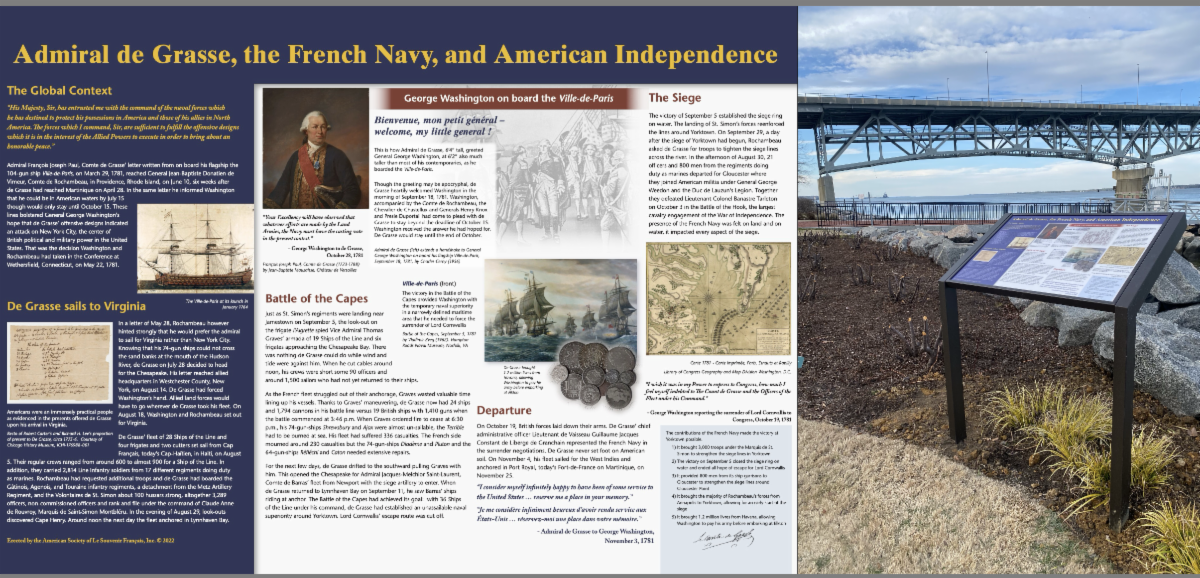
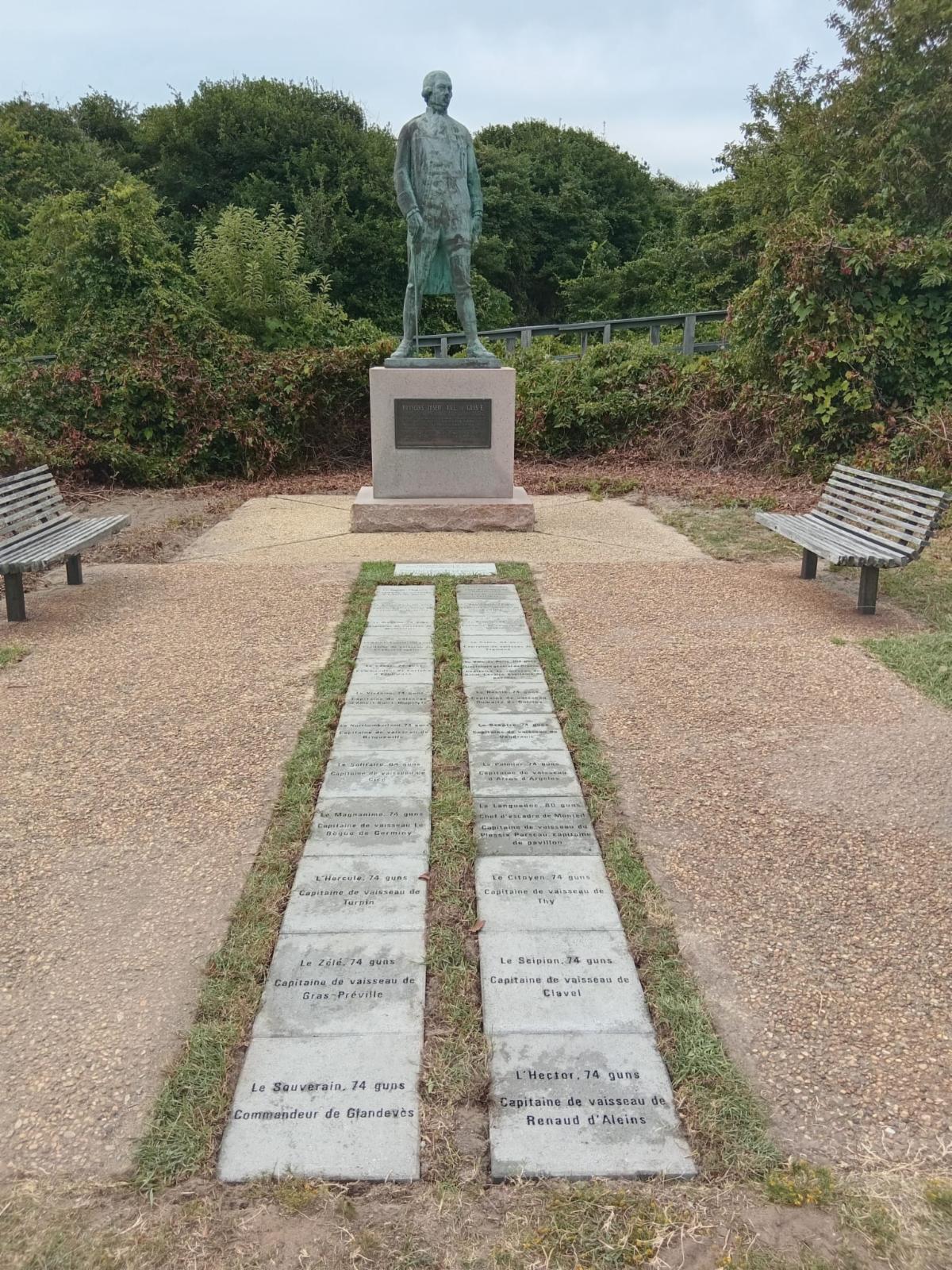
We continue our America250 series this month of September with the seminal naval victory of the Chesapeake (also known as the Battle of the Capes, or Battle of the Virginia Capes), which paved the way for the successful siege at Yorktown. This being also the 400th anniversary of the creation of the French Navy by Cardinal Richelieu, it is a fitting tribute to all the sailors and soldiers who fought at sea.
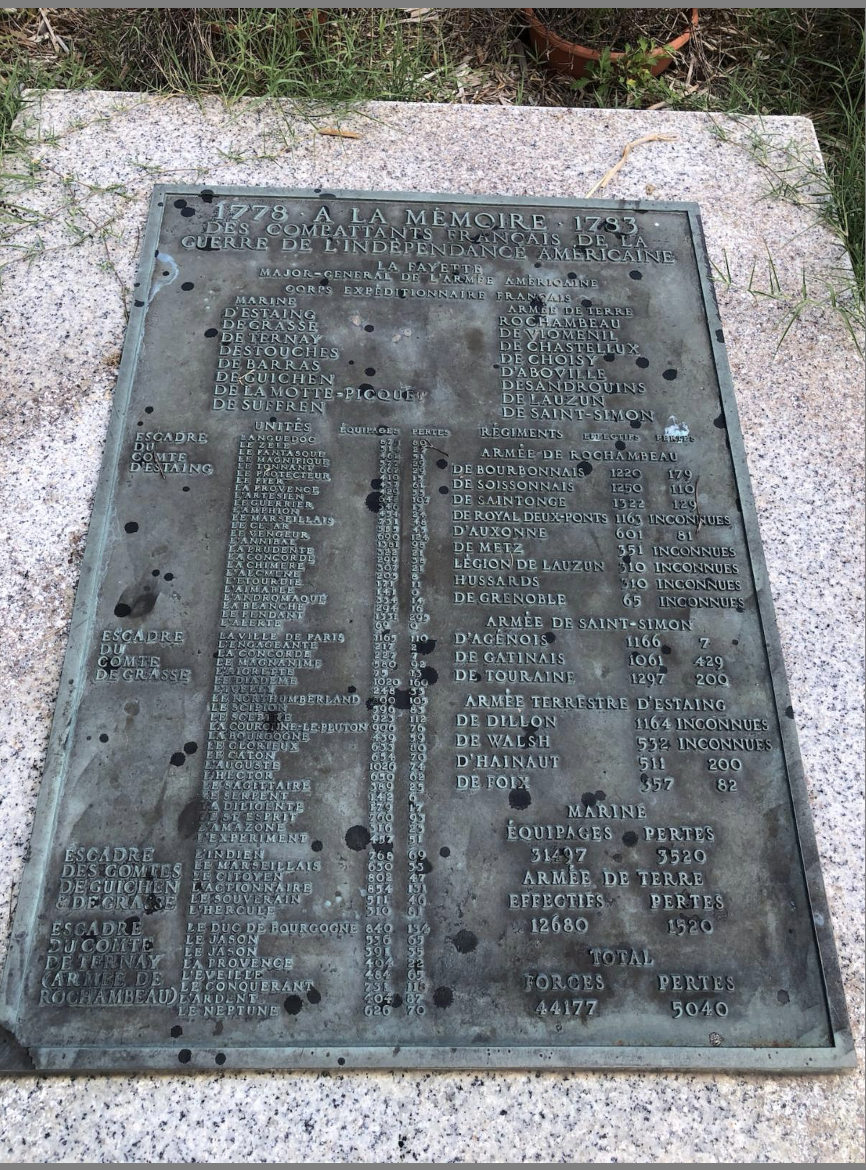
We will pay homage to the captains of the 24 French Navy ships, as well as to their crews. Of these, 221 died in a single day, on September 5, while a total of 515 sailors (and embarked soldiers) died over the course of the entire Yorktown campaign. We have recently completed their list, with names, dates of birth, city of birth, province of origin, and circumstances of their death, as transcribed from the original official records.
Many died of their wounds in the days that followed, their bodies committed to the deep, and a few others succumbed to their wounds weeks later in hospitals in Hampton, Yorktown, and Williamsburg, VA. They rest in mass graves whose locations are, alas, no longer precisely known. Like all soldiers who died far from home, they must not be forgotten. The complete list may be consulted on our website.
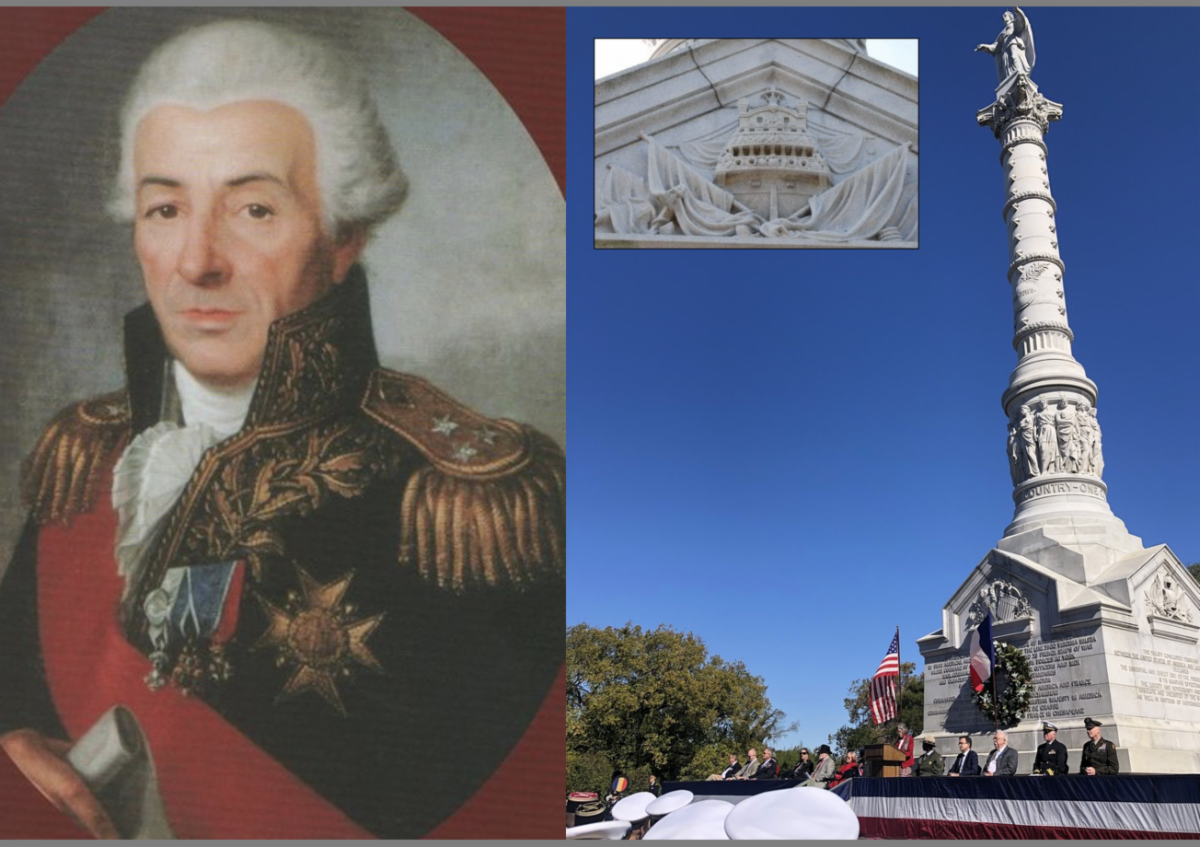
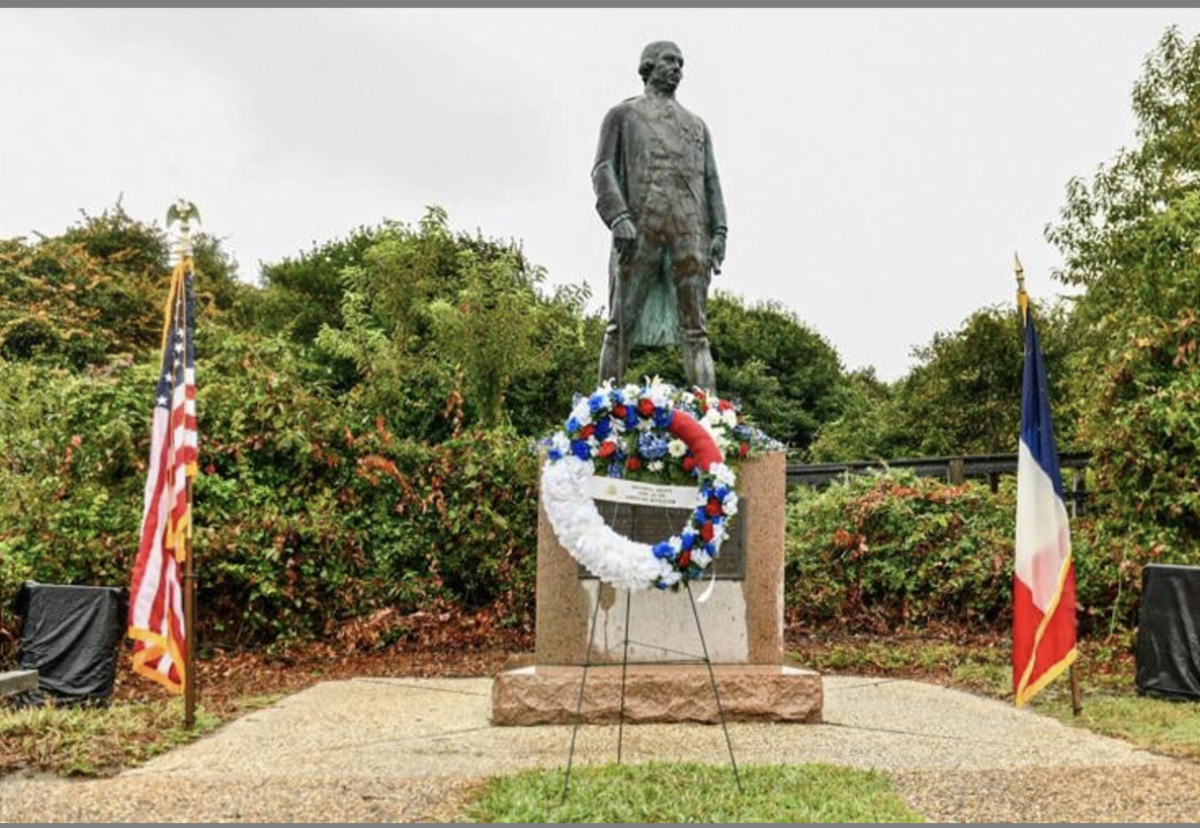
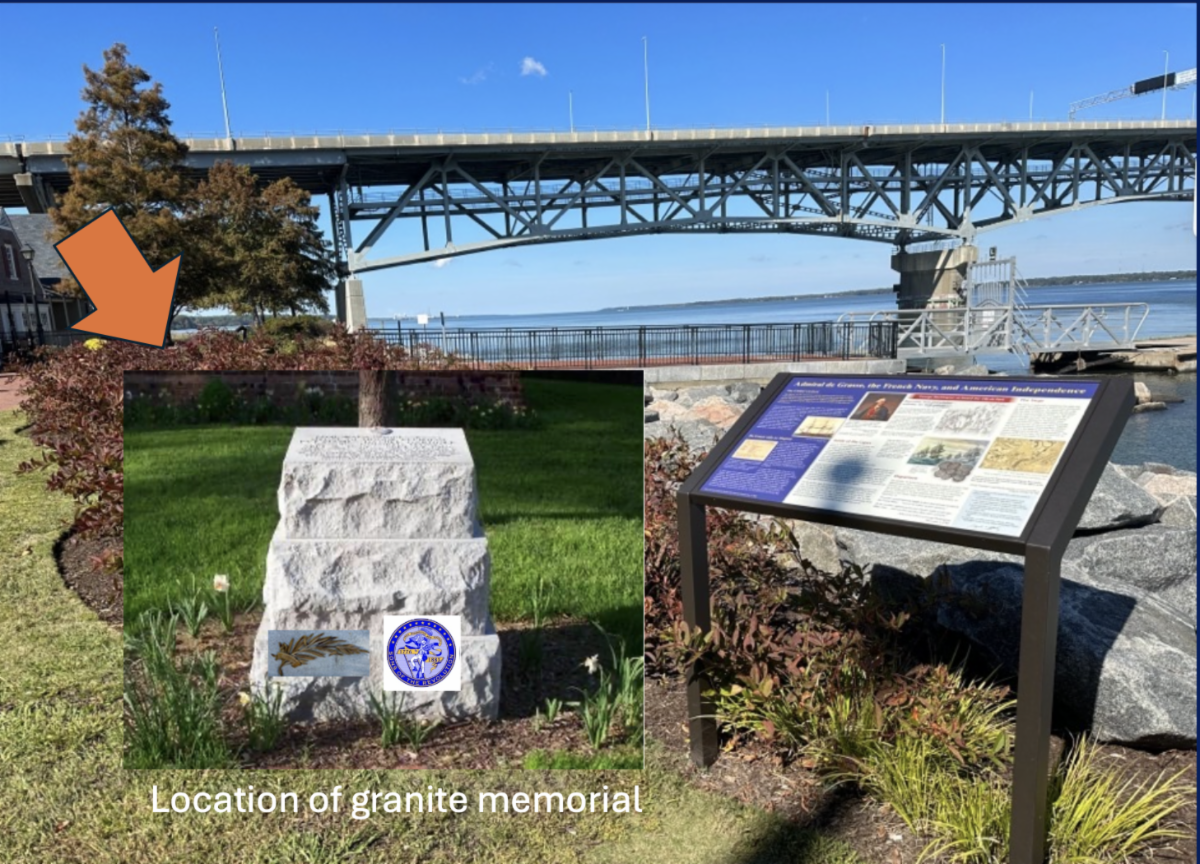
The dedication, at Yorktown Riverwalk, of our granite memorial — co-sponsored by the Sons of the Revolution — to the memory of the 3,520 French sailors and embarked soldiers who fought at sea and gave their lives for American Independence between 1778 and 1783, will take place on October 18, and you are all cordially invited to attend.
Part Two of this Bulletin continues our tradition of honoring a particular American volunteer who, conversely, fought and died for France 137 years later: First Lieutenant Wallace Charles Winter, Jr., of Chicago, Ill., a Yale football player who was shot down and declared "Mort pour la France" on March 8, 1918, at Nauroy (51-Marne), near Châlons.
Scroll down the bulletin a little further, and you will reach Part Three, which lists several news items and save-the-dates for this coming Fall.
We thank all the readers who took the time to write to us this summer. Your support and your interest remain, as ever, a source of encouragement to continue this memorial work on behalf of all those who fought for our freedom.
On behalf of the Board of Directors,
Thierry Chaunu
President, The American Society of Le Souvenir Français, Inc.
Délégué Général du Souvenir Français pour les Etats-Unis.
| |
| |
Above:
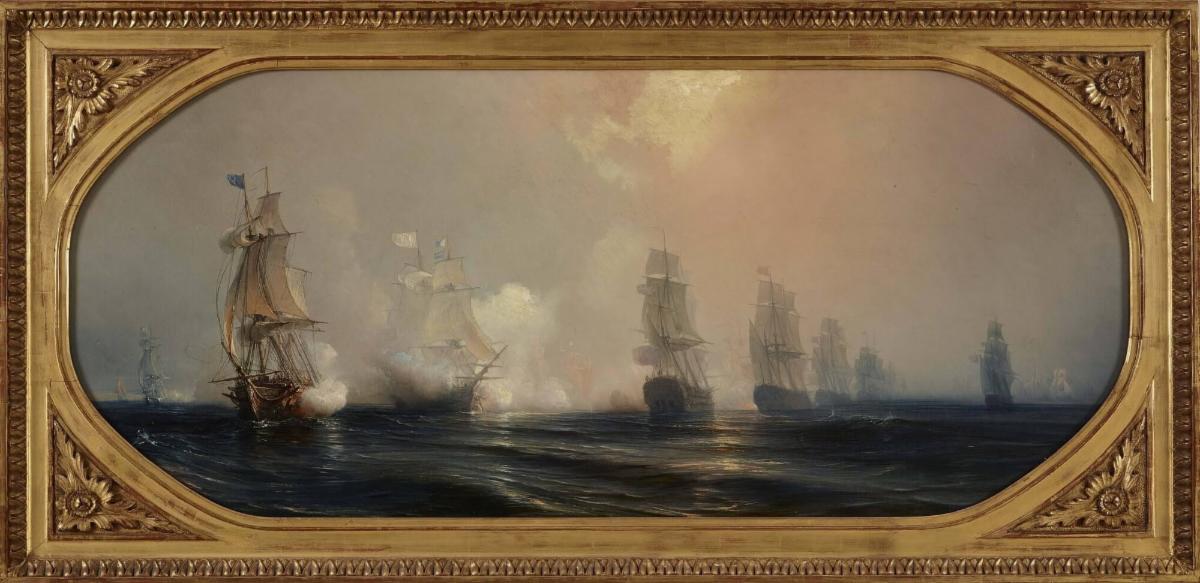
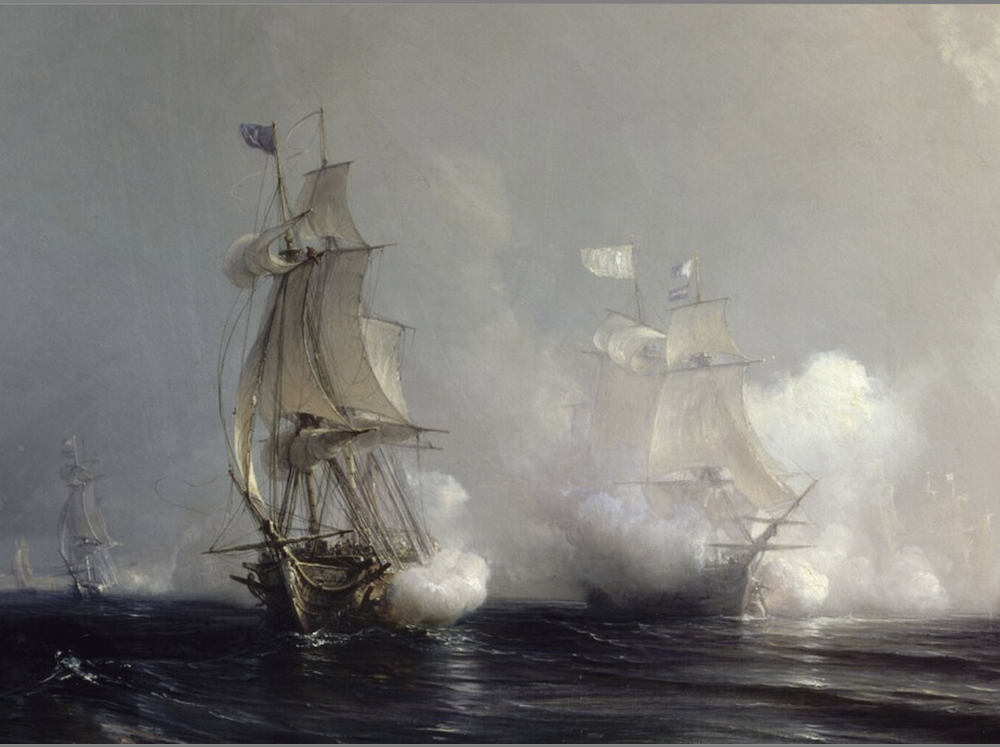
Top: Combat naval devant la Chesapeake, 3 septembre 1781, by Théodore Gudin (French, 1802-1880) , 1848 © Musée national des Château de Versailles et de Trianon
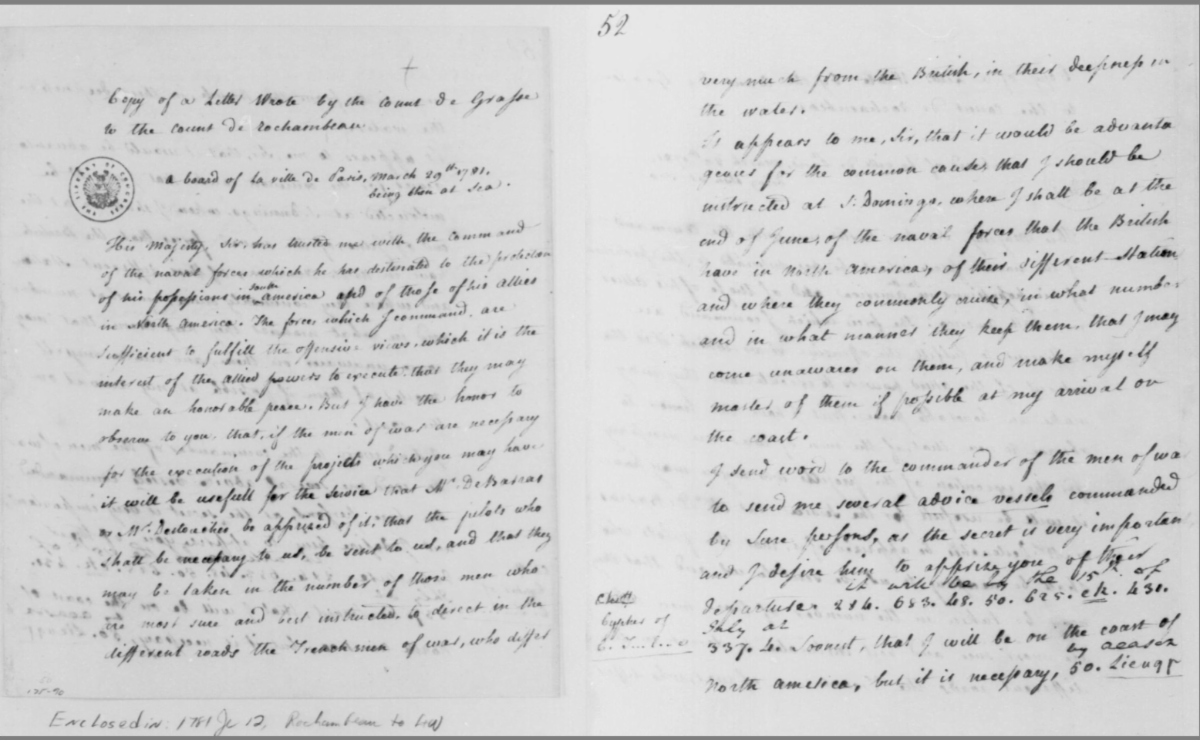
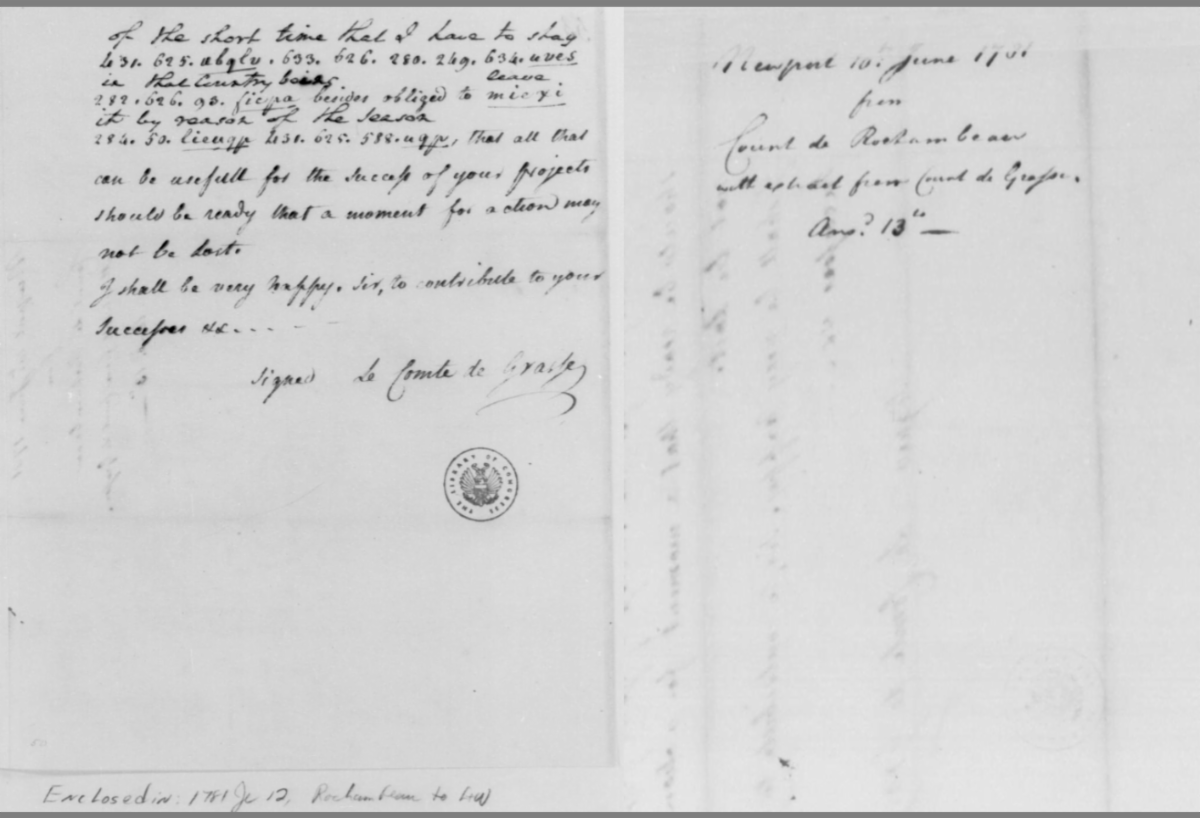
Below: Letter from Francois Joseph Paul, Comte de Grasse to Jean B. Donatien de Vimeur, Comte de Rochambeau, March 29, 1781, (Copy) - George Washington Papers, Series 4, General Correspondence, Retrieved from the Library of Congress, https://www.loc.gov/item/mgw427566/
| |
Two Commanders, Competing Strategies
In May 1781, Washington and the French commander Rochambeau met at Wethersfield, Connecticut, to plan that summer's campaign. Washington wanted to strike New York City, the main British stronghold. Rochambeau privately favored a completely different target — the Chesapeake Bay in Virginia — but publicly deferred to Washington's plan to preserve the alliance's cohesion. Crucially, though, he secured a hedge in their agreement: they'd aim for New York unless circumstances pointed them south.
A Transatlantic Correspondence
This part of the story unfolds through three letters, each taking weeks to cross the ocean.
Letter 1 (picture above) — De Grasse to Rochambeau, March 29, 1781. Sailing from France with a large fleet, the French admiral wrote ahead that his forces were ready to support a major allied offensive, adding only that time was short and secrecy essential. This letter didn't arrive in Newport until June 10 — over two months later...
"His Majesty, Monsieur, has confided to me the command of the naval force which he has destined to protect his possessions in Southern America [the West Indies] and those of his allies in the north. The forces I command are sufficient to satisfy the views as to the offensive which it is in the interest of the allied powers to carry out in order to bring an honorable peace. . . . At the earliest … it will be about July 15 when I can off the coast of North America..."
Letter 2 — Rochambeau to de Grasse, May 28, 1781. Without waiting on Washington, Rochambeau sent his own letter south, laying out both options but clearly steering de Grasse toward Virginia, noting that the winds and the state of Virginia's defenses would likely make him prefer the Chesapeake. He asked de Grasse to send a scout ship ahead once he decided.
"There are two points at which an offensive can be made against the enemy: Chesapeak and New York. The southwesterly winds and the state of defense in Virginia will probably make you prefer the Chesapeak Bay, and it will be there where we think you may be able to render the greatest service. … In any case it is essential that you send, well in advance, a frigate to inform de Barras where you are to come and also General Washington."
Letter 3 — De Grasse's reply, July 28, 1781. This was the decisive one. De Grasse confirmed he was bringing roughly 3,000 troops and an enormous fleet — between 25 and 29 warships — sailing straight for the Chesapeake Bay, which he noted matched what Rochambeau, Washington, and others had all pointed him toward. However, he gave a hard deadline: he could only stay until mid-October.
"[I will be bringing with me] from the regiments of Gatinois, Agenois, and Tourraine, amounting in all to three thousand men, one hundred artillery, one hundred dragoons, ten pieces of field ordnance, and several of siege artillery and mortars. The whole will be embarked in vessels of war from twenty-five to twenty-nine in number, which will depart from this colony on the 3d of August and proceed directly to the Chesapeake Bay, which place seems to be indicated by yourself, General Washington, M. de la Luzerne, and Count de Barras, as the best point of operation for accomplishing the object proposed."
Washington's Change of Mind
Washington took some convincing. Even after hearing of Rochambeau's overture to de Grasse, he raised objections in a June 13 letter, insisting New York was still their best shot and questioning why Rochambeau had steered de Grasse away from it without his sign-off:
"Your Excellency will be pleased to recollect that New York was looked upon by us as the only practicable object under present circumstance; but should we be able to secure a naval superiority, we may perhaps find others more practicable and equally advisable. If the Frigate should not have sailed, I wish you to explain this matter to the Count de Grasse, as, if I understand you, you have in your communication to him, confined our views to New York alone. And instead of advising him to run immediately into Chesapeak, will it be best to leave him to judge, from the information he may from time to time receive of the situation of the enemy's Fleet upon this Coast, which will be the most advantageous quarter for him to make his appearance in."
But two factors broke the deadlock:
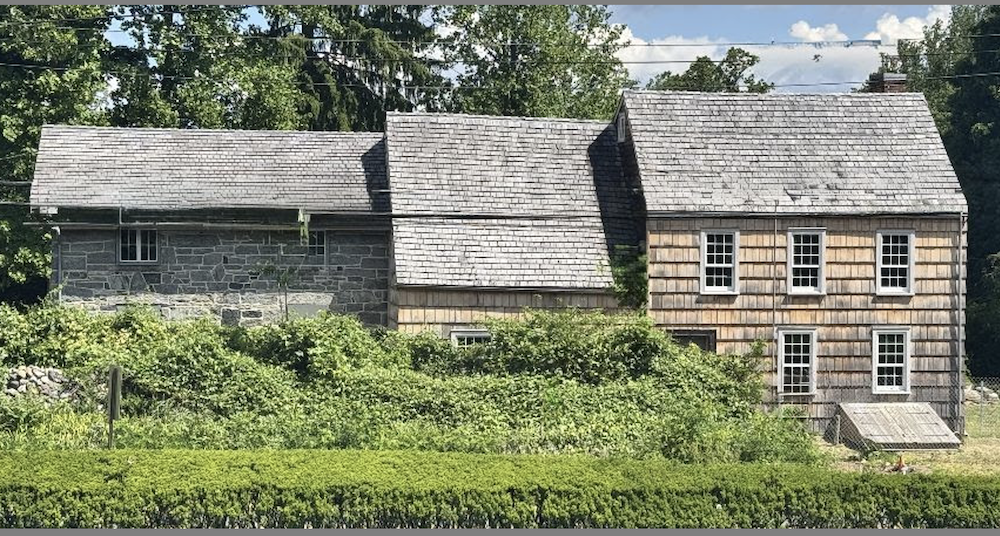
One, a sobering realization in July. By that time the two allied American and French armies had made their junction north of New York (site of the future Odell Rochambeau Museum; see announcements in Part III of this bulletin).
When Washington and Rochambeau finally scouted New York's defenses up close (July 21–23), it was obvious the British fortifications were too strong to crack with the troops and artillery on hand.
Two, a fleet with a deadline. When de Grasse's July 28 letter reached Washington and Rochambeau on August 14, the logic was clear: a huge French fleet was committed to Virginia, available for a matter of weeks, and with no intention of sailing to New York.
Washington made the call the very next day, August 15, and by August 19 the allied armies were secretly marching south — 420 miles — toward Yorktown.
| | |
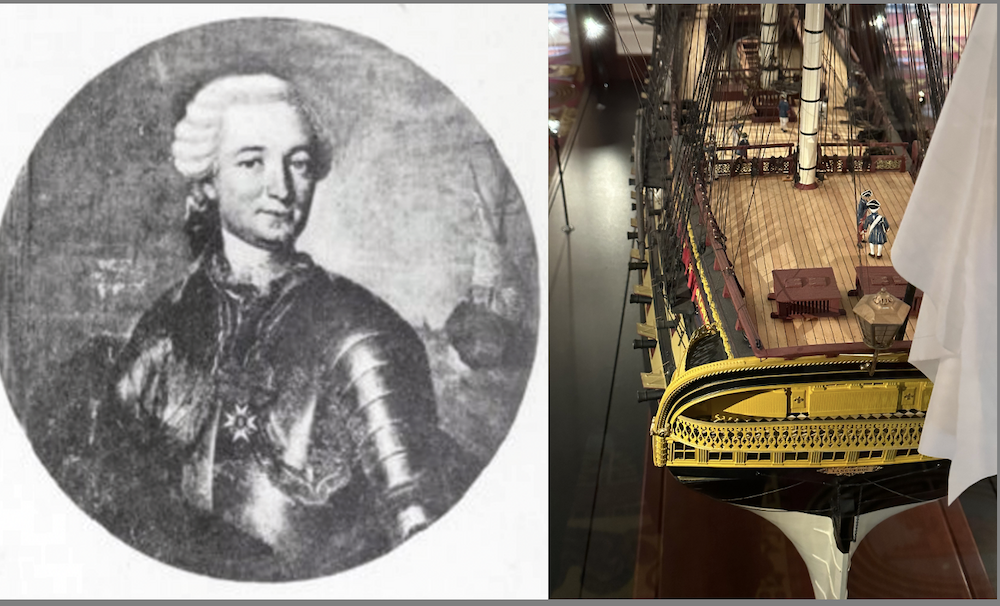
Admiral de Grasse
Flagship: 104-gun Ville-de-Paris
| | |
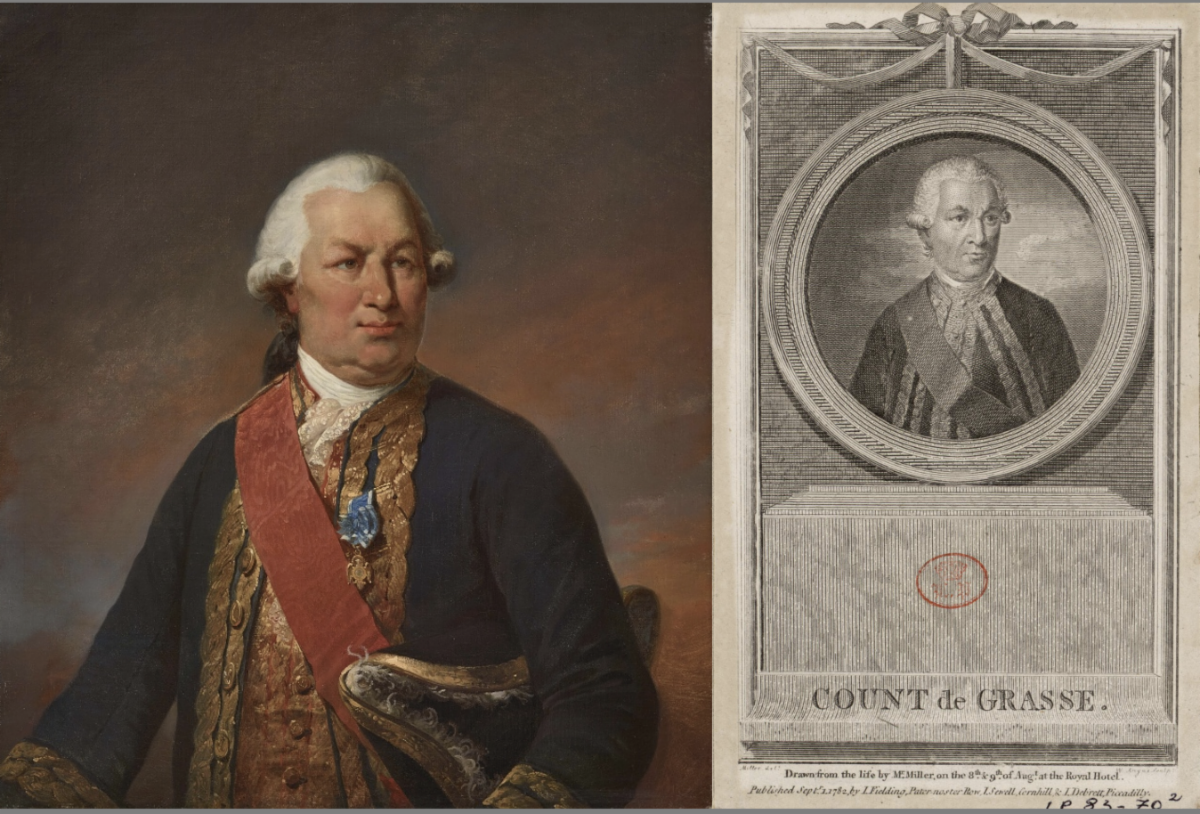
• François Joseph Paul, Comte de Grasse (September 13, 1722– January 11, 1788) was a French naval officer from Bar-sur-Loup, Provence, the youngest child of the Marquis de Grasse, best remembered for his decisive role in securing American independence.
• His military training began remarkably early: in 1734, at just 11 or 12 years old, he became a page to the grand master of the Knights Hospitaller, António Manoel de Vilhena. Through that connection, he joined the navy of the Order of Saint John, serving as an ensign aboard its galleys in engagements against the Ottoman Navy and Barbary corsairs in the Mediterranean—a formative apprenticeship in naval combat well before he ever wore a French uniform. He formally entered the French Navy in 1740 at age 17, and his career subsequently took him to India, where he saw action during the Seven Years' War and was intermittently stationed in Calcutta through the 1760s and into 1781. After France's defeat in that war, he was among the officers who helped rebuild and modernize the French fleet under the Treaty of Paris (1763).
• De Grasse's American Revolutionary War service began in 1778, when, as a division commander, he served under d'Orvilliers at the indecisive First Battle of Ushant. The following year, he joined d'Estaing's fleet in the West Indies as a squadron commander, contributing to the capture of Grenada and fighting in the Battle of Martinique under Guichen against Admiral Rodney.
• His steady accumulation of successful engagements in the Caribbean theater culminated in his promotion to lieutenant-general of the Navy—equivalent to vice-admiral—in March 1781, the same year he defeated Admiral Samuel Hood and captured Tobago.
• His most consequential achievement came later that year, when he answered an appeal from George Washington and Rochambeau for naval support, sailing from Saint-Domingue with 3,000 troops to reinforce the American war effort. After landing these reinforcements in Virginia, he decisively defeated the British fleet at the Battle of the Chesapeake in September 1781. By drawing away British naval forces and blockading the coast, he cut off any hope of relief or evacuation for Cornwallis's army, directly enabling the British surrender at Yorktown—the battle that effectively secured American independence, and the achievement for which de Grasse is best remembered.
• His career ended in semi-disgrace following his defeat and capture at the Battle of the Saintes in 1782, and he died at his Tilly château near Paris in 1788. His tomb is at Église Saint-Roch, 284 rue Saint-Honoré.
• He was Commandeur de l'Ordre Royal et Militaire de Saint Louis and a member of the Society of the Cincinnati.
A formidable naval force:
De Grasse' fleet of 24 Ships of the Line and four frigates and two cutters set sail from Cap Français, today's Cap-Haïtien, in Haiti, on August 5.
Their regular crews ranged from around 600 to almost 900 for a Ship of the Line.
• In addition, they carried 2,814 Line Infantry soldiers from 17 different regiments doing duty as marines. Rochambeau had requested additional troops and de Grasse had boarded the Gâtinois, Agenois, and Touraine infantry regiments, a detachment from the Metz Artillery Regiment, and the Volontaires de St. Simon about 100 hussars strong, altogether 3,289 officers, non-commissioned officers and rank and file under the command of Claude Anne de Rouvroy, Marquis de Saint-Simon Montbléru.
In the evening of August 29, look-outs discovered Cape Henry. Around noon the next day the fleet anchored in Lynnhaven Bay.
| |
|
Washington's Joy
on September 3, 1781
at the News of de Grasse's Arrival
| |
Above:
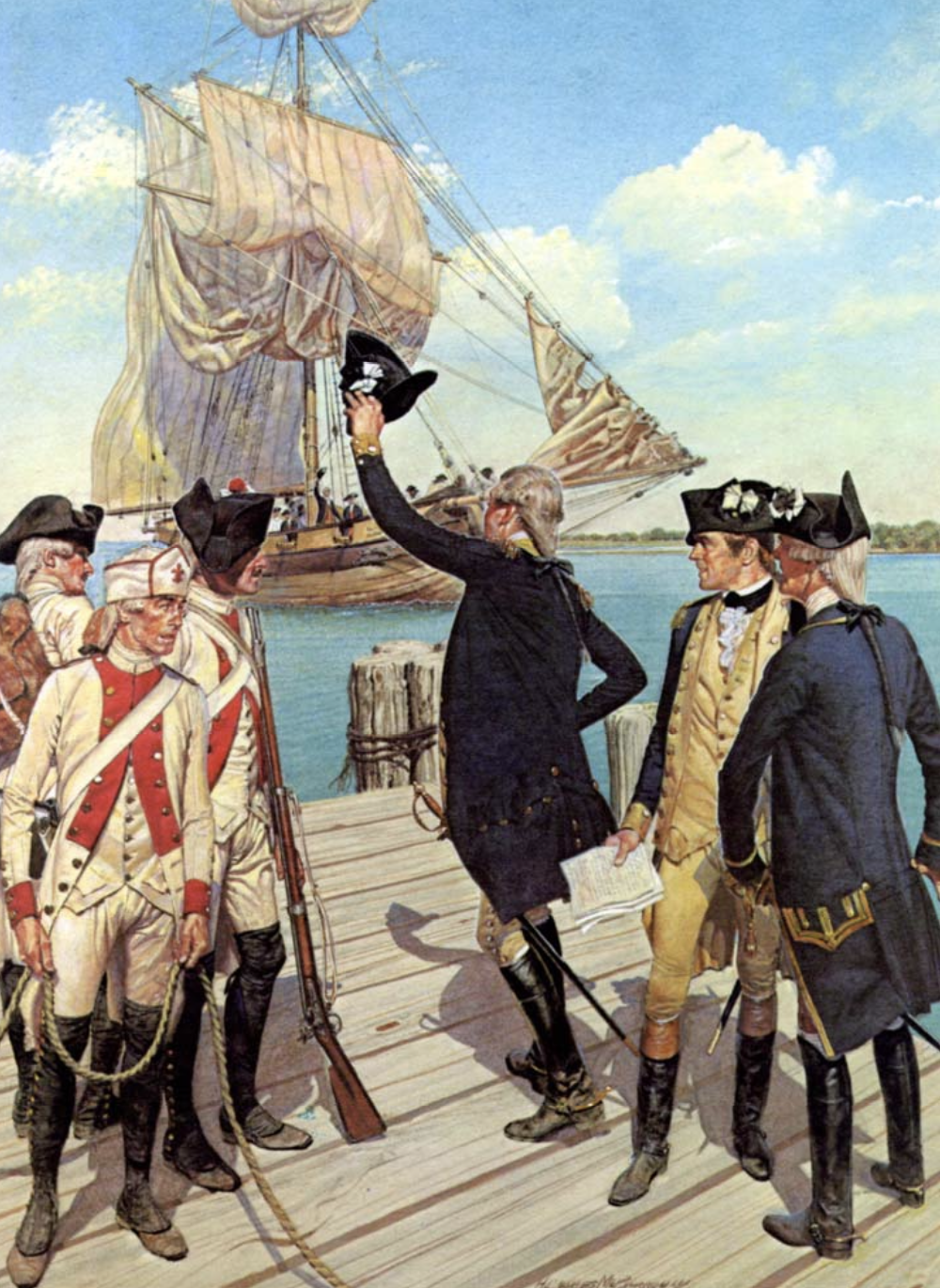
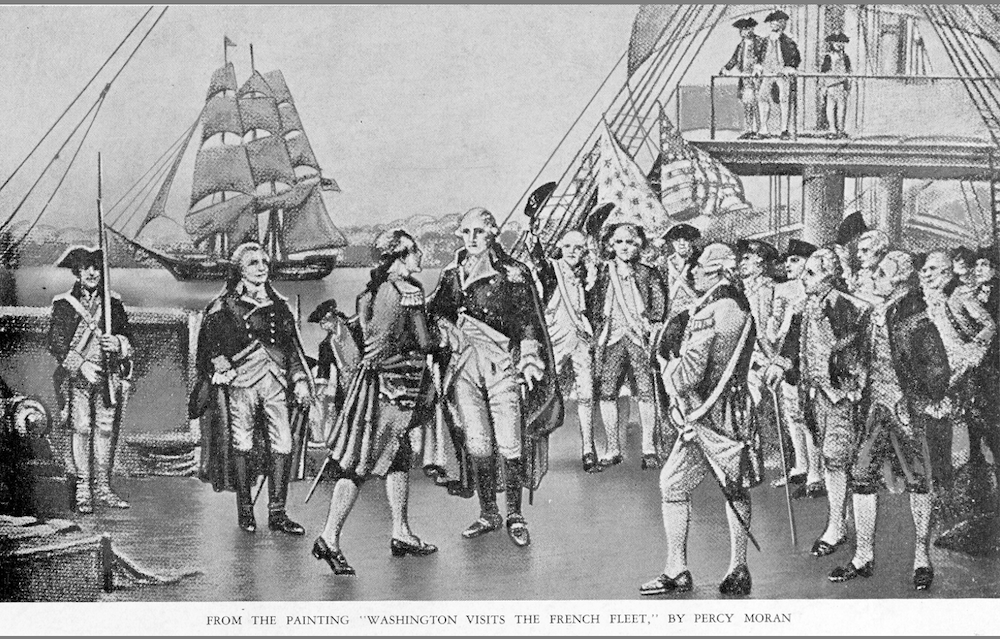
George Washington waves to Rochambeau arriving at Chester by the Delaware River. The painting shows Gen. Washington waving his hat, with three French soldiers of the Soissonais Regiment, and an American and a French staff officer. General Washington and the American staff officer wear the black cockade with white center in honor of their French allies, and the French staff officer wears a white cockade with a black center in honor of the Americans.
By H. Charles McBarron, Jr. - United States Army. Prints & Posters - The American Soldier: Set 5 - U.S. Center of Military History, Public Domain, https://commons.wikimedia.org/w/index.php?curid=57581779
| |
• Though British Admiral Hood left the West Indies several days after the de Grasse's fleet, he took a direct route to the Chesapeake Bay and passed the French fleet without spotting them. Unlike most French ships, British ships were clad with copper-sheets and were faster. Another reason is that de Grasse took a more dangerous route closer to the continent, while the British Fleet was miles away further east. Hood arrived at the bay on August 25. After finding no French ships at the Chesapeake capes, Hood then sailed up the Delaware Bay below Philadelphia in case de Grasse's fleet went there instead. Finding no French ships in the Delaware, Hood then proceeded to New York….thus allowing de Grasse to land French soldiers in Lynnhaven Roads.
• On September 3, 1781, the day after the French army marched in front of Congress in Philadelphia, Washington was riding south along the Delaware when a courier intercepted him a few miles beyond Chester, Pennsylvania. He had been waiting anxiously for word from the south — and this was it: Admiral de Grasse's fleet had reached the Chesapeake, and the troops of French marines had already landed to reinforce Lafayette against Cornwallis.
• Washington galloped back to Chester, where Rochambeau's boat was expected shortly. As the French party approached the landing, they were astonished by what they saw: the normally composed, six-foot-two commander-in-chief on the riverbank, waving his hat in one hand and a white handkerchief in the other "jumping up and down like a schoolboy."
• One account even has Washington shouting, upon embracing Rochambeau, "He's here! He's arrived!"
(American Heritage magazine, "September 28, 1781: The Beginning of the End”)
The French officers present found the scene unforgettable, precisely because it was so out of character.
• The Duc de Lauzun recalled: "I have never seen a man moved by a greater or more sincere joy than was General Washington at this moment."
• The Comte de Deux-Ponts wrote: "The French officers were as much surprised as they were touched by the joy very true and very pure of General Washington... A child whose every wish had been gratified would not have experienced a sensation more lively."
• The Baron de Closen (aide-de-camp to Rochambeau), for his part, noted that "We saw in the distance General Washington shaking his hat and a white handkerchief, and showing signs of great joy. De Rochambeau had scarcely landed when Washington, usually so cool and composed, fell into his arms..."
(National Archives, Founders Online (Papers of George Washington, September 1781), which quotes Jonathan Trumbull's journal and Rochambeau's own account)
Both generals had good reason to be elated, as did the younger officers, eager to test themselves against the enemy and hungry for glory. However, the heavy lifting, for now, rested with de Grasse, who would soon have to establish local naval supremacy in order for the upcoming siege of Lord Cornwallis to succeed.
| | |
Above:
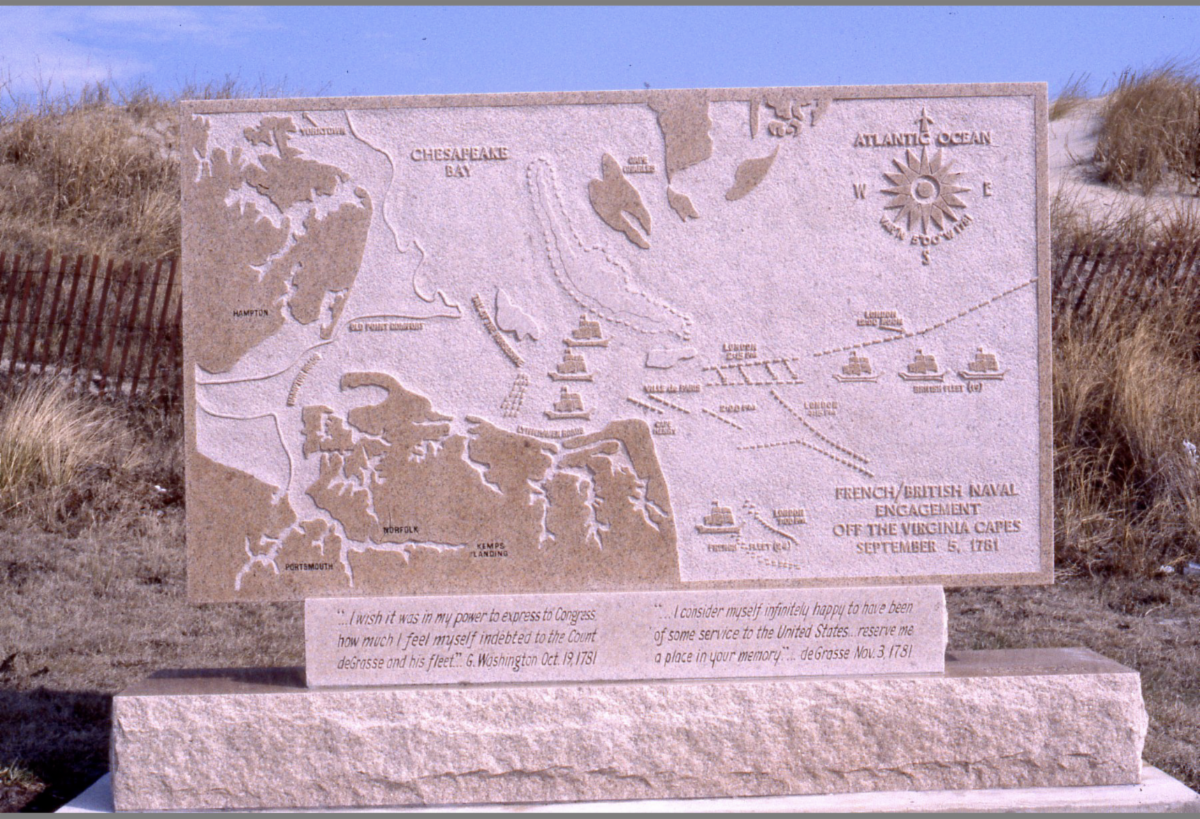
Top: Marker, “Battle of the Capes”, Cape Henry, VA
Photo: Hampton Roads Naval Museum, Public domain, Viewing north towards the marker, https://npgallery.nps.gov/AssetDetail/538170cd-155d-451f-6715-be50b64cc041
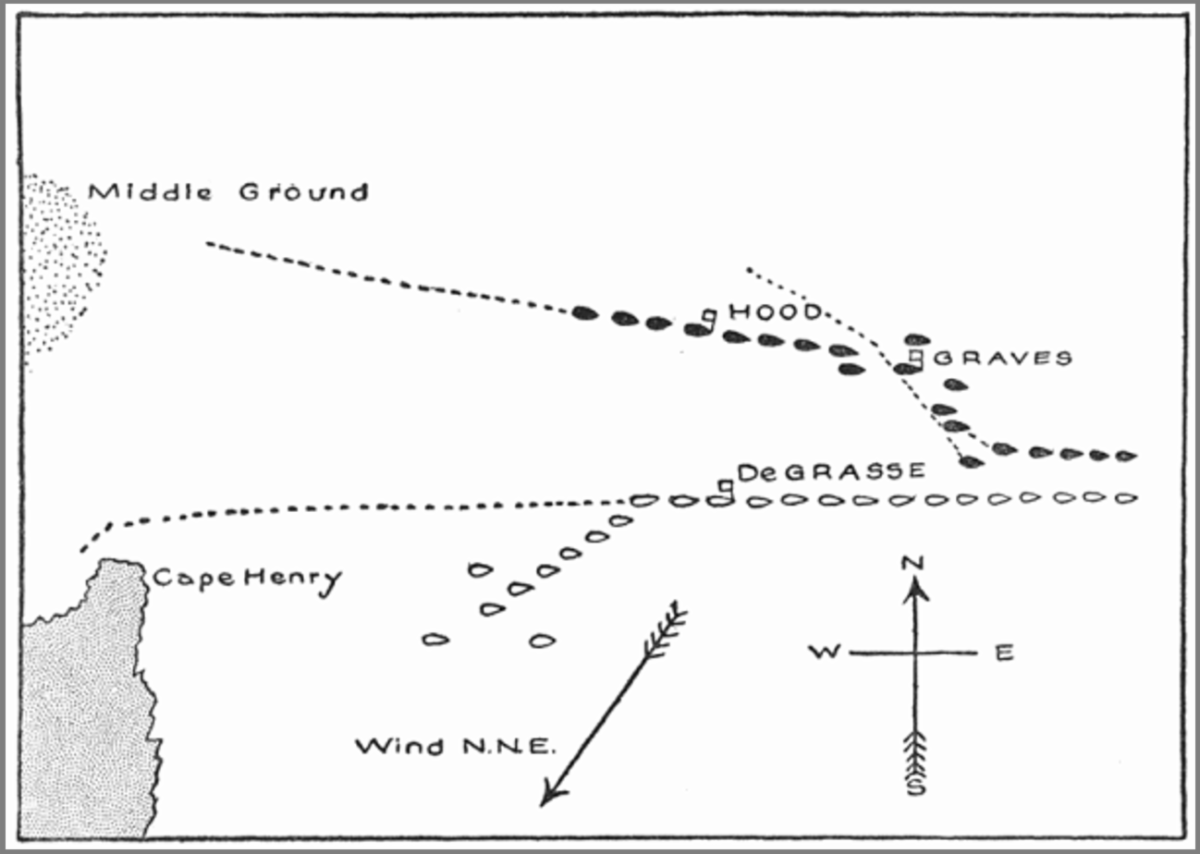
Bottom: Formation of fleets: British ships are black, French ships are white. The Middle Ground to the left are the shoals that Graves tacked to avoid. By William Oliver Stevens and Allan Westcott - A History of Sea Power Project Gutenberg edition, Public Domain, https://commons.wikimedia.org/w/index.php?curid=5525770
| |
When Admiral Hood arrived in New York, he was joined by five ships of the line commanded by Admiral Thomas Graves. As the senior officer, Graves took charge of the entire fleet. Shortly after, the British learned that eight ships of the line led by Admiral Jacques-Melchior Saint-Laurent, comte de Barras, had departed from Newport. Assuming correctly that this squadron was heading for Chesapeake Bay, Graves set sail with his 19 capital ships in time to intercept them. Upon reaching the entrance to Chesapeake, Graves found that de Barras had not yet arrived, but he was met with a surprising sight—the masts of de Grasse's large fleet anchored just inside Cape Henry!
Danger! Danger! Danger!
Just as Saint Simon's regiments were disembarking near Jamestown on September 5, the look-out on the frigate l'Aigrette spied Vice Admiral Thomas Graves' armada of 19 Ships of the Line and six frigates approaching the Chesapeake Bay.
When the British fleet suddenly appeared outside the Chesapeake Bay, the French were caught completely off guard.
There was nothing de Grasse could do while wind and tide were against him. When he cut cables around noon, his crews were short some 90 officers and around 1,500 sailors who had not yet returned to their ships!
De Grasse' displayed a brillant mastery of naval seamanship called "tiding" (or using a windward tide). Still, it was a bold decision.
Here is how the French ships pulled off their high-stakes manoeuver:
The Dilemma: Trapped by the Wind
To get out of the bay and face the British, the French ships had to sail against the incoming wind. In the 18th century, square-rigged warships could not sail directly into the wind; trying to do so meant getting stuck or moving at a crawl.
To make matters worse, the mouth of the Chesapeake Bay is narrow and filled with dangerous, shallow sandbars. The French ships had to exit one by one through a tight bottleneck, making them sitting ducks for the waiting British.
Riding the Underwater "Conveyor Belt"
Admiral de Grasse noticed that while the wind was blowing into the bay, the outgoing tide was ripping out toward the ocean.
He ordered his captains to perform a difficult maneuver:
The French ships dropped their sails just enough to catch a tiny bit of wind for steering, but allowed the powerful, invisible force of the outgoing tide to literally drag them backward and sideways out to sea.
The Result: By using the tide like an underwater "conveyor belt", they managed to slip out of the narrow bay much faster than the British expected.
The Bold Gamble: Cutting the Ropes
Even with the tide, time was ticking. Pulling up a massive, heavy iron anchor by hand using a wooden crank (capstan) could take an hour or more per ship. The French didn't have an hour.
To save every precious second, de Grasse ordered his fleet to slip their cables. Instead of wasting time reeling the anchors in, the sailors simply cut the massive anchor ropes and left their (very) precious anchors sitting at the bottom of the bay.
The Surprise Deflection
Because the French exited the bay in a hurried scramble, they didn't have time to form a neat battle line. They came out in a messy, disorganized formation.
The British commander, Admiral Graves, had a perfect opportunity to ambush the French ships one by one as they trickled out. However, Graves was a strict follower of the traditional British naval playbook. Instead of attacking the messy French line, he hesitated and spent precious hours trying to get his own ships into a perfectly straight, formal line.
By the time the British were ready to fight, the tide had allowed enough French ships to squeeze out into the open ocean to form a proper defensive wall, setting the stage for the battle that changed history.
| | |
Above:
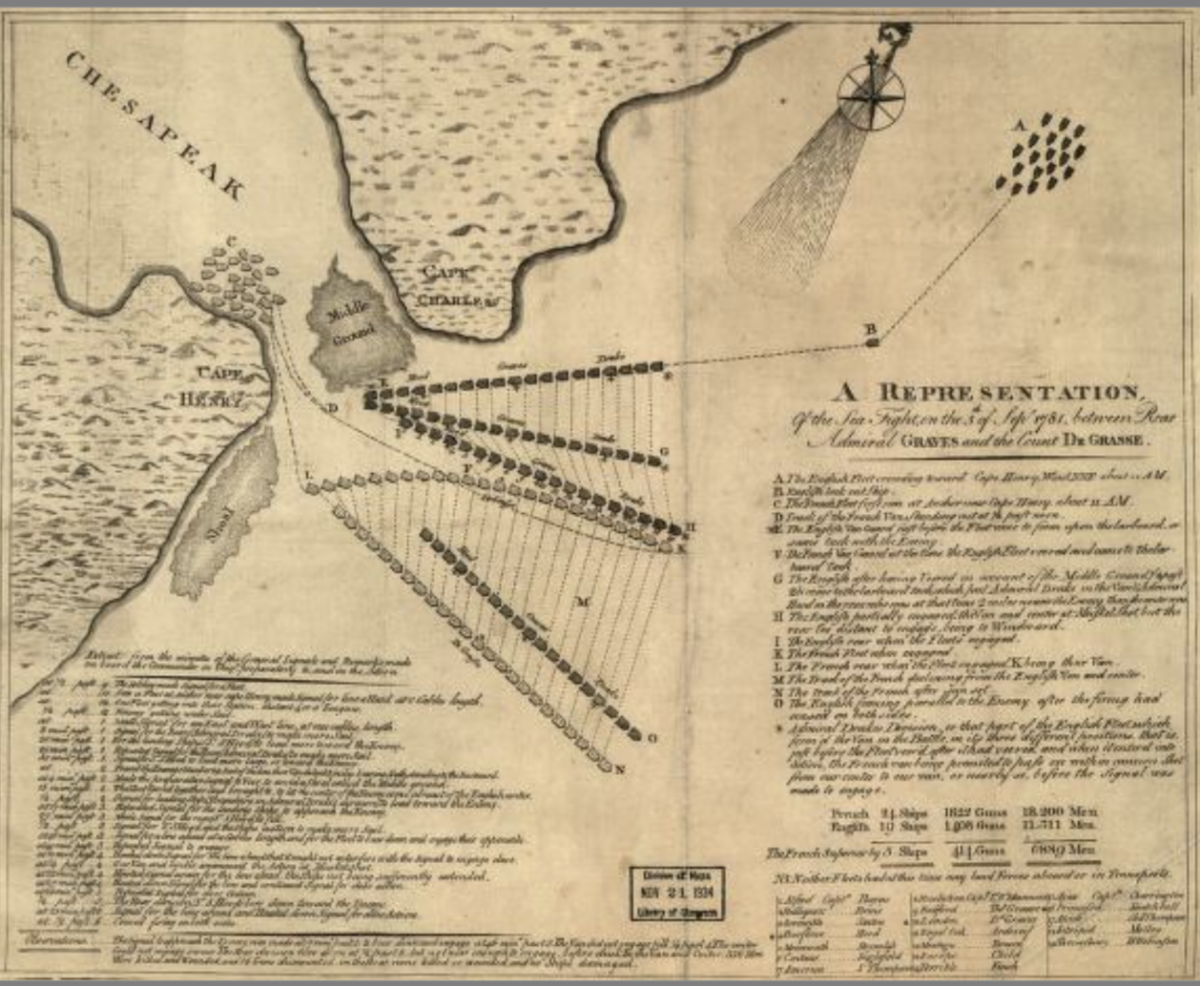
This map, which dates from the 1780s, depicts the French and British fleets at the Battle of the Chesapeake, which occurred off the Virginia Capes on September 5, 1781, during the American Revolution. The French won what one naval historian has called “the decisive battle of the war.”
Library of Congress, Washington, D.C. (digital i.d. g3884y.ar146100) Library Of Congress Geography And Map Division Washington, D.C. 20540-4650 Usa Dcu
https://www.loc.gov/item/74692129/
| | |
The victory of Admiral François Joseph Paul de Grasse at the Battle of the Chesapeake didn't come from a complex, offensive strategy. Instead, his brilliance lay in speed, seizing the geographical advantage, and a tactical retreat that outwitted his British counterpart, Admiral Thomas Graves.
How De Grasse Won the Day:
As we have just seen, by prioritizing speed over formation, he denied the British the chance to block the bay's entrance, effectively forcing the battle out into the open ocean. As the French fleet struggled out of their anchorage, Graves wasted valuable time lining up his vessels. Thanks to Graves' maneuvering, de Grasse now had 24 ships and 1,794 cannons in his battle line versus 19 British ships with 1,410 guns when the battle commenced at 3:46 p.m.
Sacrificing the Vanguard (The "Fighting Retreat" Extension)
Because the French ships exited the bay in a trickling, disorganized line, the first few French ships to reach the ocean (the vanguard, led by Louis-Guillaume de Bougainville) were heavily outnumbered.
Instead of ordering his vanguard to stop and wait for the rest of the fleet—which would have created a massive traffic jam at the mouth of the bay—de Grasse ordered them to sail hard into the wind and bear the brunt of the British attack. This bold move bought the middle and rear sections of the French fleet the precious time they needed to exit the bay and form a defensive wall.
Exploiting the Traditional British "Line of Battle"
De Grasse understood his enemy's psychology perfectly. Eighteenth-century British naval doctrine required a fleet to form a perfectly straight, parallel line next to the enemy before opening fire.
Because the French line was stretched out and messy, the British spent hours turning and maneuvering to align themselves perfectly. De Grasse used every minute of British hesitation to patch his own line together. By the time the British finally opened fire, the French were fully prepared.
Directing Fire at British Rigging
Once the two fleets were sailing parallel to each other and blasting cannons, de Grasse ordered a specific French tactical doctrine: aim high.
French gunners aimed for the masts, sails, and rigging of the British ships. De Grasse wasn't trying to sink the British; he wanted to immobilize them. By shredding their sails and snapping their masts, he stripped the British ships of their ability to steer, effectively neutralizing their offensive power while keeping French ships relatively unscathed.
When Graves ordered fire to cease at 6:30 p.m., his 74-gun-ships Shrewsbury and Ajax were almost un-sailable, the Terrible had to be burned at sea. His fleet had suffered 336 casualties. The French side mourned around 230 casualties but the 74-gun-ships Diadème and Pluton and the 64-gun-ships Réfléchi and Caton needed extensive repairs.
| | |
The Five-Day Lure
The most decisive tactical maneuver happened after the main sunset cannon battle on September 5.
For the next four days, the two fleets drifted southward, watching each other but not fighting. De Grasse intentionally lured the British fleet further and further away from the Chesapeake Bay. He acted as a distraction, keeping the British occupied out at sea.
While the British were busy chasing de Grasse down the coast, this opened the Chesapeake for Admiral Jacques-Melchior Saint-Laurent, Comte de Barras' fleet from Newport with the siege artillery to enter.
Once de Grasse estimated that the second fleet was safely inside the bay, he abruptly turned his ships around and raced back to Yorktown. When de Grasse returned to Lynnhaven Bay on September 11, he saw Barras ships riding at anchor.
When the British fleet followed him back, they found the bay completely locked down by a combined force of 30 French warships. Outnumbered and outmaneuvered, the British gave up and sailed away to New York, leaving General Cornwallis completely doomed.
The Battle of the Capes had achieved its goal; with 36 Ships of the Line under his command, de Grasse had established an unassailable naval superiority around Yorktown. Lord Cornwallis escape route was cut off.
| | |
Above
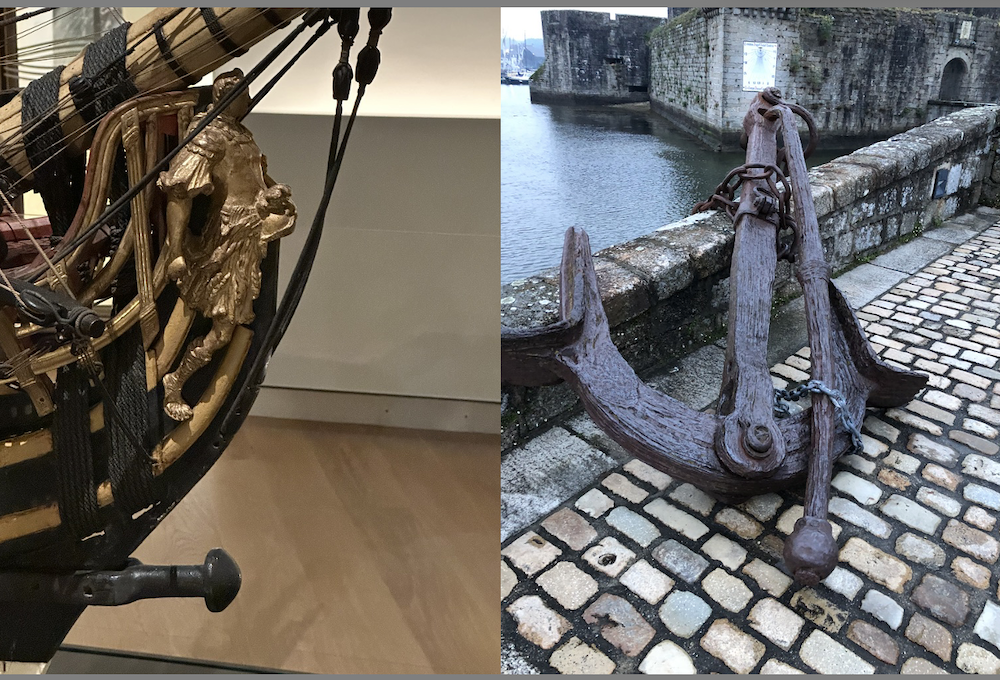
Left: Detail of figurehead and anchor, Musée de la Marine, Paris,
Right: 18th Century anchor, Concarneau, France
Photos: TC © ASSFI 2024 and 2018
| | |
When French captains cut their anchor lines in a haste to join the battle, they followed standard naval protocol by attaching floating buoys to mark the anchors' locations for later retrieval.
The following day, however, British Admiral Thomas Graves sent the frigate HMS Medea to sabotage this plan—her crew cut away the buoys and recorded compass bearings, intending to salvage the valuable anchors themselves while leaving the French unable to relocate their gear.
A week later, two more British ships, Iris and Richmond, returned to finish the job, but they arrived too late: Admiral de Grasse's fleet had already retaken the bay, trapping the two vessels and forcing their surrender after a brief engagement.
In the end, despite losing their surface markers, the French recovered most of their anchors using dragging hooks and their own recorded coordinates once they controlled the bay outright.
The anchors that were never recovered still lie somewhere in the Chesapeake's shifting sands, tantalizing but practically unreachable targets for maritime archaeologists today, given the muddy, heavily trafficked waters at the bay's mouth.
| |
|
Above:
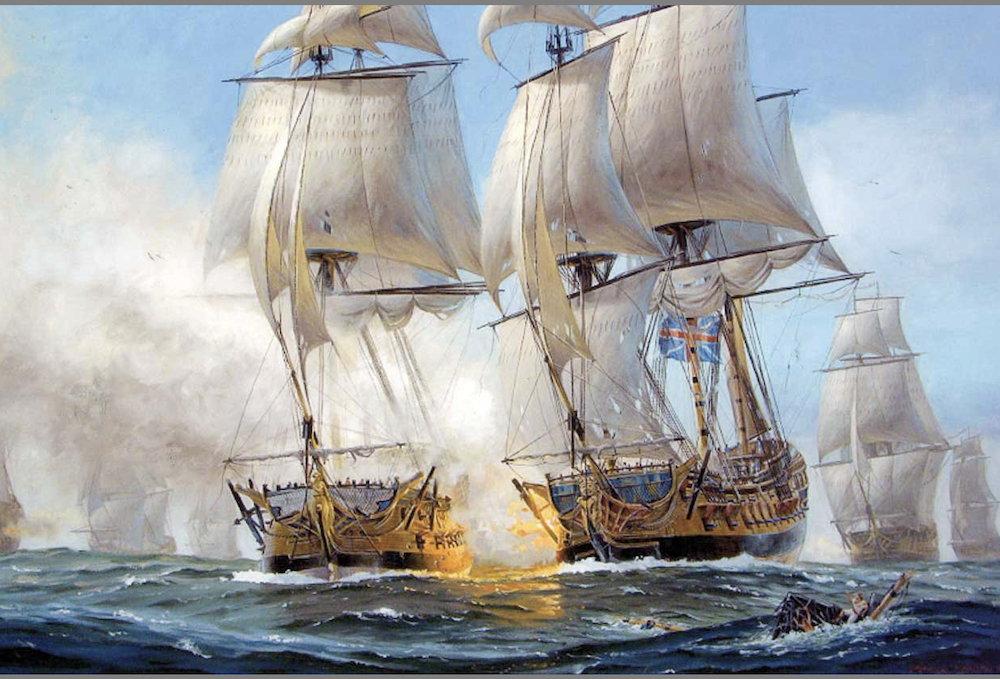
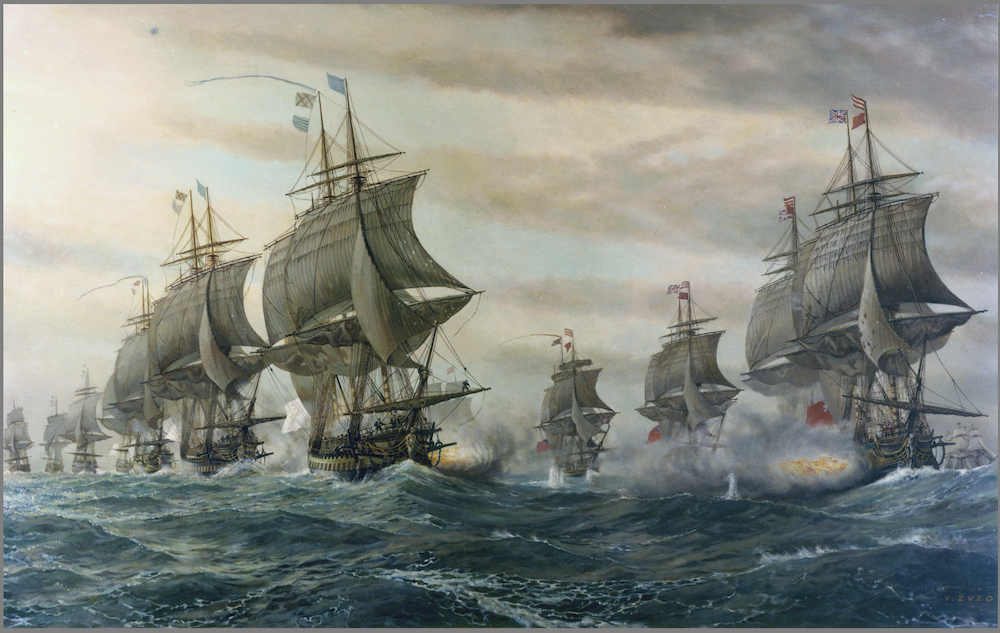
Battle of Cheasapeake, By V. Zveg (US Navy employee) - US Navy Naval History and Heritage Command: Photo #: NH 73927-KN URL: https://www.history.navy.mil/content/history/nhhc/our-collections/photography/numerical-list-of-images/nhhc-series/nh-series/NH-73000/NH-73927-KN.html, Public Domain, https://commons.wikimedia.org/w/index.php?curid=1177171
| | |
French Fleet Divided into Three Flags or Divisions
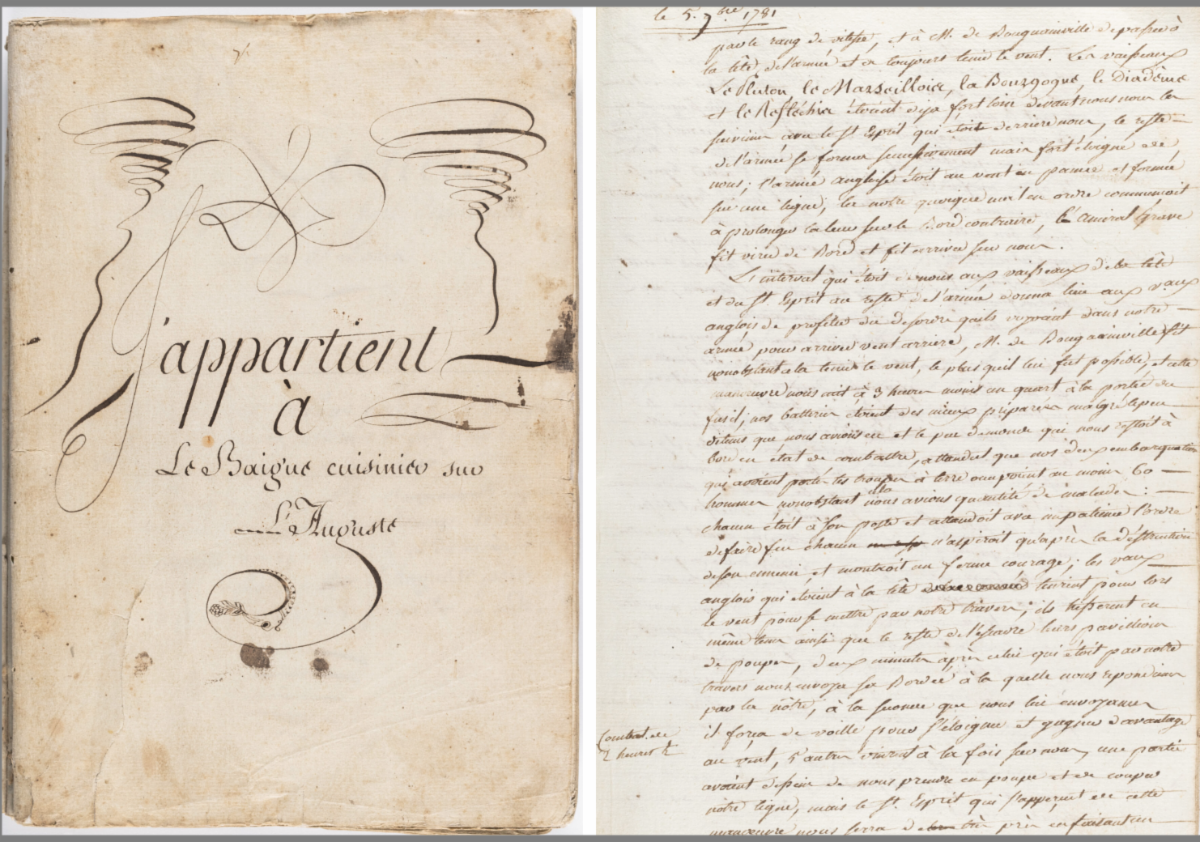
Vanguard Flag: Louis Antoine de Bougainville aboard the Auguste
- Auguste 80 Cpt. Pierre-Joseph de Castellan
- Pluton 74 Cpt. Albert de Rions
- Bourgogne 74 Cpt. Charles de Charritte
- Marseillois 74 Cpt. Henri-Cesar de Castellane-Majastre
- Diademe 74 Cpt. Louis Augustin de Monteclerc
- Reflechi 64 Cpt. Armand-Francois Cillart de Suville
- Caton 64 Cpt. Georges-Francois de Framond
- Saint-Esprit 80 Cpt. Joseph-Bernard de Chabert-Cogolin
Center Flag: de Grasse aboard Ville-de-Paris
- Cesar 74 Brigadier Charles Regis de Coriolis d’Dspinouse
- Destin 74 Cpt. Francois-Louis du Maitz de Goimpy
- Ville-de-Paris 104 Cpt. Antoine Cresp de Saint-Cesaire
- Victoire 74 Cpt. Albert de Saint-Hippolyte
- Sceptre 74 Cpt. Louis de Rigaud de Vaudreuil
- Northumberland 74 Cpt. Bon Chretien de Bricqueville
- Palmier 74 Cpt. Jean-Francois d’Arros d’Argelos
- Solitaire 64 Cpt. Louis-Toussaint Champion de Cice
- Citoyen 74 Cpt. Alexandre de Thy
Rear Flag: de Monteil in the Languedoc
- Scipion 74 Cpt. Antoine Pierre de Clavel
- Magnanime 74 Cpt. Jean Antoine Le Begue de Germiny
- Hercule 74 Cpt. Jean-Baptiste Turpin du Breuil
- Languedoc 80 Cpt. Louis Guillaume de Parscau du Plessix
- Zele 74 Cpt. Charles-Rene de Gras-Preville
- Hector 74 Cpt. Laurens-Emmanuel de Renaud d’Alleins
- Souverain 74 Cpt. Jean-Baptiste de Glandeves du Castellet
| | |
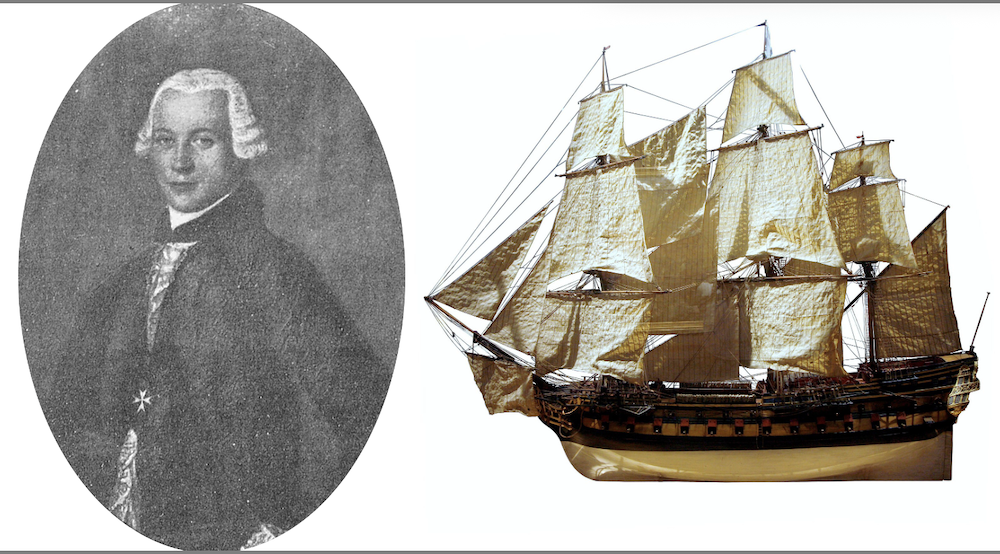
Louis-Antoine de Bougainville
80-gun Auguste
| | |
Above:
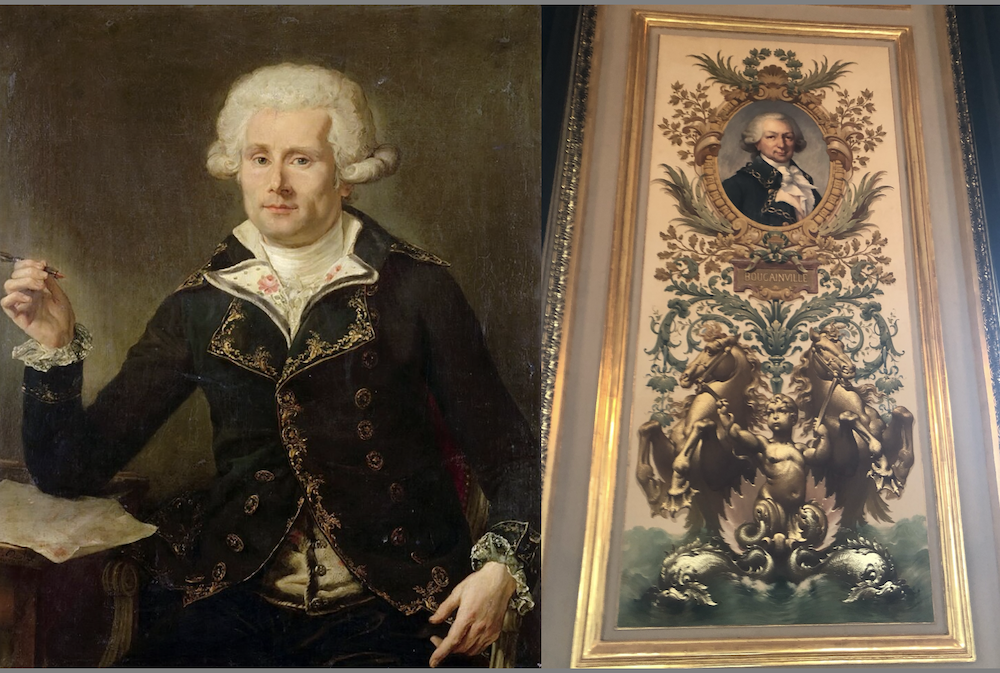
Left: Louis Antoine de Bougainville was de Grasse’s second in command. His flagship, 80-gun Auguste, was in the thick of the fight. He was the finest and most aggressive officer in the French fleet. Artwork by Joseph Decreux.
Right: Portrait of Bougainville at Hôtel de la Marine (Paris). Photo: TC © ASSFI 2021
| | |
Louis-Guillaume (frequently referred to in history as Louis-Antoine) Comte de Bougainville (November 12, 1729 – August 31, 1811) was a French military officer, naval commander, and explorer born in Paris. He trained first as a mathematician, publishing a respected treatise on integral calculus in his mid-twenties before turning to a military career, joining the French Army in 1750 and serving as aide-de-camp to General Chevert. During the Seven Years' War, he served in Canada under the Marquis de Montcalm, taking part in the capture of Fort Oswego and the Battle of Fort William Henry, and was wounded defending Fort Carillon. He remained in North America through the fall of Quebec and the final French defense of Montreal, after which the terms of surrender barred him from further combat against the British.
• He then turned to exploration: he led an expedition to settle the Falkland Islands in 1763–64, before Spain took over the colony, and in 1766 became the first Frenchman to circumnavigate the globe, commanding the Boudeuse and Étoile on a voyage that took him through Tahiti, the Solomon Islands (where Bougainville Island now bears his name), and beyond. His widely read travelogue of the voyage, particularly its idealized depiction of Tahitian society, helped popularize the concept of the "noble savage" and influenced Enlightenment thinkers including Rousseau and Diderot.
• Bougainville returned to naval command during the American Revolutionary War, captaining the 74-gun Bien-Aimé from 1777 and playing a key role in the French victory at the Battle of the Chesapeake in 1781 commanding the 80-gun Auguste.
• While Bougainville was celebrated as a hero of American independence for his brave stance at the Chesapeake, his naval career took a dramatic turn just a year later. At the Battle of the Saintes in 1782, the French fleet suffered a catastrophic defeat against the British. he managed to rally eight ships of his division and bring them safely to Saint Eustatius after de Grasse's defeat. Still, Bougainville was accused of failing to follow Admiral de Grasse's orders during that battle and was court-martialed. Though he was formally reprimanded, his massive popularity saved him, and he went on to be honored by Napoleon Bonaparte later in life.
• He was a member of the Society of the Cincinnati.
• After the war, Bougainville pursued scientific and academic pursuits, joining the Académie de Marine and, in 1787, the French Academy of Sciences. He reached the rank of vice-admiral in 1791, survived the Reign of Terror by retiring to his Normandy estate, and later helped found the Bureau des Longitudes. Napoleon made him a senator in 1799. He died in Paris in 1811, honored with burial at the Panthéon.
Legacy:
Louis-Antoine de Bougainville left a substantial mark on geography and naming: the largest eastern island of Papua New Guinea bears his name, as does the strait separating it from Choiseul Island, another strait in the New Hebrides between Mallicollo and Espiritu Santo, and two Falkland Islands sites—Port Louis and Lively Island (known in Spanish as "Isla Bougainville").
• The flowering shrub Bougainvillea is also named in his honor.
• He received further recognition later in life, made a Grand Officier de la Légion d'honneur in 1804 and granted the title of Comte de Bougainville by Napoleon in 1808.
• Thirteen French Navy ships have since been named after him.
| | |
Bougainville's role at Chesapeake
80-gun Auguste
| | |
Bougainville's actions during the battle can be broken down into three critical phases:
Leading the Scramble Out of the Bay
When Admiral de Grasse ordered the fleet to rush out of the Chesapeake Bay to face the approaching British, he threw traditional naval formation out the window, ordering the fastest ships to leave first.
Bougainville’s flagship, the 80-gun Auguste, was one of the very first warships to clear the bay and reach the open ocean. Because his squadron moved so fast, a massive gap formed between Bougainville's lead division and the rest of the slower French fleet trailing behind.
Absorbing the "Meat Grinder"
Because the French fleet was stretched out in a disorganized line, the British Royal Navy focused almost all of their firepower entirely on Bougainville's vanguard squadron.
For the first few hours of the battle, Bougainville was heavily outnumbered and cut off from the main French force. Instead of panicking or retreating, he kept his ships steady, absorbed a relentless pounding from British cannons, and fiercely traded broadsides. By refusing to give ground, he bought the rest of the French fleet the precious time they needed to exit the bay bottleneck, organize themselves, and join the fight.
Crippling the British Fleet
Bougainville didn't just play defense; he launched a devastating counter-attack.
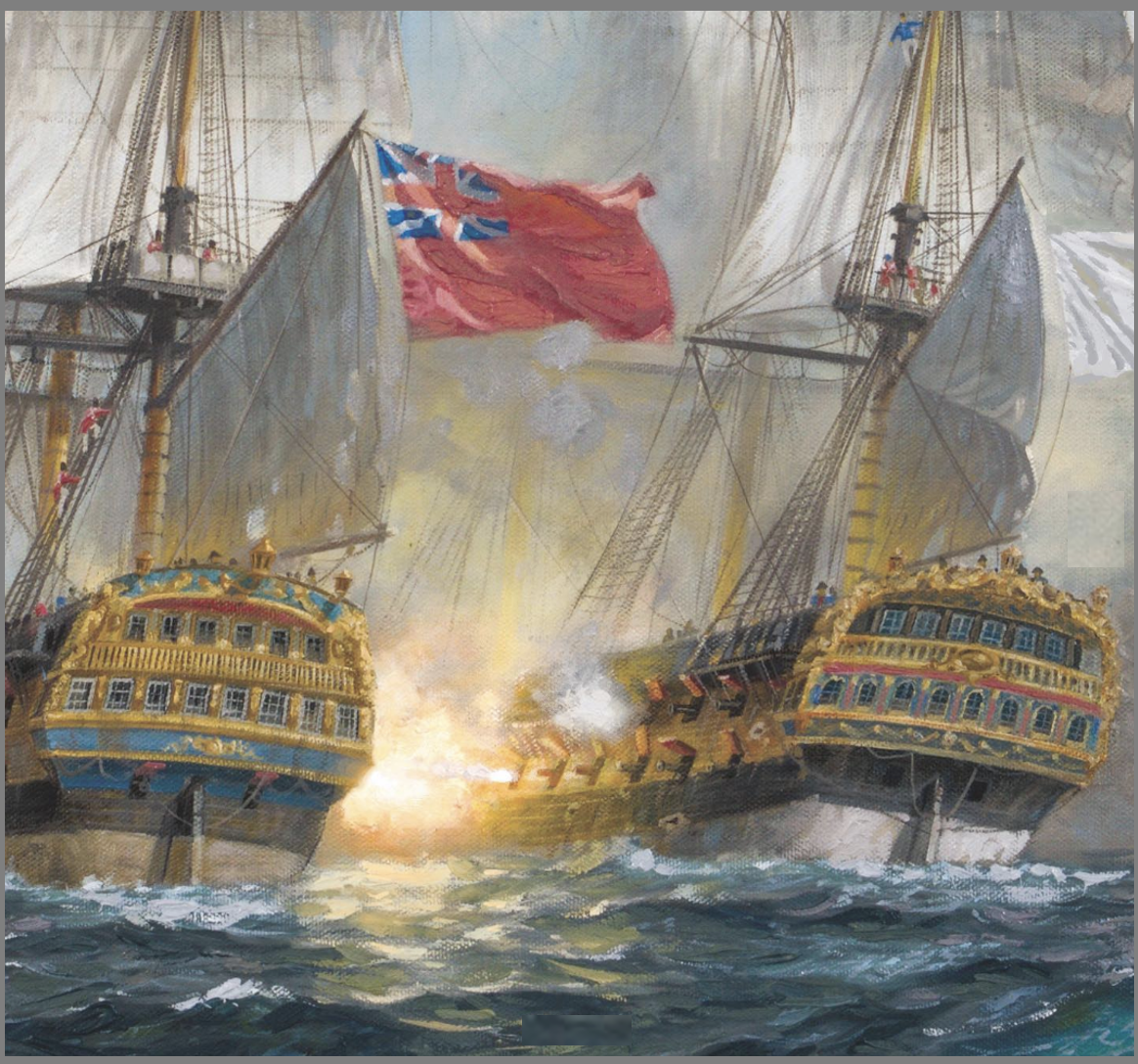
Commanding from the Auguste, he aggressively targeted the British lead ships. He locked into battle with British Admiral Francis Samuel Drake’s flagship, the HMS Princessa, and blasted it so severely that it was heavily crippled. As Drake maneuvered away to escape Bougainville's fire, the British ship behind him, the HMS Terrible, was exposed to the French guns. Bougainville's gunners battered the Terrible so badly that the British were forced to intentionally burn and sink it a few days after the battle because it was completely beyond repair.
Auguste was an 80-gun French ship of the line, laid down in 1777 and in active service from 1779 until her loss in 1795. She served in both the American Revolutionary War and the French Revolutionary Wars, most notably fighting at the Third Battle of Ushant (June 1st, 1794) before meeting a tragic end.
Soon after commissioning, she patrolled the English Channel under Captain de Rochechouart in mid-1779. During the American Revolutionary War, under Captain Pierre-Joseph de Castellan, she served as flagship of the Blue-and-White squadron under Chef d'Escadre Bougainville, fighting at the Battle of St. Lucia, the Battle of Fort Royal, and the Battle of the Chesapeake in 1781, and later at the Battle of the Saintes in April 1782.
In 1793, amid the French Revolution, she was renamed Jacobin and joined the Brest squadron, becoming caught up in the Quiberon mutinies that September. The following year, she fought at the Third Battle of Ushant, following the flagship Montagne but failing to stop HMS Queen Charlotte from breaking the French line. Renamed Neuf Thermidor in December 1794, she was wrecked with the loss of most of her crew during a storm off Brest on 29 January 1795, while taking part in the Croisière du Grand Hiver, a failed attempt by the French Republican Navy to challenge the British Royal Navy in the Atlantic (December 1794-February 1795).
| | |
François Hector d'Albert
Comte de Rioms
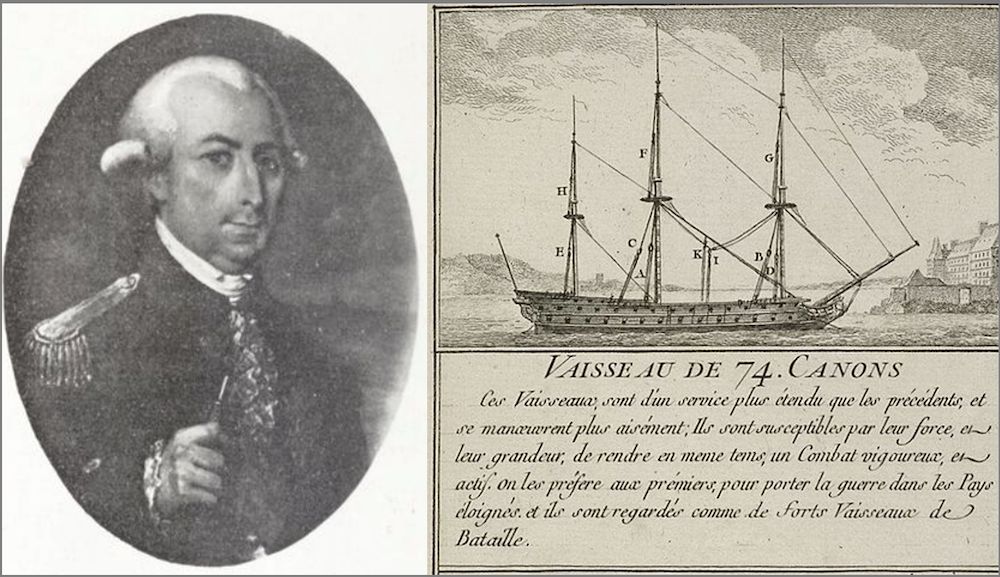
74-gun Pluton
| | |
François Hector d'Albert, comte de Rioms (February 19, 1728 – October 2, 1802), was a French Navy officer born to an Army general's family in Avignon.
• He was highly regarded as one of the most capable French sea captains of his era, notably commanding the Sagittaire under Vice-Admiral Comte d'Estaing.
• He joined the Navy as a Garde-Marine in 1743 and spent his early career escorting convoys and cruising the Mediterranean, being taken prisoner by the British twice—at Louisbourg in 1755 and at the Battle of Cartagena in 1758. He rose steadily through the ranks, becoming Lieutenant in 1756 and Captain in 1772.
• During the American Revolutionary War, he commanded several ships, including the Sagittaire, fighting at the Battle of Grenada and the Siege of Savannah, and capturing HMS Experiment in 1779. He later commanded the Marseillais and then the Pluton, seeing action at the Battle of the Chesapeake, the Battle of Saint Kitts, and the Battle of the Saintes. He was promoted to Chef d'Escadre in 1784 and took command of the Navy at Toulon the following year.
• He was a member of the Society of the Cincinnati.
• His later career was marked by conflict: as commander of Toulon's naval forces from 1788, his harsh treatment of arsenal workers amid economic hardship led to a riot in which he was seized in 1789, prompting the National Assembly to order his release. He fared no better restoring discipline at Brest afterward.
• Promoted to contre-amiral in 1792, he abandoned his post to emigrate and join the Armée des Princes, only returning to France in 1801, where he retired the following year.
Pluton was a 74-gun Scipion-class ship of the line launched at Rochefort in 1778, best known for its active combat record during the American Revolutionary War—fighting at both Battles of Martinique (1780 and 1781), the Battle of the Chesapeake (1781), the Battle of Saint Kitts (1782), and the Battle of the Saintes (1782), with François Hector d'Albert de Rions commanding for most of these engagements—before later taking part in the French expedition to Ireland in 1796, being renamed Dugommier in 1797, and ultimately being broken up in 1805 after little further active service.
| | |
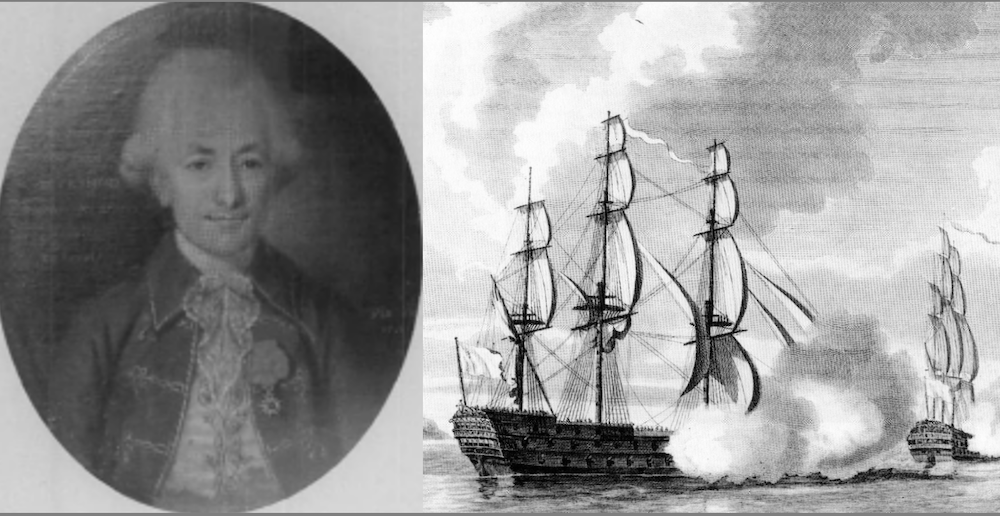
Charles de Charritte
74-gun Bourgogne
| | |
Charles de Charritte (November 1, 1733 – October 20,1815) was a French Navy officer born in Pau to a family with parliamentary standing. He joined the Navy as a Garde-Marine in 1749 and rose steadily through the ranks, becoming Lieutenant in 1763 and Captain in 1777, by which point his record already included 17 cruises and two commands.
• During the American Revolutionary War, he commanded the Auguste as flag captain to Rochechouart in 1779, then the 74-gun Bourgogne in 1781 under de Grasse's fleet. He fought at the Battle of the Chesapeake and the Battle of the Saintes, and was honored with a sword from the Estates of Burgundy for saving the Bourgogne, which they had funded. He went on to direct the harbor at Rochefort and was promoted to Chef d'Escadre in 1786.
• He was a member of the Society of the Cincinnati
• Charritte largely withdrew from public life during the French Revolution, retiring to Touraine, though the Directoire later brought him into the Conseil de la Marine in 1799. He reached the rank of contre-amiral in 1792, and under the Bourbon Restoration he was awarded the Grand Cross of the Order of Saint Louis and promoted to Vice-amiral in 1814, shortly before his death in Rennes in 1815.
Bourgogne was a 74-gun French ship of the line funded by a "don des vaisseaux" donation from the Estates of Bourgogne, commissioned in 1772 and initially serving with the Mediterranean squadron before capturing the frigate HMS Montreal alongside Victoire off Gibraltar in 1779; during the American Revolutionary War, under Charles de Charritte, she fought at the Battle of the Chesapeake and helped capture HMS Richmond on Sept.11, 1781. At the Battle of the Saintes she collided with Duc de Bourgogne , before finally being wrecked off Curaçao on 4 February 1783 with the loss of 80 of her 840 crew, an incident for which her captain was court-martialled and suspended for three months.
| |
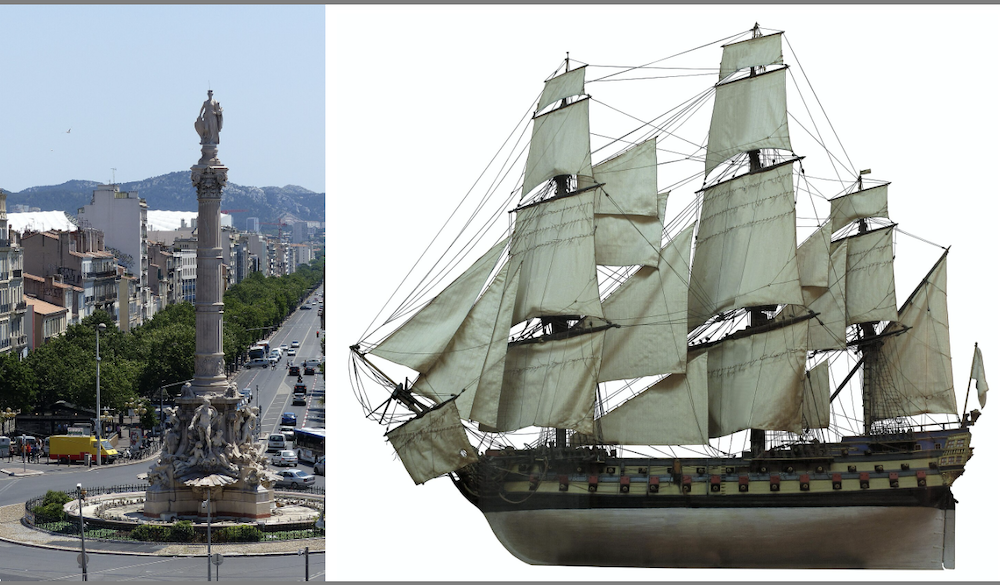
Henri-César de Castellane-Majastre
74-gun Marseillais
| |
Above:
Left: The Place Castellane with its fountain. Henri-César donated the land in 1774 for the construction of a fountain and an obelisk. By Hombrey - Own work, CC BY-SA 4.0, https://commons.wikimedia.org/w/index.php?curid=40415317
Right: Model of the Vengeur du Peuple (ex Marseillais) Photoo By Rama, Wikimedia Commons, Cc-by-sa-2.0-fr, CC BY-SA 2.0 fr, https://commons.wikimedia.org/w/index.php?curid=193198833
| |
Henri-César de Castellane-Majastre (March 28, 1733 – May 4, 1789) was a French aristocrat from the House of Castellane, born in Marseille, Provence. He built a career as a French Navy officer, rising from Gardes de la Marine in 1749 to Lieutenant in 1762 and Captain in 1775.
• He is best known for his service in the American Revolutionary War, commanding the frigate Flore and later the 74-gun Marseillais. He took part in major engagements including the invasion of Tobago, the Battle of the Chesapeake, the Siege of Yorktown, and the Battle of Saint Kitts. His wartime service earned him induction into the Society of the Cincinnati in 1782, and he was promoted to Chef d'escadre in 1784.
• He served as a representative of the nobility in the Provincial Estates held in Aix in 1788. Little is known about the final years of his life. Archival evidence confirms that he died in Riez, Provence, on May 5, 1789, though this has not prevented some authors from placing his death in 1810 while he was abroad, thereby fueling the legend of his emigration.
• Marseille's Place Castellane is named in his honor.
Marseillais (originally Marseillois, later renamed Vengeur du Peuple) was a 74-gun French ship of the line funded by a don des vaisseaux donation from the Chamber of Commerce of Marseille and launched in 1766, and she saw extensive action during the American Revolutionary War under Admiral Charles Henri Hector, Count of Estaing—dueling HMS Preston in a single-ship action in August 1778, fighting at the Battle of Saint Kitts, exchanging the day's first shots with HMS Intrepid at the Battle of the Chesapeake on 5 September 1781 while stationed in the fleet's van, and later supporting the flagship Ville-de-Paris at the Battle of the Saintes. Renamed Vengeur du Peuple in 1794, she met her end at the Third Battle of Ushant , locked in a brutal close-quarters duel with HMS Brunswick before being battered into a sinking wreck by HMS Ramillies; roughly 250 of her crew were killed in the fighting and another hundred drowned as she went down, though most were saved by British boats. Her sinking was later mythologized by members of the French Convention assembly—claims of defiant cries of "Vive la République" and a refusal to surrender became a celebrated (if largely embellished) legend of republican heroism.
| |
Georges-François Godefroy
Comte de Framond
64-gun Caton
| |
Above:
Left: Portrait de Georges-François Godefroy, comte de Framond, chevalier de Saint-Louis, capitaine de vaisseau, en 1763. Peintre anonyme (signature effacée). Huile sur toile. By Unknown author - archives of the department of Lozre, France, Public Domain, https://commons.wikimedia.org/w/index.php?curid=128698271
Right: Caton (seen at left) at the Battle of the Mona Passage, By Serres, Dominic (artist); Skelton, W (engraver); Fittler, Jame (publisher) - Beverly Robinson Collection, Public Domain, https://commons.wikimedia.org/w/index.php?curid=15123891
| |
Georges-François Godefroy de Framond de La Framondie, Count of Framond (February 4, 1733 – September 28, 1785), was a French Navy officer and aristocrat from Grèzes, Lozère, born into a family with two other Navy-serving brothers. He joined as a Garde-Marine in 1748, was promoted to Lieutenant in 1757, and commanded the xebec Caméléon during the Larache expedition in 1765. He was made a Knight in the Order of Saint Louis in 1770 and went on to command several ships in the Mediterranean, including the frigates Mignonne and Sultane, often ferrying diplomatic dispatches.
He married to Louise Stanisles Elisabeth de Bragelonde during a leave of absenceon January 5, 1775.
• Promoted to Captain in 1778, Framond commanded the 64-gun Caton during the American Revolutionary War, fighting at the Battle of Martinique in 1780 and reinforcing de Grasse's squadron at the Battle of Fort Royal in 1781. He was wounded at the Battle of the Chesapeake later that year and was promoted to Chef de Division in 1782.
• He was a member of the Society of the Cincinnati.
• Two brothers served in the Navy: Charles Auguste Framond de Grèzes (1737–1790), who became executive officer of the César in Count d'Estaing's squadron; he fought at Rhode Island in 1778, at Grenada, and at Savannah in 1779 (also a member of the Cincinnati Society of France) and Etienne Aimé, ship's captain in 1792, Knight of St. Louis (1782).
• His career ended in disgrace: in April 1782, with the Caton becalmed ahead of the Battle of the Saintes, Framond anchored at Basse-Terre without authorization, missing the battle entirely. Days later, the Caton was captured at the Battle of the Mona Passage. Court-martialed in 1783, he was found guilty, stripped of his commission, and imprisoned for life at Château de Ham. He was released in February 1785 and ordered to live at Saint-Jean-Pied-de-Port, but died just months later on September 28, 1785 at Chalette-sur-Loing near Montargis (Province of Orléanais).
Caton was a 64-gun French ship of the line launched in 1777 that served under Guichen and later De Grasse, fighting at the Battle of Martinique (1780), reinforcing De Grasse's squadron at the Battle of Fort Royal (1781), and taking part in the Battle of the Chesapeake (1781); after its capture at the Battleof theMona Passage, she was recommissioned as HMS Caton, surviving a hurricane that was believed to have sunk her, before ending her career as a prison hospital ship at Plymouth, going into harbour service in 1798, and finally being sold out of service in 1815.
| | |
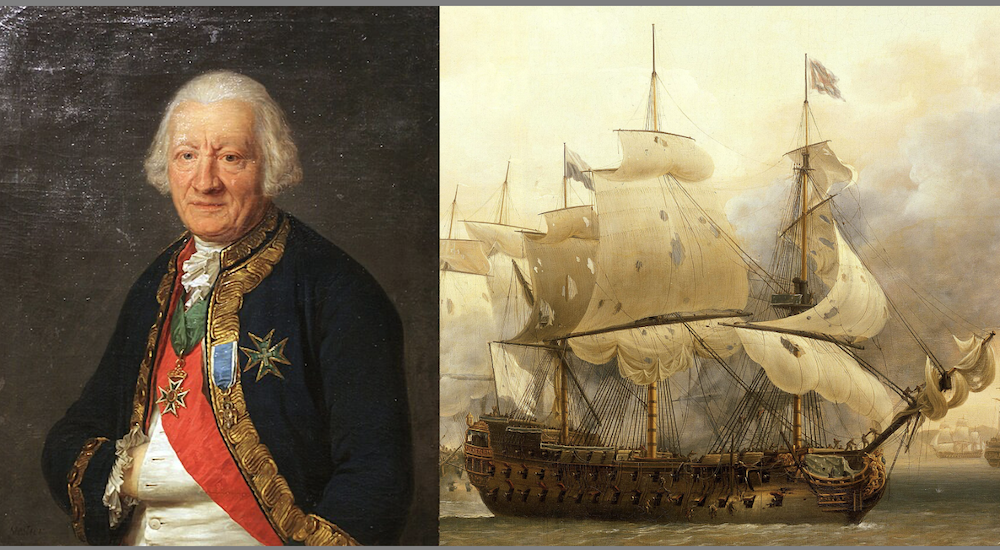
Joseph-Bernard de Chabert-Cogolin
80-gun Saint-Esprit
| |
| |
Joseph-Bernard, Marquis de Chabert-Cogolin (February 28, 1724 – December 2, 1805) was a French Navy officer born in Toulon to a naval family. He joined as a Garde-Marine in 1741, seeing early action at the Battle of Toulon, on missions to Martinique, and in the capture of a British corvette off Acadia, before being taken prisoner in 1747.
• Beyond combat, he distinguished himself as a scientist and surveyor: he charted the coasts of North America in the early 1750s, published an account of the expedition, observed a solar eclipse in Cartagena, and later tested marine chronometers on cruises to the Mediterranean—work that made him a respected member of the Académie de Marine and, eventually, a contributor to the history of longitude.
• His naval career advanced alongside this scientific work: promoted to Lieutenant in 1756 and Captain in 1771, he commanded several ships including the Atalante, on which he was badly wounded by pirate gunfire in 1776.
• During the American Revolutionary War, he captained the Vaillant and later the 80-gun Saint-Esprit, fighting at the Battle of St. Lucia, the Battle of Grenada, the Siege of Savannah, the Battle of Fort Royal, and the Battle of the Chesapeake, where he was wounded again. He also took part in the invasion of Tobago and the capture of Saint Kitts, and was promoted to Chef d'Escadre in 1782.
• He was a member of the Society of the Cincinnati.
• Chabert continued his scientific pursuits after the war, publishing on chronometers and being elected to the Royal Swedish Academy of Sciences. Promoted to Vice-Admiral in 1792, he fled France as an émigré during the Revolution, spending time in London before losing his sight around 1800. He returned to France in 1802 and was appointed to the Bureau des Longitudes, having also been honored as a Commander in the Orders of Saint Louis and Saint Lazare. He died in 1805.
Saint Esprit was a 80-gun French ship of the line launched in 1765 that fought at the Battle of Ushant under La Motte-Picquet in 1778, took part in the Armada of 1779, fought at the Battle of Fort Royal under Chabert-Cogolin in 1781 and at the Chesapeake; renamed Scipion in April 1794, she was totally dismasted at the Bataille du 13 prairial an 2 under Huguet, and was ultimately wrecked on 30 January 1795 during the Croisière du Grand Hiver, with most of her crew rescued by the 74-gun third rate shipTrente-et-un Mai.
| | |
François-Louis-Edme-Gabriel
Comte du Maitz de Goimpy
74-gun ship Destin
| | |
François-Louis-Edme-Gabriel, Comte du Maitz de Goimpy Feuquières (April 10, 1729 - December 28, 1807), was a French Navy officer born in Saint-Léger-des-Aubées (Orléanais), who joined as a Garde-Marine in 1746, rising to Lieutenant in 1757 and Captain in 1772.
• He served in the American Revolutionary War, fighting at the Battle of Martinique in 1780 and commanding the 74-gun Destin at the Battle of the Chesapeake in 1781. Alongside his active service, he was also a lecturer at the Académie de Marine.
• He continued to advance after the war, promoted to Brigadier in 1782 and to Chef d'Escadre in 1784.
Destin was a French ship of the line laid down in April 1770, though construction extended past 1774 before she was officially launched on October 21, 1777. She cruised the Eastern Mediterranean in 1778 before being assigned to the American squadrons in 1780, going on to fight at the Battle of the Chesapeake (1781) and the Battle of the Saintes (1782); after Flotte took command from Goimpy in August 1782 and sailed to reinforce Córdova's fleet at Cádiz, she was laid up in ordinary at Toulon in 1783, and was ultimately seized by Royalist insurgents during the Siege of Toulon before being surrendered to the British, who scuttled her when they evacuated the city in December 1793.
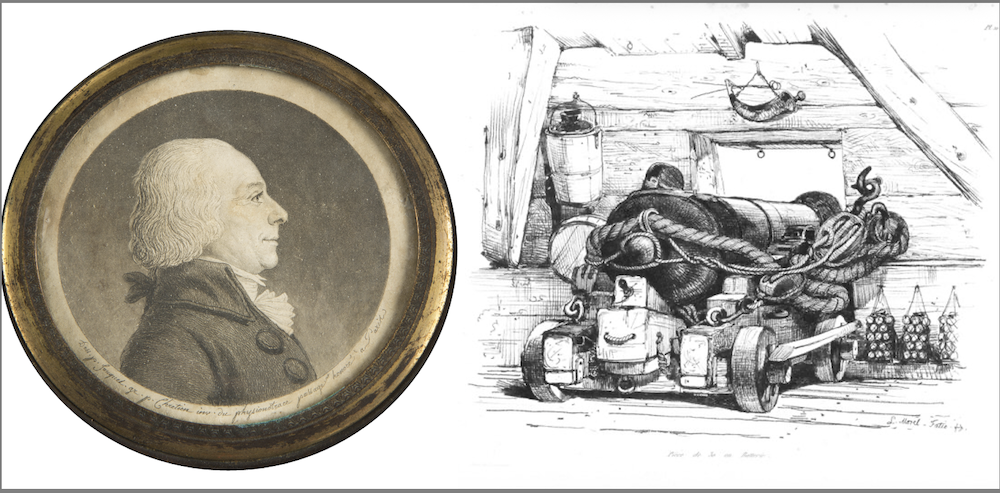
A word about the 74-gun ships and their 36-pounders:
The 36-pounder long gun was the most formidable naval weapon of the French Age of Sail, firing a shot of roughly 17.6 kg—far heavier than anything the Army fielded—and was reserved for the lower decks of the largest warships, where a 74-gun ship of the line would carry 28 of them, an 80-gun ship 30, and the mighty 110- and 120-gun vessels 32 apiece, making these decks the most devastating striking power afloat, since heavier 48-pounders proved too cumbersome for shipboard use and were largely confined to coastal batteries. Operating one of these guns was a demanding, choreographed process requiring a disciplined 14-man crew: gunners would load a powder cartridge, ram it home, insert the shot and wadding, ram again, haul the gun into firing position with ropes, prime the touch hole, aim under the chief gunner's direction, and finally fire it with a linstock (or later, a flintlock mechanism), before swabbing the barrel clean to prepare for the next devastating broadside.
It would take a minute and a half to three minutes to reload and fire again, however this could be seriously disrupted in actual naval combat, with wood splinters (and limbs) flying everywhere...
| |
|
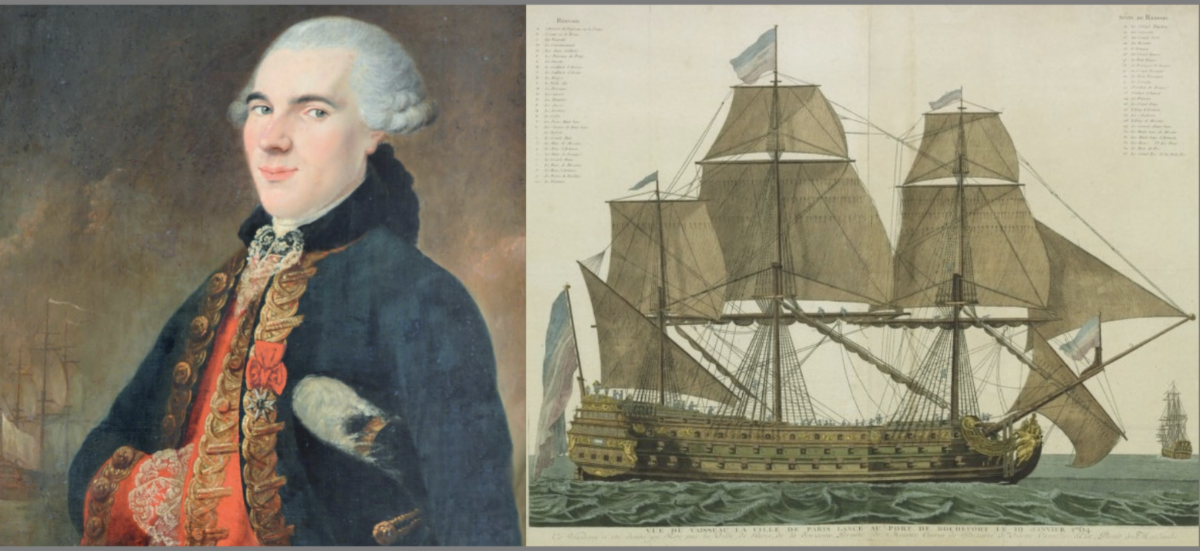
Antoine Cresp de Saint-Césaire
104-gun Ville-de-Paris
| |
Above:
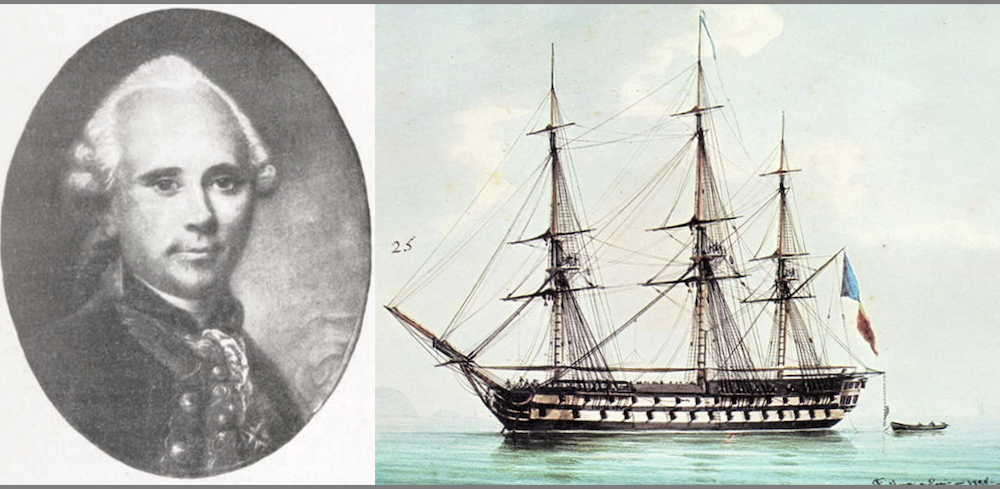
Left: Antoine Cresp de Saint-Cézaire, By Unknown (French school) - Public Domain, https://commons.wikimedia.org/w/index.php?curid=89992830
Right: Ville de Paris in Rochefort, 1764, By Unknown author - Europeana, Public Domain, https://commons.wikimedia.org/w/index.php?curid=20944788
| |
Antoine Cresp de Saint-Césaire (October 19, 1731 – April 12, 1782) was a French Navy officer born in Saint-Cézaire-sur-Siagne (Provence), and nephew to the famed Admiral de Grasse. He rose to Captain and was made a Knight in the Order of Saint Louis, and moved in prominent social circles—he was a close friend of Mirabeau and served as best man at his wedding.
• During the American Revolutionary War, Saint-Césaire served as de Grasse's flag captain aboard the 110-gun flagship Ville-de-Paris at the Battle of the Chesapeake in September 1781. The following year, he took command of the 74-gun Northumberland, and was killed in action at the Battle of the Saintes on 12 April 1782.
• He was a member of the Society of the Cincinnati.
• His hometown later honored his memory: on 3 July 1976, a commemorative plaque was unveiled at the Saint-Cézaire-sur-Siagne city hall. The ceremony brought together Admiral Frederick C. Turner, Commander of the United States Sixth Fleet; Rear-Admiral Fernand Victor Robin, commander of the French Navy's Mediterranean squadron; and Marcel Andreis, the town's Mayor.
Ville-de-Paris was a French ship of the line launched in 1764 with 90 guns—later increased to 104 following a 1779 refit—and, funded through the "don des vaisseaux" program, she served as the flagship of Admiral François Joseph Paul de Grasse during the American Revolutionary War until her final battle, the Battle of the Saintes in 1782, where she was captured by the Royal Navy; while being transported to England as a prize, she was ultimately lost with most hands when she sank in the 1782 Central Atlantic hurricane.
| |
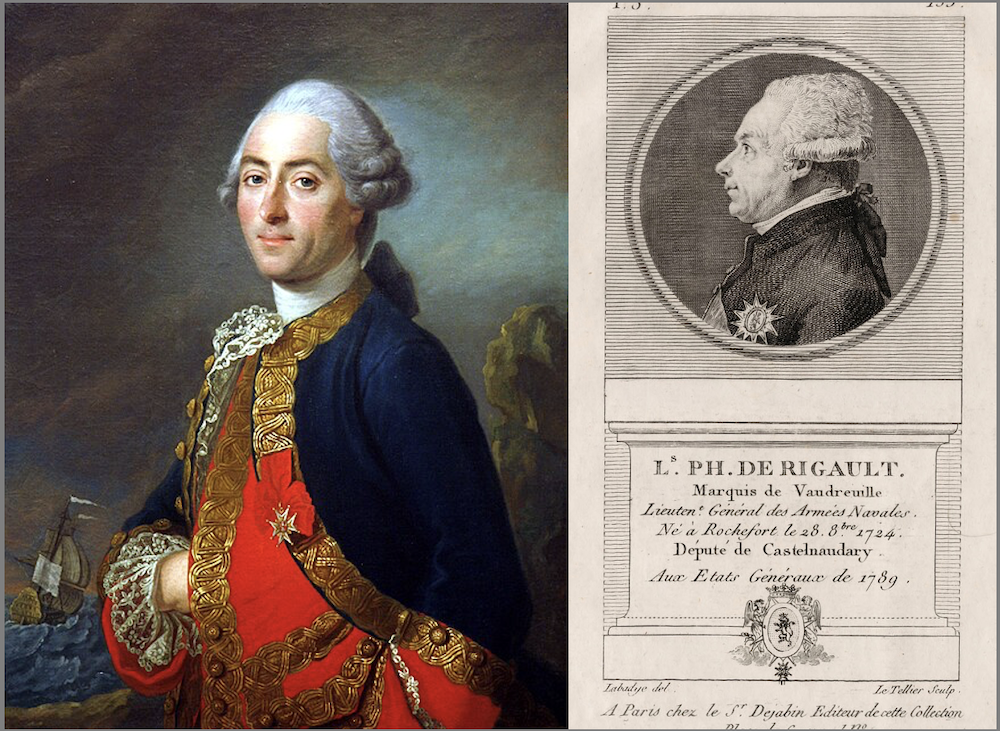
Louis-Philippe de Rigaud
Marquis de Vaudreuil
74-gun Sceptre
| |
Above:
Left: 1750 portrait of Vaudreuil by Claude Arnulphy, Public Domain, https://commons.wikimedia.org/w/index.php?curid=5188723
Right: Profile portrait of the Marquis de Vaudreuil (1724–1802). Naval officer during the American War of Independence. By an unknown artist. — Domaine public, https://commons.wikimedia.org/w/index.php?curid=12343580
| |
Louis-Philippe de Rigaud, marquis de Vaudreuil, (October 28, 1724 - October 14, 1802), born in Rochefort (Province of Aunis), played a significant role in France's naval campaigns during the American War of Independence. When France entered the war in 1778, he was serving under Lieutenant General d'Orvilliers and commanded the Fendant at the Battle of Ouessant that July.
• He then led an expedition to reclaim French positions in Senegal before joining d'Estaing's fleet in the Caribbean in 1779, distinguishing himself at the Battle of Grenada and earning promotion to Chef d'Escadre that same year. In 1780, still aboard the Fendant, he fought in several engagements against Rodney's fleet under Guichen, including the Battle of Martinique.
• His second American campaign began in December 1781, when a convoy he was escorting alongside Guichen suffered heavy losses to a British interception near Ouessant. He reached Martinique in early 1782 aboard the Triomphant, placing himself under de Grasse's command and taking charge of the vanguard. In the decisive Battle of the Saintes he was credited with saving the majority of the French fleet; when de Grasse was captured aboard the Ville-de-Paris, Vaudreuil assumed command of the French navy in American waters. He was promoted to Lieutenant General that August.
• He was a member of the Society of the Cincinnati.
• Later in 1782, from his base in Boston, he ordered La Pérouse to strike British positions via Hudson Bay, a mission that succeeded.
• At the war's end in 1783, he was entrusted with bringing Rochambeau's victorious army home to France, and was granted a pension the following year in recognition of his service.
Sceptre was a 74-gun French ship of the line built under the Ancien Régime that fought under Admiral de Grasse at the Battle of the Chesapeake and, under Louis de Rigaud de Vaudreuil, against HMS Formidable at the Battle of the Saintes in 1782, before joining La Pérouse's raids on English fur trading posts during the Hudson Bay Expedition and being decommissioned at Brest in 1783; renamed Convention in 1792, she went on to engage HMS Caesar and Bellerophon at the Third Battle of Ushant in 1794, took part in the Croisière du Grand Hiver, the Expédition d'Irlande, and Bruix's expedition of 1799, and was finally renamed Marengo in 1800 before being condemned in 1802, used as a prison hulk at Brest, and broken up in 1811.
| |
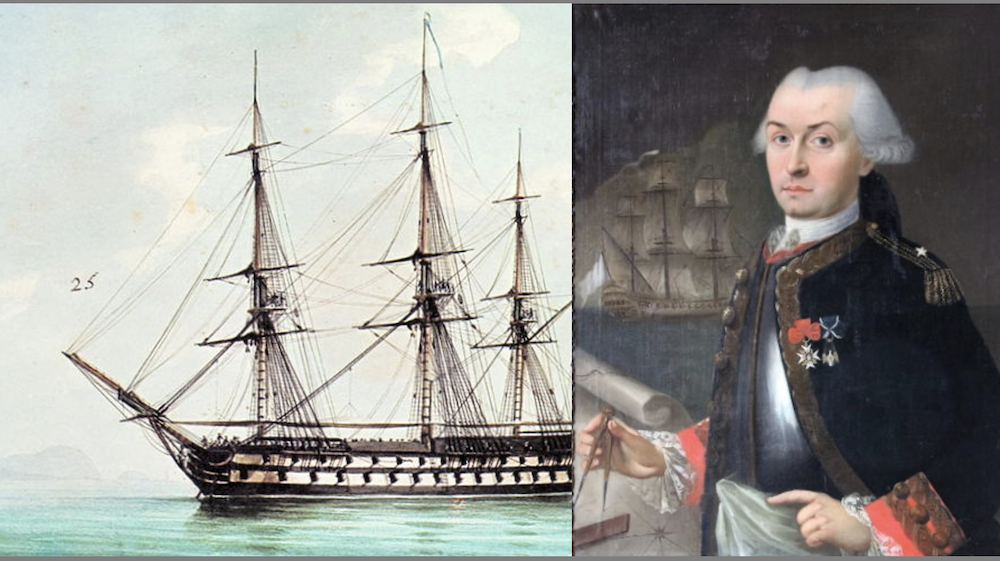
Comte Antoine Pierre De Clavel
74-gun Scipion
| |
Above:
Left: Pluton, Scipion's sister ship, By François Geoffroi Roux - Frederic Roux - Watercolours C. From L'Album de L'Amiral Willaumez, Public Domain, https://commons.wikimedia.org/w/index.php?curid=90892355
Right: Portrait of Comte Antoine Pierre De Clavel, dit l'Aîné, By Unknown author - Public Domain, https://commons.wikimedia.org/w/index.php?curid=89975375
| |
Antoine Pierre de Clavel (1734–1797) was a French Navy officer born in Toulon to a Navy captain's family, with a brother who also served. He joined the Navy as a Garde-Marine in 1750, was promoted to Lieutenant in 1763, and reached Captain in 1777.
• During the American Revolutionary War, he commanded the Scipion at both the Battle of the Chesapeake in September 1781 and the Battle of the Saintes in April 1782. He retired from the Navy on 21 November 1785.
• He was made a member of the Society of the Cincinnati.
Scipion was a 74-gun Scipion-class French ship of the line completed in 1779. She served in the American War of Independence, sailing at the rear of the French squadron under Antoine Pierre de Clavel at the Battle of the Chesapeake, before meeting a dramatic end in the Action of 18 October 1782, when, under Captain Nicolas Henri de Grimouard, she fought gallantly against two larger British ships of the line, skillfully damaging HMS London and escaping the engagement, only to run aground and be destroyed the following day after being chased down.
| |
Louis Guillaume de Parscau du Plessix
90-gun Languedoc
| |
Above:
Left: Louis Guillaume de Parscau du Plessix: "Chef d'escadre chevalier de Parscau du Plessix, au comte de Parscau” By Unspecified - Ludovic de Contenson, La Société des Cincinnati de France et la guerre d'Amérique (1778-1783), Public Domain, https://commons.wikimedia.org/w/index.php?curid=90408004
Right: Model of Languedoc, at the Ships of the Sea Maritime Museum, Savannah, GA
Photo: TC © ASSFI 2023
| |
Louis Guillaume de Parscau du Plessix (July 5, 1725 – May 8, 1786) was a French Navy officer born in Saint-Malo, Brittany, to an Ensign's family. He joined as a Garde-Marine in 1743 and served during the Seven Years' War aboard the Brillant under Conflans, being promoted to Lieutenant in 1756. He had a son, Hervé Louis Joseph Marie de Parscau du Plessix, in 1762.
• Promoted to Captain in 1772, he commanded the Roland—one of six ships kept on permanent standby by Navy Minister Sartine—and later served as flag captain to Orvilliers aboard the 110-gun Bretagne in 1779.
• During the American Revolutionary War, he commanded the 74-gun Intrépide, fighting at the Battle of Martinique and the Siege of Pensacola, until the ship exploded in an accidental fire in 1781—an incident for which de Grasse absolved him of blame and secured him a new command.
• Parscau went on to captain the 80-gun Languedoc as flag captain to Monteil at the Battle of the Chesapeake, afterward carrying the Duc de Lauzun with news of the Yorktown victory back to France.
• He was promoted to Brigadier in 1782, commanding the Guerrier under Córdova, and reached Chef d'Escadre in 1784.
• His service earned him membership in the Society of the Cincinnati.
Languedoc was an 80-gun French ship of the line, offered to Louis XV by the Estates of Languedoc as part of the "don des vaisseaux" program and designed by Joseph Coulomb, though shipyard delays at Toulon meant she took years to complete; upgraded to 90 guns, she became the flagship of Admiral d'Estaing for his mission to America in 1778, surviving a devastating tempest that wrecked her rigging and left her vulnerable to HMS Renown before Suffren's timely arrival saved her, and going on to fight at the Battle of St. Lucia and the Capture of Grenada. She later served under de Grasse's fleet at the Battle of the Chesapeake in 1781 and, under Captain Arros d'Argelos, followed the flagship Ville-de-Paris at the Battle of the Saintes in 1782, though she retreated when the French line was broken, leaving De Grasse to be captured—an inquiry subsequently cleared Argelos of blame. Refitted by engineer Jacques-Noël Sané, she served in the French Revolutionary Wars under de Latouche Tréville off Italy, survived Toulon's occupation by the English, and was successively renamed Antifédéraliste and then Victoire during the political upheavals of the Revolution, going on to confront Nelson's squadron off Italy and serve off Canada, before being deemed too old for the Irish expedition and finally condemned at Brest in 1798.
| |
Charles-René de Gras-Préville
74-gun Zélé
| |
Above:
Left: Portrait de Charles-René de Gras-Préville, dit chevalier de Gras-Préville, brigadier des armées navales., By Pce13 - Ludovic de Contenson, La Société des Cincinnati de France et la guerre d'Amérique (1778-1783), Paris, Auguste Picard, 1934, p. 184., CC BY-SA 4.0, https://commons.wikimedia.org/w/index.php?curid=126651704
Right: Model of Protecteur, Zélé's sister ship By Med, CC BY-SA 3.0, https://commons.wikimedia.org/w/index.php?curid=5183352
| |
Charles-René de Gras-Préville (April 30, 1732 – December 11, 1793) was a French Navy officer born in Tarascon (Provence), to an aristocratic family, and uncle to René Louis Dominique de Gras-Préville. He joined the Navy as a Garde de l'Étendard in 1746, rose to Ensign in 1754 and Lieutenant in 1762, and was promoted to Captain in 1777 despite relatively little command experience.
• During the American Revolutionary War, he commanded the frigate Engageante, capturing the British privateer Rose in 1778 and later defending a convoy from Martinique, which earned him a pension. Promoted to command the 80-gun Triomphant in 1779, he served as flag captain at the Battle of Martinique in 1780. In 1781, he took command of the 74-gun Zélé under de Grasse, taking part in the invasion of Tobago and the Battle of the Chesapeake; the ship was later damaged in a collision with the Ville de Paris in April 1782.
• He was made a member of the Society of the Cincinnati.
• Gras-Préville retired from the Navy in 1786. During the French Revolution, he joined the Royalist army and fought at the Siege of Lyon in 1793, but was captured by Republican forces and executed by firing squad on 11 December that year.
Zélé was a 74-gun French ship of the line funded by a don des vaisseaux donation from the Régisseur général des finances, and she saw active service throughout the American Revolutionary War—fighting in the vanguard at the Battle of Grenada in 1779, joining Bruyères-Chalabre's blockade during the Siege of Savannah, and later serving in de Grasse's fleet during the Invasion of Tobago and the Battle of the Chesapeake in 1781 under Charles-René de Gras-Préville; her most consequential moment, however, came on the night of 11–12 April 1782, when a collision with the flagship Ville-de-Paris left her badly damaged and forced to be towed to Martinique for repairs, an incident that helped trigger the disorganization leading to the French defeat at the Battle of the Saintes later that same day. She was ultimately broken up in May 1806.
| | |
Other French Captains
Vanguard Flag Division
| |
Above:
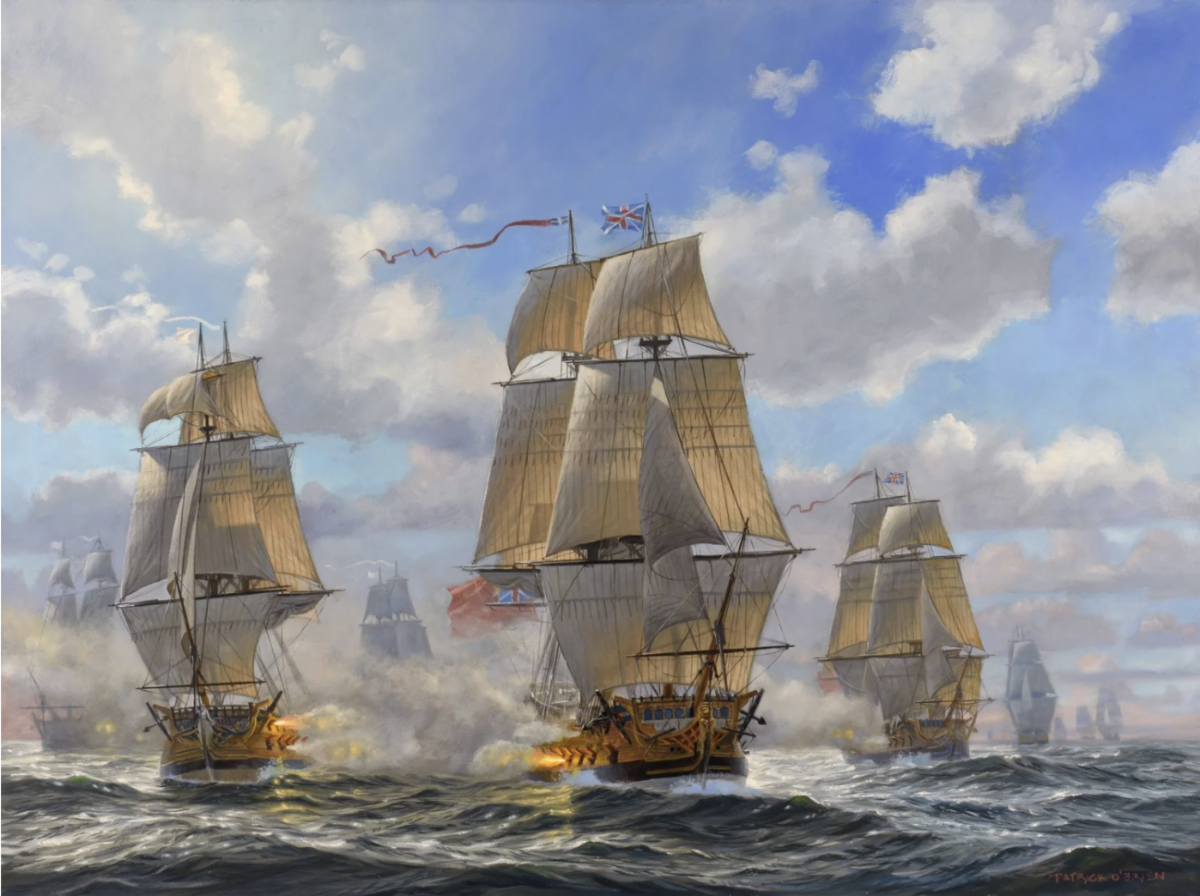
Oil painting of the Battle of the Chesapeake. These ships are 74-gun ships-of-the-line.
By O'Brien Studios, artist (American, 1960-) at: https://www.patrickobrienstudio.com/
| |
Pierre-Joseph de Castellan (June 21, 1733 - April 12, 1812) was a French Navy officer born in Saint-Martin-sur-Oust, Morbihan (Brittany) who served during the War of American Independence. He joined the Navy as a Garde-Marine on 10 April 1748, and rose through the ranks over the following decades—becoming a Lieutenant in 1762 and finally Captain in 1779.
• His most notable service came as commander of the 80-gun ship Auguste, in which he fought in two major engagements: the Battle of the Chesapeake in September 1781 and the Battle of the Saintes in April 1782. In both battles, he served as flag captain to Louis Antoine de Bougainville, a trusted role placing him aboard the ship carrying the senior commander.
• He was made a member of the Society of the Cincinnati.
• Castellan retired from the Navy on 25 March 1785, having attained the rank of Brigadier.
Louis Augustin de Monteclerc (September 14, 1727 – Mars 25, 1784) was a French Navy officer from La Rongère, in the French Province of Maine, who served in the American Revolutionary War. He joined the Navy as a Garde-Marine in 1743 and was promoted to Lieutenant in 1757, serving under Conflans during the Seven Years' War aboard the Éveillé.
• Promoted to Captain in 1772, he commanded the Bizarre—one of six ships Navy Minister Sartine kept on permanent standby—and later led a division that captured 400 prisoners hunting privateers in 1779.
• That same year he was named vice-Director, then Director, of naval construction at Brest, while also commanding the Hector. Promoted to Brigadier in 1781, he took command of the 74-gun Diadème under de Grasse, was wounded at the Battle of the Chesapeake, and fought at the Battle of the Saintes the following year.
• In addition to being a chevalier of the Ordre Royal et Militaire de Saint-Louis, he was made a member of the Society of the Cincinnati
• Following the Saintes, Monteclerc was acquitted in the subsequent inquiry into the battle's conduct. He served briefly under Vaudreuil before retiring in 1783, and died the following year in Quimper, Brittany.
Diadème was the lead ship of the Diadème-class 74-gun French ships of the line, notably capturing HMS Greenwich alongside Éveillé off Saint-Domingue in 1757; during the American Revolutionary War, she served under de Grasse and fought at the Battle of the Chesapeake under Louis Augustin de Monteclerc, before playing a costly role at the Battle of the Saintes in 1782, where the gap between her and the mastless Glorieux allowed HMS Formidable to break the French line, leaving Diadème severely damaged and forced to withdraw. Renamed Brutus in 1792, she was razéed down to a 42-gun frigate in 1794 and went on to fight at the Third Battle of Ushant, notably taking the damaged Indomptable under tow, before finally being broken up in 1797.
Armand-François Marie Cillart de Suville (February 1, 1730 – June 30, 1801) was a French Navy officer born in Séglien (Brittany) to a military family; his father was a dragoon captain, and two of his brothers also served in the Navy. He joined as a Garde-Marine in 1746 and served during the Seven Years' War aboard the Robuste, including an expedition to Newfoundland under Ternay. He was promoted to Lieutenant in 1771 and Captain in 1777.
• During the American Revolutionary War, he commanded the Réfléchi, was wounded at the Battle of Grenada in 1779, and fought at the Battle of Martinique later that year under Lamotte-Picquet. He also took part in the Battle of the Chesapeake in 1781.
• He was made a member of the Society of the Cincinnati.
• Promoted to Brigadier in 1782, he commanded the Actif at the Battle of Cape Spartel that same year. His career continued to advance in the following years: he became Chef d'Escadre in 1786 and reached the rank of contre-amiral in 1792. He died in Jersey in 1801.
Réfléchi (also referred to as Réfléchy) was a 64-gun Solitaire-class French ship of the line that, under Captain Cillart de Suville in the White squadron of Admiral d'Orvilliers's fleet, helped save a convoy from the British at the Battle of Martinique in December 1779 alongside Annibal and Vengeur; she went on to fight Hyde Parker's squadron off Saint Domingue in the action of 20 March 1780 alongside Diadème, Amphion, and Annibal, and was later present at the Battle of the Chesapeake. After a stint at the Martinique station under Captain Du Bois in 1783, she was hulked at Brest in November 1788 and ultimately broken up around 1793, having by then been renamed Turot.
| | |
Other French Captains
Center Flag Division
| | |
Above:
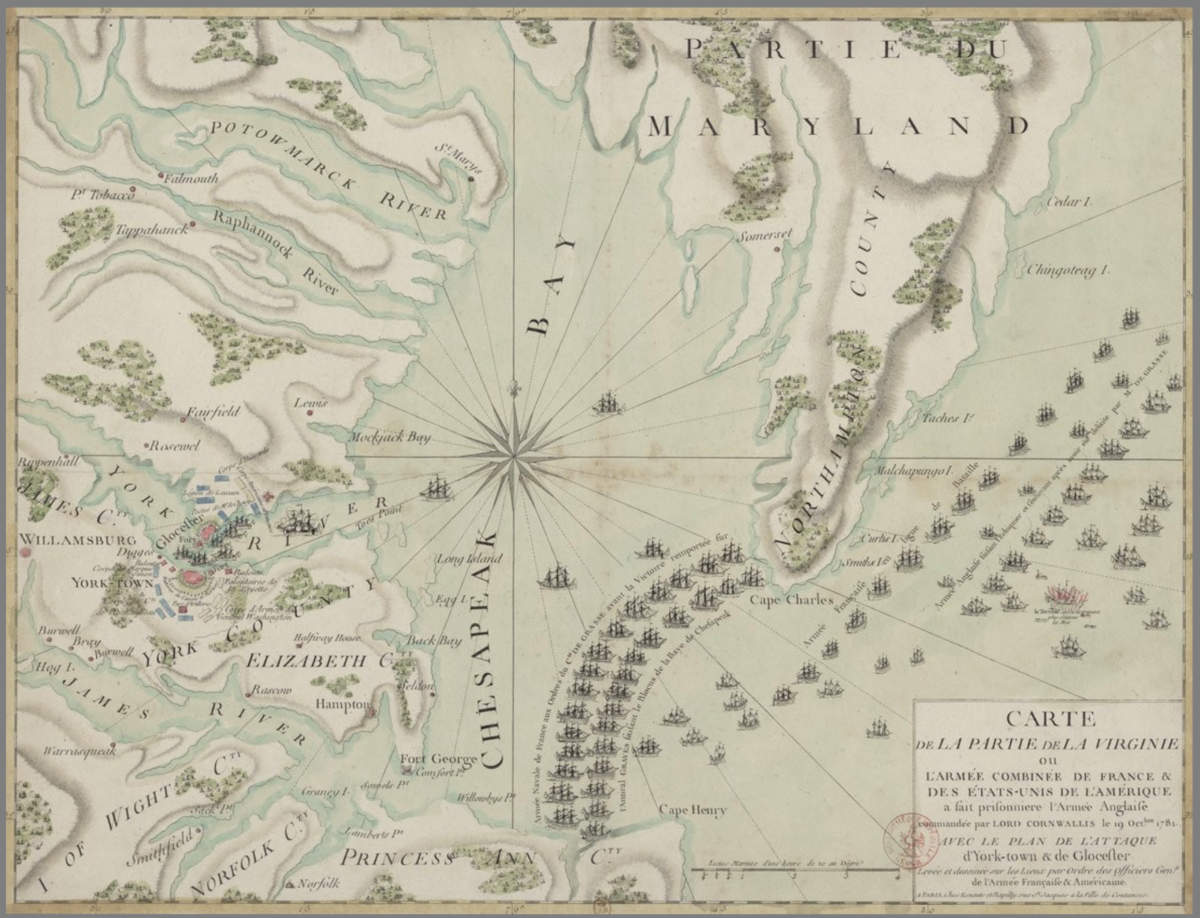
"Carte de la Partie de la Virginie ou l'Armée combinée de France & des Etats-Unis de l'Amérique a fait prisonnière l'Armée Anglaise commandée par Lord Cornwallis le 19 Octobre 1781. Avec le Plan de l'Attaque d'York-town & de Glocester. Levée et dessinée sur les Lieux par Ordre des Officiers Genx. de l'Armée Française et Américaine”, Esnauts & Rapilly (Paris). Bibliothèque Nationale de France, https://gallica.bnf.fr/ark:/12148/btv1b8492773g.r=yorktown?rk=128756;0#
| | |
Charles Régis de Coriolis d'Espinouse (March 26, 1725–1793) was a French Navy officer from Aix-en-Provence who served in the American Revolutionary War.
• He joined as a Garde-Marine in 1741 and was promoted to Lieutenant in 1756, spending his early career commanding smaller vessels like the xebec Requin and the corvette Flèche on missions to Corsica and around Toulon.
• Promoted to Captain in 1771, he commanded a series of increasingly powerful ships through the 1770s, including the frigate Aurore in the Mediterranean and the 64-gun Caton and Destin as part of larger French squadrons. In 1781, he took command of the 74-gun César, leading her at the Battle of the Chesapeake.
• He was promoted to Chef d'Escadre in January 1782 and went on to fight in the Battle of Saint Kitts and the subsequent invasion of the island. Later that year, he transferred to the 80-gun Duc de Bourgogne, commanding her at the Battle of the Saintes in April 1782.
• He was promoted Commander of the Order Saint-Jean de Jérusalem in 1783 (he was made a Chevalier in 1737) and made a member of the Society of the Cincinnati. The exact date and place of his death in 1793 is unknown.
César was a 74-gun French ship of the line launched at Toulon in 1768, and she served throughout the American Revolutionary War—sailing with d'Estaing's fleet from 1778, battling HMS Iris (where Captain Raimondis lost an arm), and fighting at the Battle of St. Lucia and the Battle of Grenada before returning to France for refit. In 1781–82, under Charles Régis de Coriolis d'Espinouse in de Grasse's fleet, she fought at the Battle of Fort Royal, covered the Invasion of Tobago, took part in the decisive Battle of the Chesapeake, and fought at the Battle of Saint Kitts, before meeting a catastrophic end at the Battle of the Saintes on 12 April 1782, where she was dismasted and captured by HMS Centaur; that night, an accidental fire started by the British prize crew reached her magazine and caused a massive explosion, killing around 400 French sailors and 50 British crew—including her own captain, Bernard de Marigny—in one of the deadliest losses suffered by the French Navy during the war.
Joseph François Auguste Jules d'Albert de Saint-Hippolyte (May 4, 1726 - March 9, 1799) was a French Navy officer born in Aix-en-Provence who served in the American Revolutionary War, earning membership in the Society of the Cincinnati. He joined as a Garde-Marine in 1741, was promoted to Lieutenant in 1756, and reached Captain in 1771.
• He commanded a succession of ships through the 1770s, including the frigate Sultane at Toulon and the 74-gun Victoire, which he led into the Battle of Martinique in 1780 and the capture of HMS Montreal in 1779. He also captained the Victoire at the Battle of the Chesapeake in September 1781.
• Later that year, he commanded a four-ship division escorting a large convoy back to France alongside Chabert-Cogolin's Saint-Esprit. He was promoted to Chef d'Escadre on 12 January 1782.
• He was a member of the Society of the Cincinnati.
Victoire was a Bien-Aimé-class 74-gun French ship of the line that departed Toulon for the Mediterranean in 1778 under Captain d'Albert Saint Hippolyte, capturing HMS Industry and the 10-gun Levant that same year; in 1779, she joined Bourgogne in capturing HMS Montreal off Gibraltar and confronted HMS Thetis the following day. She went on to fight at the Battle of Martinique and the Battle of the Chesapeake, before being decommissioned at Brest in 1782 and broken up in 1792.
Bon Chrétien de Bricqueville, seigneur of Roncey and Neuville-au-Plain, (October 20, 1726 - January 2, 1803) was a French naval officer born in Bretteville-en-Saire in Normandy. He joined the Navy young, becoming Garde de la Marine at seventeen in 1743, and climbed steadily through the ranks as an "officier bleu"—Ensign in 1748, Lieutenant in 1756, artillery Captain in 1762, and frigate Captain in 1767.
• He was made a Knight of Saint-Louis in 1763 and received his commission as ship's Captain in 1772, the same year he was named a naval major.
• During the American Revolutionary War, he commanded the 64-gun Solitaire at the Battle of Ushant in July 1778. He later sailed with de Grasse's fleet from Brest in 1781, commanding the 74-gun Northumberland at the Battle of Fort Royal against Admiral Hood's British fleet, and fought at the Battle of the Chesapeake that September. He took command of L'Aigrette in 1782.
Bricqueville was promoted to Chef d'Escadre in 1784, following the Peace of Paris.
• He was also a member of the Académie de marine and a founding member of the Society of the Cincinnati of France. He died in Valognes, Normandy, on 2 January 1803, at the age of 76.
Northumberland was a 74-gun Annibal-class French ship of the line that fought at the Battle of the Chesapeake in 1781 under Bon Chrétien de Bricqueville, and at the Battle of the Saintes the following year under Captain Cresp de Saint-Césaire, who was killed in the action—the ship herself was saved thanks to Swedish officer Henrik Johan Nauckhoff, then serving with the French to gain combat experience. She went on to capture the sloop HMS Allegiance in 1782, but was herself captured by the British at the Third Battle of Ushant in 1794 under Captain François-Pierre Étienne; recommissioned into the Royal Navy as HMS Northumberland, she was broken up the following year, in December 1795.
Jean-François d'Arros d'Argelos (August 20, 1730 – September 9, 1791) was a French Navy officer born in Arthès (Languedoc)to a Navy Captain's family, and D'Arros Island bears his name in his honor. He joined as a Garde-Marine in 1744 and was promoted to Lieutenant in 1756, spending his early career commanding a series of ships between France, the Caribbean, and Brazil—including the fluyt Balance, which wrecked near Madeira in 1768.
• Promoted to Captain in 1772, he commanded the 64-gun Indien in the Indian Ocean before taking charge of the 80-gun Auguste at Brest in 1780 as flag captain under Chef d'Escadre Rochechouart.
• During the American Revolutionary War, he commanded the 74-gun Palmier at the Battle of the Chesapeake in 1781, earning promotion to Brigadier the following year.
• At the Battle of the Saintes in April 1782, commanding the 80-gun Languedoc, he was among the officers de Grasse blamed for the French defeat in the inquiry that followed, though he was ultimately acquitted of all charges. He continued to advance nonetheless, reaching Chef d'Escadre in 1784, and was also a member of the Académie de Marine.
• He was a member of the Socidety of the Cincinnati.
Palmier was a 74-gun French ship of the line launched in 1752 that fought at the Battle of Ushant in 1778 under Henry-César Boscal de Réals as part of d'Orvilliers's vanguard; sent to the Antilles in 1780 with Guichen's fleet, she fought at the Battle of Martinique and two other indecisive engagements against Rodney, before serving as François-Aymar de Monteil's flagship at the Siege of Pensacola in 1781. She then joined de Grasse's fleet, fighting at the Battle of the Chesapeake, the Battle of St Kitts, and the Battle of the Saintes as part of the rearguard, before being retired from active service later that year—only to be lost with the fleet's return voyage when she sank in a major storm off Bermuda on 24 October 1782.
Louis-Toussaint Champion de Cicé, Comte de Coueguel (August 5, 1732 – January 28, 1792) was a French Navy officer born in Rennes (Brittany) to an aristocratic family with dragoon military roots. He came from a notable family—his brothers included a future bishop and Jérôme Champion de Cicé, who served as Minister of Justice and helped draft the Declaration of the Rights of Man and of the Citizen.
• He joined the Navy as a Garde-Marine in 1746, was promoted to Lieutenant in 1757 and Captain in 1772, and married Jeanne-Geneviève-Henriette de Fusée de Voisenon in 1767.
• During the American Revolutionary War, he served as first officer on the Zodiaque in 1778, then took command of the 64-gun Solitaire in 1780 under Guichen. He fought at the Battle of Fort Royal in 1781, and later served under de Grasse at the Battle of the Chesapeake and the subsequent Siege of Yorktown, earning membership in the Society of the Cincinnati for his service.
• He continued to rise afterward, promoted to Brigadier in 1782 and to Chef d'Escadre in 1784.
• He was a Chevalier de l'Ordre royal et militaire de Saint Louis and a member of the Society of the Cincinnati.
• He died in Paris at the age of 60.
Solitaire was a 64-gun French ship of the line, lead ship of her class, built by Antoine Groignard and launched in 1774; she served as flagship under Chef d'Escadre Chartres in 1776, fought at the Battle of Ushant in 1778 under Captain Briqueville, and led an anti-privateer expedition under Louis Augustin de Monteclerc in 1779 that brought back 400 prisoners. She later fought at the Battle of Fort Royal in 1781 under Cicé-Champion, before being captured by the Royal Navy on 6 December 1782, when Captain de Borda's squadron ran into a British force under Rear-Admiral Richard Hughes near Martinique—Solitaire engaged HMS Ruby to buy time for the rest of the French squadron before being forced to strike, in an action that also saw the brig Speedy captured and her captain killed. Solitaire was recommissioned into the Royal Navy as HMS Solitaire and was sold out of service in 1790.
Alexandre Hugues de Thy de Milly (1729 - 1789) was a French Navy officer from an aristocratic family, born in Thoiras (Languedoc). He joined the Navy as a Garde-Marine in 1751, was promoted to Ensign in 1755 and Lieutenant in 1764, and spent much of his career serving in the Eastern Mediterranean. He was made a Knight in the Order of Saint Louis.
• During the American Revolutionary War, he was promoted to Captain in 1779 and commanded the 74-gun Citoyen in de Grasse's squadron, fighting—and being wounded—at the Battle of the Saintes. He was subsequently acquitted in the inquiry that followed the battle.
• He continued his career afterward, as captain of the Junon, promoted to Chef de Division in 1786. The following year, he voiced strong objections to a treatise on naval tactics written by Pierre Buor de la Charoulière.
• He was a Chevalier de l'Ordre royal et militaire de Saint Louis and a member of the Society of the Cincinnati.
Citoyen was a 74-gun French ship of the line, lead ship of her class, designed by Joseph-Louis Ollivier and funded by a don des vaisseaux donation from the Bankers and General Treasurers of the Army; originally ordered as Cimeterre in 1757, she was renamed Citoyen in 1762 and finally launched in 1764 after an aborted attempt left her stuck on the ramp for 17 days. She fought at the Battle of Martinique in 1780 under Captain Poute de Nieuil, and in 1781, under Alexandre de Thy in de Grasse's squadron, took part in the Battle of Fort Royal, captured HMS Cormorant off Charleston alongside Glorieux, and fought at the Battle of the Chesapeake; the following year she also fought at the Battle of St Kitts and the Battle of the Saintes. She was decommissioned upon returning to France in 1783 and was broken up in 1791.
| | |
Other French Captains
Rear Flag Division
| | |
Above:
There are several videos available on YouTube, some created by AI (but the uniforms are from the 19th Century). This one can be enjoyed by children!
Click on the illustration above to view this short animation.
| | |
Jean Antoine Le Bègue de Germiny (1 December 1727 – 13 May 1808) was a French Navy officer born in Nancy, Lorraine, to Léopold Le Bègue de Germiny, a state councillor to the Duke of Lorraine, and Agnès Gabrielle von Hunolstein, comtesse du Saint Empire.
• As a young man, he was received as a Knight of Malta and served as a page to the Grand Duke of Tuscany, François III, before leaving Florence to pursue a naval career in Toulon, where he sought to enlist alongside Pierre André de Suffren, then himself a Garde-Marine. After considerable difficulty securing a place, he formally entered the Navy and was named Ensign on 23 May 1754.
• He embarked aboard the Espérance, which was captured by three English ships while returning from Louisbourg, Canada, after being battered by storms; Germiny was taken prisoner and wounded—the fourth time he had been injured in service. He was promoted to Lieutenant on his return to France in 1761 (some sources give 21 December 1757), and later returned to sea aboard the Entreprenant, which caught fire at Louisbourg, wounding him once again.
• He married Marie Josèphe de Parceveaux, a captain's daughter, and was named a Knight of the Order of Saint Louis. He was promoted to Captain on 4 April 1777, and named Director of Artillery the following year.
• During the American Revolutionary War, he proposed raiding British trading posts on the Senegal coast in 1779, though his main service came at sea: on 1 March 1781, he took command of the 74-gun Magnanime, which he captained at the Battle of the Chesapeake that September, and fought—and was wounded—at the Battle of the Saintes the following year.
• He continued to advance afterward, promoted to Brigadier in 1782 and to Chef d'Escadre des Armées Navales on 2 November 1786.
• He was also a member of the Académie de Marine and was a member of the Society of the Cincinnati..
• A ministerial dispatch dated 8 January 1792 informed him that he had ceased active service as of 15 September 1791, though he retained his salary of 6,000 francs.
• During the Revolution, he was imprisoned as a suspect and as the father of an émigré. He died in Landernau, Brittany, in 1808.
Magnanime was a 74-gun French ship of the line, lead ship of her class, that served in the American Revolutionary War as part of De Grasse's squadron under Captain Jean Antoine Le Bègue de Germiny, fighting at the Battle of the Chesapeake, the Battle of St. Lucia, and the Battle of the Saintes; she was later commanded by Antoine-Stanislas de Curières de Castelnau, chevalier de Saint-Cosme Sainte-Eulalie around 1782–83, and was ultimately broken up at Brest in 1793.
Jean-Baptiste Turpin du Breuil (September 21, 1734 – April 18, 1783) was a French Navy officer from an aristocratic family in Saint-Martin-lès-Melle (Province of Poitou), connected by marriage to Admiral Jean-Baptiste Mac Némara (of an old Irish family established in France), under whose command he began sailing at just 14. He formally joined the Navy as a Garde-Marine in 1751, commanding the xebec Caméléon (a xebec is a small, fast three-masted ship of the Mediterranean) on voyages to Saint-Domingue and Louisiana in 1753 before being promoted to Lieutenant in 1764.
• He went on to command the corvette Écureuil on missions to the Caribbean, where he married Marie Elisabeth Germain du Paty at Saint-Pierre, Martinique.
• Promoted to Captain in 1777, he commanded the 60-gun Fier the following year, taking an incidental part in the Battle of Ushant since his underpowered ship stayed outside the main line of battle. He later captained Fier at the capture of Grenada in 1779, weathering a damaging gale that same year.
• During the American Revolutionary War's later campaigns, he commanded the 74-gun Hercule under de Grasse, fighting at the Battle of the Chesapeake in 1781 and taking part in the subsequent Siege of Yorktown.
• In 1782, he was placed in charge of training student officers as commander of the Gardes-Marine at Rochefort. He died the following year at Les Saintes.
• He was a member of the Society of the Cincinnati.
Hercule was a 74-gun Scipion-class French ship of the line built at Rochefort that, under Captain Jean-Baptiste Turpin du Breuil in the Blue squadron of de Grasse's fleet, fought at the Battle of the Chesapeake in 1781 and took part in the subsequent Siege of Yorktown; she later fought at the Battle of the Saintes under Captain Jean Isaac Chadeau de la Clocheterie. She was razeed in 1794, renamed Hydre in May 1795, and was ultimately broken up in 1799.
Laurens-Emmanuel de Renaud d'Alleins (born 12 July 1739), spelled as such in genealogical documents, but at times spelled elsewhere as Laurent d'Aleins, was a French Navy officer born in Aleins, (near Salon-de-Provence), from a noble family. He joined the Navy as a Garde-Marine in 1750, was promoted to Lieutenant in 1764, and reached Captain in 1777.
• During the American Revolutionary War, he commanded the 74-gun Hector at the Battle of Fort Royal in April 1781 and the Battle of the Chesapeake that September, before taking command of the 74-gun Neptune at the Battle of the Saintes in April 1782.
• He later served as Albert de Rions' flag captain of the Patriote during the famous naval review in the presence of King Louis XVI at Cherbourg on June 24, 1786, the same year he was promoted to Chef de Division.
• He was a member of the Society of the Cincinnati.
Hector was a French ship of the line launched in 1755 and commissioned under Captain Vilarzel d'Hélie, whose voyage to Louisbourg in 1757 tragically brought a typhus outbreak back to Brest that killed 10,000 people; reactivated for the American Revolutionary War, she captured HMS Thunder and HMS Senegal in August 1778 while serving under d'Estaing, and went on to fight at the Battle of Grenada, the Siege of Savannah, and the Battle of the Chesapeake in 1781. At the Battle of the Saintes in 1782, she battled HMS Canada and Alcide before being captured, with her captain Lavicomté killed in the action; recommissioned into the Royal Navy as HMS Hector, she was damaged in the action of 5 September 1782 and, weakened further by the Central Atlantic hurricane later that month, ultimately sank on 4 October 1782, though the privateer Hawke managed to save 200 of her crew.
Jean-Baptiste de Glandevès du Castellet, aka "Le Commandeur" (November 7, 1728 – 1803) was a French Navy officer from Castellet-Saint-Cassien (Provence), born to Charles François de Glandevès du Castellet and Marie Hiéronyme de Bruny, and connected to a broader family of naval officers. • He was admitted as a minor, at the age of 5, as a page in the Order of St. John of Jerusalem on December 10, 1733; he was knighted in 1781.
• He joined the Navy as a Garde-Marine in 1741, seeing early combat at the Battle of Cape Sicié, and later took part in the Duc d'Anville expedition in 1746.
• Promoted to Lieutenant in 1756, he fought in the Battle of Minorca that year and was wounded at the Battle of Lagos in 1759 during the Seven Years' War. • He rose to Captain in 1772, commanding a series of ships including the frigate Atalante and the 64-gun Lion, before taking command of the 74-gun Souverain.
• Aboard the Souverain, he fought in the American Revolutionary War at the Battle of Martinique, the Battle of the Chesapeake, and the Battle of the Saintes, earning promotion to Brigadier in 1782 and Chef d'Escadre in 1784.
• He was a member of the Society of the Cincinnati.
• He commanded the Navy at Toulon from 1790 to 1791, where he was assaulted by a mob during revolutionary unrest, but was promoted to Contre-amiral in 1792 nonetheless. A Commander in the Order of Saint Louis and a Knight of the Order of Malta, he was fondly remembered by the comte de Ségur in his memoirs, who praised him as a widely respected officer known for his skill, bravery, intelligence, and gentle, kindly character.
• We do not have the exact date and place of his death in 1803.
Souverain was a 74-gun French ship of the line, lead ship of her class, that fought at the Battle of the Chesapeake in 1781 and was renamed Peuple Souverain in 1792; she went on to take part in the Battle of the Nile in 1798, where a shot from HMS Orion cut her cable and sent her drifting out of position before she was captured by the British. Recommissioned into the Royal Navy as HMS Guerrier, she was found too damaged for service at sea and was instead used as a guard ship until she was broken up in 1810.
| | |
Last but not least...
Pierre René Marie de Vaugiraud
Comte de Rosnay
Admiral de Grasse's Chief of Staff
104-gun Ville-de-Paris
| | |
Above:
Left: Pierre-René-Marie de Vaugiraud, Count of Rosnay (1741–1819), vice admiral, hero of the American War of Independence, by an unknown author — Public domain, https://commons.wikimedia.org/w/index.php?curid=20265869
Right: The Monument to the Alliance and Victory in Yorktown (“Resolved, That … Congress … will cause to be erected at York, in Virginia, a marble column, adorned with emblems of the alliance between the United States and his Most Christian Majesty; and inscribed with a succinct narrative of the surrender of Earl Cornwallis to his excellency General George Washington … to his excellency the Count de Rochambeau … and his excellency the Count de Grasse ….” Journals of Congress, October 29, 1781) depicts the Ville -de-Paris. Photos: TC © ASSFI 2022
| | |
Pierre René Marie de Vaugiraud de Rosnay (December 27, 1741 – March 13, 1819) was born in Les Sables-d'Olonne (Province of Poitou), a French Navy officer, colonial administrator, and staunch royalist born to an aristocratic family whose brother served as bishop of Angers. He joined the Navy as a Garde-Marine in 1755 and saw early action during the Seven Years' War, taking part in the capture of HMS Greenwich in 1756 and fighting at the Battle of Quiberon Bay in 1759, before being promoted to Lieutenant in 1773.
• He served at the Battle of Ushant in 1778 and later became second major of Orvilliers' squadron aboard the Bretagne. Promoted to Captain in 1780 (effective 1781), he served as Major-général of de Grasse's squadron aboard the flagship Ville-de-Paris during the American Revolutionary War, fighting at the Battle of Fort Royal and the invasion of Tobago in 1781. That July, he saved lives when he managed to sail the burning Intrépide away from the fleet and run her aground before she exploded. He went on to fight at the Battle of the Chesapeake, the Siege of Yorktown, and the Battle of Saint Kitts, and was wounded at the Battle of the Saintes in 1782—service that earned him membership in the Society of the Cincinnati.
• After the war, he commanded the frigates Railleuse and Gracieuse in the late 1780s. When the French Revolution broke out, Vaugiraud fled France in 1791 to become an émigré, joining the counter-revolutionary Army of Condé and fighting at the Battle of Quiberon in 1795 before retiring to England.
• Following the Bourbon Restoration, he was promoted to Vice-Admiral in 1814 and appointed Governor of Martinique in the Windward Islands. He suppressed Bonapartist supporters there during the Hundred Days, but his authoritarian style of administration eventually led to his recall to Paris, where he died in 1819.
• A street in his native city of Les Sables-d'Olonne (in today's département of Vendée) was named after him in 2008.
| | |
The 3,520 French Sailors
(and embarked soldiers)
who died for American Independence
1778-1783
| | |
Above:
French Memorial Plaque, Yorktown, located by the French Memorial, at Fusiliers Redoubt Ram (by the river, across the American Revolution Museum), Yorktown, VA
GPS: 37.240875, -76.521614
Photo: courtesy Brig. Gen. Alain Abad, French Army
| | |
The famous compilation of Warrington Dawson "The 2,112 Français Morts aux Etats-Unis de 1777 à 1783" was written in 1936. Since then, a considerable number has been added!
• The bronze plaque near the French Monument at Yorktown, installed by our Society more than 40 years ago, details the list of French Navy casualties per ship, and indicates a total of 3,520 sailors for the duration of the war, while the stone monument itself (inaugurated in 1989) only lists the names of those participating in the Yorktown campaign. Over the years, still more additional names have been found, all verified from original documents, as they became available in French archives.
• Our work of compiling all known French soldiers and sailors who died during the War of Independence is nearly complete. We compiled this list on excel, which allows for sorting depending on names, provinces, ships or regimental units, date of death, circumstances of death, from many sources previously available on pdf.
• The total so far is 7,076 dead (in the 13 Colonies & coastal waters, as well as the Caribbean and Atlantic theater of operations), out of a total of 54,872 French combattants in the War of American Independence 1778-1783 (worldwide, India and Indian ocean included).
• Of these, there are 520 records of sailors (and embarked soldiers) who are listed as having died between September 5, 1781 (the date of the Battle of the Chesapeake) and January 1st, 1782, "at sea" or at hospitals, from their wounds). The last entry for the Yorktown campaign which specifically states that a sailor died from his wounds received in combat is for ""Raybtel Philippe, canonnier servant, Saint-Esprit, Mort de ses blessures le 4 oct. 1781 au large de Yorktown, Virginie" (Philippe Raybtel, gunner, Saint-Esprit, died of his wounds on Oct. 4, 1781, off the coast of Yorktown, Virginia")
The cutoff date of January 1st is somewhat arbitrary, as several records after this last entry do not specify the reason for their death.
The complete list is available on our website.
A few statistics:
The big number: 221 of the 520 deaths (42%) happened on 09/05/1781 itself — the day of the battle. The rest died over the following months from wounds, disease, and drowning, with deaths tapering off sharply after October.
Youngest and oldest (of the 53 records with a usable birth date):
-
Youngest: Pierre Camus, from Saint-Étienne, just 18 when he died on 10/30/1781.
-
Worth flagging separately: 15 of the dead are listed simply as "Mousse" (ship's boy) with no birth date recorded — these were almost certainly young teenagers, and 8 of them died in the battle itself on 09/05.
-
Oldest: Pierre Bretel, a gabier ou timonier (topman/helmsman) from Sassetot-le-Mauconduit, 51 when he died on 11/17/1781 — old for a sailor of that era.
-
Average age among the known cases: about 28.
Province of birth (of those with a known origin — 161 are "province indéterminée"):
- Brittany: 143 (by far the largest single group)
- Normandy: 90
- Provence: 14, Languedoc: 11, Aunis: 9, Burgundy: 9 — then a long tail of provinces with just 1–7 each, plus a handful of foreign-born soldiers (Sweden, Malta, Germany, Switzerland).
So Bretons and Normans together account for nearly half of everyone with a known birthplace — unsurprising given France's naval recruiting grounds.
Possible brothers: The strongest candidate is Jean and Joseph Jaubert, both from the same village (Goux, Franche-Comté), both in the Beaujolais unit embarked on Le Citoyen, and both dying on the exact same day, 10/02/1781 — that pattern is hard to explain any other way. Two more plausible pairs: Yves and Guénolé Hamon, both born in Saint-Brieuc, Brittany; and Antoine and Jean-Pierre Rousse, both born in Marseille (though on different ships). Beyond that, there are 18 surnames that appear more than once (Martin appears 8 times!), but most look coincidental — same-ish names were extremely common in a small number of French regions.
Ships hit hardest overall: Le Saint-Esprit (45 deaths total), Le Citoyen (37), La Ville-de-Paris (32) — though on the day of battle itself, L'Auguste (24), Le Diadème (23), and Le Languedoc (22) lost the most.
Cause of death is overwhelmingly combat-related, but there's a smaller cluster of 9 who died "de maladie" (disease) and 8 who drowned ("noyé").
To all of them, we pay our respects!
| | |
"Bienvenue, mon petit général — welcome, my little general !"
This is how Admiral de Grasse, 6’4” tall, greeted General George Washington, at 6’2” also much taller than most of his contemporaries, as he boarded the Ville-de-Paris.
Though the greeting may be apocryphal, de Grasse heartily welcomed Washington in the morning of September 18, 1781. Washington, accompanied by the Comte de Rochambeau, the Chevalier de Chastellux and Generals Henry Knox and Presle Duportail had come to plead with de Grasse to stay beyond the deadline of October 15. Washington received the answer he had hoped for. De Grasse would stay until the end of October, thus ensuing the successful outcome of the siege of Lord Cornawallis.
| | |
Above:
Top: The Statue of De Grasse, a gift from France, was placed at the Cape Henry Historic Park in 1976. A granite memorial honor those who fought in the battle.
Photo: (U.S. Navy photos by Mass Communication Specialist 2nd Class Joseph T. Miller) - Sept. 14, 2024, https://www.militarynews.com
Bottom: A "Chemin de mémoire" ("Path of Memory") with the names of the French Navy commanders in front of De Grasse's statue has just been installed to commemorate the 245th anniversary of the Battle of the Chesapeake.
Photo: courtesy of CDR Julien Dechanet, French Navy
| | |
On October 19, British forces laid down their arms. De Grasse’ chief administrative officer Lieutenant de Vaisseau Guillaume Jacques Constant de Liberge de Granchain represented the French Navy in the surrender negotiations. De Grasse never set foot on American soil. On November 4, his fleet sailed for the West Indies and anchored in Port Royal, today’s Fort-de-France on Martinique, on November 25.
50th Anniversary of the statue
• A bronze statue of De Grasse exists but it is not easily visible by the general public, as it sits on a military base.
It is located at 600 Atlantic Ave, Virginia Beach VA 23459 (Located inside Fort Story Military Reservation in Virginia Beach, VA. Parking lot- corner of Atlantic Avenue and New Guinea Road.
GPS: 36.928190,-76.009419
• Inscription:
“This statue, a gift from France, is placed here overlooking the waters where Admiral Comte de Grasse successfully engaged the British fleet on September 5, 1781. The “Battle of the Capes” prevented crucial reinforcements from reaching Cornwallis thus hastening his surrender.
Dedicated in grateful remembrance of the decisive contribution of Admiral de Grasse to the winning of American Independence.”
• Inscription on memorial nearby:
…I wish it was in my power to express to Congress how much I feel myself indebted to the Count of deGrasse and his fleet…"
G. Washington Oct 19, 1781
"…I consider myself infinitely happy to have been of some service to the United States …reserve me a place in your memory …"
de Grasse Nov. 3, 1781”.
• The complete sentence in General Washington's report to Congress reads:
"I wish it were within my power to express to Congress how much I feel myself indebted to the Count de Grasse and the Officers of the Fleet under his Command for the distinguished Aid and Support which have been afforded by them, between whom and the Army, the most happy concurrence of Sentiments and Views have subsisted and from whom every possible Cooperation has been experienced."
• Statue in Washington, D.C.:
Another statue of amiral de Grasse can be seen at Lafayette Square in Washington D.C, directly facing the White House. However, it is located at the base of the statue of Lafayette (named "Lafayette and his Compatriots"), even though he was never under the command of Lafayette.
The case could be made for a statue of his own, alongside those of Rochambeau and Lafayette!
| |
New findings
History in progress
| |
Above:
Manuscript of Le Baigue's Journal, photos: The American Revolution Institute
https://www.americanrevolutioninstitute.org/new-french-view-of-the-chesapeake/
| |
An unpublished 185-page manuscript journal written by a ship's cook named Le Baigue aboard Bougainville's flagship, the Auguste, reveals intimate details of the Battle of the Chesapeake from a working-class perspective. The diary recounts that the flagship ran aground on a sandbar before being freed by the rising tide, details the chaotic formation of the French battle line based on speed rather than numerical order, and depicts the grim reality of the intense fighting on the vanguard.
Read the full story at American Revolution Institute
Furthermore, the digitization of records in recent years at numerous archives scattered throughout France and French overseas departments has made it possible to identify many French sailors and soldiers who fought in the war. Previously recorded in a wide variety of documents, these different sources have enabled our association to create a very large spreadsheet compiling all available information, allowing for in-depth research and statistics that were previously impossible to compile on all these French soldiers and sailors killed during the American War of Independence. For example, sorting by province of origin, date of death, regiment, or ship, etc..
As per the motto of Le Souvenir Français:
"À nous le Souvenir, à eux l'immortalité!"
(“To us, remembrance; to them, immortality!”)
| | |
PART TWO
Tribute to the American Volunteers
who joined the Lafayette Flying Corps:
Every month, we are paying tribute to an American volunteer who fought for France, freedom and democracy. This month, we honor:
1st Lieutenant Winter Wallace Charles, Jr.
Declared "Mort Pour la France"
March 8, 1918
at Nauroy (51 - Marne, France)
Note*: "Mort pour la France" meaning "Died for France," is a legal term in France. It is an honor given to men or wome who lost their lives in conflicts while serving the country. This phrase appears on their death certificates. Both French citizens and foreign volunteers can receive this recognition.
| | |
Wallace Charles Winter, Jr.
Born on May 4, 1896, in Saint Cloud (United States)
Died at the age of 21 years, 10 months, and 4 days
Rank: Private Second Class, promoted to Corporal (French Army), then 1st Lt, (US Army)
Unit: French Foreign Legion Marching Regiment (RMLE)
Class 1917 (EV)
Recruitment Office: Seine Central Office (75)
Recruitment ID: Number 12286
Designation: Died for France on March 8, 1918, in Nauroy (51 - Marne, France)
Place of death registration: Paris 1st arrondissement (75 - Paris (formerly Seine), France)
Buried: Crypt of Lafayette Escadrille Memorial, Marnes la Coquette, Paris suburb
Wallace C. Winter Jr. was the son of Wallace Charles Winter Sr., a former Yale tackle, 1891 College Football All-American, and head football coach at the University of Minnesota in 1893. Like his father, the younger Winter played football at Yale, serving as a back for the team, but he left before completing his college career to volunteer as an aviator in France during World War I. His service was harrowing: he was reported missing at one point but survived that ordeal and was awarded the Croix de Guerre in February 1917 for his actions. He was ultimately killed in action in March 1918 while flying a mission behind enemy lines, dying young in service to a cause far from home.
"At Pau, Winter distinguished himself by the finesse and daring of his flying, and was specially commended by the Commandant for landing safely a machine which had been severely damaged in an aerial collision. Like a very few others, Winter was a man who seemed to take instinctively to flying; in the acrobatic class, his performance was that of an old pilot; he seemed to control perfectly the evolutions of his machine in vrilles and renversements, and in doing vertical virages, most difficult of all maneuvers for a young pilot, he never slipped on the wing or nosed down toward the earth.
Winter went to the Front in December, 1917, joining Escadrille N. 94, and transferring in January to the N. 156. This latter was one of the few squadrons which received the small Morane monoplanes. With Winter in the N. 156 were Putnam and Shaffer, and though their machines were soon pronounced unsafe and no one was ordered to fly them, the four Americans were constantly over the lines on volunteer patrols. Winter was with Putnam when he shot down his second Boche, and for his part in the combat was decorated with the Croix de Guerre. Although the Sector was at that time very quiet, he was constantly in the air, hunting the enemy far within his own lines, and his French comrades soon came to recognize in him an indomitable spirit of aggressiveness and action. Had he lived, he would have become a famous flyer; of that there can be no doubt.
On March 8, 1918, the eve of his transfer as a First Lieutenant to the American army, Winter made his last flight. It is characteristic of the man that, at the time, he was not even connected with the escadrille, but simply waiting there for orders to report to American Headquarters, for he was not the type which searches for excuses to avoid flying. The Commanding Officer, out of courtesy to a man he liked, granted his request for a machine. In the mist of early morning, five little Moranes, swift and graceful as dragon-flies, rose from their aerodrome near Chalons and headed for the lines. A French pilot who was on the patrol is the only man who saw the fall. Shortly after they reached the lines, he perceived a pair of German two-seaters well below him and attacked at once, plunging down at headlong speed. When close to the Boche, he found that his gun was jammed and sheered off to avoid the enemy's fire while clearing his mitrailleuse. Glancing over his shoulder at this moment, he saw another Morane diving straight on the German from behind; suddenly, when the distance between them was only a few yards, the wings of the Morane seemed to fold up and it plunged down, to disappear, its bracing cut away, undoubtedly, by German bullets. It was Winter.
All along the Front, from aerodrome to aerodrome, wherever American pilots were stationed, the news spread that Winter was dead, and his friends, saddened by the loss, added a new and heavy item to their account against the enemy."
Source - Google book "The Lafayette Flying Corps, Volume 1" by James Norman Hall, Charles Nordhoff, Edgar G. Hamilton, Houghton Mifflin publisher, 1920.
| | |
PART THREE
NEWS & ANNOUNCEMENTS
| | |
Washington-Rochambeau Trail Park
inaugurated, August 16, 2026
Westfield, NJ
| | |
Congratulations to the City of Westfield, NJ, and Julie Didell, National Vice Chair, National Washington-Rochambeau Revolutionary Route Association (W3r-US) on dedicating the first and only park in the country “Washington-Rochambeau Trail Park”!
Among the dignitaries present at the inauguration: United States Representative Thomas H. Kean, Jr, representing New Jersey 7th district at the U.S. Congress, Senator Jon M. Bramnick, New Jersey Legislature, Mayor Jeremy Berman, Town of Westfield, New Jersey, Jennifer Jaruzelski, Westfield Historic Preservation Commission, Mayor Shelley Brindle, Westfield Historical Society Dawn Salemme Mackey and Sam Davis. Historian Dr. Robert A. Selig, Ph.D. enlightened participants of all ages with his insights on the allied march to Victory from Newport, RI, to Yorkotwn, VA.
Our Society's president was also honored to attend and offer remarks on the crucial contribution of the French Army and the French Navy to the cause of American independence.
| | |
News from our members
Tim & Monika Stoy
Annual celebrations of the liberation of Provence
Society of the 3rd Infantry Division
August 2026
| | |
Clockwise, throughout Provence:
At Rhone American Cemetery, Draguignan, we paid our deepest respect to those fallen and Missing in Action during the Operation Dragoon. Anniversary poster at Saint-Paul-Trois-Châteaux. 82nd anniversary of the liberation of Gardanne by the 3rd USD. August 15 ceremonies in Saint Tropez.
On 20 August, at Epinal American Cemetery, the city of Lure sponsored a 3rd ID soldier who was killed in liberating their town on 17 August 1944. 82 years later, he has a French Family which will visit him regularly. We are grateful to the city of Lure and General Maxime Do Tran who participated in this historic event including a POW/MIA ceremony. I encourage you to sponsor a soldier at the cemetery. If interested, please let me know.
Last 7 photos at bottom: At Montboucher-sur-Jabron on 23rd August.
Rock of the Marne!
| | |
Yorktown celebrations
October 18-19, 2026
Dedication
of our Memorial to French Sailors
Riverwalk, Yorktown, VA
October 18, 2026
| |
In 2022, we installed an interpretive marker dedicated to Admiral de Grasse explaining the crucial role of the French Navy 1778-1783. It has been seen by thousands of tourists on the Riverwalk, a few steps from the 4 sculptures of General Washington, Rochambeau, Lafayette and admiral de Grasse.
We have received the authorization from Yorktown authorities to install a granite memorial "In honor of 3,520 French sailors and soldiers who fought at sea and died for the independence of the United States 1778 - 1783 ".
They do not have tombs as there are resting at the bottom of the ocean.
We are deeply grateful for the support from the Virginia Society, Sons of the Revolution. The inauguration is planned for October 18, 2026, on the eve of the 245th anniversary of the joint French-American victory.
Details will be included in our next Bulletin in September.
| | |
Dedication
of our Memorial to 4 soldiers of the
Régiment Royal-Deux-Ponts
at Odell House - Rochambeau HQ Museum
425 Ridge Road, Hartsdale, NY
(originally set for October 10 - postponed to Spring 2027)
| | |
The Odell House dates to 1732 and served as headquarters for Gen. George Washington's French ally, Gen. Count de Rochambeau during the Revolutionary War. It was there, in 1781, that Rochambeau and Washington hatched the plan to march the Continental and French armies south from New York to Virginia to confront the British. Just a few weeks later, the pair led their forces to victory over British troops at Yorktown, effectively ending the war and securing American independence.
Restoration of the house has been underway since 2021 thanks to the tireless energy of president Susan Seal and the board of the Friends of Odell House Rochambeau Headquarters association. It is nearly complete thanks in part to more than $2 million in funding from the New York State Department of Parks, Recreation and Historic Preservation and supported with a $500,000 grant from Majority Leader Stewart-Cousins. The museum will contain the many relics and historic artifacts which the Friends are meticulously cataloging for themed exhibits.
The dedication ceremony of our granite memorial listing the names of the 4 soldiers of the Régiment Royal-Deux-Ponts buried in the vicinity is postponed to next Spring 2027, when the landscaping and the museum furnishings are complete and ready for the official inauguration.
We will make sure to announce it in advance!
| | |
Re-dedication
of the
Lapérouse Memorial
and inauguration of our Society's marker
Maui, Hawaii
Postponed to late Fall 2026 (date to be announced)
| | |
This restoration of the lava rock monument and installation of the marker would not have been possible without the constant support of Marc Onetto, West Coast Regional Delegate. Our interpretive marker, in three languages (English, Hawai'ian and French) and in Hawai'ian style, was installed last October and already visited by many tourists.
We were hoping to officially re-dedicate the site by the end of May 2026. Due to the French Ambassador's other pressing obligations, the ceremony has now been postponed.
We will announce the exact day of the rededication ceremony in a future Bulletin!
| | |
Back to school Reading List!
| |
From Prof. Norman Desmarais
and Arthur S. Lefkowitz:
"George Washington's Dilemna"
| |
From Professor Norman Desmarais, Regional Delegate of our Society for New England: "I am happy to announce the publication of my 51st book, George Washington's Dilemma, co-authored with Arthur S. Lefkowitz. This is first ever account of the 200 French volunteers who joined the Continental Army. They volunteered to serve prior to the entry of France into the war as America's ally. The Continental Congress commissioned them as officers and told them to report to General Washington for assignments. Washington had to decide which of the volunteers had valuable military experience while others were frauds who bluffed their way into the Patriot Army."
"...a team of unique Revolutionary War scholars have successfully tackled the story of the French volunteers who helped win American independence. They are Arthur Lefkowitz, who has a reputation for dogged research and Norman Desmarais who is fluent in French and has written extensively about French participation in the American Revolution. Their research has produced this groundbreaking book. It reveals that the Europeans who fought with the Patriots were either educated in France, officers in the French Army or influenced by the French to join the rebel cause. It lists 200 men who came from France as volunteers early in the war who were commissioned as officers in the Continental Army. Some of them were a great asset to General Washington while others were frauds who came to America to make money. The book focuses on some of the most interesting and important of the French volunteers. George Washington's Dilemma is a pioneering study of a previously ignored but fascinating aspect of the American Revolution."
Available on Amazon.com
| |
Major General Vincent de Kytspotter
Yorktown, October 1781
The Franco-American victory
that secured the independence
of the United States
| |
The forgotten victory that brought independence to the United States.
Yorktown, on October 19, 1781, was the last major battle of the American Revolutionary War, which, in the end, led the British Crown to relinquish its thirteen American colonies.
It was the culmination of France’s tremendous political and military drive to avenge the humiliation of its defeat in the Seven Years’ War (1756–1763) and to reclaim its central place among the great European powers. This iconic and historic victory over the world’s finest army was achieved thanks to the resolute and decisive commitment of the French expeditionary force under the command of exceptional and visionary general officers: General Count de Rochambeau for the land forces, and Admiral Count de Grasse for the Royal Navy.
The Siege of Yorktown also stands as a prime example of the seamless interoperability and coordination between the Continental Army of the United States and the French auxiliary force, both under the unified command of General Washington. This unprecedented military campaign, conducted between 1780 and 1782 in North America, served as a formidable testing ground for new French weapon systems—which would later bring glory to the Napoleonic armies—such as the Gribeauval artillery system and the Charleville musket. The corps of general staff officers of the Kingdom, the Republic, and later the Empire had its origins on the American battlefields. Rochambeau’s captains would go on to become Napoleon’s generals and marshals! It was also the last victorious military campaign of the Ancien Régime—one that the French Revolution, the wars of the Republic, and later the military exploits of the Empire would help to consign to oblivion.
Finally, the victory at Yorktown not only led to the independence of the United States—the 250th anniversary of which we are celebrating—but it also profoundly altered the balance of power for centuries to come, thereby contributing to the emergence of a new world.
Paperback, in French, $39.60, available on Amazon
| | |
Dr. Raymond E. Sullivan, M.D.
Middlebury Historical Society, CT
(Foreword by Thierry Chaunu)
Rochambeau's French Army at Breakneck
| | |
"After the American victory at Saratoga in 1777, France formally entered the Revolutionary War under the command of General Rochambeau. In 1780, over 5,000 French troops landed in Rhode Island and later marched through Connecticut to join General Washington's army on the way to the decisive victory at Yorktown. This book tells the powerful story of that journey - focusing on their encampment at Breakneck Hill - and honors the sacrifice of the thousands of French soldiers whose courage helped secure America's independence."
Available at Barnes & Noble and on Amazon
| | |
And for the upcoming Holiday Season...
Announcement from
Joy Song, Society member
Publication of her new children's book:
"Joy and the Menagerie, Book 3"
| | |
In the spirit of continuing the French-US friendship, "Joy and the Menagerie, Book 3: Summertime Travels" features the Menagerie family planning an upcoming vacation at a rented cabin in Sturgeon Bay, WI. Officer Gerard Bear of the Police Nationale of France, along with Albert Royale, formerly of the London Symphony Orchestra, and Officer Edward Bear, NYPD retired (all 3 pictured), gather around the family laptop to conduct research into the history of the surrounding area. They learn that the first Europeans who arrived were French, which is confirmed the next day, when Gerard meets with his employer at the French Consulate in Chicago. Gerard learns that 2 river explorers, Jean Nicolet and Father Marquette, reached this area by sailing down Lake Michigan from the French territory of Quebec. Gerard's employer loans him a rare pamphlet from the Consulate Library to take on his vacation, along with suggestions of places of interest that the family could visit while in Wisconsin.
Gerard's employment journey at the French consulate continues in Book 4, as he accepts an offer to travel to New York City as part of his employer's security detail.
Books 1 through 3 are available for purchase on Amazon. Book 4 is scheduled for release early-mid 2027.
A great gift for your children or grand-children ahead of the Holiday Season!
| | |
Join Us!
If you have not done so already....
Please renew now your Membership!
Whether you are renewing, joining us for the first time, or after an absence, we send you our warm greetings of welcome.
Your contribution is essential to our activities!
- $ 25 for Veterans and Students
- $ 50 for a membership ($80 for a couple)
- $100 for a Supporting Level membership
- $150 for a Benefactor Level membership
- $250 donation for the 'America250 special fund' (installation of a bronze plaque at Gwynn Island, VA)
- $500 donation for our granite memorial at Riverwalk, Yorktown, VA to honor the 3,250 French sailors who died at sea for the independence of the United States (1778-1783)
-
Any amount for the sculpture of Le Petit Prince and Antoine de Saint Exupéry in Miami (with $1,000, your name will be on the Donors plaque inside the Museum)
- We are an IRS-qualified 501(c)3 non-profit organization. Dues and/or donations are tax deductible. Donations of $250 or more automatically include membership for 2026
Note: If you joined in the final quarter of 2025, your membership is automatically extended through the entirety of the calendar year 2026.
The list of our activities, achievements, projects, is extensive and can be discovered on our site: www.SouvenirFrancaisUSA.org as well as our monthly Bulletins.
Please help us promote the historical ties between France and the United States. We thank you for your membership and any donations you may make to help us promote our missions and values!
| | |
You can send your Membership or donation
via PayPal:
https://souvenirfrancaisusa.org/donate/
(100% secure - no need to have an account with PayPal - major credit cards accepted)
or
By check, payable to "American Society of Le Souvenir Français, Inc"
Mailing address:
Yves de Ternay, General Secretary
5650 Netherland Avenue #4G Bronx NY 10471
You will receive a Membership e-card, a donation receipt,
and
a unique link to access our compilation of French sites in the U.S.A.
(a $19.5 value)
| | |
The 3rd edition of Memories of France (Revised & Augmented) is now available on Amazon documents 3,000 sites of French presence across all 50 states and five centuries of American history, up from 2,000 from the previous edition.
Join us and receive a special link to access a free PDF special version !
| |
OUR MISSIONS:
• To preserve the memory of the French soldiers, sailors and airmen who gave their lives for freedom, and who are buried in the United States.
• To honor French Citizens who did great deeds in the United States, or with a strong connection with the United States,
• To promote the appreciation for French culture and heritage in the United States, and the ideals that unite our two nations, in order to pass the torch of memory to younger generations.
• To strengthen the long-standing traditional bonds of friendship between the American and French peoples, and to this end: erect or maintain memorials and monuments and encourage historical research, public presentations and publications in the media.
The American Society of Le Souvenir Français, Inc. is an independent American corporation, apolitical, established in 1993 in NY, with 501 (c) 3 non-profit status.
| | |
Board of Directors
2025 - 2028
Directors:
Françoise Cestac, Honorary President • Gabriel Chalom • Thierry Chaunu, President • Yves de Ternay, General Secretary • Patrick du Tertre, 1st Vice President • Francis Dubois • Alain Dupuis, 2nd Vice President •
Daniel Falgerho • Dr. Patti Maclay, M.D. • Domitille Marchal-Lemoine •
Mathias Maisonnier, Treasurer • Prof. Clément Mbom, 3rd Vice President •
Jean-Hugues Monier, Auditor • Patrick Pagni • Harriet Saxon
We are pleased to announce that W. Robert Kelly, Jr. is our new Regional Delegate for Virginia as of June 1st, 2026.
Regional Delegates:
Jacques Besnainou, Great Lakes and Midwest • Bruno Cateni, South •
Prof. Norman Desmarais, New England • W. Robert Kelly, Jr., Virginia •
Alain Leca, Washington D.C. • Marc Onetto, West Coast •
Brigitte Van den Hove – Smith, Southeast
| | |
MONTHLY BULLETINS
OUR AIM: To turn the spotlight on a famous, or less famous, episode or historical figure during the long shared history between France and the United States, with illustrations and anecdotes.
You can have access to our past monthly Bulletins
(in English and French) at: www.SouvenirFrancaisUSA.org
Click on the illustrations on each page for further access to sources and references
| | |
The American Society of Le Souvenir Français, Inc. is a registered NY State non-profit corporation and has full IRS tax exempt 501(c)3 status. All donations are tax deductible.
Copyright © 2026 The American Society of Le Souvenir Français, Inc.
All Rights Reserved
Merci de nous contacter si vous souhaitez recevoir ce bulletin dans sa version traduite en français.
Contact: Thierry Chaunu, President
Email: tchaunu@SouvenirFrancaisUSA.org
| | | | |