NEJHE has spilled much ink (pixels?) on stories related to trauma, the coronavirus pandemic and immigration, treated as mostly distinct issues. Here, psychologist Diya Kallivayalil ties those angles together as she explains how the Victims of Violence Program that she directs at Cambridge Health Alliance pursues its mission of bringing health equity and social justice to underserved, medically indigent populations. A faculty member in the Psychiatry Department at Harvard Medical School, Kallivayalil writes of many patients who have lost their incomes and who "also face crowded multigenerational living conditions and unregulated and crowded work conditions." She continues: "These 'collapsing effects' are further exacerbated by reports from our patients that they are also being targeted by hateful rhetoric such as 'the China virus' and larger anti-immigrant sentiment stoked by the Trump administration and the accompanying narrative of 'economic anxiety' that has masked the racialized targeting of immigrants at their workplaces and beyond." Kallivayalil also reflects on the roles of telemedicine and underappreciated immigrant healthcare professionals.
|
|
|
Recently from The New England Journal of Higher Education
|
|
|
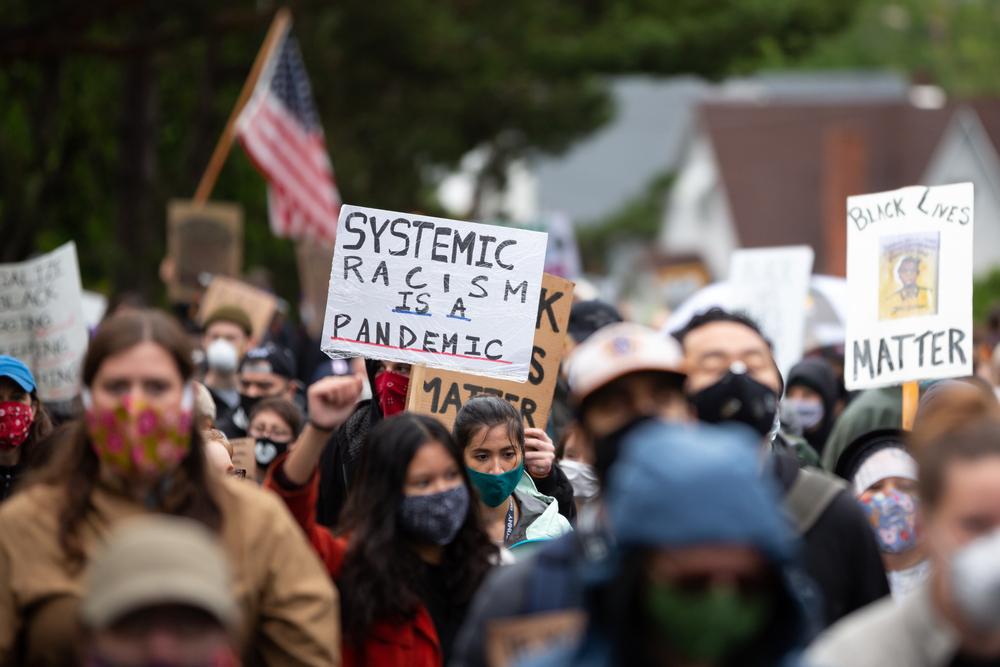
Even in this time when people presume to be having a “racial reckoning,” signs of enduring racial inequity pop up everywhere. From nagging disparities in health—Black, Indigenous and People of Color (BIPOC) die at higher rates than other groups from COVID-19 and are underrepresented in medical research (except in vile experiments such as in the Tuskegee study) … to the steep declines in Black and Latino students submitting the Free Application for Federal Student Aid (FAFSA) … to Black food service workers experiencing disproportionate short-tipping for enforcing social distancing rules … inequality reigns. These persistent forces should be a big deal for New England’s Historically White Colleges and Universities, which are rarely called out as HWCUs. Executive Editor John O. Harney reports on the racial equity conversation that he has monitored mostly via Zoom since the pandemic began.
|
|
|
Last week, NEBHE released the following statement about the recent violent attacks on the Asian American Pacific Islander community ...
We condemn violence and discrimination of any kind against our Asian American Pacific Islander (AAPI) friends and neighbors. We unite with AAPI students, faculty, staff, trustees, alumni and others across the region to support safe communities and education institutions for all—and to end racism and xenophobia. We express our sincere support for all AAPI students and colleagues during this time of worry and distress.
|
|
|
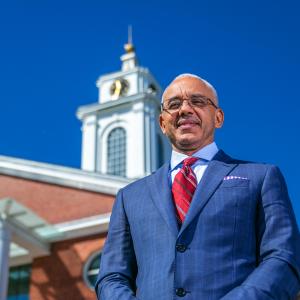
E. LaBrent Chrite, president of Bethune-Cookman University and former dean of the University of Denver's Daniels College of Business, was named president of Bentley University, the first Black president in the university's 104-year history. He succeeds Alison Davis-Blake who left after two years in charge of the noted business college.
Pictured: E. LaBrent Chrite
|
|
|
New England state lawmakers focused their 2020 sessions almost exclusively on COVID-19-related legislation and budget concerns. In 2021, COVID-19-related legislation has continued to be a major focus, but other issues are also sharing the stage. Among them: expanding work-based learning, raising educational attainment, extending broadband, ensuring children's wellbeing and fighting campus sexual assault. NEBHE's Policy and Research experts tally state legislation in these and other key areas.
|
|
|
At its peak, the COVID-19 pandemic forced 55 million American children temporarily out of school. While education systems tried remote and hybrid learning to serve students, researchers think the closures will produce substantial losses in learning and the need for action now to prevent a “lost COVID cohort.” On March 19, NEBHE’s Legislative Advisory Committee convened national experts to explore the implications of a COVID-19-related dip in transition to postsecondary education due to K-12 learning loss and ways to New England’s students on track to higher education enrollment, attainment and economic mobility. Expert presenters included Monica Martinez, director of strategy initiatives at the Learning Policy Institute based in Washington, D.C., Rhode Island Elementary and Secondary Education Commissioner Angélica Infante-Green, and Ryan Reyna, senior director of Education Strategy Group based in Maryland. Stephanie M. Murphy, NEBHE's associate director of policy research and analysis at NEBHE, explores takeaways from their presentations.
|
|
|
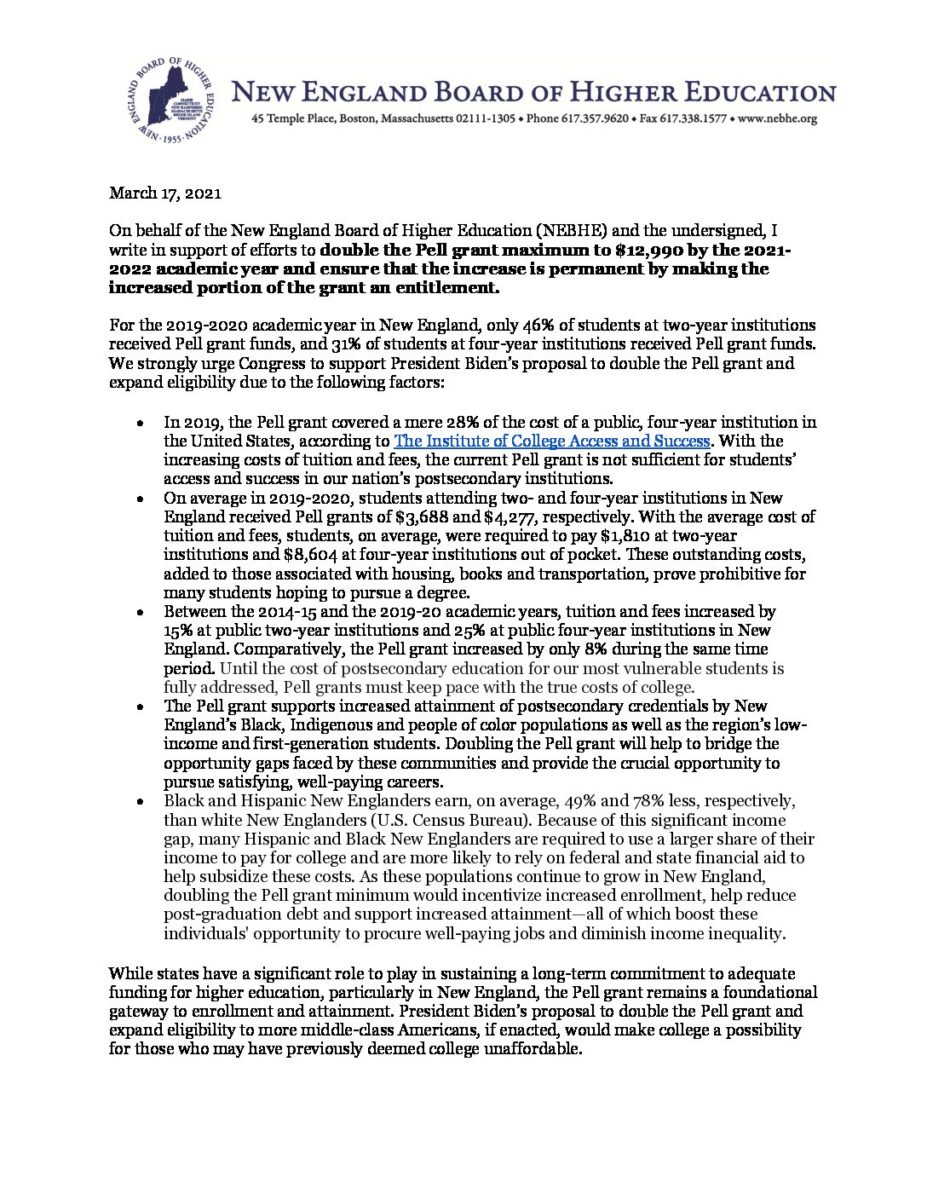
On March 17, NEBHE joined the New England Council and the American Council on Education in urging Congress to bolster the Pell Grant program. The program is crucial to increasing postsecondary attainment for New England’s BIPOC populations, as well as the region’s low-income and first-generation students. The NEBHE letter, cosigned by several New England higher ed leaders and organizations, asks Congress to double the Pell Grant maximum to $12,990 by the 2021-22 academic year and ensure that the increase is permanent by making the increased portion of the grant an entitlement. Read NEBHE's letter to Congress here.
|
|
|
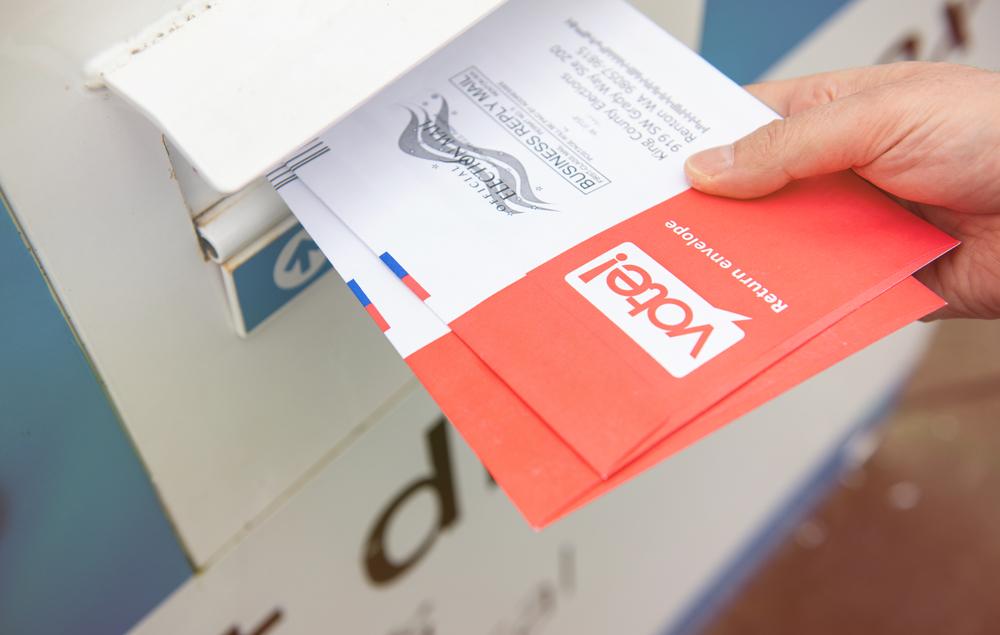
New England states set new records for voter turnout in the 2020 presidential election ... and in absentee and mail-in voting due to COVID-19 fears. In terms of state legislative control, Democrats prevailed across the region, except in New Hampshire, where Republicans gained control of the House and Senate. As of mid-March, lawmakers continued to work remotely, while state capitols remained closed to the public, and the legislative agendas were dominated by COVID and the fiscal challenges it created. Carolyn Morwick, former director of government and community relations at NEBHE and former director of the Caucus of New England State Legislatures, takes a state-by-state look at New England elections and key issues.
|
|
|
Besides the news from the CDC, the Biden administration announced it will invest $12.3 billion in COVID-19 testing expansions, with $10 billion going to help schools reopen for in-person learning. Congress, meanwhile, stepped up work to reform federal student loan repayment programs and address teacher shortages in rural schools as well as citizenship rules. Read the latest from NEJHE's DC Shuttle, featuring national news drawn from our friends at the New England Council.
|
|
|
COVID-19 had a significant impact throughout the U.S. Enrollment at higher education institutions (HEIs) declined by 2.5% overall, nearly twice the rate of decline reported in fall 2019, according to the National Student Clearinghouse. Freshman enrollment overall decreased an unprecedented 13%. Public colleges and universities saw a 4% decrease from fall 2019 enrollment, and community colleges saw a 10% decrease. Although the majority of New England public colleges and universities saw overall enrollment decreases in fall 2020, 40% of them saw increases in the number of students enrolled through NEBHE's Tuition Break. Total enrollment through Tuition Break increased about 1% at the four-year institutions and decreased nearly 12% at the community colleges.
|
|
|
Tracking Coronavirus: A Deep Dive |
|
|
This semester, NEBHE is deep-diving on topics related to New England institutions' response to COVID-19 (see our updated COVID-19 response page here). We will publish periodic briefs on topics including: plans for spring 2021, federal actions that affect higher education, vaccination distribution, mental health and planning for fall 2021. Interested in a topic we haven't covered? Reach out to Charlotte Peyser at cpeyser@nebhe.org.
|
|
|
The Boston-based business networking group Get Konnected! will honor NEBHE Senior Fellow Charles F. Desmond as one of the 50 Most Influential People of Color in Higher Education. Desmond is president of the Hildreth Stewart Charitable Foundation, a Boston-based family foundation that funds nonprofit organizations committed to a just, equitable and sustainable society. He is past chair of the Massachusetts Board of Higher Education. The Get Konnected! 12th anniversary event, cosponsored with the EOS Foundation and GBH, will honor Desmond among the legends, pioneers and trailblazers in academia.
Pictured: Charles F. Desmond
|
|
|
budgeting, human resources, administration and IT.
The director will play a critical role in partnering with the senior leadership
team in strategic decision-making and operations as NEBHE continues to enhance its quality programming and build capacity. Qualified candidates may submit a cover letter and resume to gdavis@nebhe.org. |
|
|
The Western Interstate Commission for Higher Education is seeking a Project Manager for our student transfer initiative, Interstate Passport. The Interstate Passport program is a proven, faculty-driven, and student-centered way to streamline transfer for students nationwide through block transfer of lower-division general education. WICHE is looking for a highly-skilled, self-directed, and detail-oriented project manager to implement and scale membership of the Interstate Passport. The project manager will oversee various aspects of grant management and manage the onboarding process for new institutions, working closely with the registrars, academic affairs staff, and faculty members. The ideal candidate will have a master’s degree with five to seven years of relevant work experience in higher education enrollment management, registrar’s office, institution research, or another campus department. While WICHE’s offices are in Boulder, Colorado, the position can potentially remain permanently remote for the right candidate. For questions, please reach out to Sarah Leibrandt, Ph.D. To see the full job description and to apply, please visit WICHE’s hiring website. Applications will be reviewed beginning on March 26, 2021. |
|
|
NEJHE NewsBlast is a summary of NEJHE content and other news around NEBHE prepared weekly by NEJHE Executive Editor John O. Harney and emailed every Wednesday to opinion leaders and practitioners. When responding to NEJHE content, please make sure that your remarks are relevant, courteous and engaging. Individuals are responsible for their comments, which do not represent the opinions of the New England Board of Higher Education. We urge commenters to briefly note their occupational or other interest in the topic at hand. Please refrain from offensive language, personal attacks and distasteful comments or they may be deleted. Comments may not appear immediately. Thank you for staying engaged.
|
|
NEJHE NewsBlast is sponsored by
|
|
For more information about partnering with NEBHE, click here
or send an email message to our events coordinator Marla Phippen.
|
|
© 2020 New England Board of Higher Education |
|
|
|
|
|
|
|