Week of March 10, 2025 | Vol. 15, Issue 10 | |
|
Bourne Insights
Key Topics of Conversation this Week
| | |
|
|
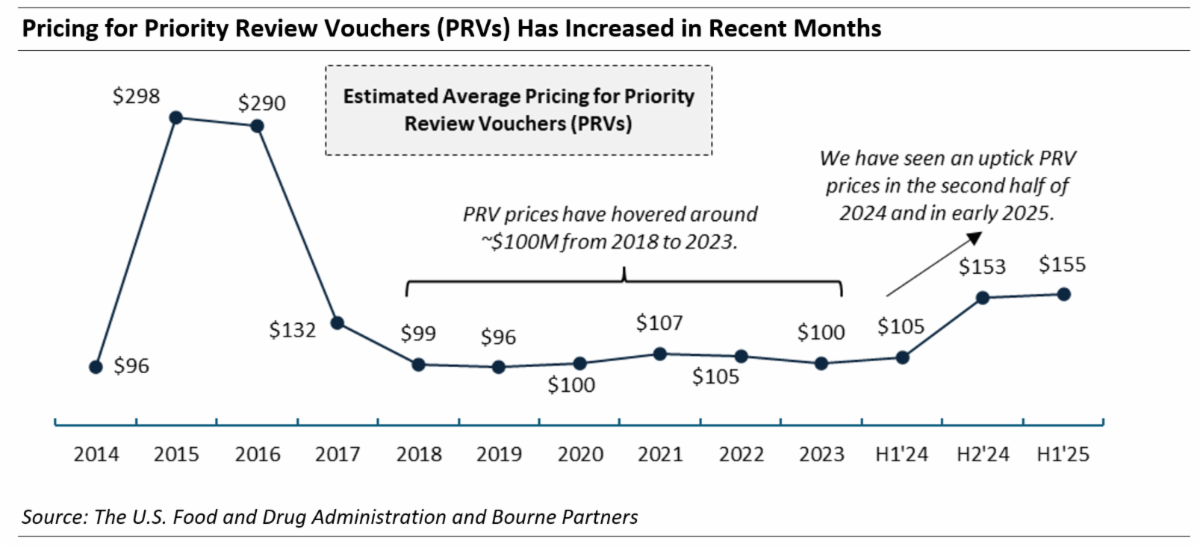
We are hopeful that the priority review voucher (PRV) rare pediatric disease program will be renewed ahead of the pending March 14 continuing resolution (budget) deadline. As with many, we were disappointed (and surprised) that Congress was unable to reauthorize the program last year, after it has been renewed regularly over the past decade. We see the PRV rare pediatric disease program as a market-based solution that helps small biopharma firms fund ongoing research into rare pediatric diseases. However, political/election related dynamics resulted in this program, among others, to slip through the cracks. Now, another attempt to renew the PRV rare pediatric disease program has been proposed called the “Give Kids a Chance Act of 2024” as Congress hopefully works to avoid a shutdown. If Congress is unable to support the program, biopharma firms with existing rare pediatric disease designations will only have until September 2026 to get their drugs approved by the FDA in order to earn a voucher. Read More
| | |
|
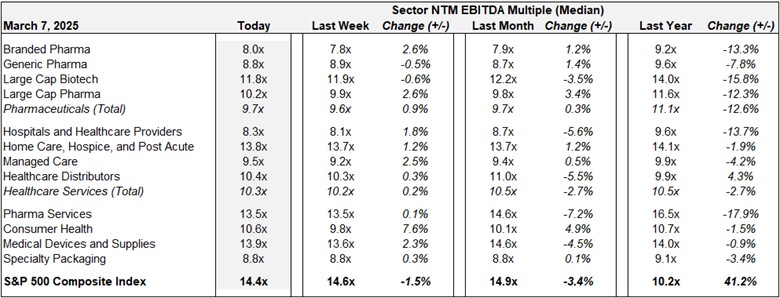
The acquisition of Walgreens Boots Alliance (NASDAQ: WBA) by private equity firm Sycamore Partners raises questions about the fate of WBA’s healthcare business. Specifically, WBA (finally) announced plans to be acquired by Sycamore Partners, after months of speculation, subject to a 35 day “shopping period.” The acquisition bid implies an enterprise value of $23.7B (or 7.5x NTM EBITDA). Walgreens has been attempting to pursue a turnaround strategy after several years of weak economic conditions, increasing online competition, a more challenging Medicare Advantage environment, and lower reimbursement rate for drugs. Sycamore Partners has historically focused on retail and consumer companies. So, it stands to reason that Sycamore Partners will be focused on exiting Walgreens’s various healthcare businesses, e.g., VillageMD (primary care), Shields Health Solutions (specialty pharmacy), the Boots business (U.K. pharmacy chain), Summit Health/CityMD (primary care), and CareCentrix (post-acute care coordination) as well as a rapidly growing clinical trial site network, among others. Read More | | |
|
We are concerned that a new cost cutting policy by the U.S. Department of Health and Human Services (HHS) could result in new regulations not being fully vetted by the public and the healthcare industry having less time to prepare for new regulations. Specifically, the HHS under Secretary Robert F. Kennedy Jr. (RFK) issued a new policy statement in the Federal Register indicating that the department is no longer planning to go through a “public comment period” following the publication of proposed rulemaking. However, individual HHS agencies and offices may choose offer a public comment period at their discretion. Technically, the HHS has not been required to gather and response to public comments on proposed rules since 1971, but the department has always done so anyhow in good faith. The rationale for this change in HHS policy is the costs and administrative burden caused by public comment periods on the HHS budget. Needless-to-say, this change in HHS policy is drawing controversy from political opponents who point out RFK’s promise for greater transparency. Read More | | |
|
Veeva Systems (VEEV), a bellwether vendor of SaaS solutions for the life sciences, continues to gain ground in the clinical trial software market with strong fiscal year January 2025 results. The highlight of the Veeva’s recent quarter was a very large win with an existing top-20 pharma customer of its eTMF solution that went “all-in” on Veeva’s full clinical trial SaaS platform -- e.g., CTMS, Study Startup, Site Connect, Study Training, and EDC, among others. Today, we view Veeva as the emerging leader in the clinical trials space with 17 of the top-20 pharma companies now having standardized on its CTMS solution and 9 of the top-20 pharma companies now having standardized on its EDC solution. Also, Veeva reported strong momentum in the pharmacovigilance space with a fourth top-20 pharma company adopting its Veeva Safety software. Veeva management further highlighted the pharmacovigilance space as an area that is ripe for artificial intelligence (AI) and we expect more AI innovation from Veeva in this area in the coming years. Read More | | |
|
The tariff drama continues with President Trump increasing his previously announced tariffs on China by an additional 10% (from 10% last month to 20% now) as well as continuing to threaten a new 25% tariff on Canada and Mexico. Since early February the Trump administration has been using the threat of tariffs as a negotiating tool to get the Mexican and Canadian governments to be more active regulating cross-border migration, criminal activity, and drug trafficking. In our view, it is not clear how trade relations with Canada and Mexico will play out. However, trade relations with China appear to be clearly deteriorating. Most recently, the Chinese government has barred Illumina (NASDAQ: ILMN) from selling its DNA sequencers in country as an obvious response to U.S. tariffs. (ILMN generates ~7% of its consolidated revenue from China.) Also, U.S. pharma companies continue to discuss plans for bringing drug manufacturing back to the United States. Most recently, at a recent investor conference, the management of Pfizer (NYSE: PFE) indicated that it is considering bringing more pharma manufacturing back to the United States in support of Trump’s trade policy. Read More | |
|
Note: Market values as of the close of business March 7, 2025
Source: S&P Global Intelligence
| |
Active Banking Deal Contacts | |
Select Banking Transactions | | | | |