Resources from the Washtenaw County Public Safety and Mental Health Preservation Millage first became available on January 1, 2019.
In this e-mail, we highlight some of the recent work accomplished with millage funding.
|
|
At a youth service mapping retreat, local leaders agreed that Washtenaw County needs a systematic approach to divert youth away from the justice system. Juvenile assessment centers (JACs) are a solution that communities across the country have adopted to identify youth needs and subsequently connect youth to appropriate community services. “I feel like we're really close to a spot where the reasons you would have a kid in [juvenile] detention are infinitesimally small,” says Mike Langenright, program manager at Washtenaw County Children's Services who is part of a group of local leaders exploring the implementation of a JAC. Read more.
|
|
On the first day of 2022, Washtenaw County residents began to access substance use treatment support, 24/7, through the main Washtenaw County Community Mental Health (WCCMH) phone line. The number gives residents access to an immediate screening, referral to a community-based provider, or guidance about how to get connected to services. The calls are answered by licensed mental health and substance use professionals. Read more.
|
|
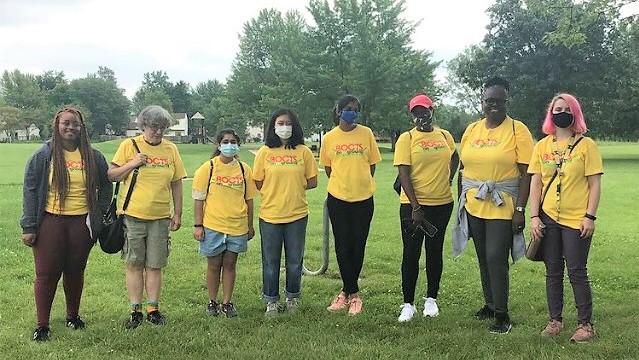
Since 2020, NAMI has used millage funding to conduct outreach work in underserved areas of Washtenaw County. While millage funding has expanded our county's mental health services, some residents are still unaware. NAMI's outreach work creates and strengthens community relationships and informs people about local resources. Read more.
|
|
Teaching mental health first aid |
|
Mental health prevention and education were identified as top community priorities for the millage. That’s why funding was used to train local residents to become Mental Health First Aid (MHFA) instructors—who can now train others. “It’s highly valuable information for anyone,” notes Celeste Gentile, a teacher consultant with the Washtenaw Intermediate School District. “[but] especially for educators, parents, and those who support young people in the educational setting. Read more.
|
|
Supporting students in schools |
|
As pandemic conditions change, the need for mental health services in schools continues to rise. “It’s like a tsunami,” says Stacey Doyle, a Washtenaw Intermediate School District (WISD) social worker. “Because of the pandemic, a lot of students are coping with loss right now. Loss of their life before COVID, loss of family members to COVID. There’s a lot of isolation, a lot of depression.” Read more.
|
|
More than half of Michiganders who experience jail time will return within three years of release. And for those with mental health or substance use needs, the risk of recidivism is even higher. Washtenaw County is working to change that with community reentry staff and programs co-funded by a federal grant and millage dollars. Washtenaw County’s entire reentry team is “passionate about building systems that help people find their place and break their cycles [of incarceration],” says Aaron Suganuma, reentry coordinator with the Washtenaw County Sheriff's Office. Read more.
|
|
It's been just over three years since funding began for Washtenaw County's Public Safety and Mental Health Preservation Millage. However, millage funding priorities were established the year before by the Community Mental Health Advisory Committee (CMHAC), through community engagement and local data. We review how careful planning helped the millage magnify impact where it was most needed and the work that remains. Read more. |
|
If you or someone you know needs support,
contact us 24/7 at 734-544-3050 or 1-800-440-7548
|
|
|
|
|
|
|