barley, sunflowers, and sugarbeets should be tested to a depth of 48 inches. When soil is tested for N, nitrates are measured. Nitrate is the N form that is most readily available to plants.
Nitrogen makes up a small component of the soil, but is 78% of the air we breathe. Nitrogen is a leaky plant nutrient is lost from the soil. Nitrates can leach out of the rootzone in wet sandy soils. Saturated clay soils are prone to denitrification where nitrates are converted to gaseous forms of N and return to the atmosphere.
Year by year, we can increase soil phosphorus and potassium levels by applying a little more than what a plant demands. This “buildup” strategy has been successfully practiced by many producers for years. Phosphorus and potassium soil levels are more easily increased as those nutrients aren’t lost as easily as nitrate. We can build soil N in the soil by increasing soil organic matter. No-till, manure applications (grazing or applied), and diverse crop rotations can increase soil organic matter. Soil organic matter, crop rotations, and no-till provides crops with a N credit.
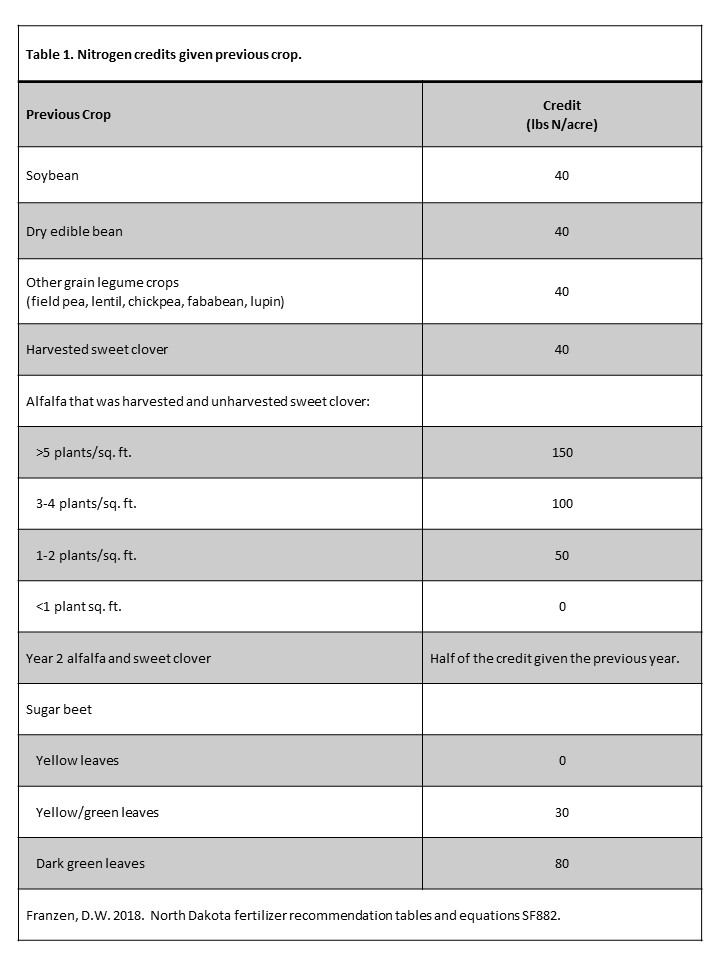
A N credit is an estimate of how much organic N will be mineralized and made plant available during the growing season. As organic N and not nitrate, N credits do not show up on a N soil test. Hence the label “credit”. Some N credits are based on the previous crop (table 1).
Most of the N credits are recommended following a legume. Post-harvest legumes render a soil habitat that facilities soil mineralization. Additionally, legumes have the ability to form a symbiotic relationship with rhizobia bacteria who take N out of the air and convert the N2 into a ureide-N compound that the plant can use. In exchange for N, the rhizobia receive energy from the plant. Farmers capitalize on this phenomenon by not applying N fertilizer on legumes.
The no-till N credit comes from the soil microbiome being different than conventional tillage. Work conducted by Franzen et al. (2019) found that long-term North Dakota soils contain more asymbiotic N fixing bacteria (asym-bac) and N-fixation. The asym-bac are similar to rhizobia in that N2 gas is fixed. However, rhizobia require a host plant (legume) to carry out their life cycle whereas the asym-bac do not require a host plant. A big factor for the asym-bac N credit is that no-till fields tend to have more active carbon (bacteria food) than conventional tilled fields. Soil organic matter levels above 5.9% are high in active carbon, feed the soil microbiome, and have been found to give soil fertility plans another 50 lbs N/ac credit.
Today, N fertilizer is near $1/lb N. Using N credits can save a long-term no-till producer $50/ac. If the previous crop was a legume there would be another $40/ac in crop input savings. Remember soil testing is the best way to agronomically manage your fertilizer budget, but keep in mind the N-credit does not show up on a soil test. The N-credit will save you input costs while still producing good yielding crops.
For more information:
Crop nitrogen calculators were developed by Dave Franzen (NDSU Extension Soil Specialist). Below are links to the three different North Dakota Nitrogen calculators.