|
Advent and "Waiting for God/ot"
It can be comforting to imagine that time moves in a straight line, can't it? We seem to move in a way that carries us steadily forward from beginning to end.
The church calendar shows us a different model, though. This Sunday is the grand finale of the liturgical year — “The Reign of Christ” — a feast meant to signal the end of all things. Even so, nothing actually stops. Seven days later, we turn the page to Advent I and start the whole story over again.
But the fact is that many experience time less like a "highway made straight in the desert" and more like a circular track, or even a hamster wheel. Both our commercial calendars and our liturgical ones serve as signposts to help us navigate the innumerable “laps” of the year.
When Advent automatically follows "The End” the rhythm can become a sedative rather than a wake-up call. It is tempting to “check out,” and to let time do what it does: flow seemingly ever onward. And in so doing, we are in danger of letting the map become the terrain.
As we approached “The End” that this Sunday represents, we were told to stay awake. Advent, too, is a season of watchfulness and wakefulness.
How do we stay awake inside a cycle that keeps repeating, keeps lulling us to sleep? And in the middle of all that repetition, what—or whom—are we actually waiting for?
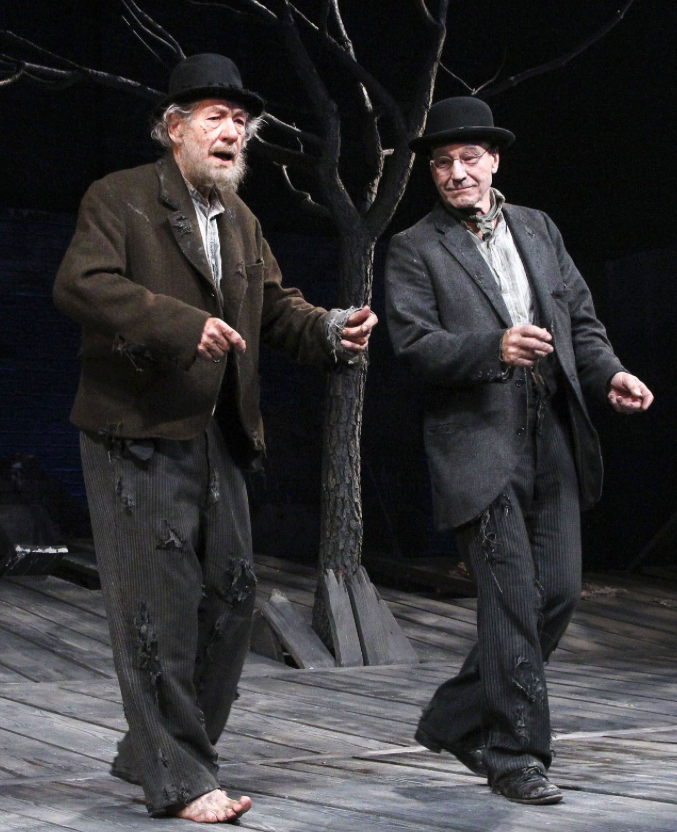
Starting November 29, the first Sunday of Advent, I’m excited to invite you to wrestle with those questions in our upcoming 4-session Sunday Forum, "Waiting for God/ot" at 9am in the conference room. Drawing on both Scripture and Samuel Beckett’s enigmatic play, we will explore the difference between killing time and keeping watch—and discover what it means to wait for God when nothing seems to change.
Image: Ian McKellen (Estragon) and Patrick Steward (Vladimir) in Waiting for Godot by Samuel Beckett at New York City's Cort Theatre, 2013; Bruce Glikas, Getty Images
Wishing you peace,
Gregory Peebles, Director of Ministry
|