1961-2022
It is with a heavy heart that ASIPP shares the passing of Dr. Gerard A. Malanga (Madison, New Jersey), who passed away on May 14, 2022.
Dr. Malanga was Director of Sports, Spine, and Orthopedic Rehabilitation at Kessler Institute for Rehabilitation, then Director of Sports Medicine at Mountainside Hospital, and Director of Pain Management at Overlook Hospital. In addition to his love and devotion to his family, he was a mentor, leader, and friend to so many physicians who looked up to him as a guiding light in the field. He was a great physician, mentor, and teacher.
We extend our condolences to Dr. Malanga’s family, friends, patients, and colleagues.
|
|
Why You Should Have a Specialty Designation of 09 for Interventional Pain Physicians |
|
Specialty codes are used by CMS for programmatic and claims processing purposes. Medicare and commercial payers use the primary specialty designation in processing claims. Physicians in a group of the same specialty must bill and be paid as if they were one physician. Appropriate use of specialty codes helps reduce inappropriate suspensions and improves the quality of utilization data.
Physicians should monitor their specialty status to ensure that they are enrolled in the specialty type that most accurately represents their practice. This is particularly important as physicians change the focus of their practice and become more specialized. Failure to notify Medicare of specialty changes can affect reimbursement. If you are performing interventional pain procedures but your primary designation is Anesthesiology (5) or Pain Management (72) this will negatively affect the reimbursement for pain procedures. Interventional pain physicians’ primary designation should be 09 – Interventional Pain Management, a designation that ASIPP fought for and gained to assure more representation and reimbursement.
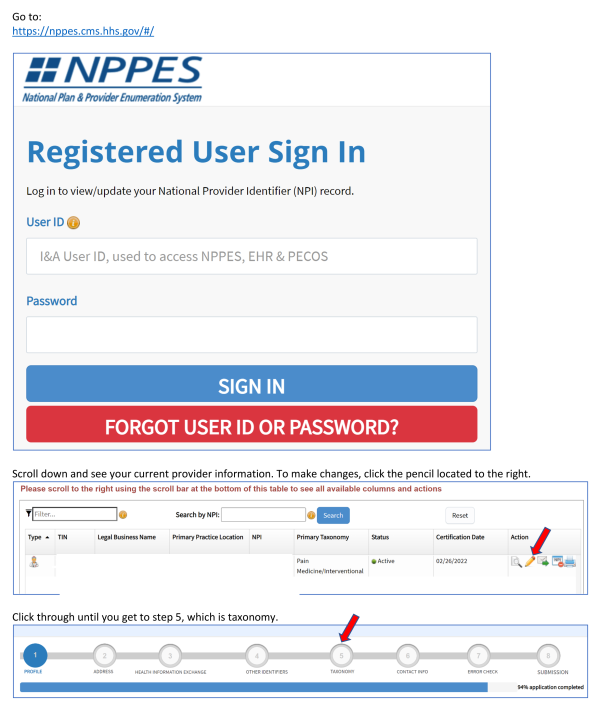
You may check your current specialty designation and/or to change it to Interventional Pain Management (09) on the following CMS website: https://nppes.cms.hhs.gov/#/please
Before doing so, CLICK HERE for a step-by-step instructional guide created by ASIPP member Dr. Rohit Choudhary to assist members in this process.
|
|
NEXT EXAM DATES:
Part I
May 28, June 18, July 30, August 27, September 17, October 22, November 19 & December 17
Part II
September 23
|
|
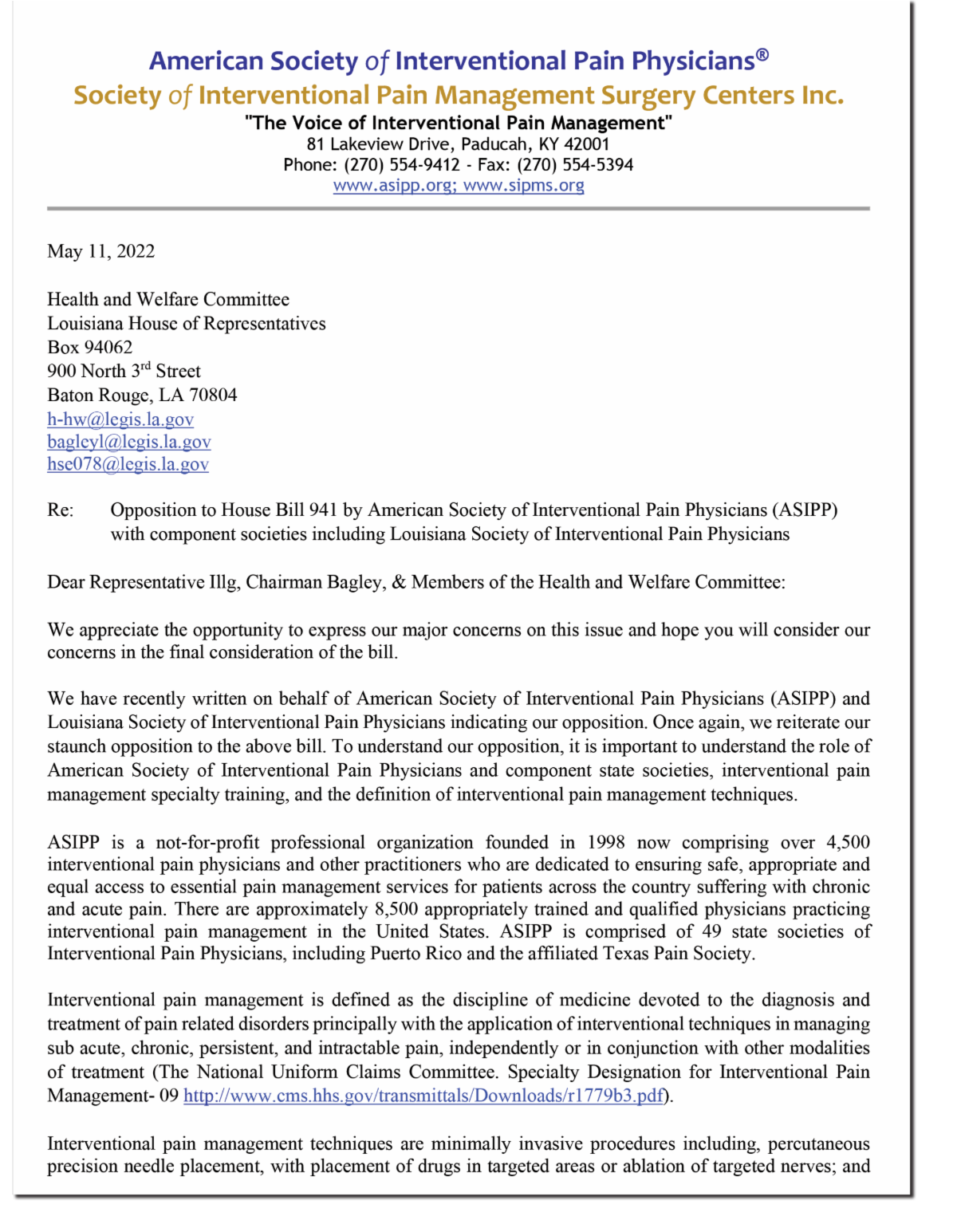
The American Society of Interventional Pain Physicians (ASIPP) and Louisiana Society of Interventional Pain Physicians (LSIPP) actively opposed Louisiana HB 941 which would restrict access to minimally invasive spine procedures performed by appropriately trained interventional pain management physicians.
The bill would restrict access to care, prevent new minimally invasive techniques from being accessed in LA which are currently readily available across the country, and ultimately harm patient care by forcing patients to have much larger and more invasive procedures completed by surgical specialists who only seek to protect their financial well-being by restricting access only to themselves to complete more invasive procedures.
It was to be acted upon two weeks ago, Tuesday, May 2, but because of the ASIPP/LSIPP lobbying and opposition, this onerous bill has been tabled at this time. LSIPP Executive Director and President, Paul Hubbell, was set to testify our opposition when the bill was tabled in the final hour. We must keep this issue in our sights as it may be reintroduced with edits in the future.
Please keep in mind that bills such as these can occur in all states, and often are introduced quietly without much notice. This is an example of the importance of the ASIPP affiliate state societies! If you are not a member of your state society, please consider joining today. https://asipp.org/join-us-renew-2/
Click here to see ASIPP/LSIPP letter to the Louisiana House of Representatives, Health and Welfare Committee.
|
|
New data shows a surge in overdose deaths involving fentanyl and methamphetamine. Overall, the nation saw a 15 percent increase in deaths from overdoses in 2021.
After a catastrophic increase in 2020, deaths from drug overdoses rose again to record-breaking levels in 2021, nearing 108,000, the result of an ever-worsening fentanyl crisis, according to preliminary new data published on Wednesday by the Centers for Disease Control and Prevention.
The increase of nearly 15 percent followed a much steeper rise of almost 30 percent in 2020, an unrelenting crisis that has consumed federal and state drug policy officials. Since the 1970s, the number of drug overdose deaths has increased every year except 2018.
A growing share of deaths continue to come from overdoses involving fentanyl, a class of potent synthetic opioids that are often mixed with other drugs, and methamphetamine, a synthetic stimulant. State health officials battling an influx of both drugs said many of the deaths appeared to be the result of combining the two.
|
|
Some 60% of spread starts with those who have no symptoms, and that may be higher with Omicron
A cough or sneeze in the checkout line at the grocery store may elicit fear of COVID-19, but that maskless person quietly sitting next to you on the subway could pose just as much of a threat, public health experts say.
That may be even higher now, as early reports have signaled a greater percentage of asymptomatic infections from Omicron than from previous variants. That could have a lot to do with higher baseline levels of immunity in the population when that variant hit, Helen Chu, MD, MPH, an infectious diseases physician at the University of Washington School of Medicine, told MedPage Today.
|
|
Former Vanderbilt nurse gets 3 years probation for negligent homicide, adult abuse
RaDonda Vaught, the Tennessee nurse convicted after a medical error led to a patient's death, was sentenced to 3 years of supervised probation, evading a possible prison sentence of up to 8 years.
Today's sentencing caps a years-long process, including delays caused by the COVID-19 pandemic, that brought to light Vaught's medical error, led to her prosecution, and sparked a national outcry from the medical community.
Vaught, 38, was convicted on March 25 of negligent homicide and impaired adult abuse over the medication error, which resulted in the death of 75-year-old Charlene Murphey at Vanderbilt University Medical Center (VUMC) in 2017. Vaught received concurrent sentences of 3 years probation for the adult abuse charge and 2 years probation for the reckless homicide charge.
|
|
- ASIPP Members Only Site Information - |
|
-
To log in for the first time you will need to click “forgot password” at the bottom of the login window.
- Check your email and then log in as directed.
-
If you have problems logging into your account, click here.
|
|
Pain Medicine Case Reports (PMCR) and Editor-in-Chief Alaa Abd-Elsayed, MD, PhD would like to invite you to submit case reports and case series to the PMCR journal. Your article will be published free of charge.
Open access journals are freely available online for immediate worldwide open access to the full text of published articles. There is no subscription fee for open access journals. Open access journals are no different from traditional subscription-based journals: they undergo the same peer-review and quality control as any other scholarly journal.
Interested in becoming a member of the PMCR Editorial Board?
Editorial board members are asked to review 2-6 manuscripts per year. Please submit your most up-to-date CV to sgold@asipp.org for consideration.
For more information or to submit your articles, click here.
|
|
| CASE REPORT |
Ravi Ramya, MBBS, Nivan Loganathan, MB BCh BAO, Ryan Tan Choon Kiat, MBBS, and Cindy Lee Mei San, RN-BC
Abstract
BACKGROUND: Pain arising from traumatic rib fracture contributes to significant patient morbidity and mortality.
CASE REPORT: A 68-year-old man with multiple comorbidities presented to the emergency department with a left-sided multiple rib fracture (ribs 6-8) and altered mental status after an unwitnessed fall. The patient was started on a standard of care oral analgesic regime, but continued to deteriorate because of inadequate pain relief in his pulmonary function. Given his altered mental status and insufficient pain control, to facilitate pulmonary physiotherapy, we performed an early (day 5) thermal radiofrequency ablation (RFA) of intercostal nerves at 80 ºC for 90 seconds each level. Significant pain relief was noted on the same day of the procedure (pain score - 1/10).
CONCLUSIONS: This case report demonstrates the feasibility and efficacy of early thermal RFA of intercostal nerves in a frail elderly patient with multiple rib fractures and delirium in the acute pain setting.
KEY WORDS: Rib fracture, radiofrequency, denervation, intercostal nerve, acute pain
|
|
| OBSERVATIONAL STUDY |
Amol Soin, MD, Megan Hirschbeck, MD, Michael Verdon, DO, and Laxmaiah Manchikanti, MD
Abstract
BACKGROUND: Chronic spinal pain is the most prevalent chronic disease, with chronic persistent spinal pain lasting longer than one-year reported in 25% to 60% of the patients. Health care expenditures have been escalating and the financial impact on the US economy is growing. Among multiple modalities of treatments available, facet joint interventions and epidural interventions are the most common ones, in addition to surgical interventions and numerous other conservative modalities of treatments. Despite these increasing costs in the diagnosis and management, disability continues to increase.
Consequently, algorithmic approaches have been described as providing a disciplined approach to the use of spinal interventional techniques in managing spinal pain. This approach includes evaluative, diagnostic, and therapeutic approaches, which avoids unnecessary care, as well as poorly documented practices.
Recently, techniques involving artificial intelligence and machine learning have been demonstrated to contribute to the improved understanding, diagnosis, and management of both acute and chronic disease in line with well-designed algorithmic approach. The use of artificial intelligence and machine-learning techniques for the diagnosis of spinal pain has not been widely investigated or adopted.
OBJECTIVES: To evaluate whether it is possible to use artificial intelligence via machine learning algorithms to analyze specific data points and to predict the most likely diagnosis related to spinal pain.
STUDY DESIGN: This was a prospective, observational pilot study.
SETTING: A single pain management center in the United States.
METHODS: A total of 246 consecutive patients with spinal pain were enrolled. Patients were given an iPad to complete a Google form with 85 specific data points, including demographic information, type of pain, pain score, pain location, pain duration, and functional status scores. The data were then input into a decision tree machine learning software program that attempted to learn which data points were most likely to correspond to the practitioner-assigned diagnosis. These outcomes were then compared with the practitioner-assigned diagnosis in the chart.
RESULTS: The average age of the included patients was 57.4 years (range, 18-91 years). The majority of patients were women and the average pain history was approximately 2 years. The most common practitioner-assigned diagnoses included lumbar radiculopathy and lumbar facet disease/spondylosis. Comparison of the software-predicted diagnosis based on reported symptoms with practitioner-assigned diagnosis revealed that the software was accurate approximately 72% of the time.
LIMITATIONS: Additional studies are needed to expand the data set, confirm the predictive ability of the data set, and determine whether it is broadly applicable across pain practices.
CONCLUSIONS: Software-predicted diagnoses based on the data from patients with spinal pain had an accuracy rate of 72%, suggesting promise for augmented decision making using artificial intelligence in this setting.
KEY WORDS: Algorithmic approach, artificial intelligence, facet joint pain, lumbar disc herniation, lumbar radiculopathy, lumbar spondylosis, machine learning, pain scores, post laminectomy syndrome, sacroiliitis, spinal pain
|
|
| ARTIFICIAL INTELLIGENCE |
Jagadesh N. Nagireddi, MEng, Amanya Ketan Vyas, Mahendra R. Sanapati, MD, Amol Soin, MD, and Laxmaiah Manchikanti, MD
Abstract
BACKGROUND: Traditional pain assessment methods have significant limitations due to the high variability in patient reported pain scores and perception of pain by different individuals. There is a need for generalized and automatic pain detection and recognition methods. In this paper, state-of-the-art machine learning (ML) and deep learning methods in this field are analyzed as well as pain management techniques.
OBJECTIVE: The objective of the study is to analyze the current use of artificial intelligence (AI) and ML in the analysis and management of pain and to disseminate this knowledge prompting future utilization by medical professionals.
STUDY DESIGN: A narrative review of the literature focusing on the latest algorithms in AI and ML for pain assessment and management.
METHODS: Research studies were collected using a literature search on PubMed, Science Direct and IEEE Xplore between 2018 and 2020.
RESULTS: The results of our assessment resulted in the identification of 47 studies meeting inclusion criteria. Pain assessment was the most studied subject with 11 studies, followed by automated measurements with 10 studies, spinal diagnosis with 8 studies, facial expression with 7 studies, pain assessment in special settings evaluated in 5 studies, 4 studies described treatment algorithms, and 2 studies assessed neonatal pain. These studies varied from simple to highly complex methodology. The majority of the studies suffered from inclusion of a small number of patients and without replication of results. However, considering AI and ML are dynamic and emerging specialties, the results shown here are promising. Consequently, we have described all the available literature in summary formats with commentary. Among the various assessments, facial expression and spinal diagnosis and management appear to be ready for inclusion as we continue to progress.
LIMITATIONS: This review is not a systematic review of ML and AI applications in pain research. This review only provides a general idea of the upcoming techniques but does not provide an authoritative evidence-based conclusive opinion of their clinical application and effectiveness.
CONCLUSION: While a majority of the studies focused on classification tasks, very few studies have explored the diagnosis and management of pain. Usage of ML techniques as support tools for clinicians holds an immense potential in the field of pain management.
KEY WORDS: Pain assessment, pain management, pain prediction, machine learning, deep learning, artificial intelligence, numeric rating scale, facial pain, chronic pain
|
|
Since this malpractice insurance program officially launched in November 2018, ASIPP has signed up hundreds of providers with an average savings of 30%. This is professional liability insurance tailored to our specialty and will stand up for us and defend our practices.
Norcal Mutual is A-Rated by AM best and is licensed in all 50 states. To read a few important points to keep in mind about the program, including discounts, administrative defense, cyber coverage, aggressive claims handling, and complimentary award-winning risk management CME activities, click here.
|
|
ASIPP® has formed a partnership with Henry Schein and PedsPal, a national GPO that has a successful history of negotiating better prices on medical supplies and creating value-added services for independent physicians. Working with MedAssets, PedsPal provides excellent pricing on products like contrast media that alleviate some of the financial pressures you experience today.
|
|
ASIPP® is now offering our members the benefit of a unique revenue cycle management/ billing service.
We have received a tremendous amount of interest in the ASIPP® billing and coding program.
Click here to learn more about the negotiated rate for practices and more!
|
|
|
up-to-date news related to you, your practice, and your patients!
|
|
|
|
|
|
|