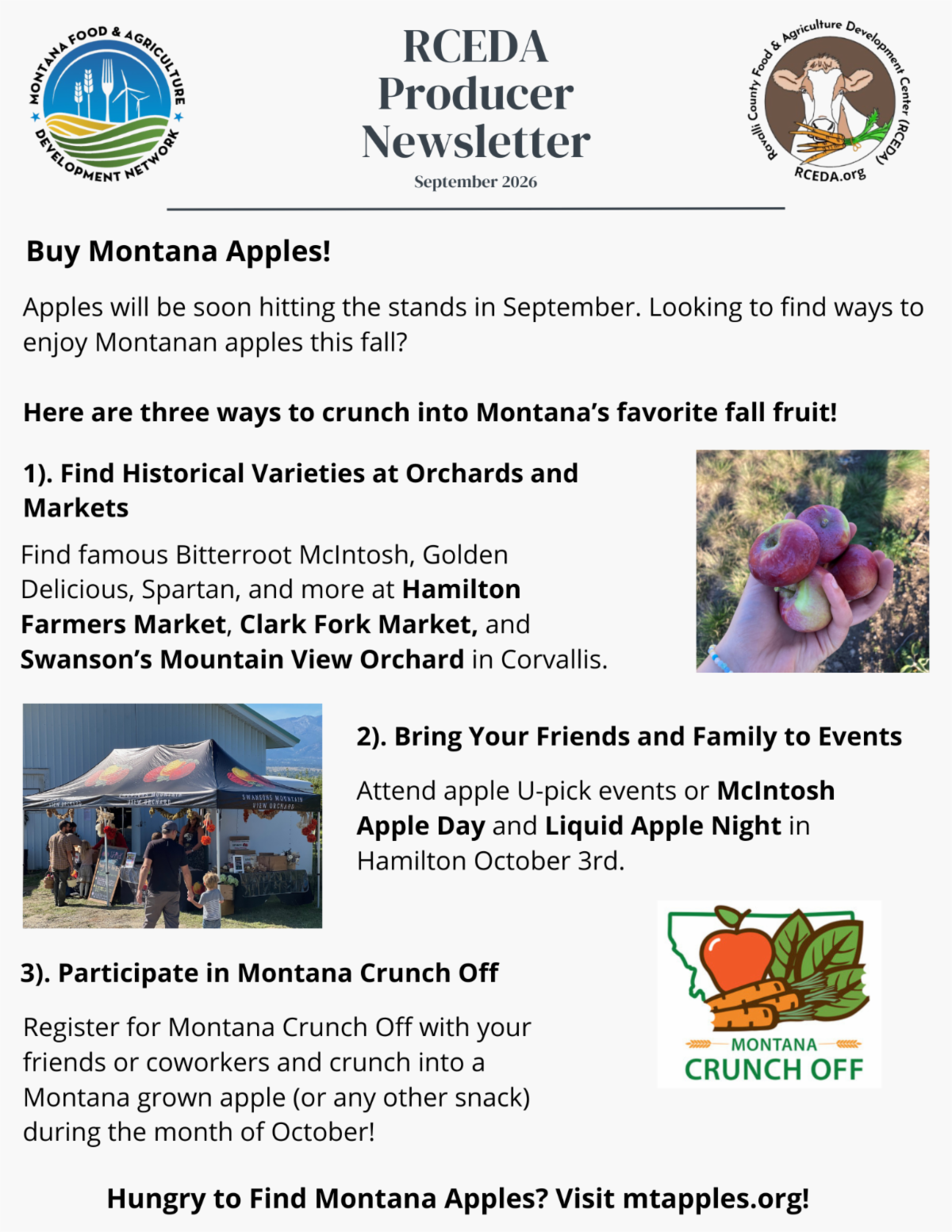
1). Find Historical Varieties at Orchards and Markets


2). Bring Your Friends and Family to Events


3). Participate in Montana Crunch Off


Hungry to Find Montana Apples? Visit mtapples.org!

Looking for:

  • Montana Grown Apples?
  • Apple and Cider Events?
  • Orchards with U-Pick?


Follow Buy Montana Apples on Facebook and Instagram.


Find orchards near you here!

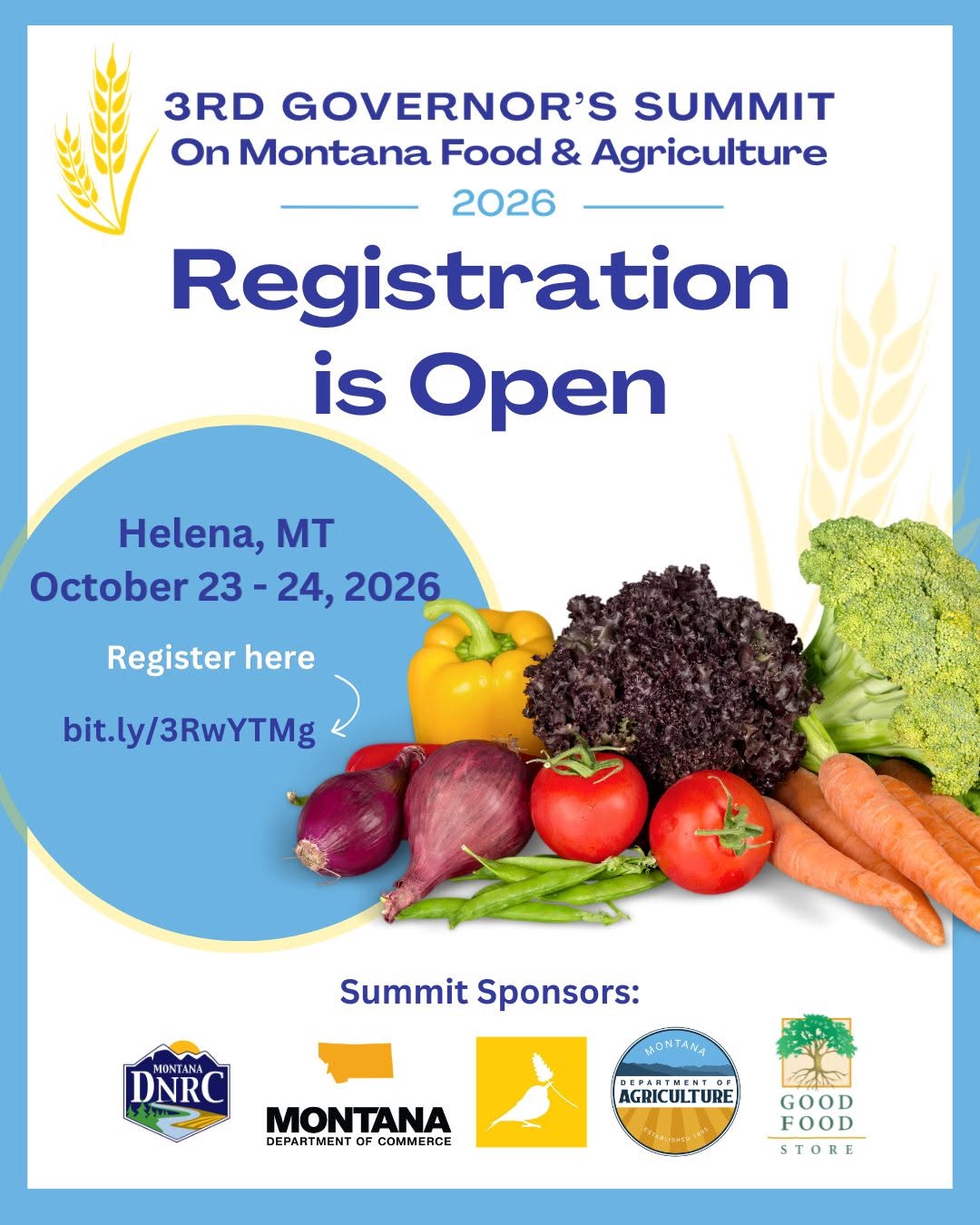
The 2026 Summit - the first in a decade - will build a strategic roadmap to increase the percentage of Montana food bought in-state from 3% to 33% by 2033.


The Summit brings Montanans together to celebrate progress made in Montana's food and farming, build networks, and develop collaborative action plans that grow and strengthen Montana's supply chain.


Register Now!

Ag In the News


Ag Field Day showcases research on specialty fruit and vegetable crops


WARC shares latest research at Field Day


Meadow Gold Billings correcting non compliance issues


Group aims to raise $10,000 to offset Hamilton lunch debt


Bitter Root Land Trust inks 70-acre conservation easement


Bill would fund non-lethal tactics to protect livestock


Butte community farm seeks to bolster food system


CSKT Bison Range auctioning 50 buffalos from historic herd


REO program helps ag workers reach education and work goals


Artist collaboration with farms depicts local farms


Daines, Sheehy oppose Trump plan on foreign beef tariffs

Did You Experience Crop Loss due to Weather in 2023 or 2024?


Supplemental Disaster Relief Program


USDA is extending the deadline for farmers to apply for Stages 1 and 2 of the Supplemental Disaster Relief Program (SDRP) to September 30, 2026.


Additionally, USDA’s Farm Service Agency (FSA) is providing greater flexibility for farmers who experienced quality losses on eligible crops. Farmers who experienced quality-related discounts can use verifiable and reliable documentation to show quality losses due to natural disasters occurring in 2023 and 2024. Farmers also now have the flexibility to use a quality loss percentage for crops having a final use that is different from their intended use.


Lost Crops to Wind Damage in December 2025?


Farm Service Agency is extending much-needed emergency credit to producers recovering from natural disasters through emergency loans. Emergency loans can be used to meet various recovery needs including the replacement of essential items such as equipment or livestock, reorganization of a farming operation, or to refinance certain debts. FSA will review the loans based on the extent of losses, security available, and repayment ability.


Impacted Area: Montana, Idaho and Wyoming Triggering Disaster: Severe winter storm and straight-line winds occurring December 17-18, 2025


Application Deadline: 12/07/2026


More Resources On farmers.gov, the Disaster Assistance Discovery Tool, Disaster Assistance-at-a-Glance fact sheet, and Loan Assistance Tool can help you determine program or loan options. To file a Notice of Loss or to ask questions about available programs, contact your local USDA Service Center.


Read the press release here


Looking for Crop Insurance on Specialty Crops?


FSA has a program for trees and "non-insured" crops.


Noninsured Crop Disaster Assistance Program-

Remember to register in January


Tree Assistance Program


Questions? Reach out to FSA 

Ravalli, Missoula, Mineral:

coral.maxwell@usda.gov

Taelynn.Stillsmoking@usda.gov


Loan Program: debra.duke@usda.gov


Click here to enroll


Click here to learn more


Help Shape the Future of Variable Rate Fertilizer Management in Montana


With support from Montana Department of Agriculture, Montana State University is launching a new statewide on-farm research and extension project focused on helping producers evaluate and implement variable rate fertilizer application. 


This is a complete, end to end project involving multiple MSU faculty and specialists in precision agriculture, soil fertility, agricultural economics, remote sensing, and Extension. Our team will work directly with participating producers to:


• Define field management zones using yield data, soil information, topography, remote sensing, and producer knowledge.


• Collect zone-based soil samples to better understand field variability.


• Develop variable rate fertilizer prescriptions tailored to each field.


• Assist with implementation and work alongside producers and crop consultants throughout the process.


• Evaluate agronomic and economic outcomes to determine whether variable rate management improves profitability and nutrient use efficiency.


One of the biggest challenges producers face is determining whether variable rate technology will provide a return on investment. To answer that question, each participating field will include side by side comparison strips, where the variable rate prescription is evaluated against the producer's standard fertilizer practice. After harvest, MSU agricultural economists will conduct an economic analysis to compare costs, yields, and profitability.


We recognize that access to equipment can be a barrier. For producers who do not have variable rate application capability, project funds may be available to help support implementation costs, allowing more operations to participate regardless of their current equipment setup.


We are currently seeking producers interested in participating on this effort. Whether you are already using precision agriculture technologies or are simply curious about how variable rate management could fit your operation, we would welcome the opportunity to visit with you.

In addition, we have developed a short survey to help identify research and Extension priorities related to variable rate fertilizer management in Montana. The survey takes approximately five minutes to complete and will help us better understand current adoption, challenges, educational needs, and opportunities for future research. Your feedback will support the development of practical programs and help us pursue additional funding to address producer priorities. 


Take the survey: Link [montana.qualtrics.com]


If you are interested in participating, please contact Dr. Ricardo Pinto, ricardo.pinto@montana.edu or 406-994-6374.

Organic Certification Cost Share Program (OCCSP)


What It Is

The Organic Certification Cost Share Program (OCCSP) provides cost share assistance to producers and handlers of agricultural products who are obtaining or renewing their certification under the National Organic Program (NOP). Certified operations may receive up to 75 percent of their certification costs paid during the program year, not to exceed $750 per certification scope.

Due December 31st


Interested in learning more? Click here.


Wanting to apply? Contact Coral Maxwell if you're in Ravalli or Missoula County


Bitterroot Chamber

Ag & Local Foods Committee


Interested in meeting other farmers, ranchers, producers, or local food enthusiasts? Come to the Bitterroot Valley Chamber of Commerce's Local Ag and Food Committee!

We meet the last Tuesday of the month at 4:00pm. Locations vary. Stay up to date here.


Farmer Education Scholarship 


The Ag & Local Foods Committee is proud to announce the launch of the Farmer Education Scholarship program. The Committee will continue to fund the scholarship through event proceeds, and the Chamber will distribute the funding.


The application is available online and is open year-round.


Click here to apply: Farmer Education Scholarship

Have you or your business benefited from working with Grace, Julie, or the RCEDA Food and Agriculture Development Center?


Learn about how the Montana Department of Ag funds these incredible programs through the Coal Trust Fund!


Watch the webinar hosted by the Montana Economic Development Association HERE

Grant And Loan Opportunities

Grant Program for Agriculture Workers in Montana


Employment and Training Services


Rural Employment Opportunities (REO) provides The National Farmworker Jobs Program grant for farm, ranch, greenhouse, and other agricultural workers. Applicants must have worked in agriculture sometime within the past 2 years and fall under our income guidelines per household size. 

Our state-wide grant funding is used to help agriculture workers gain training in almost any area of their choosing. The most common, but never limited to, training choices seem to be CDLs, welding, mechanics, EMT, QuickBooks, farrier, farm/ranch management, and a variety of other short-term trainings and certifications. We also have a few students who are attending college courses in a degree program or changing career fields to support their families in programs such as Business, Nursing, Forestry, Teacher Education, Electrical Lineman, Engineering, and Veterinary, and other programs. 


REO is able to support each participant with needed items for training or new employment such as tuition assistance, books, laptops, fuel vouchers, work clothing, and/or tools to help reach their goals.


Contact Lacey to learn more


Learn more here


View the FAQ here


Business Acceleration and Marketing (BAM) Program


The Montana Department of Agriculture is excited to offer the GTA Business Acceleration and Marketing Program (BAM), to support businesses entering expansionary phases of growth and to aid in the access, development, and expansion of new markets. Funds are available now and are awarded on a quarterly basis, in the order the application is received, until funds are expended. These funds are to:

  • Help businesses access and develop new and existing markets.
  • Support businesses in overcoming market barriers
  • Expand businesses' digital/web offerings
  • Fund projects still in early expansionary phase of development
  • Support startup businesses in minimizing time to profitability.
  • Offer expanding businesses the ability to establish groundwork for capital expenditure.
  • Accelerate new, innovative products up to commercialization.


Award Amounts:

Grants up to $10,000, 50% cost-share over a one-year grant period.


GUIDELINES


APPLY


Agritourism Grant Program

Purpose: The purpose of Agritourism Grants is to assist Montana’s rural and tribal agricultural businesses and communities and to promote diversification and support in Montana. Commerce's Destination MT Division will administer Agritourism Grants in accordance with these guidelines.


Grant Amount-

Up to $50,000 on a reimbursement basis.

Match is not required for Projects up to $10,000.

A 1:1 Match is required for Projects between $10,001 and $50,000 and must be met on each request for funds. Up to 25% of required Match can be In-kind. 


Guidelines: Click HERE for the program guidelines


Due Oct 22nd


Montana Native Plant Society Grant Program


The Montana Native Plant Society is currently accepting grant proposals to fund projects that stimulate research, conservation, and educational activities that help foster an appreciation for Montana’s native plants and plant communities. These grants are intended to promote native plant conservation through better understanding of our native flora and the factors affecting their survival.


Maximum Award Limit: $2,500

Application Deadline: Oct 31, 2026


Guidelines: Click HERE for the program guidelines


Questions? Email Grace!